Reagan's Nine Most Terrifying Words: Mid-Project Database Schema Change
Why is this Databases meme funny?
Level 1: Rebuilding the Foundation of a Finished House
Imagine spending weeks building an amazing treehouse — walls painted, rope ladder attached, snacks already inside — and then someone says, "Looking great! By the way, we're moving it to a different tree." Everything you built attaches to this tree. The scariest part isn't the work; it's the cheerful voice saying "it's almost done, BUT..." — because everyone knows whatever comes after that "but" is about to undo the "almost done" part completely.
Level 2: What a Schema Is and Why Moving It Hurts
The database schema is the blueprint of your data: which tables exist, what columns they have, their types, and how they relate (this user_id points at that users table). Code throughout the application assumes this shape, the way furniture assumes the room's walls.
A migration is a script that changes the schema on a live database — adding a column, renaming a table — ideally with a rollback path if it goes wrong. An ORM (object-relational mapper) is the library that translates between code objects and database rows; when the schema moves, all those mappings must move with it.
The junior-dev rite of passage encoded here: you'll estimate a task as "almost done," then a requirement change will touch the data model, and you'll discover that databases have state — unlike code, you can't just redeploy; you have to transform millions of existing rows without losing any and without downtime. The first time you run a migration against production data, you learn why seniors get quiet when someone says "small schema tweak."
Level 3: The Blast Radius of a Late Schema Change
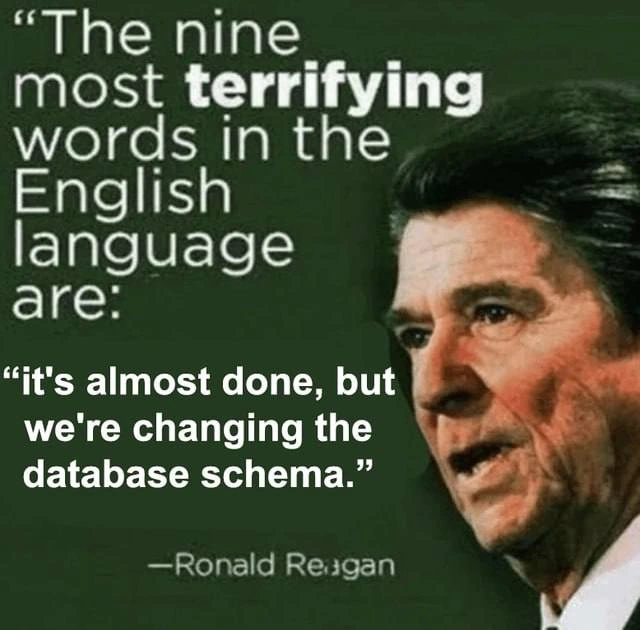
The meme grafts developer horror onto Reagan's most-quoted joke — his original "nine most terrifying words" were "I'm from the government and I'm here to help." Here, over the familiar green-tinted presidential portrait, the punchline becomes:
"it's almost done, but we're changing the database schema."
(The word count doesn't survive the edit — that's nine-ish words by Impact-font accounting — and the fake attribution to "—Ronald Reagan" is part of the genre's charm: solemn typography lending statesmanlike gravity to a sprint-planning catastrophe.)
The reason this specific sentence terrifies is that the schema is the one component of a system with maximal fan-out. Application code is layered on top of the data model the way a city is built on its street grid. Change a function and you touch a file; change a schema and you touch: every ORM mapping that mirrored the old shape, every raw query someone wrote when the ORM was too slow, every test fixture seeded against the old columns, every analytics dashboard quietly SELECT-ing the renamed field, the migration scripts themselves, the rollback scripts for those migrations, and the downstream service that — surprise — was reading your tables directly because someone needed data "just this once" in 2023. The phrase "it's almost done" supplies the dramatic irony: a late-stage schema change resets "almost" to a value best expressed in fiscal quarters.
There's a deeper architectural sermon underneath. Late schema changes are rarely random; they're the bill for skipping data modeling up front, or for letting the demo's convenient denormalization harden into production truth. The painful patterns are well-known — expand-and-contract migrations, dual writes during transition, backfill jobs that run for days, the column that can't be dropped because one batch job nobody owns still reads it. Everyone knows the safe playbook. Nobody budgets time for it, because the change request arrives wearing its most innocent costume: "we just need to split that one field." That's how a name column becomes a three-week distributed-systems project with a war room.
The Reagan format adds one more layer: the original quote is about help you didn't ask for arriving with authority behind it. So is this. The schema change is never proposed by the person who'll write the migrations.
Description
A fake inspirational quote meme over a dark green-tinted photo of Ronald Reagan mid-speech in a suit. Large white text reads: '"The nine most terrifying words in the English language are: "it's almost done, but we're changing the database schema."' attributed to ' - Ronald Reagan'. The meme parodies Reagan's famous quote about 'I'm from the government and I'm here to help', swapping in the developer-horror scenario of a late-stage schema change - implying cascading migrations, broken ORM mappings, rewritten queries, and invalidated test fixtures right before a release
Comments
7Comment deleted
It counts as 'almost done' the way a schema migration counts as 'reversible' - true until someone runs it on production
#whalegang takes over this channel slowly but surely Comment deleted
🐳 Comment deleted
There's flyway for that (It's a db Migration technology) Comment deleted
Finally. I've foreseen this. So, the project is split into pure business logic domains, each with its own dependency inverted adapters and... Comment deleted
and you've spent three times to much time Comment deleted
how about THE most terrifying word Comment deleted