Software Estimation: The Painful Truth
Why is this ProjectManagement meme funny?
Level 1: It Always Takes Longer
Imagine your teacher asks you how long your homework will take. You think, “Maybe about 1 hour.” But somehow, it always takes longer than that. You might get stuck on a tough question, take a break, or find out you misunderstood something and need extra time. So if you’re smart, you might tell your teacher 3 hours instead. That way, if you actually finish in 2 hours, you look really good for being “early,” and if it does take the full 3 hours, that’s okay too. This meme is joking about grown-up programmers doing the same thing with their work. They know that whatever time they think a job will take, it almost never goes as planned — there’s always an unexpected twist or delay. So to be safe, they’ll ask for a lot more time than their first guess. It’s funny because it’s true: whether it’s homework or writing code, we’ve learned that things usually end up taking more time than we thought!
Level 2: The Fudge Factor Rule
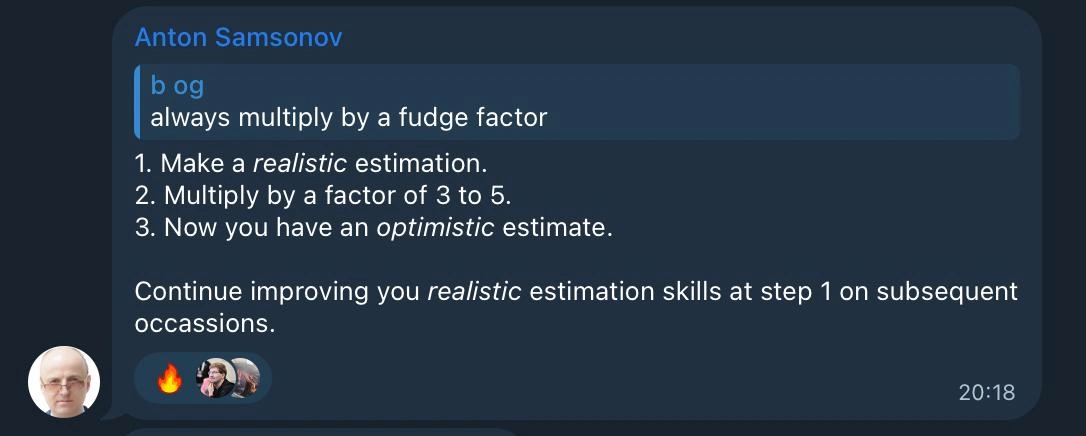
This meme shares a piece of hard-earned project planning wisdom in a very sarcastic way. The screenshot is from a dark-themed chat (think Slack or Discord) where a user named Anton Samsonov is replying to another message. The quoted snippet at the top (b og always multiply by a fudge factor) suggests someone else mentioned “always multiply by a fudge factor.” Anton then elaborates with a numbered list, almost like a mini-tutorial on time estimation. Here’s what his 3-step fudge factor rule means in plain terms:
“Make a realistic estimation.” – First, figure out how long you truly think the task will take. This realistic estimate is your honest, informed guess based on past experience and the task’s known requirements. For example, you examine the feature request or bug fix and conclude, “Okay, considering everything I know, this should take about 2 days of work.” That’s your realistic timeline if things go normally.
“Multiply by a factor of 3 to 5.” – Now take that realistic time and multiply it by some fudge factor, anywhere from 3× to 5× (meaning 300% to 500% of the original estimate). This is the crux of the joke. If you thought it was 2 days, you now stretch it to somewhere between 6 days and 10 days. Why triple or even quintuple the time? Because in software projects, there are almost always unexpected delays and hidden complexities. Maybe setting up the development environment takes longer, maybe you’ll hit weird bugs, or maybe the requirements will change mid-way. By multiplying the original number, you’re adding a big safety buffer. This pm_buffer_multiplier is like saying, “Better safe than sorry.” It’s a common practice (though often unspoken) in many teams — both project managers and developers add padding to timelines to avoid disappointment. We call this extra padding a “fudge factor”. The term fudge here means a sort of flexible, made-up adjustment. It’s like adding an extra fudge piece to a batch of candy to make sure you have enough. In planning, it means adding extra time just in case. So essentially, if a coder genuinely believes a job will take 1 week, they might secretly plan for 3 weeks just to be safe. It’s exaggerated on purpose.
“Now you have an optimistic estimate.” – After inflating the time by 3–5×, the result is labeled (very sarcastically) as an “optimistic” estimate. Normally, an “optimistic estimate” in project management means the best-case scenario where everything goes perfectly and you finish faster than usual. But here they’re flipping the idea on its head. The joke is that once you’ve multiplied your realistic guess by, say, 5, only then will management consider it optimistic. In other words, the timeline a developer truly expects (the realistic 100% figure) is apparently not optimistic enough for planning. They assume things will go so wrong that even a number five times larger is still hopefully achievable. It’s a bit like saying: “You think it’ll take 1 day? Let’s call 5 days our optimistic plan.” The humor comes from calling such an obviously padded timeline “optimistic” with a smile. It highlights the gap between what developers feel is reasonable and what management will accept as “safe”. Everyone tacitly knows that even this inflated number might be blown if things don’t go well, hence it’s only optimistic, not guaranteed.
Finally, Anton adds: “Continue improving your realistic estimation skills at step 1 on subsequent occasions.” This line is a sly, tongue-in-cheek extra step. It mockingly encourages the reader to keep practicing making realistic estimates in the future — implying that no matter how much you improve, you’ll likely still be repeating this fudge factor process again and again. It’s basically saying, “Even if you get better at guessing, you’ll still have to multiply by 5 next time too.” This is the estimation snark at the heart of the meme. The author knows that software estimation is a never-ending learning process, often humbling even for experienced engineers. There’s a famous truth in programming: no one ever gets estimation perfect, because building software is full of surprises. So the joke here is to playfully admit defeat — just pad the numbers liberally and roll with it.
All of this is poking fun at real Project Management practices in tech teams. Time estimation is notoriously difficult in software development. New developers (and even optimistic project managers) often underestimate how long things will take. Then they face deadline pressure when the initial timeline proves too tight. This meme’s “rule” is basically a satirical solution to UnrealisticDeadlines: pad your estimates so much that you might actually hit them. It’s a form of self-defense against overly eager scheduling. There’s even a pop culture reference akin to this: on Star Trek, the engineer Scotty would famously overstate how long a repair would take and then finish sooner, so he looked like a miracle worker. Real-world developers do a similar thing (minus the starship): if we think a task takes 1 hour, we might say 3 hours to the boss. Then if it takes 2 hours, we come out looking good for delivering “early.” The meme takes that idea to an extreme by suggesting a 3×–5× multiplier every time.
The chat screenshot itself underscores how common this knowledge is. The user “Anton Samsonov” is likely a developer sharing this bit of sarcastic advice with peers. The small blue quoted text (“always multiply by a fudge factor”) indicates someone previously mentioned this concept, and Anton decided to spell it out step-by-step as a joke. The fact that his message has a 🔥 fire emoji reaction (and another user’s cat avatar reaction) shows that others in the chat found it hot or spot-on. In online dev communities, a fire emoji reaction means “this is straight fire” or “such a good truth/joke.” So basically, other developers are nodding along, saying “Yes, exactly! This is how you survive planning meetings.” It’s both AgileHumor and ProjectManagementHumor – everyone involved in making software, from engineers to project managers, recognizes this pattern of padded estimates. Even though we’re all aiming for accuracy and agility, there’s an inside joke that behind the scenes, we’re multiplying every promise by a secret fudge factor to keep projects on track. The meme is funny because it openly tells that secret in a deadpan, instructional style. For a junior developer or someone new, it reads like absurd advice – “Wait, you’re telling me to multiply by five and call that optimistic?” But for seasoned folks, it’s hilarious because it rings so true. It’s basically saying: plans are nonsense, so let’s all pretend our exaggerated timeline is actually reasonable. This blend of truth and sarcasm is why the meme resonates across teams dealing with agile planning and tight deadlines.
Level 3: Hofstadter’s Law in Action
In this darkly comedic chat screenshot, a battle-worn developer lays down the legendary fudge factor rule of software scheduling. The message enumerates a three-step plan for time estimation that every senior engineer knows by heart (often painfully): 1) make a realistic estimate for the task, 2) multiply that number by 3, 4, or 5, and 3) present the inflated result as an optimistic timeline. It’s a tongue-in-cheek formula born from countless blown schedules and DeadlinePressure fiascos. The sarcastic punchline: “Now you have an optimistic estimate.” In other words, even after tripling the timeline, we’re still only willing to call it “optimistic” — a wry nod to how chronically unrealistic deadlines can be in the real world.
Why such extreme padding? Seasoned developers have learned the hard way that Hofstadter’s Law always prevails: “It always takes longer than you expect, even when you take into account Hofstadter’s Law.” No matter how carefully you plan, unforeseen complexities and surprise setbacks will devour your buffer. By multiplying the “realistic” guess by a hefty buffer multiplier, engineers attempt to account for the unknown unknowns: hidden bugs, integration hell, testing fiascos, last-minute requirement changes, coworker sick days, meetings about meetings — you name it. This cynical optimistic_estimate_math (realistic_estimate × fudge_factor) is an acknowledgment that our initial guesses are often laughably naive. As another infamous adage goes, “The first 90% of the code accounts for the first 90% of the development time... the last 10% of the code accounts for the other 90%.” 😅 In other words, tasks tend to balloon far beyond the original plan, so veterans preemptively balloon the plan itself.
To illustrate, here’s the “fudge factor” algorithm in action:
realistic_days = 10
fudge_factor = 5 # recommended optimism multiplier
optimistic_days = realistic_days * fudge_factor
print(f"Optimistic timeline: {optimistic_days} days")
# Developer says: "It'll realistically take 10 days."
# Management hears: "Great, 50 days is our optimistic schedule." 🤦
The code above pokes fun at how a ProjectManagement team might handle estimates. A developer might privately think a feature needs 10 working days of effort. But to survive the inevitable scope creep and manager’s revisions, they’ll magnify it by, say, 5. The print line outputs “Optimistic timeline: 50 days” — a facetious demonstration that an honestly estimated 2-week task magically becomes a 10-week “optimistic” schedule after applying the sacred fudge factor. Here, optimistic doesn’t mean “quick” at all; it means “we fervently hope we can get it done in this much time (and not slip even more).” It’s a twisted inversion of the usual meaning. Normally, an “optimistic” estimate is supposed to be the best-case, shortest time. But in this meme’s universe, the realistic vs. optimistic labels are essentially flipped: the realistic time from the engineer is treated as dangerously low, and only after tripling it do we attain an “optimistic” (read: barely acceptable) timeline in management’s eyes. This highlights a core absurdity in corporate software projects — everyone knows the schedule is likely bogus, but we still call the padded numbers “optimistic” with a straight face.
This sardonic advice encapsulates a major AgilePainPoints and project planning pain point: humans are terrible at TimeEstimation in complex systems, yet businesses demand exact deadlines. Agile methodology was supposed to alleviate this by focusing on iterative delivery instead of long-term date promises. But even in Agile shops, the culture of fixed deadlines persists (“Sprint 0 was for planning, remember?”). Teams still end up doing mental math gymnastics to satisfy ProjectManagementHumor like “velocity” and “burn-down charts” while quietly using a fudge factor under the hood. It’s part of AgileHumor to joke that story points and planning poker are just formalized ways of saying “we have no clue, so let’s call it an 8 and double it to be safe.” The meme specifically jabs at the ritual of turning any developer’s estimate into something palatable for stakeholders by multiplying it by π (3.14…) or another arbitrary factor and calling that “agile planning.” It’s a shared secret that what management deems an “optimistic estimate” is often just the original honest estimate with a huge safety margin applied. The estimation_snark runs deep here: step 3 is followed by “Continue improving your realistic estimation skills at step 1 on subsequent occasions.” The author is cheekily saying, even if you keep practicing making better estimates, you’ll still end up multiplying by 5 next time, too. The cycle of estimate, slip, pad more next time continues ad infinitum.
Notice the reactions at the bottom of the chat: there’s a 🔥 fire emoji (and a cat avatar reaction) under Anton’s message. In developer communities, a fire emoji reaction means “this is straight fire/truth.” It signals that others in the chat strongly resonate with the sentiment. The fact that multiple people reacted enthusiastically (one literally with 🔥) shows that this estimation snark struck a nerve. It’s essentially a war-weary agreement: “Yes, this is exactly how it feels to negotiate timelines with management.” The humor works because it converts that frustrating reality into a succinct, mock-“how-to” guide that engineers can laugh about instead of just crying. The fudge_factor_rule has become legendary for a reason – it’s our collective coping mechanism for UnrealisticDeadlines. Any programmer who’s been burned by a “sure thing” task that blew past its due date reads this and goes, “Amen! Next time I’m totally multiplying by five and calling that optimistic.” It’s funny because it’s true.
Description
A screenshot of a text message from a user named Anton Samsonov, presented in a dark-themed chat interface. The message offers a cynical, three-step guide to software project estimation, starting with 'always multiply by a fudge factor'. The steps are: '1. Make a realistic estimation. 2. Multiply by a factor of 3 to 5. 3. Now you have an optimistic estimate.' The message concludes with the advice to 'Continue improving you realistic estimation skills at step 1 on subsequent occassions.' This piece of text captures a well-known piece of gallows humor in the software development world. It reflects the chronic difficulty and frequent inaccuracy of estimating complex technical work, a nod to Hofstadter's Law. For senior developers, this isn't just a joke; it's a battle-scarred heuristic for managing expectations with project managers and stakeholders, acknowledging that unforeseen issues, scope creep, and dependencies will inevitably invalidate the initial, purely technical timeline
Comments
7Comment deleted
The original estimate is for the happy path. The 5x estimate is for the 'actually has to work in production' path
Some call it the Fibonacci sequence, others call it sprint planning - either way the multiplier mysteriously converges on whatever keeps the Gantt chart green
After 20 years in the industry, I've discovered the only accurate estimation formula: Take your best estimate, multiply by π, add the number of stakeholders squared, then realize you're still off by an order of magnitude because someone just added 'just one small feature' that requires rewriting the entire authentication layer
The real engineering challenge isn't building the system - it's convincing stakeholders that your 'realistic' estimate already accounts for the three production incidents, two architectural pivots, and one framework deprecation that haven't happened yet. By the time you multiply by the fudge factor and call it 'optimistic,' you're still probably underestimating the number of meetings about why it's taking so long
Enterprise estimation heuristic: t_realistic * 5 is a poor man’s Monte Carlo where every sample includes CAB lead time, a missing API contract, and a blocked CI runner
PERT says ±400%; finance halves whatever you propose - so we multiply by 5 and call it “optimistic.” Monte Fudge for the cone of uncertainty
Step 4: Multiply by the number of microservices, then divide by optimistic velocity from the last sprint demo