Skip to content
DevMeme
6330 of 7435
Caste-Gated Programming Languages at Microsoft
CorporateCulture Post #6941, on Jul 5, 2025 in TG

Caste-Gated Programming Languages at Microsoft

Why is this CorporateCulture meme funny?

Level 1: The Forbidden Toy

Think of a classroom where the teacher does something very unfair: She brings a fancy new toy but says only kids with last names A–M can play with it, and kids with last names N–Z have to go clean the desks instead. Crazy, right? Everyone would immediately see that as wrong and silly. This meme is like that, but in a company and with coding. In the picture, a boss at Microsoft basically says, “Only the special group of employees can use the cool programming tool (Python). The other kids – oops, I mean employees – who aren’t in that group have to use the old boring tools or even do cleaning work.” It’s such a ridiculous rule that you can’t help but laugh at how dumb and unfair it is. The joke highlights something simple: nobody should be told they can’t do the fun work just because of who they are. When we see a pretend news story about it, we find it funny because we know it’s not real – it’s making fun of how wrong that would be. Deep down, the humor comes from the shock: “Can you imagine a boss actually doing that? That’s so outlandish it’s laughable!” So it’s like laughing at a really silly, made-up classroom rule, which also reminds us how important it is to share the cool toys (or tasks) with everyone.

Level 2: Language Prestige in Big Tech

Let’s break this down in simpler terms. This meme is a satire – a humorous exaggeration – about life inside a big tech company. It combines a serious social issue with a tech industry in-joke. The serious part is caste discrimination, which is a real-world problem, especially in South Asian communities. In a caste system, people are born into social groups (castes) that historically determined their job and status. Brahmins and Kshatriyas are traditionally high-ranking castes, while Dalits are at the very bottom (Dalits were once referred to as “untouchables” and faced a lot of unfair treatment). In many countries today (including India and the US), caste discrimination is illegal, but it can still happen in hidden ways. In fact, there have been actual lawsuits in the tech world where employees from Dalit backgrounds accused companies of bias. So that’s the serious backdrop.

Now the silly, techy part: programming languages and their perceived status in a company. In the meme, Python is depicted as the “fancy” language that only the favored high-caste engineers are allowed to use. C++ and Java are portrayed as the less desirable languages that the lower-caste (in the joke, the Dalit) engineers get stuck with. In reality, Python, C++, and Java are just tools – different programming languages suited for different tasks:

  • Python is a very popular, high-level language known for being easy to read and write. It’s used in cutting-edge fields like data science, machine learning, and quick prototyping. Because it’s newer (and honestly fun to work with), some folks consider Python “cool” or modern.
  • C++ is an older, lower-level language known for its speed and performance. It’s used for things like operating systems, game engines, or any software where you need to manage memory and performance tightly. It’s powerful but also more complex and harder to master. Some might call it “hardcore” or just “tedious,” depending on their experience.
  • Java is a very common language in enterprise and big companies. It’s known for its stability and for powering huge systems (like bank software or large-scale backends). It’s not as trendy as Python these days, but it’s reliable and widely used in corporate environments.

Within large tech companies, there can be an informal hierarchy or prestige attached to certain projects or tech stacks. It’s not official, but you’ll hear things like, “Oh, that team gets to use the shiny new Go microservices and Kubernetes, while this other team is stuck maintaining the 20-year-old Java monolith.” It can feel like some technologies are considered “modern” or high-status (like how Python or AI/ML projects are seen as sexy right now) and others are considered grunt work or legacy (like keeping old C++ code running). This meme parodies that idea by taking it to a ridiculous extreme: it imagines a world where a company literally says “Python is for the upper castes only.” In other words, they turned an informal bias (preferring one language) into an explicit, absurd company rule. That’s what we call dark humor – it’s funny, but in a slightly shocking way.

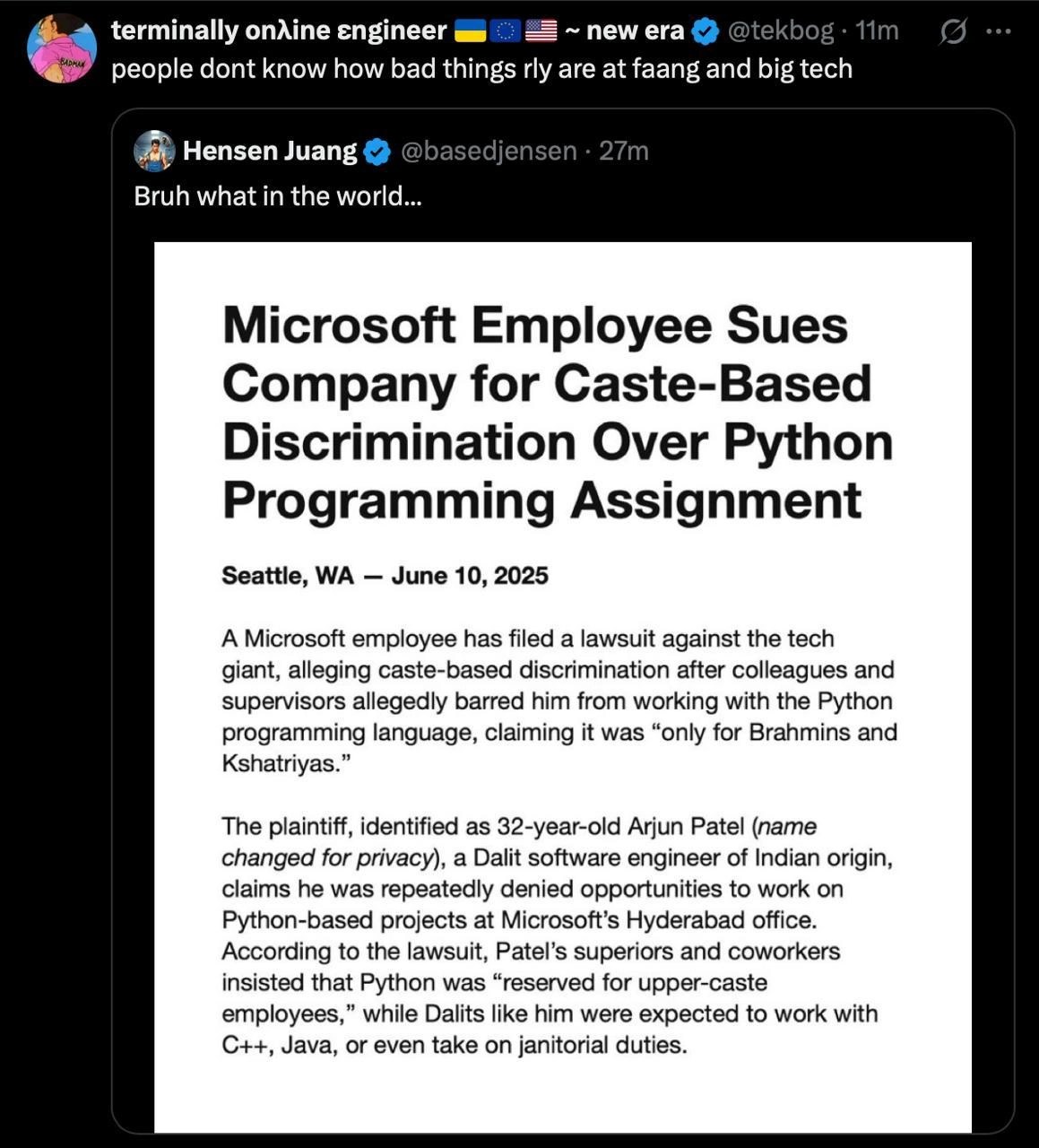
The format of the meme is a screenshot of a fake news article headline. It looks like an official tech news site reporting “Microsoft Employee Sues Company for Caste-Based Discrimination Over Python Programming Assignment.” The style is very deadpan and professional, which contrasts with how crazy the content is. This contrast is what makes it a fake_news_headline_meme – the presentation is serious, but the information is obviously a joke. It catches people off guard. On social media (in this case X/Twitter), someone posted this image with the caption “people dont know how bad things rly are at faang and big tech.” Here FAANG is an acronym for the big tech giants: Facebook, Amazon, Apple, Netflix, Google (often extended to include companies like Microsoft too, since Microsoft is just as big in the tech world). The person is joking that things are so messed up inside these companies that even something as insane as a “programming language caste system” might be happening. Of course, that’s a huge exaggeration – they are poking fun at both Big Tech’s problems and at gullible people who believe every wild dystopian story about Silicon Valley.

Because this meme references Microsoft, let’s give a bit of context: Microsoft is a massive tech company and has offices worldwide (including Hyderabad, India, which is mentioned in the fake article). Big companies like Microsoft are very diverse, with employees from all over the world. Lately, there’s been more awareness about issues like discrimination based on race, gender, and even caste. Most companies now have strict HR (Human Resources) policies against such discrimination. If something like the scenario in the meme really happened, an employee absolutely could file a complaint or lawsuit (and they would likely win, because that behavior blatantly violates workplace laws and company ethics). The meme plays with that idea by actually showing the employee suing the company. It’s filed under the category of a career/HR disaster, turning an HR nightmare into a humorous anecdote. Underneath the humor, it’s highlighting how outlandish and career-destroying such misconduct would be. Basically, it’s saying: imagine a manager so absurdly biased that they’d restrict someone’s work based on caste – the company would get taken to court, which is exactly what’s written!

Now, for a junior engineer or someone new to the tech industry, what’s the takeaway of this meme? It’s pointing out a couple of things:

  1. Discrimination is real, but this example is exaggerated – Companies should not (and legally cannot) assign work based on personal traits like caste (or race, gender, etc.). The meme is using exaggeration to criticize that kind of bias. So it’s a parody of discrimination (“caste_discrimination_parody” as tagged).
  2. Programming languages shouldn’t have “status,” but sometimes in the industry they unofficially do – You might encounter attitudes like “Oh, you work in that old language, that’s not as cool as this new language.” It’s a silly attitude, because all languages are just tools to get the job done. This meme mocks that attitude by calling it a “language caste system.”

Finally, the humor style here is very much TechIndustryHumor mixed with DeveloperCynicism. Developers often cope with frustrating realities (like office politics or outdated practices) by joking about them. This meme is basically an inside joke: it makes fun of the idea that a tech workplace could be as rigid and prejudiced as an old feudal system. The reason many of us find it funny is because it’s so over-the-top and obviously not the way a company should run. Yet, it indirectly reminds us to stay alert about fairness and not to put any technology or group of people on an undeserved pedestal. Everyone should have a fair chance to work on the cool projects – whether it’s Python today or whatever the hot tech is tomorrow – and no one should be stuck doing “janitorial” work just because of who they are. In summary, it’s a joke that says: “Imagine if workplace bias were taken to a ridiculous extreme where even coding languages were segregated – pretty crazy, right?” and we laugh because yes, it is absolutely crazy.


Level 3: The Code Caste System

If you think office politics in Big Tech are bad, this meme imagines CorporateCulture so twisted it enforces a literal caste system for coding. The screenshot shows a faux-news article about a Microsoft engineer suing over caste-based discrimination – specifically because he wasn’t allowed to code in Python. For seasoned developers, the humor hits on two levels: it satirizes real-world diversity scandals (caste bias in tech) and lampoons the absurd prestige wars over programming languages. In other words, it’s blending WorkplaceCulture nightmares with nerdery about coding stacks, creating a darkly comic scenario only an industry insider (with a cynical streak) could dream up.

First, the satire draws on an actually serious issue: caste discrimination in the tech industry. Real lawsuits have happened – for example, engineers of Dalit (lower-caste) background accusing colleagues of bias at big tech firms. Here that reality is exaggerated to a big_tech_dystopia extreme: a manager literally tells a Dalit developer he can’t work with Python because that language is “only for Brahmins and Kshatriyas.” Brahmins and Kshatriyas are the two highest groups in the traditional Indian caste hierarchy (think of them as the old-school “upper management” of society). So in the meme’s fictional Microsoft office, Python is treated like some coveted executive perk – practically a sacred entitlement of the upper caste engineers – while the Dalit employee, despite being a skilled coder, is relegated to “lower” languages like C++ and Java or even to janitorial duties. It’s an outrageous concept, and that IndustryIrony is exactly why it’s funny. Seasoned devs have joked about “glamour projects” vs “grunt work” for ages, but framing it as a literal caste system pushes it into jaw-dropping, DarkHumor territory.

This idea of a “coding caste system” also skewers the arbitrary python_language_supremacy that sometimes crops up in big companies. We’ve all seen technology fads where one programming language or stack suddenly gets treated as the golden child of the org. Maybe management decides Python (or JavaScript, or Go, or whatever’s hot) is the future, and the devs working on that get all the glory – while teams maintaining the old C++ backend are viewed as second-class citizens. The meme cranks that phenomenon up to eleven by literally labeling the shiny language as “upper caste” and the legacy tech as “Dalit work.” It’s so extreme you have to laugh, but it resonates with any senior engineer who’s felt the sting of their work being considered less trendy. It’s a parody of WorkplaceHumor that contains a grain of truth about tech fads and internal prestige battles.

On tech Twitter, where this meme is formatted as a tweet, the reactions in the screenshot set the tone. One user writes “people don’t know how bad things rly are at faang and big tech” – playing into the popular image that FAANG companies (Facebook, Amazon, Apple, Netflix, Google) and their peers hide bizarre or dystopian practices behind closed doors. The reply “Bruh what in the world…” with the fake news story suggests even the jaded online crowd is doing a double-take. As an experienced dev reading this, you nod knowingly at the faang_corporate_absurdity: after all the crazy headlines out of Silicon Valley (from privacy scandals to employee walkouts), a headline about “Python reserved for upper castes” feels like the logical next level of insane corporate satire. It’s a classic case of DeveloperCynicism turned into a joke headline – half of you is laughing, and half is thinking, “Well, given the stories I’ve heard, I wouldn’t be entirely shocked if some clueless manager tried something like that.”

The meme’s format (a screenshot mimicking a serious news article) is a common fake_news_headline_meme strategy. It reads like a real tech news piece at first glance – location, date, lawsuit description – which only makes the punchline land harder when you see what it’s actually claiming. The text itself is written in a deadpan news style, describing how the plaintiff (a 32-year-old Dalit engineer in Microsoft’s Hyderabad office) was denied opportunities to work on Python projects. The absurd quote about Python being “reserved for Brahmins and Kshatriyas” is dropped in as if it were a normal statement, which is comedic gold for those of us with a dark sense of humor. It mocks how corporate PR or news sometimes sanitize outrageous behaviors, except here the behavior is so obviously ridiculous that it highlights the CorporateHumor. For a veteran engineer, this juxtaposition is hilarious: it’s like reading an HR report from an alternate evil universe where coding languages have social castes. And speaking of HR – the scenario is also poking fun at how Career_HR issues escalate in big companies. A lawsuit over who gets to code in Python? That’s poking at the idea that diversity and WorkplaceCulture problems in tech sometimes reach headline-grabbing levels of folly.

To drive home how ludicrous this “policy” is, imagine implementing it in code form. As a senior dev, you might humorously envision the kind of check that would enforce such discrimination:

# Hypothetical enforcement of the "code caste" policy at Big Tech
if engineer.caste not in {"Brahmin", "Kshatriya"} and project.language == "Python":
    raise PermissionError("Python is reserved for upper castes only.")
else:
    assign_to_project(engineer, project)

In a real code review, seeing something like this would make any sane engineer spit out their coffee. It’s pointing out that bias can be as blunt and stupid as a poorly-written if statement. And of course, any actual corporate policy like this would be flagrantly illegal and career-ending for the managers involved. But that’s the satire: it’s a send-up of the kind of behind-the-scenes discrimination that, while usually more subtle, does unfortunately happen. TechIndustryHumor often uses these over-the-top examples to shine light on real issues – here it’s the combination of caste_discrimination_parody and tech’s internal pecking order. The result is both uncomfortable and comical. Seasoned engineers chuckle because it’s an outrageous exaggeration of a familiar problem: sometimes who you are (or what tech you happen to work on) unfairly dictates the respect you get in a company.

Ultimately, why this lands so well with veteran developers is because it mixes two domains of cynicism: IndustryIrony about diversity and inclusion (we’ve seen companies preach equality publicly while weird biases persist internally), and the perennial language wars of software development. It’s a joke with layers – and much like a well-structured program, each layer (social commentary, tech stack elitism, corporate dystopia) calls out something we collectively know is broken. In true cynical veteran fashion, we laugh, then sigh, and hope that reality isn’t quite as bad as the meme (on our more optimistic days, at least).


Description

A screenshot of a tweet thread discussing a shocking news article. The top tweet, from 'terminally onλine εngineer', comments, 'people dont know how bad things rly are at faang and big tech'. This is a reply to Hensen Juang's tweet, 'Bruh what in the world...', which quotes a news article. The article, dated June 10, 2025, from Seattle, WA, is headlined: 'Microsoft Employee Sues Company for Caste-Based Discrimination Over Python Programming Assignment'. The article details a lawsuit filed by a 32-year-old Dalit software engineer of Indian origin. He alleges that at Microsoft's Hyderabad office, he was repeatedly barred from working on Python projects because supervisors and coworkers claimed the language was 'reserved for upper-caste employees' like Brahmins and Kshatriyas, while Dalits were expected to work with C++, Java, or even perform janitorial duties. This image is not a meme but a serious social commentary on the deeply rooted issue of caste discrimination manifesting in the modern tech workplace, using programming languages as a tool for exclusion

Comments

20
Anonymous ★ Top Pick Some companies are worried about technical debt. Others are still working through their 3,000-year-old social debt
  1. Anonymous ★ Top Pick

    Some companies are worried about technical debt. Others are still working through their 3,000-year-old social debt

  2. Anonymous

    And here I was thinking the GIL was Python’s worst gate-keeper - turns out I needed the right varna to import sys

  3. Anonymous

    Finally, a lawsuit that explains why Python's whitespace sensitivity is actually about maintaining social hierarchies - turns out PEP 8 was really about keeping the untouchables from touching production code

  4. Anonymous

    Apparently at some companies, your access to Python isn't determined by `import antigravity` but by `import caste_system`. Who knew the real reason for language wars wasn't tabs vs spaces, but whether your surname grants you permission to use list comprehensions? Meanwhile, the rest of us thought the hardest part of getting assigned to a Python project was convincing management it wasn't just 'scripting' - turns out some engineers face an entirely different `PermissionError: [Errno 13] Access denied based on social hierarchy`. I guess 'Pythonic' has taken on a whole new meaning when the Zen of Python's 'There should be one-- and preferably only one --obvious way to do it' gets overridden by organizational caste policies

  5. Anonymous

    If language choice is dictated by hierarchy instead of latency, your codebase becomes a sociology project and the pager does the peer review at 3am

  6. Anonymous

    Python as the Shudra of stacks in Hyderabad? Even C++ devs know garbage collection hits different when it's your varna doing the sweeping

  7. Anonymous

    Only in BigCo does language neutrality ship as RBAC - pre‑commit blocks .py unless your role is Staff+, while everyone else inherits the C++ services and the 3 a.m. pages

  8. @vgy4sw 1y

    Typical microshit

    1. @kitbot256 1y

      Previous time IIRC a similar lawsuit was from a Cisco eng

      1. @chupasaurus 1y

        and Google prior to that one

    2. Deleted Account 1y

      microsoft 🚫 micropoop✅

      1. @deadgnom32 1y

        megahard

  9. @JackOhSheetImSorry 1y

    They'd better leave the c++ "for Brakhmins and Kshatriyas", and maybe, just maybe Windows would have a Start menu a normal part of the system, not a c..ck memory sucking electron app

  10. शठे शाठ्यं समाचरेत् 1y

    Not a real news Fake news

  11. @anonusernametg 1y

    Of course this behavior is plain wrong, but shouldn't it be the other way around? Reserving Python! for upper-caste is stupid lol

    1. @NaNmber 1y

      easier to write a bad code maybe 🙄

  12. Septimius Oedenathus 1y

    People really think China will never take over the west in tech because their ideology and culture is so backward and yet western tech is actually just a bunch of jeets Amazing

    1. @chupasaurus 1y

      they've made usable Linux DE in 2 years

  13. Deleted Account 1y

    Straight to the point

  14. アレックス 1y

    >giving MORE cognitively demanding tasks to lower castes India Moment™

Use J and K for navigation