Skip to content
DevMeme
6269 of 7435
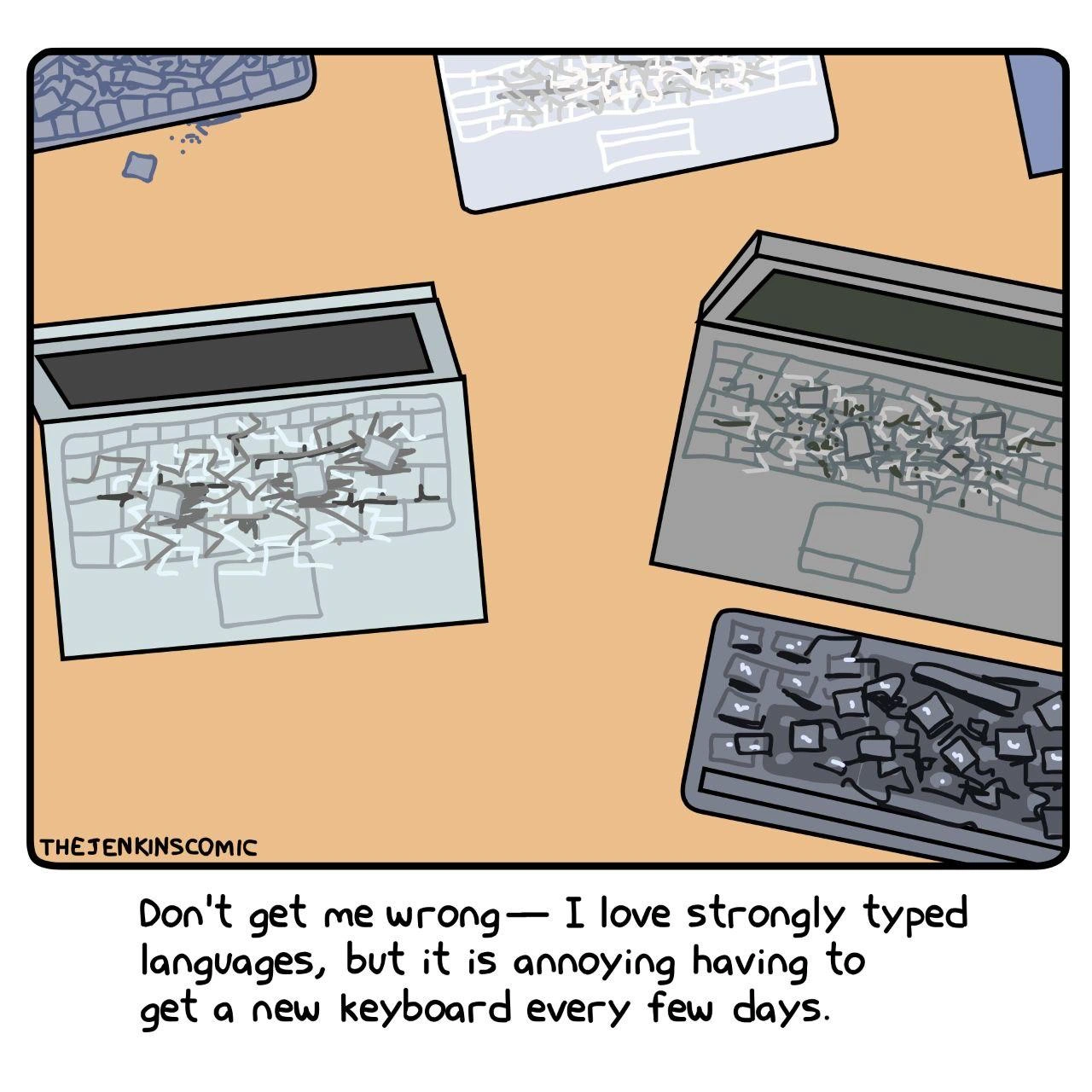
When “strongly typed” literally requires a hardware budget line item
Languages Post #6872, on Jun 10, 2025 in TG

When “strongly typed” literally requires a hardware budget line item

Why is this Languages meme funny?

Level 1: Typing Too Hard

Imagine your teacher tells you, "Always write with a strong hand so your writing is clear." Now, what they mean is you should write confidently and firmly. But what if you misunderstood and thought they meant you should press your pencil really, really hard? You might push so hard that the pencil lead snaps and you rip the paper. That would be a silly mistake, right? That's basically what's happening in this picture, but with computers.

In the picture, a person loves using a certain kind of computer language that is described as "strongly typed." Normally, in computer talk, "strongly typed" just means the computer is strict about how you use different kinds of information. It has nothing to do with actual physical strength. But this joke pretends that "strongly typed" means you have to type strongly – like, hit the keyboard with a lot of force. The result? The person typed so hard that they broke all their keyboards! You can see keys flying off and keyboards smashed to bits. And they joke that they have to buy a new keyboard every few days because they keep destroying them.

Why is this funny? Because it's a mix-up of meanings. It’s like if someone said “break a leg” to wish an actor good luck, and the actor took it literally and actually broke their leg! We know "strongly typed" isn't about muscle strength, so seeing it taken that way is unexpected and goofy. The poor keyboards in the picture show an exaggerated, crazy outcome. It makes us laugh because we don't expect a computer term to turn into a real-life problem like needing a new keyboard. In simple terms: the coder was typing way too hard – and just like pressing a pencil too hard, it ended up in disaster, which is funny when it’s not happening to you.

Level 2: Heavy-Handed Typing

Let's break down the joke in simpler terms. In programming, a strongly typed language is one that is very strict about how you use data types. Data types are kinds of information, like numbers, text, or true/false values. A strongly typed language (often also a statically typed one) will usually check your code and not even let it run if you try to do something odd like treat a number as text without converting it. For example, in Java (which is strongly typed), if you have an integer age = 30 and you accidentally try to do age + "5" (adding a number to a string of text), the code won't compile – it stops you with an error. You'd have to explicitly convert that "5" to a number or 30 to a string for it to make sense. This is great because it catches mistakes early. In a language that isn't as strict (let's say a weakly typed scenario), the computer might try to improvise – sometimes leading to weird results or bugs that are hard to track down.

Now, "strongly typed" as a phrase has the word "strongly" in it, which in normal English can mean "with a lot of force." The meme plays on this double meaning. The cartoon shows several laptops from a top-down view, and all their keyboards are completely destroyed – keys popped off, plastic bits everywhere. There's even a separate keyboard at the side that's also shattered. It looks like someone went full Hulk mode on these poor keyboards! Beneath the image, the caption says: "Don't get me wrong—I love strongly typed languages, but it is annoying having to get a new keyboard every few days."

Why would someone need a new keyboard every few days? The joke is: because they're typing so strongly (literally hitting the keys with great force) that they keep breaking their keyboards. Of course, normally when programmers talk about loving strongly typed languages, they mean they appreciate the strict rules about data types and the error-checking that happens before the program runs. It has nothing to do with how hard you press the keys on your keyboard. But the humor here is imagining that maybe this developer took the term a bit too literally. It's as if they thought "strongly typed" means you should type strongly. Picture a very enthusiastic coder hammering away at the keyboard whenever they write code in a language like C++ or Rust (both known for being strongly typed and catching type errors early). They're not actually required to do that, but the cartoon exaggerates the scenario to make us laugh.

This joke is very relatable in the software world because it mixes a classic tech concept with everyday physical experience. Many of us programmers have a favorite type of programming language. Some prefer dynamic languages (looser about types, like Python or JavaScript where you don't declare types for every variable), and others prefer static languages with clear, strict type rules (like Java or Go, where you must declare types and the compiler yells at you if you mess them up). Both sides like to tease each other. This comic is teasing the static/strong typing fans by saying, "You love your strict rules so much, look what it’s doing to your keyboards!" It's like saying their passion for type safety is so high-impact that it's physically destructive.

For a junior developer or someone new to coding, the key takeaway is: "strongly typed" is a technical term about programming languages enforcing type rules, but here it's used as a pun to mean physically typing with strength. The image literally shows the consequence of heavy-handed typing: broken keyboards. It's a playful reminder that tech jargon can sound funny. Another example: if we say a program "crashed", we usually mean the program stopped working – but imagine someone thinking it meant the computer literally crashed to the floor! That mismatch between the technical meaning and the literal meaning is what makes this meme humorous. And on a practical note, it also pokes at the idea of developer ergonomics (how developers interact with hardware): if you really were this rough on your keyboard, you'd need an ergonomic solution… or at least a bulk discount on keyboards.

So in summary, strongly typed languages (tech term) = good at catching errors, but typing strongly (literal action) = bad for keyboards. The developer in the comic loves the former, but is jokingly suffering from the latter. It's a classic case of wordplay in DeveloperHumor that turns a serious software concept into a physical gag. And yes, seeing those keys scattered like shrapnel definitely drives the joke home – maybe next time our enthusiastic coder should invest in some sturdier hardware or lighten up their touch!

Level 3: Strongly Typed, Loosely Keyed

Every experienced developer can recall (or has vividly witnessed) the endless debates between proponents of static, strict typing and the fans of dynamic languages. These debates often get... well, let's just say strongly opinionated. This meme takes that to a hilarious extreme: picture a die-hard static typing evangelist literally pounding their keyboard to dust as they extol the virtues of type safety. The phrase "Don't get me wrong—I love strongly typed languages" in the caption is exactly something you'd hear from a senior engineer defending compile-time checks after hours spent wrestling with a statically typed compiler. But here our enthusiast has taken their love so far that the keyboard itself becomes a casualty! The image of four obliterated laptop keyboards is an absurd visual metaphor for the overzealous evangelism that sometimes accompanies language wars. It's as if each keycap shrapnel on that desk is a battle scar from the static vs dynamic typing holy war.

Why is this so funny (and painfully relatable) to seasoned devs? Because we've all felt a bit of that frustration and fervor. Think of those marathon coding sessions in a language that refuses to compile until every type mismatch and missing semicolon is fixed. You might not physically smash your keyboard, but internally you’re smashing your head against a wall. Many of us have pounded a desk or keyboard in exasperation when a supposedly “type-safe” refactor still wouldn’t pass the compiler’s strict checks. And then there’s the flip side: the dynamic language bugs that sneak through and have you face-keyboarding (a gentle smash) when a production crash reveals a silly type error you wish a compiler had caught. In other words, SharedPain on both sides. The meme chooses the static side’s pain and exaggerates it: "Using these safe languages is great… aside from the minor issue of my hardware disintegrating." It’s a tongue-in-cheek acknowledgement that even things we love in software (like TypeSafety or rigorous StaticTyping) have their annoyances. Sure, your DeveloperExperience_DX is generally better when the language catches mistakes early – but that often comes at the cost of verbosity, countless compile cycles, and sometimes a feeling of being at war with the compiler. Here, that war has literal casualties: keyboards.

From an industry perspective, this comic pokes fun at our tendency to take tools and philosophies to extremes. Have you ever been in a meeting where a senior dev pounded the table arguing that "if it isn't caught at compile time, it's not a real solution"? Here the table-pounding becomes keyboard-pounding. We're laughing at ourselves a bit: the DeveloperHumor in how seriously we can get about things like TypeSystems. The caption’s dry aside about the "hardware budget line item" is especially on point for veterans. It implies the company’s finance department has noticed an unusual expense: Jim in engineering keeps expensing new keyboards every week! It's a sly way of saying: this is a recurring issue. Much like an overly enthusiastic static typing fan who won’t stop hammering on about the benefits, he's literally hammering his keys to oblivion. And you can bet some sarcastic manager would joke, "We need to put another $500 in the budget for keyboards because Jim's writing C++ again this quarter."

There's also a grain of truth about DeveloperErgonomics: programmers actually do care about keyboards a lot. A comfortable, durable keyboard is a prized tool of the trade. Many experienced devs have strong preferences – the laptop scissor-switch keys might not cut it if you're used to a sturdy mechanical keyboard with Cherry MX switches that can survive millions of presses. The cartoon keyboards look like they've been through a war zone, which is how it feels when you're debugging that one type error for hours on end. It's taking the internal struggle external. Those of us who have been around long enough have seen trends swing back and forth – from rigidly typed enterprise languages to the free-for-all of scripting, then back toward typed discipline with things like TypeScript (a strictTyping add-on to JavaScript). Every swing of the pendulum comes with evangelists banging the drum (thankfully not usually banging the keys this literally). This meme resonates because it captures that fervor in a single image: the shattered_laptop_keys are basically the aftermath of a passionate sermon on the mount of Static Typing. As senior devs, we laugh, and maybe cringe a little, because we've either been that person or argued with that person. We know that feeling of "If only I press harder, maybe the code will compile!" or the sarcastic thought "This compile error is so stubborn I might as well smash something." The meme is a lighthearted reminder that in the end, no matter how strong our opinions on languages are, we shouldn’t take ourselves (or our keyboards) too seriously.

Level 4: Type Safety by Force

In the realm of programming language theory, strongly typed has a very precise meaning – and it has nothing to do with physical strength. It's about the rigidity of a language's type system. In a strongly typed language, the rules of type safety are ironclad: you can't, for example, pretend that a number is a piece of text or treat memory holding an int as if it were a String without an explicit conversion. These languages enforce strict static analysis (at compile time) or run-time checks to prevent type errors. This meme comically literalizes that concept. It imagines a world where "strongly typed" isn't just metaphorical rigor, but literal muscular rigor – as if writing code in a strict language inherently means you must press the keys with brute force. It's a classic category error turned joke: mixing up abstract software strictness with real-world physical strength.

From a theoretical perspective, this is humor via type pun (pun absolutely intended). In formal terms, strongly typed refers to a continuum of how strictly languages avoid unpredictable behavior from type errors. For instance, static typing means type-checking is done at compile-time (like in Rust or Ada), whereas dynamic typing does it at runtime (like in Python or JavaScript). But strong vs weak typing is orthogonal: it's about how strictly types are distinguished and conversions handled. Python, for example, is dynamically and strongly typed (it won't silently convert "5" and 2 to a common type – it will throw a type error if you try improper arithmetic). C is statically typed yet can be considered weakly typed in some respects, since it will let you cast pointers arbitrarily (inviting havoc if you're not careful). Our meme gleefully ignores all these nuanced axes. Instead, it seizes on the wordplay: "strongly typed" as in physically strong typing.

There's a subtle subtext here about how seriously developers champion type systems. The image – shattered keys and all – lampoons the almost fanatical zeal of some TypeSafety advocates by turning their fervor into physical collateral damage. In reality, using a strongly typed language might involve writing a bit more code (and maybe hitting backspace vigorously when the compiler complains), but it certainly doesn't require a gym membership or budget for replacement keyboards. The humor emerges from this incongruity: we take a rigorous but abstract concept from computer science and apply it literally. It's like an absurd thought experiment: "What if a programming paradigm had a direct analog in the physical world?" If type errors physically blew up your keyboard, developers might approach TypeSystems a lot differently (and procurement teams would track hardware cost of type safety on the balance sheet!). Thankfully, in practice, the worst a strict compiler will do is blow up your build with errors – not your actual keyboard. This strongly_typed_language_wordplay gives a wink to those of us who appreciate type theory: it's a gentle reminder that our technical jargon can sound pretty wild (and ripe for puns) outside its proper context.

Description

Cartoon-style panel viewed from above: four open laptops and one detached keyboard sit on a tan desktop. Every single keyboard is destroyed - keycaps are scattered like shrapnel, leaving empty switch wells and plastic debris across the machines. A small signature in the lower left reads "THEJENKINSCOMIC." Beneath the image, a caption says: "Don't get me wrong - I love strongly typed languages, but it is annoying having to get a new keyboard every few days." The gag plays on the double meaning of "strongly typed": instead of static type systems, the developer is apparently typing with literal force, annihilating keyboards at a pace that would alarm any procurement team. The scene pokes fun at veteran debates about type safety, static analysis, and the sometimes-overzealous evangelism that accompanies language choice
Comments

24
Anonymous ★ Top Pick I love compile-time guarantees, but at this point my keyboard OPEX rivals my cloud spend - turns out type safety isn’t the only thing that’s static and brittle
  1. Anonymous ★ Top Pick

    I love compile-time guarantees, but at this point my keyboard OPEX rivals my cloud spend - turns out type safety isn’t the only thing that’s static and brittle

  2. Anonymous

    After 20 years of explaining to stakeholders that 'strongly typed' doesn't mean aggressive keyboard usage, I've finally given up and just expense my Cherry MX switches as 'type system enforcement hardware' - the CFO thinks it's a security feature

  3. Anonymous

    The real cost of type safety isn't the learning curve or verbose syntax - it's the hardware budget. When your compiler insists that `Option<Result<T, E>>` needs explicit handling for the 47th time today, and you're three layers deep in generic trait bounds just to add two numbers, suddenly that mechanical keyboard investment becomes a recurring operational expense. At least with dynamically typed languages, your keyboard survives long enough to experience the runtime errors in production

  4. Anonymous

    Strongly typed languages: Enforcing type Consistency at the expense of Keyboard Availability - CAP theorem hits the hardware

  5. Anonymous

    Static typing eliminated our runtime crashes; procurement calls it shifting failure left - onto the keyboard

  6. Anonymous

    Type safety cured our runtime crashes; the keyboard budget became a P0 - apparently the compiler doesn’t ship with shock absorption

  7. @ahmubashshir 1y

    then, vehicles with internal combustion engine need new engines every few days, eh?

  8. @IDemakI 1y

    Fixed your meme

  9. @Algoinde 1y

    I feel their problem is that they are using Typescript, which is not a strongly typed language they think it is

    1. @Agent1378 1y

      Use vanilla JS, take responsibility!

      1. @Algoinde 1y

        yeah that's what i did for 10 years

        1. @Agent1378 1y

          That's boring, yes. You have to mix DB, backend and frontend to keep the fun going

          1. @Algoinde 1y

            yeah that's what i did for the past 5 years

            1. @Agent1378 1y

              Have you written a bootable MBR already, for fun?

              1. @TheFloofyFloof 1y

                *writes it in JavaScript

                1. @Agent1378 1y

                  Never to late to learn asm

              2. @qtsmolcat 1y

                Y'all aren't writing your own uefi firmware?

              3. @Algoinde 1y

                no but i've committed sins by doing complex library initialization in DllMain

                1. @qtsmolcat 1y

                  https://www.youtube.com/watch?v=vc6vs-l5dkc

  10. @Algoinde 1y

    That said, judging by the amount of the clown emojis, people completely missed the wordplay lmao

    1. @chupasaurus 1y

      Those are from people who've overcomed the issue by using boards with industrial-grade keys.

    2. @viktorrozenko 1y

      At first, I thought that the broken keebs are due to them being angry with the type checker (I definitely wanted to smash my keyboard mulptiple times fighting against Rust's borrow checker, so I assumed that maybe some people feel as strongly about type cheks). Only later did I realise the word play.

      1. @Algoinde 1y

        This meme landed right in the middle of me trying to make typescript realize what my code is doing, so that's definitely where my mind went first

  11. @patsany_horosh_mne_v_dm_pisat 1y

    Says the gamer (not offensive)

Use J and K for navigation