Skip to content
DevMeme
6270 of 7435
Preventing AI takeover with even more cryptic legacy spaghetti code
AI ML Post #6873, on Jun 10, 2025 in TG

Preventing AI takeover with even more cryptic legacy spaghetti code

Why is this AI ML meme funny?

Level 1: Confuse the Robot

Imagine you have a super smart robot friend who can learn to do anything by watching how you do it – clean your room, do your homework, etc. Let’s say this robot learns best when everything is done neatly and clearly. If you’re worried this robot might get so good that it replaces you in doing your chores or homework, you might come up with a silly plan: be as messy and confusing as possible so the robot can’t figure things out! For example, if the robot learns from a neatly organized room, you decide to keep your room outrageously messy on purpose. Clothes everywhere, toys in weird places, nothing labeled – total chaos. The funny twist is, you realize you don’t even have to start making a mess… because your room is already always a mess! In other words, you’re pretending your bad habit (being messy) is actually a “smart strategy” to trick the robot. 😊 The humor here is like a kid saying, “Ha! The cleaning robot will never take my job because my room is so crazy, it won’t know what to do – and I was already living in this craziness anyway!” It’s a goofy way to feel better about something that isn’t really good. We all know being neat and clear is better in real life, but joking that your messiness could “save the day” makes us laugh. So, the meme is funny because the character’s big plan to stop the AI (the robot) is basically “I’ll be really confusing!” – and then he realizes he’s been confusing all along. It’s like winning by doing the wrong thing on purpose, which is a very silly idea and that’s why it makes us giggle.

Level 2: Spaghetti Code 101

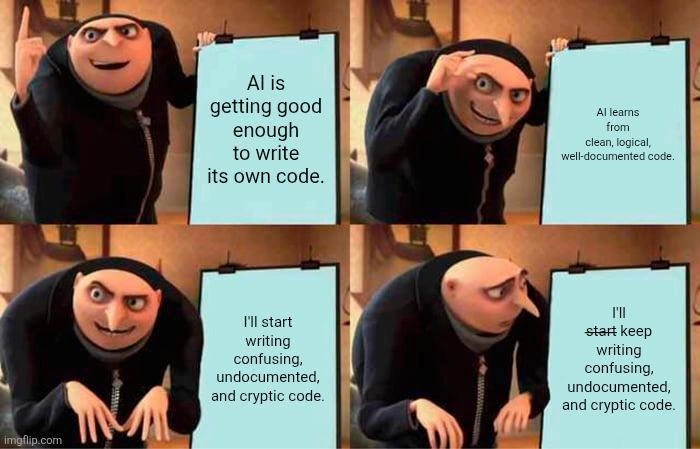
Let’s break down the meme in simpler terms. First, who is that character and what’s happening in the images? The character pointing at the flip chart is Gru, the comic villain from the movie Despicable Me. In a popular meme format, Gru presents a three-step plan on a chart, but the fourth panel usually shows the plan backfiring or an obvious flaw that Gru overlooked. It’s a setup for a punchline. Here, the plan Gru writes on the board is about AI and code.

In Panel 1, the text says: “AI is getting good enough to write its own code.” This refers to the recent trend of AI code-generation. Tools like ChatGPT or GitHub Copilot can actually write code based on prompts or by learning from lots of example programs. Many developers have noticed that AI is improving at programming tasks – it can autocomplete functions, suggest how to fix bugs, or even generate simple apps. So there’s a notion that AI might one day be able to handle a lot of coding on its own. Some developers feel excited by this, while others feel a fear (half-serious, half-joking) that if AI becomes too good at coding, human programmers might become less needed. That’s the underlying ai_code_generation_fear being hinted at. Gru, in the meme, acknowledges this: “Alright, AI is getting pretty good at coding now.”

Panel 2 reads: “AI learns from clean, logical, well-documented code.” This is basically saying that AI improves by studying high-quality examples. Machine learning (which includes AI) works by finding patterns in data. So if you give an AI lots of examples of a certain task done well, the AI will pick up on those patterns and try to mimic them. In the context of coding, if the training data (the code the AI studies) is clean code – that means code which is neatly organized, easy to read, and well-documented with comments – the AI will learn the good practices and logical structures from it. Think of it like a student learning from a textbook: if the textbook is well-written and clear, the student has a better chance of learning correctly. So, the meme sets up that AI’s strength (learning to code) comes from having good code to learn from. Clean, logical, well-documented code is basically the ideal. For example, code where variables have meaningful names, functions are not too long, everything is organized, and there are comments explaining tricky parts – that’s the kind of source that helps both humans and machines understand what’s going on.

Now, Panel 3 is where things take a comical turn. It says: “I’ll start writing confusing, undocumented, and cryptic code.” This is Gru’s big “solution” to the scenario. In other words, if the AI is getting smarter by reading clean code, the plan is to feed it the opposite: confusing, undocumented, cryptic code. Let’s clarify those terms:

  • Confusing code: Code that is hard to follow or understand. This might happen if the logic is all over the place, or if it’s written in a very roundabout way.
  • Undocumented code: Code with little or no comments or documentation. Generally, good code has comments that explain what tricky pieces do, or at least a README file or docs. Undocumented code leaves everyone guessing why something was done.
  • Cryptic code: This usually refers to code that might work, but only the original author (if anyone) can easily understand it. It might use weird variable names (like x, y, or even misleading names), lack any structure, or use clever but obscure tricks that aren’t obvious.

All these characteristics are often summed up by the term “spaghetti code.” That’s a slang term in programming for code that’s a tangled mess, much like a pile of spaghetti. If you’ve ever seen a spaghetti dish, all the noodles are twisted and interwoven – it’s hard to follow one strand from start to end. In the same way, spaghetti code has lots of tangled control flow (like jumps, goto statements, deeply nested loops and conditionals) and no clear organization. It’s the opposite of clean, modular code. Sometimes spaghetti code happens in older projects that have had many quick fixes applied over time, or when novice programmers write everything in one giant function. It’s also a hallmark of Legacy code, which means old code that has been around and perhaps no one updated it to modern standards. Legacy often implies that the code was written with old practices or without current tools, and people are afraid to change it too much because it’s running some critical systems (“if it ain’t broke, don’t touch it” mentality).

So Gru’s plan in panel 3 is basically: “If the AI needs good code to learn from, I’ll give it bad code instead, so it won’t learn well.” This is a humorous take on a dataset_poisoning_strategy, meaning intentionally giving bad examples to an AI so it performs poorly. It’s important to note: no one actually recommends doing this! It’s just the joke of the meme. In reality, writing bad code makes life harder for human developers and doesn’t really stop AI from existing. But the character Gru thinks like a cartoon villain: sabotage the AI by messing up the input.

Now, the funniest part is Panel 4. The text in Panel 4 is the same as panel 3 except one change: the word “start” is crossed out and replaced with “keep”. So it reads: “I’ll start keep writing confusing, undocumented, and cryptic code.” And Gru’s expression has changed from proud to a sort of embarrassed or resigned look. Why is that funny? Because it reveals that our villainous programmer doesn’t actually need to start making confusing code – he’s already doing it! The strikethrough implies that writing spaghetti code isn’t a new tactic for him at all; it’s his status quo. Essentially, he’s admitting, “I’ve been writing nasty spaghetti code all along, so I guess I’ll just continue – now with the excuse that it’s to confuse the AI.” This is a great example of DeveloperSelfDeprecation – programmers poking fun at themselves. We often joke that our code isn’t as good as it should be. Seeing Gru realize that his big new idea is actually nothing new is a comedic way to say, “Who am I kidding? My code has always been kind of a mess.”

To a newer developer (or someone just learning coding), this meme is highlighting a few cultural points:

  • AIHumor/AILimitations: There’s a running joke in the dev community about AI taking over jobs, and equally jokes about ways to limit AI. This meme imagines a tongue-in-cheek method to limit AI: give it bad learning material. It’s humorous because it’s not a serious or practical solution, just a cheeky commentary on AI’s dependency on data.
  • CodeQuality vs. Job Security: Normally, newcomers are taught to strive for high code quality – that’s definitely the right approach. But you might hear older devs jokingly say things like “well, that messy module guarantees I’ll have a job maintaining it, heh.” It’s not something people truly take pride in, but humor helps cope with the frustration of messy code. It’s a way of saying, “Yes, I know this code is terrible. Rather than cry about it, I’ll joke that I did it on purpose to keep the robots (or junior devs) from taking my place.”
  • TechnicalDebt: This term appears in the categories and tags. Technical debt is a metaphor: if you take shortcuts in code (like skipping tests, not refactoring, or writing confusing logic just to make a feature work quickly), you “borrow” time in the present, but you incur a “debt” that must be paid back later when the messy code causes bugs or slows down further development. In the meme, Gru’s approach of writing cryptic code is basically piling on technical debt. It’s like saying, “I’m okay owing a ton of cleanup later, as long as it confuses the AI now.” In reality, too much tech debt can sink a project, so it’s not a good strategy – which the meme implicitly knows, that’s why it’s funny. Everyone reading it understands this is a joke, not advice.
  • Context of the meme format: For completeness, knowing Gru’s plan meme format helps. Typically, panel 3 of a Gru meme has the twist, and panel 4 has Gru realizing the mistake or the ironic outcome. In this instance, the twist is simply that he doesn’t need to change his behavior at all – he was already writing bad code. It’s a self-inflicted punchline.

In everyday terms, imagine someone saying: “The new smart student learns from well-written textbooks. So my plan is to give it lousy, confusing textbooks… Actually, wait, all our textbooks are already lousy and confusing.” It’s that kind of humor. Programmers find it funny because it reflects both a fear (AI might surpass us if it has great material) and an admission (we often struggle to keep code quality high). It’s basically laughing at the notion that our worst coding practices might inadvertently be our saving grace from AI automation. Of course, in real software teams, the goal is to reduce spaghetti code, not increase it. But this meme lives in the space of irony and tech sarcasm, which is a beloved form of CodingHumor among developers.

Level 3: Job Security by Obscurity

This meme strikes a chord with experienced developers because it satirizes a very real tension: the gap between ideal code quality and the messy reality of legacy systems. Gru’s “plan” is essentially a jab at the way some senior engineers jokingly justify their convoluted code. The humor comes from flipping best practices on their head. Normally, we preach writing clean, logical, well-documented code to improve maintainability and CodeQuality. But here our protagonist (Gru, the comic villain) is delighted by the opposite: writing confusing, undocumented, cryptic code as a defensive measure. Why? To keep the machines from taking his job. It’s a classic case of DeveloperHumor and DeveloperSelfDeprecation. We often half-joke that our code is such an impenetrable maze that it guarantees our continued employment – “job security through obscurity,” as one might say. In security, “security by obscurity” (hiding flaws in hope attackers won’t find them) is frowned upon; here we have job security by obscurity of the code, a cheeky acknowledgment that “no one else – human or AI – can deal with this mess I’ve made, so they still need me.”

The four-panel Gru’s plan meme format delivers the punchline perfectly. In the first two panels, Gru is proud of a plan: he notes AI is getting good at coding, and that AI learns from good code. That’s reflecting a genuine industry trend – AI pair programmers and code generators have improved by training on high-quality open-source code. The senior dev community has indeed been watching AI progress with a mix of awe and anxiety (the ai_code_generation_fear is real in some quarters). Panel 3 is where Gru smugly announces the “solution”: “I’ll start writing confusing, undocumented, and cryptic code.” This is funny on its face because it’s obviously counterproductive to deliberately write bad code. Any seasoned engineer knows that adding TechnicalDebt and chaos to your codebase is usually a career-limiting move, not a smart tactic. It’s the sort of cynical coping mechanism one jokes about after wading through a 5,000-line ball-of-mud legacy function at 2 AM. We’ve all seen code so bad that we mutter, “Who wrote this?!” – and occasionally realize with horror it was ourselves from years ago. The meme leans into that self-own.

Panel 4 then twists the knife by striking through “start,” so it reads: “I’ll start keep writing confusing, undocumented, and cryptic code.” Gru’s proud grin turns into a blank, sheepish look. This is the self-deprecating punchline. The developer’s master plan to thwart AI isn’t really a new plan at all – it’s what he’s already been doing all these years! That’s hilariously relatable in tech circles. Who among us hasn’t looked at a gnarly piece of legacy code and thought, “Was this written to confuse robots or humans… or both?” We often poke fun at our own bad habits: insufficient comments, rushed fixes that turn into permanent hacks, or that one bizarre workaround nobody else understands. This meme basically says, “Haha, I’ve been unintentionally preparing for the AI apocalypse all along by writing such terrible code.” It’s comedy gold because it taps into the collective guilt and relief of developers: guilt that our code isn’t as clean as it should be, and a dark relief that maybe our messiness has an upside (albeit a not-very-noble one).

On a more serious note, this joke highlights a common source of TechnicalDebt in the industry: the reluctance or failure to document and refactor. Projects often have that one guru who knows the brittle, convoluted system by heart. It might not have started as sabotage; more often it’s due to tight deadlines, evolving requirements, or one developer heroically patching things on their own at 3 AM. Over time, that system accretes so much implicit knowledge and weird quirks that nobody else can step in easily. This situation can breed a kind of job security (intentional or not) for the original author, because they become the de-facto gatekeeper of a very convoluted castle. The meme slyly suggests that maybe some developers lean into this – consciously or subconsciously writing inscrutable code to ensure they remain indispensable. It’s a known anti-pattern: “If it was hard to write, it should be hard to read,” as the cynical joke goes. Realistically, few if any engineers truly plan this from the start (maintaining spaghetti code is stressful, not fun), but we’ve all seen scenarios where someone is the only one who understands a legacy system and thus cannot be easily replaced. This dynamic can slow down onboarding of new team members and definitely frustrates any AI or tool trying to auto-refactor the code. The meme’s scenario exaggerates it for effect: a dev proactively choosing chaos to one-up the AI. It’s funny because it feels plausible in an absurd way – a logical extreme of protecting one’s niche. It tilts at the genuine fear underlying some AI jokes: “What if the AI makes me redundant?” Our Gru character quips back: “Ha! I’ll make myself irreplaceably bad instead.”

Another layer here is the idea of dataset_poisoning_strategy – not something that comes up in everyday office chatter, but an amusing concept when applied to code. We already see mild forms of this: developers of stack overflow joke about deliberately putting weird code comments or bogus answers out there “for the bots.” And historically, there’s precedent for workers sabotaging technology to preserve their jobs (think 19th-century Luddites smashing textile machines). In a much less drastic way, writing bizarre code that only you can maintain is like a modern coder’s Luddite move. Of course, the irony is that this ultimately makes the developer’s own life harder too. Maintaining cryptic legacy code is a painful ordeal, leading to burnout and endless firefighting. In real organizations, accumulating such technical debt can hamstring the entire team’s productivity. This meme isn’t advocating it seriously – it’s mocking the very notion. The senior dev in the meme looks a bit defeated in the last panel because he recognizes the absurdity: he’s basically admitting he has been creating a problem all along. The humor has a tinge of dark truth: sometimes instead of fixing issues, devs joke about doubling down, because fixing them is daunting or undervalued. It’s a form of gallows humor in IT. We laugh, but it’s the laugh of familiarity – we’ve inherited projects full of confusing code and wished “if only it had been documented!” Yet here we are jesting that this nightmare code is our secret weapon against Skynet.

In summary, at a senior engineer level, this meme pokes fun at our TechDebt sins and the hype (or fear) around AIGeneratedContent in programming. It resonates because it combines two pervasive developer sentiments: unease about AI, and ongoing frustration with code quality. Rather than a preachy take, it mashes them into a single tongue-in-cheek “solution” that’s so wrong it’s right (in a comic sense). Senior devs chuckle because we know exactly the kind of spaghetti code that’s being implied – maybe we’ve even checked in some ourselves – and the idea that this mess could save us from an AI takeover is delightfully absurd. We recognize the irony that AI learns from us, so if we’re terrible, maybe the AI will be terrible too. It’s a jab at AI’s limitations (they’re only as good as their training data), and a self-jab at our own foibles. After all, if the robots are coming, they might take one look at our legacy COBOL banking software or that 15-year-old Java monolith with zero comments and decide, “No thanks, let’s not conquer this planet just yet.” 😜

Level 4: Adversarial Spaghetti Attack

At the bleeding edge of AI_ML, this meme hints at an adversarial data poisoning strategy. Modern AI code-generators (think OpenAI’s Codex or GitHub Copilot) are essentially specialized large language models trained on millions of lines of code. They learn statistical patterns from that training data. If most of the code they see is clean, well-structured, and well-documented, they become pretty adept at producing clean, well-structured code. However, feed them enough tangled, cryptic legacy spaghetti and you start to confound those learned patterns. This is analogous to an adversarial attack on a neural network – like adding invisible perturbations to images to fool a classifier, here we’re adding logical perturbations in code to baffle the AI. In theory, a codebase full of oddly-named variables, deeply nested logic, and zero comments is a noisy training signal, raising the model’s perplexity (a measure of how unpredictable the text/code is) and reducing its confidence. The meme’s “plan” is to intentionally degrade the quality of the training corpus so the AI can’t easily learn to write maintainable code. It’s basically poisoning the well: tainting the data pool with convoluted examples so the machine’s outputs get worse (or at least no better than the humans).

This connects to software entropy and complexity theory. Spaghetti code is notorious for its high cyclomatic complexity – the number of distinct paths through the code logic skyrockets with each ad-hoc conditional and tangled loop. For a human, that means it’s a nightmare to follow; for a machine learning model, it means there’s no clear statistical regularity to latch onto. An AI trying to infer what a function does from messy code is like trying to learn grammar from randomly generated sentences. In information-theoretic terms, cryptic code has higher Kolmogorov complexity – it’s not compressible into simple patterns or concise rules. A well-structured program might be broken down into logical modules and idioms that the AI recognizes (loops, API calls, standard algorithms), but a chaotic one is effectively Einstein’s nightmare: you can’t easily reduce it, you have to memorize lots of arbitrary quirks. This memorization without understanding is exactly what we don’t want an AI doing if we expect it to generalize good coding practices. So from a theoretical standpoint, flooding the training set with bizarre, idiosyncratic codebases could force the model to bloat with exceptions and edge cases, never deriving the elegant abstractions or best practices we hope it would. It’s a devious inversion of the usual machine learning goal: normally we strive for data quality and signal clarity; here the “plan” is to weaponize noise and complexity.

We can draw parallels to obfuscated code challenges. The International Obfuscated C Code Contest (IOCCC) has produced human-written programs that are virtually indecipherable, with creative use of macros, side effects, and pointer arithmetic that would give any static analyzer a headache. If an AI were trained on IOCCC winners, it might learn to write programs that technically work but look like pure gibberish. In security terms, this resembles a poisoning or backdoor attack on an AI: the AI trusts its training data, so maliciously confusing code could plant a sort of “logic bomb” in its coding style. Granted, advanced models are somewhat robust – they’ve likely ingested plenty of real-world messy code from public repositories (which are not all exemplars of clarity!). There’s already a significant amount of technical debt present in the wild code that AI trains on. But if one were to systematically introduce truly perverse coding patterns (imagine thousands of open-source projects intentionally full of misleading names, dead-ends, and copy-pasted stack overflow hacks), the AI’s performance or the sanity of its outputs could indeed degrade. In the extreme, we’d get an AI that autocompletes our code with the same confusing legacy quirks and obtuse hacks that we fed it – a sort of vicious cycle of spaghetti propagation. This is the tongue-in-cheek “endgame” the meme jokes about: by preserving and amplifying our worst coding habits, we ensure the AI overlords learn the wrong lessons and remain just as flawed as their human teachers. It’s a high-tech twist on “garbage in, garbage out” – if the training data is intentionally garbled, the AI’s generated code will be equally garbled, thereby foiling any clean-code revolution the machines had planned.

Of course, any serious AI engineer will note that deliberately worsening code quality is a Pyrrhic defense. You might stunt the AI’s abilities, but you’re simultaneously making your own systems harder to maintain and evolve. It’s a bit like trying to confuse an alien invader by speaking only in tongue-twisters: you may succeed, but now none of your compatriots understand each other either. Nonetheless, from a purely theoretical lens, the meme’s “strategy” riffs on genuine concepts in machine learning robustness. If someone were truly worried about autonomous AI rewriting all our software, then indeed flooding the ecosystem with Byzantine, convoluted code would raise the bar for any algorithm trying to learn coding via pattern recognition. It’s a comically self-sabotaging form of AI alignment problem: solving the “AI takeover” by making the target task (code generation) so fiendishly convoluted that even super-intelligent AI struggles. In reality, human developers and AI assistants are likely to collaborate, with AI handling boilerplate and humans guiding architecture – but the meme wryly imagines an arms race where developers actively try to stay one step ahead by embracing ever-more cryptic code. It’s half-joking about our pride in understanding our own messy systems: “We built this ridiculously complex legacy by hand – good luck to any AI trying to make sense of it!”

Description

Four panels of the classic “Gru’s plan” cartoon from Despicable Me. In panel 1, Gru proudly points to a flip-chart that reads: “AI is getting good enough to write its own code.” Panel 2 shows Gru looking pleased at a new slide: “AI learns from clean, logical, well-documented code.” In panel 3, the slide now says: “I’ll start writing confusing, undocumented, and cryptic code.” Panel 4 keeps the same text but the word “start” is struck through, leaving “I’ll keep writing confusing, undocumented, and cryptic code,” while Gru looks sheepishly resigned. The meme plays on the idea that AI code-generation models need quality training data; the senior dev’s self-deprecating “strategy” is to sabotage the dataset by doubling down on spaghetti code, thereby protecting job security while simultaneously increasing technical debt
Comments

11
Anonymous ★ Top Pick Dataset poisoning doesn’t require advanced adversarial attacks - just let the ten-year-old legacy module keep compiling
  1. Anonymous ★ Top Pick

    Dataset poisoning doesn’t require advanced adversarial attacks - just let the ten-year-old legacy module keep compiling

  2. Anonymous

    The real irony is that after 20 years in this industry, I've seen enough 'job security through obscurity' code to know that the developers who write it are usually the first ones let go during refactoring initiatives - turns out companies prefer engineers who can scale knowledge, not hoard it in cryptic variable names

  3. Anonymous

    The real existential crisis isn't whether AI will replace developers - it's realizing that AI models trained on Stack Overflow answers, legacy enterprise codebases, and that 'temporary' hack from 2015 will perpetuate our worst practices at scale. We're not just writing technical debt anymore; we're creating the training corpus for an entire generation of AI that will confidently generate the same cryptic, undocumented spaghetti code we've been promising to refactor 'next sprint' for the past five years. The singularity isn't when AI becomes smarter than humans - it's when it becomes exactly as lazy about documentation

  4. Anonymous

    AI masters clean repos; only vets architect callback hell that survives a decade of refactors

  5. Anonymous

    If LLMs learn from clean repos, our 2011 monolith - with Hungarian notation, global singletons, and zero docs - is basically an alignment WAF

  6. Anonymous

    We called it security through obscurity; AI calls it data poisoning - either way, my commit history predates your training set

  7. Deleted Account 1y

    do that better

  8. @learner_beginner 1y

    Lol

  9. @learner_beginner 1y

    @RiedleroD

    1. @affirvega 1y

      That's normal

      1. @learner_beginner 1y

        I see, he's been already banned before

Use J and K for navigation