Skip to content
DevMeme
3116 of 7435
The True Source of All Bugs
Bugs Post #3435, on Jul 19, 2021 in TG

The True Source of All Bugs

Why is this Bugs meme funny?

Level 1: It Was Me All Along

Imagine you and your friend hear a weird noise in your room at night. You both get scared and start searching for a monster that you think is causing it. You look under the bed, behind the curtains, everywhere. Finally, you peek under the bed with a flashlight and, instead of a monster, you find a mirror showing your own face! You suddenly realize you were making the noise by accident the whole time (maybe you left a toy on that’s making sounds, or you were unknowingly tapping the bed in your sleep). The big “scary problem” turns out to be you all along.

This meme is funny in a similar way. A developer (a person who makes a computer program) thought something was horribly wrong deep in their computer code. They went looking for the bad thing, like someone looking for a monster under the bed. But in the end, they discovered the “monster” was just their own mistake — basically, they found out that they caused the problem themselves. It’s like if you blamed a gremlin for breaking your toy, and later you remember that you dropped it earlier and that’s why it broke. Oops!

We laugh at this because it’s a little surprising and a little embarrassing, but very relatable. Everyone makes mistakes, and sometimes we go on a big search to figure out what went wrong, only to realize we did it. The developer in the comic had that experience: after all that work hunting for the bug, they essentially looked in a mirror and had to say, “Ah, it was me.” It reminds us to be honest and humble. The good thing is, once you know you made the mistake, you can fix it! And next time, you might remember to check the mirror (your own actions) first when something goes wrong, whether it’s a broken code or a spilled drink. The meme gives us a friendly nudge that finding out it was you all along can be both funny and a learning moment.

Level 2: Under-Bed Bug Hunt

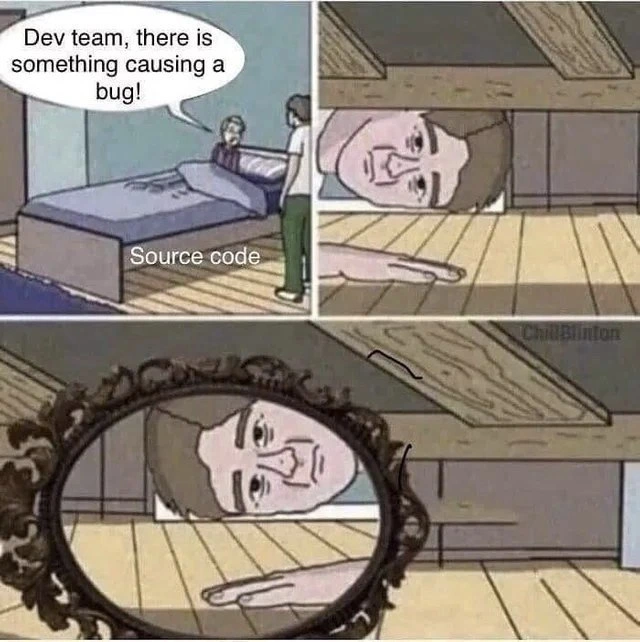
Let's break down the meme in simpler terms. Imagine you're a programmer and something is wrong with your application – that's what we call a bug. (Fun fact: the word "bug" has been used in engineering for a long time. There’s a famous story of a moth causing a computer failure in 1947, which is how a computer mistake came to be called a bug! 🦋) In the first panel of the comic, someone says, "Dev team, there is something causing a bug!" They suspect there's a pesky error hiding somewhere in the source code. The bed in the drawing is labeled "Source code" to represent the entire codebase (all the files of program code) where the bug might be lurking. It’s like they’re saying, “Something in our code is causing a problem, and we need to find it.” Just like a kid might think there's a monster under the bed at night, the developers think there's a bug-monster hiding somewhere under their code.

In the second panel, the developer literally gets down on the floor and reaches under the "Source code" bed, searching intently for the cause of the bug. This represents the process of debugging – digging through your code, checking logs, and investigating step by step to find out what's going wrong. The developer in the picture is on a bug hunt, checking every nook and cranny of the code (under the bed, behind the furniture in the analogy) for that elusive problem. This scene will feel familiar to anyone who has tried to troubleshoot a software issue: you systematically go through possibilities, test different parts of your program, and look wherever a bug might hide. It can feel like you’re searching in the dark for a tiny creature causing mischief in your program.

Now the punchline comes in the third panel. Instead of finding a nasty bug creature under the bed, the developer finds a decorative mirror on the floor. In the reflection of that mirror, we see the developer’s own face. In plain language, the meme is saying: the root cause of the bug was the developer themselves! After all that frantic searching through the code, the "monster" responsible for the bug turns out not to be a hidden gremlin or a glitch in the computer, but a human mistake made by the developer who wrote the code.

So every element in the image has a meaning:

  • The bed labeled "Source code": This represents the entire codebase or project, imagined as a place where the bug could be hiding.
  • The person reaching under the bed: This is the developer in debugging mode, searching through the code for the cause of the problem. (Picture a detective looking for clues.)
  • The mirror under the bed: A mirror reflects whoever looks into it. Here it reveals that the cause of the bug is the developer themselves. In other words, the "bug" was self-inflicted – a mistake by the person who’s now looking for it.

This twist is a classic bit of developer humor. We often perform a root cause analysis when something goes wrong, which means tracing the problem back to its origin. In this comic, the root cause wasn’t an obscure system failure or a mysterious quirk in the programming language – it was the developer's own oversight. Maybe they wrote a condition slightly wrong (for example, using > when they meant >= in an if-statement), or perhaps they forgot to initialize a variable. Those kinds of slip-ups can cause a program to behave oddly. The meme is basically illustrating a scenario every programmer encounters: you spend time blaming the code or the computer, only to discover the bug was introduced by your own code change.

For a newer developer, the message here is both funny and educational. It reminds us not to always assume the computer is doing something magical or that the tools are broken. Nine times out of ten, a software bug comes down to a simple logic error or a case you didn’t think of. The comic exaggerates it by showing the developer literally finding themselves to blame. It’s a bit of developer self-deprecation – meaning we developers are poking fun at ourselves. We've all written code we later look at and go, "Who wrote this? It's terrible!" only to realize we wrote it some time ago. This meme just takes that feeling and puts it into a funny visual scene.

And it’s okay! The reason this resonates is because it’s so common and normal. Part of becoming a good programmer is learning to systematically check your own work and assumptions. When debugging, a good tip is to start by questioning, "Could it be something I did or didn’t do?" instead of immediately blaming the computer or someone else’s code. The meme delivers that little lesson with a wink. It says: don’t be surprised if, after all your searching, you discover the bug was a result of your own code. It’s a humble reminder that everyone makes mistakes, and the real skill is finding and fixing them — even if it means confronting the “mirror” of your own code.

Level 3: The Developer in the Mirror

"To err is human, but to really foul things up you need a computer."

This tongue-in-cheek proverb perfectly captures the meme's punchline: in modern software projects, the biggest troublemaker is often us, the developers, armed with computers that faithfully execute our flaws. The comic’s scenario of a dev team hunting for “something causing a bug” under the bed (labeled Source code) hits home for any experienced engineer. We've all been there: a bug pops up, and our first reaction is to suspect some elusive external cause. It must be the new library update! Maybe the server configuration changed! Could cosmic rays have flipped a bit in memory? We comb through logs and ping teammates, trying to find anything else to blame. But after exhausting every theory, we have that sinking (and slightly comical) realization: the bug was introduced by our own code change.

The mirror in the final panel is a brilliant metaphor for root cause analysis pointing right back at the developer. In debugging culture, there's even a tool called git blame that shows which developer last modified a particular line of code. Running that is like holding up a mirror to the codebase to see whose face is reflected next to the troublesome line. And yes, more often than we'd like to admit, the face staring back is our own. This meme playfully dramatizes that "gotcha!" moment. The developer on the floor is like a detective hunting for a monster under the bed, only to find a mirror, meaning the “creature” causing the problem was them all along. It’s basically a software version of the classic Scooby-Doo unmasking: the villain wreaking havoc in production turns out to be the developer themselves in disguise (unintentionally, of course). Cue the “I would have gotten away with it, too, if it weren’t for my own meddling!”

From a senior dev perspective, this scenario is painfully relatable. Many of us have war stories of chasing a phantom bug for hours, only to track it down to a one-line typo we wrote or a configuration we forgot to update. Perhaps you left a feature flag on in production that should've been off, or misused an API parameter. The initial reaction is usually a mix of embarrassment and relief. Embarrassment because you realize you were the one who slipped up; relief because at least now you found the cause and can fix it. It's a humbling rite of passage in software development to learn that, while computers do exactly what you tell them, we often don’t tell them exactly what we intend.

There’s also an element of camaraderie and humor in how universal this experience is. Even star developers with decades of experience occasionally facepalm at their own mistakes. This is why practices like code reviews and pair programming exist: a fresh set of eyes can catch errors that the original author might overlook. The industry also preaches “blameless postmortems” – when analyzing why a bug or outage happened, the goal is to avoid shaming any one individual and instead identify how the team or process can improve to catch such mistakes. Yet, in those very postmortems, it’s not uncommon to find phrases like “root cause: developer misconfiguration” or “root cause: a typo in the code”. We try to phrase it gently, but among ourselves, we often chuckle and admit the obvious. This meme cuts through the polite phrasing with self-deprecating honesty: I caused the bug; the call was coming from inside the house!

Tech folks even have slang for these "oops, it was me" situations. In IT support, they joke about PEBKAC errors – "Problem Exists Between Keyboard And Chair" – implying the user did something wrong. For developers, a similar tongue-in-cheek term is an ID10T error (which, written out, looks like “IDIOT”). We use these terms lightheartedly, usually to laugh at our own mishaps after the fact. They highlight that the cause wasn’t some mystical system gremlin but a simple human mistake. Of course, nobody in a professional setting actually calls someone an idiot seriously; it's more of an inside joke we apply to ourselves to take the sting out of messing up.

What makes the meme so spot-on is that mix of frustration and humility every coder knows too well. Debugging can feel like a detective adventure in a haunted house: you suspect ghosts, goblins, everything except yourself. When it turns out the “ghost” was just your reflection all along, about the only thing you can do is laugh. It’s a gentle reminder that no one is infallible in coding. The ability to laugh at this scenario is actually a healthy sign – it means we acknowledge our humanity and learn from it. After all, once you’ve spent a long night tearing your hair out over a bug, discovering it was a one-character fix that you wrote incorrectly, you either find some humor in it or you’ll drive yourself crazy. This meme lets developers collectively sigh and smile, knowing we’ve all been the person looking under the bed for a bug, only to find a mirror.

Level 4: No Silver Bullet

Even in theoretical computer science and software engineering, the joke in this meme hints at an inescapable truth: as long as humans write programs, human error remains a fundamental part of the system. In formal terms, eliminating every bug from non-trivial software is at best extremely difficult and at worst computationally undecidable. A program's correctness can be thought of in terms of formal verification – mathematically proving that the code does exactly what it's supposed to. Writing such proofs for complex systems is akin to solving the program's behavior for all possible inputs, a task that quickly hits the limits of computation. This touches on the famous halting problem in computer science, which essentially says there's no general algorithm that can perfectly detect all possible errors or infinite loops in any arbitrary program. In other words, we can't have a magic debugger that foresees every bug in every scenario. No matter how clever our tools, some bugs only come out of hiding when a human stumbles over them.

Software complexity adds to this challenge. Fred Brooks famously wrote "No Silver Bullet" to express that no single technique will give an order-of-magnitude improvement in software reliability (or productivity) in one leap. Decades later, this holds true: we've invented automated tests, sophisticated static analysis tools, and advanced programming languages with strong type systems to catch mistakes early. These have certainly reduced the number of bugs, but none have completely eliminated the classic scenario of a programmer introducing a flaw. The more complex a codebase gets, the more interactions and edge cases exist. Testing every possible path through a large program is practically impossible because the number of possibilities can grow exponentially. Ensuring absolutely zero bugs would require examining an astronomical number of execution paths. We can reduce the risk (for example, using proven algorithms or formally verifying critical modules), but verifying a whole system end-to-end remains a herculean task. There's always a corner case no one thought of, or a moment of tiredness where a developer writes = instead of ==. The result? A bug slips through.

There's an inherent self-referential loop in software creation: programmers design the system and they design the tests meant to catch their mistakes. If the developer has a flawed assumption while writing the code, that same assumption might carry into how they test it (or fail to test it). The bug sits in a blind spot of the author's mind, effectively invisible until someone (maybe a user or another developer) shines a light on it. It's almost like writing a book and proofreading it yourself – your eyes might skip over a typo because you know what you intended to write. Some advanced methodologies, like formal specifications and model checking, try to break this loop by introducing rigorous outside perspectives (mathematical models, proofs) for critical parts of the software. These methods can catch classes of bugs that human testing might miss, which is awesome! But even those approaches are limited by the completeness of the specification – and who writes that spec? The developer, again. It's like trying to lift yourself by your own bootstraps; there's only so much we can catch without an external reference point of "correctness" that isn't just our own biased brain.

In safety-critical fields like aerospace or medical devices, teams strive for near-zero bugs through exhaustive processes and multiple layers of review. They use techniques like pair programming, extensive peer review, and formal verification for certain modules. (For example, avionics software must comply with standards like DO-178C, which involves a ton of analysis and testing.) Yet, even organizations like NASA have encountered software bugs causing mission issues. It's not that engineers are careless; it's that complex systems plus human involvement guarantee a sliver of imperfection. The meme humorously condenses this truth: the "root cause" of a bug often lies outside the code's text – it lives in the mind of the person who wrote that code. No matter how advanced our compilers or analysis tools become, the last mile of logic is human thought, which isn't automatically error-proof. Until one day maybe AI writes and verifies all code (and even then, who writes the AI?), the mirror will keep showing the developer as part of the root cause.

Description

A three-panel comic strip meme illustrating a developer's debugging journey. In the first panel, a character representing a manager or stakeholder stands by a bed labeled 'Source code' and says in a speech bubble, 'Dev team, there is something causing a bug!'. In the second panel, a developer is shown looking under the bed, searching for the culprit. The third and final panel shows the developer still looking under the bed, but an ornate mirror on the floor reflects his own face back at him, revealing he is the 'something' causing the bug. A watermark for 'ChillBlinkton' is visible in the third panel. The meme is a classic and highly relatable joke in the software development community. It humorously captures the humbling moment of realization during debugging when a developer discovers that the source of a complex, frustrating bug is their own mistake. It's a visual metaphor for 'the call is coming from inside the house,' a core tenet of troubleshooting complex systems

Comments

15
Anonymous ★ Top Pick The five stages of debugging are: 1. It can't possibly be my code. 2. How is this even possible? 3. Oh, it was my code. 4. How did this ever work? 5. I will never tell anyone about this
  1. Anonymous ★ Top Pick

    The five stages of debugging are: 1. It can't possibly be my code. 2. How is this even possible? 3. Oh, it was my code. 4. How did this ever work? 5. I will never tell anyone about this

  2. Anonymous

    Our incident RCA ended when someone aliased “git blame” to open Photo Booth

  3. Anonymous

    The bug is just a race condition that only happens when Mercury is in retrograde and someone microwaves fish in the break room - naturally, it's been living in that event handler written by the contractor who left in 2016

  4. Anonymous

    Every senior engineer knows that terrifying moment when you're hunting down a critical production bug, meticulously tracing through layers of abstraction, only to discover the git blame points directly at a commit from 3am six months ago... with your name on it. The real horror isn't the bug - it's realizing you're debugging your past self's 'clever' optimization that seemed brilliant at 2:59am but now reads like an eldritch incantation. At least you can't file a ticket against yourself... or can you?

  5. Anonymous

    The ultimate debugging plot twist: grep for the bug, and the source code greps your scared face right back

  6. Anonymous

    Postmortem was blameless until someone brought a mirror

  7. Anonymous

    Our new RCA tool is a mirror wired to git blame - MTTR dropped, my ego didn’t

  8. @ZgGPuo8dZef58K6hxxGVj3Z2 4y

    new Color(.95,.5,.5,.5,1)

    1. @RiedleroD 4y

      Almost Red™

      1. @ZgGPuo8dZef58K6hxxGVj3Z2 4y

        No

        1. @RiedleroD 4y

          what then

          1. @ZgGPuo8dZef58K6hxxGVj3Z2 4y

            argbr

            1. @RiedleroD 4y

              so almost blue™

            2. @Roman_Millen 4y

              What does the last "r" stand for? Reflection?

              1. @ZgGPuo8dZef58K6hxxGVj3Z2 4y

                Yeah

Use J and K for navigation