Regular Expressions: Turning One Problem into Two
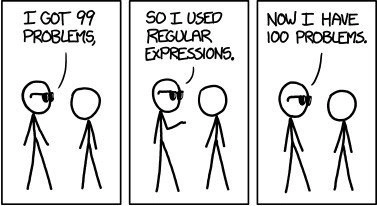
Why is this Bugs meme funny?
Level 1: Quick Fix, New Mess
Imagine you have a big mess in your room – toys all over the floor – and you want to clean it up quickly. You decide to shove them all into the closet and slam the door. It seems to solve the mess fast, but then the closet door pops open and all the toys tumble out (maybe even knocking something over!). Now your room is messy again and you have a broken closet door to fix. You tried a quick fix, but it actually gave you an extra problem. That’s exactly what’s happening in this comic: the programmer tried a fast, fancy trick to fix his coding problem, but it backfired and created an even bigger mess. It’s funny because we’ve all experienced moments where trying to cheat or take a shortcut ends up making more work for us in the end.
Level 2: Regex is Hard
In plain language, this comic is showing a programmer who tried to fix a coding problem in a clever way, but ended up with an extra problem instead. Regular expressions (regex for short) are a tool developers use to search for patterns in text. For example, a regex can quickly check if a string looks like an email address or find all the phone numbers inside a document. It’s like a tiny built-in language of special symbols (such as ^, .$ or *) that let you define complex search patterns. Because regex syntax is so terse and symbolic, it’s easy to make mistakes with it.
In the comic, the first stick figure says, "I got 99 problems," which humorously means "I already have a lot of bugs/issues in my code." (He’s exaggerating with the number 99 to be funny.) Then he says, "So I used regular expressions," meaning he decided to use a regex pattern as a quick fix for one of those problems. The punchline is, "Now I have 100 problems." In other words, his attempt to fix things with a regex backfired and introduced a new bug. Now he has one more problem than he started with!
This joke lands because it’s so relatable to programmers: we’ve all tried a quick fix that backfired. Regular expressions in particular have a reputation for causing this. If you write a regex pattern incorrectly, it might do something unexpected. For instance, your regex might match text you didn’t intend to match, or fail to catch things you wanted, all because of one tiny syntax slip-up. Then you have to spend time debugging (which means finding and fixing the error) in your regex. In the comic’s words, the developer gained “a new headache.”
Notice the number change from 99 to 100. That is a wink at a classic programming mistake called an off-by-one error. That’s when a loop or count in code is off by one. It’s one of those simple bugs (like forgetting that counting might start at 0 instead of 1) that can cause a big issue. Here, the character literally ends up with one more problem than before, as if he miscounted. It’s a playful way to highlight the mistake.
The overall lesson is: be careful with clever one-line solutions like regex. A regular expression is a powerful shortcut, but it can be tricky to use correctly. If you’re not careful, you might solve one issue and accidentally create another. The comic uses a simple stick-figure drawing (similar to the style of the geeky webcomic xkcd) to deliver this message. Even without knowing the technical details, you can laugh at the idea that the programmer’s fancy solution made things worse. In short, regex can save the day or ruin it – which is why you’ll often hear developers half-jokingly say, “Regex is hard.”
Level 3: Off-by-One Solutions
"I got 99 problems,"
"so I used regular expressions."
"Now I have 100 problems."
This three-panel comic nails a classic developer joke about quick fixes backfiring. In the first panel, our stick-figure programmer boasts, "I got 99 problems" (a tongue-in-cheek nod to a famous lyric, meaning he already has a ton of issues). In the second panel he proudly announces his grand plan: "So I used regular expressions." The punchline lands in the final panel: "Now I have 100 problems." Instead of reducing his bug list, the regex solution actually added one more! It’s a perfect illustration of a fix that makes things worse.
Every seasoned developer laughs (perhaps a bit nervously) at this because we’ve all been there. The comic riffs on the well-known adage that using regex to solve a problem often gives you two problems. Here it’s exaggerated by starting with 99 issues, so the off-by-one increase to 100 is both literal and symbolic. (For context, an off-by-one error is a common programming bug where a loop or index goes one step too far or not far enough – the joke slyly nods to that by literally incrementing the problem count by one). The humor draws on shared experience: you attempt a clever one-liner fix and end up with an extra headache to debug.
Why does this happen so often with regex? Because regular expressions, while powerful, are notoriously tricky to get right. They form a tiny language of their own embedded in our code. Many programming languages (from Perl to JavaScript to Python’s re library) include regex support, tempting developers to write elaborate patterns like /^([A-Za-z0-9]+)@\w+\.\w+$/ to validate an email. But these patterns can be cryptic and unforgiving. One wrong character, and your regex might accidentally match too much, or not enough, or even cause a performance snarl. Seasoned devs know that moment of regex regret: the wizardly one-liner you whipped up to save the day is now the prime suspect in a new bug report.
The meme’s stick-figure with sunglasses is a brilliant touch. It represents the coder’s initial confidence – perhaps a bit of swagger ("Regex can do anything, watch this!"). The simplistic xkcd-style art (just two stick people trading lines) keeps the focus on the dialogue that every programmer can relate to. By the final panel, you can almost hear the defeated sigh in his statement, "Now I have 100 problems," delivered with deadpan irony. It’s the quintessential “well, that didn’t go as planned” moment.
In practice, this scenario plays out during debugging and troubleshooting all the time. You have a bug (say, problem #99), you throw a regex at it hoping for a quick cure, and suddenly you’re chasing a brand new bug caused by that very regex. It might be something subtle – your pattern inadvertently replaces text it shouldn’t, or fails on weird input, or makes the code impossible for your teammates to maintain. The net result? The original issue might be resolved, but a fresh bug (problem #100) has spawned, and you’re back in the debugger with a facepalm.
This meme resonates as developer humor because it encapsulates a hard-learned lesson: there are no silver bullets in coding. Regular expressions are a powerful tool in our programming arsenal, but with great power comes great responsibility (and sometimes great headaches). The commenter who simply wrote "Classic" recognizes this scenario as timeless programmer wisdom. It’s funny precisely because it’s true – we laugh to keep from crying when our clever fix backfires. In the end, a solution that adds one more problem is, unfortunately, way too relatable for anyone who’s been in the trenches of software development.
Level 4: Formal Language Folly
Under the hood, a regular expression is rooted in formal computer science theory. Regex defines a regular language – a set of strings recognized by a finite state automaton (basically a state machine). This concept was introduced by mathematician Stephen Kleene in the 1950s (hence the regex operator * is called the Kleene star), and later legendary hacker Ken Thompson built one of the first regex engines for early Unix tools like grep. The idea is elegantly simple: you describe a pattern once, and the computer finds matches without explicit loops or if-else logic.
However, the humor in this comic comes from how adding such an "elegant" tool can actually increase complexity. Real regex engines (e.g. PCRE in many languages) are more powerful than the theoretical minimal model – they support fancy extensions like backreferences and lookahead assertions that make them essentially Turing-complete (no longer just finite automata). This extra power comes at a cost: a poorly crafted regex can exhibit catastrophic backtracking, where matching certain tricky inputs takes exponential time. In extreme cases, using a single regex can turn a minor bug into a performance disaster or even a security hole (think ReDoS – Regular Expression Denial of Service). So our developer’s "solution" might have introduced a brand new class of problem: algorithmic complexity and unpredictable behavior stemming from the regex itself.
This situation is practically a computer science parable. We even have a proverb in programming folklore (commonly attributed to Jamie Zawinski): “Some people, when confronted with a problem, think ‘I know, I’ll use regular expressions.’ Now they have two problems.” The comic explicitly plays on this by incrementing the problem count from 99 to 100 – a literal off-by-one error in the count of issues. It underscores the truth that theoretical power doesn’t guarantee practical simplicity. By bringing in regex (a mini-language inside your code), the developer essentially opened a new chapter of complexity. It’s a reminder that every new abstraction or tool comes with its own problems to solve, often turning one big headache into two (or in this case, ninety-nine into one hundred).
Description
A classic three-panel black-and-white comic strip from the webcomic xkcd, featuring two stick figures. In the first panel, one stick figure wearing sunglasses says to the other, 'I GOT 99 PROBLEMS,'. In the second panel, the conversation continues with the same character explaining, 'SO I USED REGULAR EXPRESSIONS.'. In the final panel, the character delivers the punchline: 'NOW I HAVE 100 PROBLEMS.'. This comic perfectly encapsulates a universal and painful experience for software developers. It's a humorous take on the famous quote by Jamie Zawinski: 'Some people, when confronted with a problem, think ‘I know, I’ll use regular expressions.’ Now they have two problems.' While regex is an incredibly powerful tool for pattern matching and text manipulation, its complex, often cryptic syntax can lead to solutions that are difficult to read, debug, and maintain, effectively creating a new, more complicated problem than the one it was meant to solve

Comments
23Comment deleted
My favorite part of using regex is the follow-up task six months later, titled 'Figure out if it's cheaper to reverse-engineer this regex or just rewrite the entire application.'
Regex: the only tool that lets you upgrade an off-by-one bug to exponential-time catastrophic backtracking - and call it a hotfix
After 20 years in the industry, I've learned that regex is like a distributed system - it works perfectly until someone asks you to explain why it works, then you realize you've been cargo-culting the same Stack Overflow answer since 2009 and praying the edge cases never show up in production
This perfectly captures the moment when a senior engineer confidently reaches for regex to solve a string parsing problem, only to spend the next three hours debugging catastrophic backtracking, Unicode edge cases, and that one test case where someone put a newline in their email address. The real problem isn't the 100 problems - it's explaining to the PM why the 'simple text validation' ticket is now in its third sprint
Regex: where 'simple match' backtracks into a state explosion that'd make CAP theorem jealous
Ship a one‑line regex to prod and you’ve deployed an NFA with a 2 a.m. SLA
Had 99 problems; used PCRE - now we have catastrophic backtracking, Unicode edge cases, and a RE2 migration. Call it an even 100
but still need 28 problems to get round number 😉 Comment deleted
I got 99 problems, but RegExp ain't one Comment deleted
Мем говно (Cool meme) Comment deleted
thats not how translations work Comment deleted
Ты долбоеб(You're a cool man bruh❤️). Just joke, don't be serious) Comment deleted
Следи за базаром, because some understand russian Comment deleted
So do I -- I'm Russian Comment deleted
Админ петучь That's a great meme, really funny Comment deleted
I think admin is russian too, his name is east european Comment deleted
This channel reminds me of Orwell’s Animal Farm, but instead of communists, there are Russians Comment deleted
I have to admit I never used regex but doesn't look that hard Comment deleted
it isn't hard Comment deleted
Lol then why are there that many memes about it? Comment deleted
well, it looks hard if you don't know how it works. Just like svg paths btw, they're also really simple. Comment deleted
Oh okay Comment deleted
Now I have \d+ problems? Comment deleted