Skip to content
DevMeme
3117 of 7435
Biological Firmware Update: Patching the Human System
Security Post #3436, on Jul 20, 2021 in TG

Biological Firmware Update: Patching the Human System

Why is this Security meme funny?

Level 1: Stopping the Bad Guys

Imagine your body and a computer are a bit alike when it comes to fighting off bad guys. In a computer, you have a special helper program (antivirus) that knows about a list of all the bad guy programs (viruses). Every so often, this helper program needs to learn about new bad guys that have shown up. When it learns about new bad guys, it says, “The list of bad guys is updated!” That’s what happens during a computer’s virus database update – the computer basically got new “wanted posters” of viruses so it can recognize and stop them.

Now think about a baby getting a vaccine at the doctor. A vaccine shot teaches the baby’s body about a bad germ (like a virus that causes illness) without actually giving the baby the sickness. It’s like showing the baby’s immune system a picture of the germ so it can remember and fight the real one later. After a vaccine, the baby’s body has an updated list of germs to watch out for, just like the computer had an updated list of viruses.

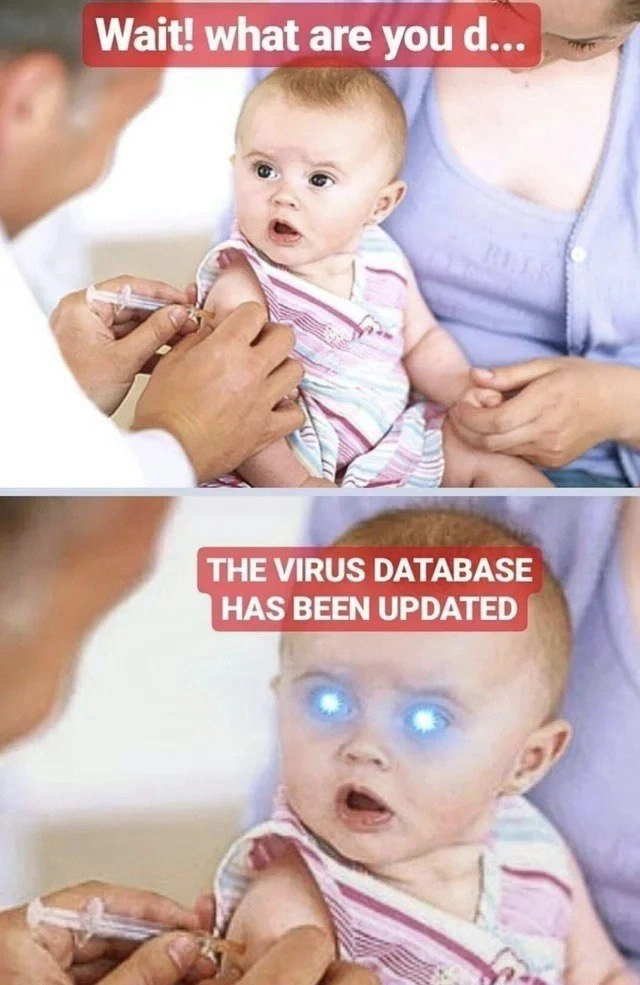
In the meme’s picture, the baby gets the shot and suddenly reacts as if it were a computer that just updated its antivirus! The phrase “THE VIRUS DATABASE HAS BEEN UPDATED” appears, and the baby’s eyes even glow blue like a robot that just turned on. This is funny in a silly way: we don’t expect a baby to behave like a talking computer. It’s as if the baby is saying, “Don’t worry, I’ve downloaded the latest germ-fighting power!” Just like a game character getting a power-up, the baby got a virus-fighting power-up.

So, in super simple terms: the doctor’s shot gave the baby new info to beat germs, and the meme jokes that the baby responds the way a computer does when it gets new info to beat computer germs. It’s mixing a real-life thing (a baby’s vaccine) with a computer thing (antivirus update) to make us laugh. Basically, both the baby and the computer are safer from “bad guys” now – and that’s both cute and funny!

Level 2: Antivirus Vaccine

Let’s break down the key ideas for a newer developer or someone just getting into security concepts. This meme plays on the double meaning of virus in computing and medicine:

  • Computer Virus vs. Real Virus: In tech, a virus is a type of malware (malicious software) that can copy itself and infect computers, similar to how a biological virus spreads between people. To combat computer viruses, we use antivirus programs. In health, a virus is a germ that can make you sick, and we use vaccines to prevent those illnesses. The joke compares updating an antivirus program to vaccinating a baby. In other words, updating a computer’s virus database is like updating a baby’s immune system.

  • “Virus Database Has Been Updated”: This phrase is a direct quote from Avast Antivirus’s famous notification. Avast (a popular free antivirus, especially in the 2000s) used to literally speak aloud when it downloaded new virus definitions. The voice was a calm female voice stating, “The virus database has been updated.” Imagine sitting at your computer, and suddenly your speakers declare that phrase – it was memorable! In this meme, when the doctor injects the baby, we see that exact phrase appear in a caption, as if the baby just played the Avast sound. This is funny because obviously babies don’t announce things like a computer does. It’s a playful avast_reference that many tech-savvy folks recognize immediately.

  • Virus Database / Definitions: What is a virus database? It’s basically a big list of known bad programs (viruses, trojans, etc.) that an antivirus software keeps. Each known virus has a sort of fingerprint or signature. The antivirus scans files on your computer and compares them to these signatures. If it finds a match, it knows that file is a virus and can block or remove it. Because new malware comes out all the time, the antivirus regularly updates this database (downloading new signatures daily or even hourly). That’s why you often see your antivirus software updating – it’s pulling in the latest threat definitions. The meme treats the vaccine as if it were just an update to the baby’s internal virus database. The doctor isn’t just giving a shot; he’s “installing latest virus signatures” into the baby! From a SecurityAwareness perspective, it’s actually a good message: always keep your protection updated, whether it’s your PC’s antivirus or your personal vaccines.

  • Injection – Different Meanings: The word “injection” shows up in both medicine and computing, but in very different ways. In medicine, an injection is a shot using a needle, often to give a vaccine. In computing, code injection is a term for a hacking technique where malicious code is inserted into a program or system (for example, an SQL injection attack where a bad guy tricks a database into running harmful commands by injecting them via input). In cybersecurity, injections are usually bad news – they’re security flaws. One of the tags here, InjectionFlaws, refers to those kinds of vulnerabilities. However, in this meme the injection is a good thing: it’s delivering medicine to protect the baby. The humor partly comes from this contrast. The meme is doing a tongue-in-cheek reversal – a literal injection that “updates” a system (the baby’s immune system) in a beneficial way, whereas normally in tech, an injection means a breach or problem.

  • Glowing Eyes Trope: In the second panel, after the shot, the baby’s eyes are glowing blue and wide open. This glowing-eyes imagery is a common meme trope indicating someone or something has powered up, gained special abilities, or been “activated.” Here it emphasizes that the baby has just gotten a boost – like the antivirus alert turned the baby into a tiny virus-fighting machine. It’s as if the baby’s internal software just got a high-powered update. For someone new to DeveloperHumor, it’s a visual way to show “system online and updated.” The baby looks startled, maybe because even the baby is surprised at their new upload of germ-fighting info!

All these elements combine to make a cybersecurity meme that’s both educational and funny. If you’re a junior dev or just learning about security, the meme actually highlights a best practice: keep your defenses current. Computers do it with antivirus updates; people do it with vaccines. And the next time you hear an antivirus or system update notification, you might humorously think of a baby getting its shots. It’s a lighthearted reminder that whether it’s code or health, updates guard us against known dangers.

Level 3: Definition Injection

At the highest level, this meme fuses cybersecurity practice with biological immunization in a delightfully nerdy way. It references the classic Avast antivirus voice prompt announcing "The virus database has been updated." In the meme’s two-panel setup, a doctor’s syringe is about to vaccinate a baby – and mid-injection, the famous phrase appears as if the baby’s internal “anti-malware engine” just got new signatures. This is a literal code injection joke, treating the vaccine like an update to the baby’s virus definitions.

For seasoned developers and security professionals, the humor works on multiple layers:

  • Signature-based Detection: Traditional antiviruses rely on a virus definition database, a collection of known malware signatures (unique patterns of code). Whenever new malware is discovered “in the wild,” security companies issue definition updates so the antivirus can recognize and block those new threats. Avast became notorious (and beloved) for its voice alert “Virus database has been updated” each time new definitions downloaded. It was a reassuring sound for some and an occasional jump-scare for others – your PC could suddenly blare this monotonous announcement at any time, much like a disembodied doctor reporting a successful inoculation. The meme leans on our nostalgia for that era of SecurityAwareness: we’re essentially seeing a real-life “signature update” being applied to a tiny human. The baby’s glowing eyes in the second panel even suggest a powered-up, Terminator-style scanning mode, as if the new definitions are actively running.

  • Vaccine Analogy: A vaccine teaches a baby’s immune system to recognize a virus – in other words, it updates the baby’s biological virus database. The meme cleverly maps this concept to computers: just as an antivirus needs the latest malware signatures to catch new Malware, a child needs updated antibodies to fight new germs. It’s a security joke straddling two worlds. The phrase “the virus database has been updated” is absurd coming from a baby, which is exactly why it’s hilarious. It’s developer humor meeting medical reality. If you’ve ever sat in a meeting about patching software or updating firewall rules, you might chuckle at how even humans need “patches” (vaccines) for new viruses. The meme delivers a cheeky form of SecurityAwareness: whether in IT or medicine, always keep your defenses up to date!

  • Injection Irony: In programming and infosec, injection usually implies something malicious – think SQL injection or code injection attacks where bad actors slip harmful code into a system (a top-tier InjectionFlaws category in OWASP). Normally, hearing “injection” makes security folks groan, because injection vulnerabilities lead to data breaches. But here the script is flipped: the injection is the solution, not the problem. The doctor is “injecting” a protective agent rather than a harmful one. It’s an ironic twist that seasoned devs appreciate: a literal injection that updates a system (the baby) in a good way. This role reversal of a common security term adds an extra wink for those in the know. Essentially, the meme merges a software update paradigm with human immunology, and that crossover hits a DeveloperHumor sweet spot.

In summary, at this senior level the meme lands because it connects the cybersecurity dot of keeping systems updated (with antivirus definitions) to the real-world security of keeping people safe (with vaccines). It parodies a well-known Avast reference from the era of talkative antivirus software. Anyone who has ever maintained enterprise antivirus endpoints or just remembers that soothing “virus database updated” voice will get a kick out of seeing that concept applied to a baby. It’s the ultimate “patch Tuesday for babies” joke – funny because in both code and in life, updates are non-negotiable for safety.

Description

A two-panel meme that humorously analogizes vaccination to a software update. In the top panel, a baby with a surprised and slightly alarmed expression is receiving a vaccination shot from a doctor. A red text box above reads, 'Wait! what are you d...'. The bottom panel shows the same scene, but now the baby's eyes are glowing with a bright blue, cybernetic light. The corresponding red text box announces, 'THE VIRUS DATABASE HAS BEEN UPDATED'. The meme's humor is derived from mapping a complex biological process - immunization - onto the familiar technical concept of updating an antivirus signature database. For tech professionals, this resonates as a perfect, albeit comical, abstraction for how vaccines work: introducing a 'definition' of a threat to the body's 'security system' so it can recognize and fight it off later. The glowing eyes trope signifies the successful completion of this biological 'firmware' upgrade
Comments

7
Anonymous ★ Top Pick That's the only critical patch I know of that gets deployed with zero documentation, causes the system to scream for an hour, and then requires a 12-hour sleep cycle to apply
  1. Anonymous ★ Top Pick

    That's the only critical patch I know of that gets deployed with zero documentation, causes the system to scream for an hour, and then requires a 12-hour sleep cycle to apply

  2. Anonymous

    Medicine’s CI/CD is humbling: one syringe, instant hot-patch to prod, patient screams once and their virus signatures are already more up-to-date than our entire endpoint fleet

  3. Anonymous

    When you realize your immune system has better update management than your production Kubernetes cluster - at least it doesn't require a three-week change approval board to patch critical vulnerabilities

  4. Anonymous

    When your antivirus gets that fresh CVE feed and suddenly sees threats in production code you deployed three years ago - turns out that 'clever workaround' was actually a textbook SQL injection vector all along. The real virus was the technical debt we accumulated along the way

  5. Anonymous

    Zero-downtime security patch for the ultimate distributed system: no shard migrations required

  6. Anonymous

    InfoSec's zero-downtime deploy: hot-patch every endpoint mid-request - "Wait, what are you d..." "The virus database has been updated." CAB approval retroactively

  7. Anonymous

    A definitions refresh is just recognizing yesterday's IOCs - comforting, already stale, and still pushed straight to prod without a rollback

Use J and K for navigation