Skip to content
DevMeme
2755 of 7435
When a Stack Overflow Snippet Meets a Legacy Codebase
CodeQuality Post #3043, on May 6, 2021 in TG

When a Stack Overflow Snippet Meets a Legacy Codebase

Why is this CodeQuality meme funny?

Level 1: Fancy Front, Same Old Bus

Imagine you have a big, messy toy bus. It’s old, has scratches, maybe a wheel that’s a bit wobbly – but it still drives around carrying all your other toys. Now you find a super cool shiny piece from a model sports car, like a fancy front bumper with headlights. You tape this shiny sports car piece onto your toy bus to make it look cool. From the very front, it now looks like a fast race car, and you’re happy because that part is so pretty. But when you look at the whole thing, it’s still the same big old bus behind that fancy front. It doesn’t drive any faster or work any better just because you added one cool part. In fact, the shiny part might not fit perfectly – it could even fall off when the bus turns! This is funny because that’s what programmers sometimes do: they take one small really nice thing from somewhere else and put it on their big messy thing, hoping it will fix everything. The meme makes us laugh because we see the silly picture of a bus pretending to be a sports car, and we understand it’s just like trying to make a messy pile of code seem awesome by adding one neat piece. It’s a reminder that one fancy fix can’t magically turn a whole bus into a Lamborghini – it’s still a bus, and that’s okay, but we shouldn’t fool ourselves!

Level 2: Copy-Paste Chaos

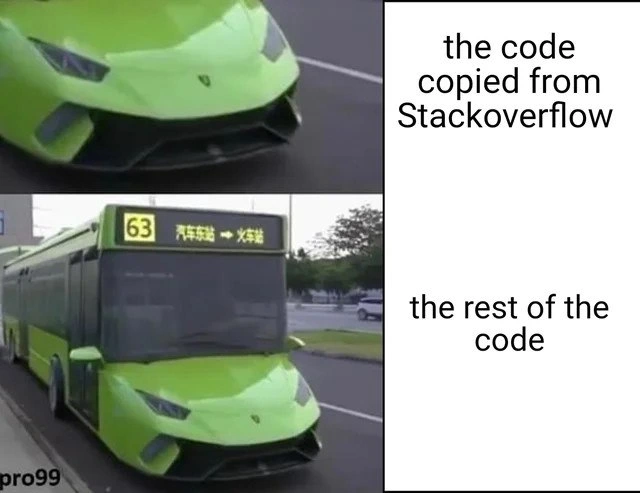
For a newer developer, let’s unpack why this meme is so relatable in the programmer world. It’s showing two pictures: in the first, you see the front of a cool lime-green sports car (it looks like a Lamborghini). In the second picture, you realize that front end is actually attached to a long green city bus! The captions label the sports car nose as “the code copied from StackOverflow” and the full bus as “the rest of the code”. This is a joke about CopyPasteCoding: taking a small piece of code from the internet (often from StackOverflow) and jamming it into your larger project.

StackOverflow is a popular Q&A website where developers ask questions and get answers. If you’re stuck on a coding problem, you search there and often find a snippet (a short bit of code) that solves it. That snippet is usually well-crafted for that specific question – almost like a perfect little Lamborghini front end: sleek, optimized, and tested by the community. On its own, that code looks beautiful and works great in the example context.

Now, your codebase (all the code in your project) is more like the bus: it’s big, probably old in parts, and not as glamorous. Real-world codebases contain lots of different code written by different people over time. Some parts might be okay, but others are clunky or outdated. We call code “clunky” or messy when it’s hard to read, maybe not well-organized, or uses older, less efficient methods. So imagine a city bus – it’s designed to carry a heavy load, it’s not very fast, and it might not be pretty. That’s your project’s code: it gets the job done but isn’t winning any beauty contests.

When you do copy-paste coding, you take that shiny snippet from StackOverflow and put it into your bus-like codebase. This can lead to uneven code standards – meaning different parts of your code follow different styles or quality levels. For example, the StackOverflow snippet might use clear variable names and modern language features, but the surrounding code uses older conventions and maybe less clear names. It’s like bolting a brand-new car part onto an old machine; they technically might connect, but they don’t really match in style or quality.

Let’s break down a few terms and why they matter here:

  • Code Quality: This refers to how good your code is in terms of readability, maintainability, and correctness. High-quality code is easy for others (and future you) to understand and modify without introducing bugs. In our meme scenario, the StackOverflow snippet is high quality (like a finely engineered car nose), and the rest of the code might be lower quality (like a clunky bus that’s been patched over and over). When you mix the two without cleanup, the overall code quality suffers. It’s harder to work with a codebase that isn’t consistent.
  • Technical Debt: This is a metaphor in software development. It’s like taking shortcuts that you’ll have to pay back later. If you copy-paste code instead of writing it to fit your project, you incur technical debt. It’s similar to cheaply fixing something in your house instead of doing it properly – it works for now, but eventually you’ll need to redo it properly, often at a higher cost. In the meme, using the StackOverflow snippet without refactoring the rest is a quick fix – you saved time now, but you “owe” time later to reconcile that snippet with the whole system. The big bus represents all those quick fixes piling up.
  • Developer Experience (DX): This term means how it feels to be a developer working on the project. Good DX means it’s pleasant and productive to code; bad DX means it’s frustrating and slow. When your codebase has inconsistent patterns because of many pasted snippets (one part looks like one style, another part completely different), it’s confusing. Developers might need to learn each section as if it’s a separate codebase. That’s bad DX – it’s like a bus with controls from different vehicles, hard to drive smoothly. New team members might find it daunting to navigate such a project.
  • Dev Communities: Places like StackOverflow are part of the developer community. They’re incredibly helpful – you can often find answers from experienced developers worldwide. But community-provided code should ideally be understood and adapted, not just dropped in wholesale. The meme pokes fun at those of us who skip the “understand” part and go straight to copy-paste. It’s done with love – we all admire StackOverflow – but also with a wink saying “we know we rely on it a bit too much sometimes.”

This meme is DeveloperHumor because almost every coder has been in this situation. Imagine you’re new at a coding job, and you face a bug. You find a sweet little answer on StackOverflow that fixes it quickly. You feel great—like you found a treasure. But later, when you or someone else has to work with that code, they find it odd. “Why does this part look so different from everything else?” Maintaining (keeping the code working and updating it) becomes harder – this is the maintenance nightmare folks joke about. If every part of the bus was built by different companies, a mechanic would struggle to fix it; similarly, if every part of your code was written by a different stranger from the internet, future developers will struggle to debug or extend it.

In short, the left image (sports car front) = a tiny bit of excellent code you grabbed from the web. The right image (entire bus) = your whole program, which is much larger and not nearly as sleek. The laugh comes from realizing we often fool ourselves that copying one great piece will make our whole project great. In reality, it might run, but it’s awkward and mismatched – just like a bus wearing a sports car’s face. It’s a gentle reminder: one nice snippet doesn’t erase all the messy code you have to deal with. And if you keep copying without cleaning up, you’ll end up driving a very weird vehicle of a codebase! 🚍💻

Level 3: Snippet Supercar, Codebase Clunker

From a senior developer’s perch, this meme nails a common CodeQuality irony: we graft a sleek code snippet from StackOverflow onto an otherwise lumbering codebase and expect magic. The left image (a bright-green Lamborghini front) symbolizes that polished little solution you copied from StackOverflow’s top-voted answer – concise, elegant, seemingly perfect. The right image then reveals the punchline: it’s not a sports car at all, but a full-length city bus wearing a Lamborghini nose. That bus is “the rest of the code” in your project: a huge, clunky mass of legacy logic, inconsistent style, and TechnicalDebt. The meme’s humor comes from this jarring mismatch – a supercar facade slapped onto a bus-sized codebase. It’s the software equivalent of mixing fine gourmet sauce into a giant stew of cafeteria leftovers.

In real projects, veteran devs recognize this scenario instantly. Maybe you’ve inherited a monolithic application (a single giant program, like a bus built to carry everything) that’s seen years of hurried fixes. One day you encounter a tricky bug or need a new feature. You’re in a rush, so you find a glorious snippet on StackOverflow – perhaps a clever 5-line function using an API or library in a way you hadn’t considered. It’s shiny and new, much like a Lamborghini’s front fascia, and you can’t resist. You paste it into your code. For a moment, that part of your codebase looks so sleek. It works! Problem solved… or so it seems.

But then reality steers into your lane. The rest of the code (the bus behind that Lamborghini nose) still operates on old assumptions and tangled logic. The new snippet might not follow your team’s coding standards – maybe it uses different naming conventions or a newer language feature your other code avoids. It might introduce a library that none of your other modules use, or it handles errors in a completely different way. In code review, it sticks out like a neon-green supercar part welded onto an old vehicle. Sure, that snippet might handle one task cleanly, but it doesn’t make the whole system any cleaner; if anything, it highlights how messy everything else is. Experienced developers chuckle (or cringe) at this because they’ve seen codebases where half the files read like a StackOverflow Q&A archive, each piece in isolation looking alright, but collectively forming a maintenance Frankenstein. Uneven code standards emerge – one function is pristine and well-documented (copied from an online example), sitting right next to a 500-line function from 2009 that still uses outdated practices and cryptic variable names. It’s as if part of your bus has modern aerodynamic headlights and the rest is belching smoke.

This contrast creates ongoing pain. That sly StackOverflow snippet often is just a quick fix. Under the hood (or, under the bus hood?), the snippet may rely on conditions or context that your broader application doesn’t have. It might be over-optimized for a narrow case – like a sports car engine that needs premium fuel, while your bus runs on diesel. Over time, piling on these one-off solutions leads to a patchwork codebase. We call this accumulation technical debt: every copied snippet is like borrowing a part that doesn’t quite fit, promising you’ll adjust the rest later. But “later” rarely comes on schedule. Instead, months down the line, you or your team struggle to modify the code because it’s an eclectic jumble. It's a copy_paste_maintenance_nightmare: updating that shiny snippet might break something elsewhere, or nobody remembers how it really works because nobody wrote it originally – it came from the internet with love (and without tests). The system becomes fragile, a bus with mismatched parts threatening to fall off if driven too fast.

The senior perspective also sees the organizational irony: businesses often reward quick problem-solving. You fixed the bug by Friday using that StackOverflow code – great! But they don’t see the TechDebt interest accumulating. In stand-ups you proudly mention “found a solution online,” and everyone nods knowingly because they've done it too. It’s RelatableHumor precisely because even the most battle-hardened engineers have resorted to this. We grin and groan remembering those 3 AM on-call incidents where a snippet copy-pasted at 5 PM turned into a production bug later. As the saying goes in dev ops circles, “fast fixes today, broken builds tomorrow.” The meme exaggerates it with a Lamborghini-bus hybrid: a ludicrous image to represent our ludicrous hope that a small imported gem can tow the weight of a giant messy project. We all dream of that perfect piece of code that will transform our heap of a project into something sleek. Reality: all we did was bolt a fancy bumper onto a vehicle that’s still 40 feet long and leaks oil.

This comedic exaggeration also hints at DevCommunities culture: StackOverflow is an amazing resource – a community-driven Q&A where countless developers get unstuck – but there’s an inside joke that many projects are practically “StackOverflow-driven development.” Instead of carefully designing systems, engineers (especially under pressure) often jump from one StackOverflow answer to another. It’s like building a bus by scavenging one luxury car part at a time. The result technically runs, but when something breaks, you’ve got no single blueprint. Each part (snippet) came from different models, maybe even different programming paradigms. One snippet uses functional programming magic, another is pure object-oriented, and a third is a quick procedural hack – just like mixing car parts from Lamborghini, Toyota, and a school bus. No wonder maintenance is rough.

In summary, the meme strikes a chord with senior devs because it visualizes a hard truth: a tiny bit of beautiful code can’t hide a large messy system. It’s funny and a tad painful. The Lamborghini front (that ideal code you found online) might impress at a glance, but step back and any seasoned engineer sees the bus-sized reality of your codebase trudging along behind it. We’ve all ridden that bus. 😅

Description

A two-panel meme format comparing code quality. On the right, two labels are shown. The top label reads, 'the code copied from Stackoverflow,' and the bottom reads, 'the rest of the code.' The top-left panel, corresponding to the Stack Overflow code, shows the sleek, high-performance front of a bright green Lamborghini sports car. The bottom-left panel, corresponding to the rest of the code, shows a comically absurd vehicle: the same green Lamborghini front has been grafted onto the body of a large, clunky public city bus. This meme humorously illustrates the common developer experience of finding a perfect, elegant, and efficient piece of code on Stack Overflow and trying to integrate it into a large, messy, and inefficient legacy system (the 'bus'). The result is a monstrous hybrid that highlights how a single piece of good code cannot fix underlying architectural problems and technical debt


Comments

11
Anonymous ★ Top Pick That's the 'strangler' pattern, right? Where you strangle a perfectly good Lamborghini by welding it to a city bus
  1. Anonymous ★ Top Pick

    That's the 'strangler' pattern, right? Where you strangle a perfectly good Lamborghini by welding it to a city bus

  2. Anonymous

    That StackOverflow one-liner looked like a Lamborghini until I followed the imports and found it towing a 3,000-line reflection helper, two global singletons, and our entire ORM - now it corners like a city bus

  3. Anonymous

    That pristine async/await solution from Stack Overflow now lives in a codebase where half the team still debates whether promises are better than callbacks from 2015

  4. Anonymous

    This perfectly captures the architectural reality of 'Stack Overflow-driven development' - where that beautifully optimized O(log n) algorithm you copied becomes the front-end of your O(n³) monolithic legacy system. Sure, the snippet compiles and the unit test passes, but now you've got a Lamborghini engine bolted onto a municipal bus chassis, and good luck explaining that coupling to the next architect who inherits this masterpiece during the post-mortem

  5. Anonymous

    Stack Overflow snippet: Lamborghini fascia; the rest of the service is a municipal bus serialized on a global mutex - looks fast, still makes N+1 stops through the ORM and caps out at route 63

  6. Anonymous

    That 12-line accepted answer was O(1) until it met our eight-year monolith, three ORMs, and UTF‑16 - now the bus factor is literal

  7. Anonymous

    Stack Overflow's 2012 snippet still outscales our 2024 greenfield rewrite - technical debt compounds faster than interest

  8. Deleted Account 5y

    The bus is more robust

  9. Deleted Account 5y

    roBUSt

  10. @spiritualattunement 5y

    This shit looks like a battle pass

  11. @s2504s 5y

    it's life))

Use J and K for navigation