
The Cursed Invention of Irregular Expressions
Description
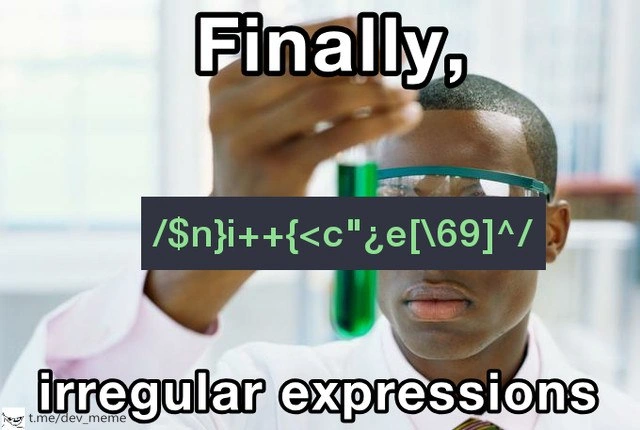
This meme uses the 'Finally' stock photo template, which depicts a scientist in a lab coat and safety goggles holding up a test tube. The top text reads 'Finally,'. The bottom text says 'irregular expressions'. A black bar is superimposed over the scientist's eyes, containing a string of garbled characters designed to look like a chaotic code snippet: '/$n}i++{<c"¿e[\69]^/'. The humor is a direct pun on 'regular expressions' (regex), a powerful but notoriously cryptic syntax for pattern matching in programming. For experienced developers, the joke lands because they have all wrestled with the often unreadable and complex nature of regex. The idea of an 'irregular expression' - represented by an even more nonsensical and chaotic string - is a hilarious exaggeration of the pain points associated with writing and debugging regex

Comments
15Comment deleted
Some say that if you have a problem and you use regular expressions, you now have two problems. If you use irregular expressions, you now have a segfault and a metaphysical crisis
“Nice, irregular expressions are official - now the 900-character Perl regex in prod counts as a monolith we can schedule a strangler pattern around.”
After 15 years in the industry, you realize the real regex was the Stack Overflow answers we copied along the way - and that one colleague who actually understands lookaheads is basically a wizard who should be protected at all costs
After 15 years, you realize regex isn't about memorizing syntax - it's about accepting that every time you need one, you'll still Google 'regex email validation' and copy-paste from Stack Overflow, because the moment you close that tab, the knowledge evaporates like it was never there. The real mastery is knowing which Stack Overflow answer to trust
Irregular expressions: when your regex contains i++ and the only thing it matches consistently is the Sev‑1 counter - PCRE backreferences masquerading as business logic
Irregular expressions: when someone tries to parse HTML with regex, the engine silently spawns a PEG parser, bills you in exponential time, and pages SRE
Regex: Write-only code where one quantifier turns your parser into a production black hole
nice Comment deleted
no Comment deleted
@Danilaltd Please, keep discussion here in English, thanks! Comment deleted
oh Comment deleted
APL be like Comment deleted
what does it do Comment deleted
It matches nothing, because it expects end of the line ($) first and begging of the line (^) last Ignoring that, n}i++{<c"?e and one of these: \, 6 or 9 Comment deleted
haha Comment deleted