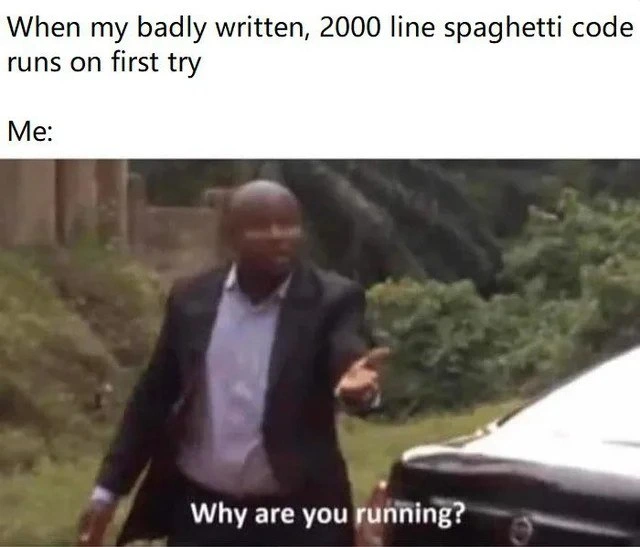
That miracle moment when spaghetti code actually works on the first run
Why is this CodeQuality meme funny?
Level 1: Messy Magic
Imagine you build a huge tower out of toy blocks by just stacking pieces together in a crazy, messy way with no plan. Normally, you'd expect this wobbly tower to crash down, right? But somehow, on the very first try, your wild, floppy tower stands up perfectly stable. You'd stare at it in amazement and maybe even laugh, asking, "How is this not falling?!"
That's what’s happening in this meme. The programmer made a big messy program (kind of like a sloppy tower of blocks) and expected it to fall apart. But it didn't – it worked! They're so surprised and happy, it's almost like magic. The funny picture of the man saying "Why are you running?" is the programmer jokingly talking to their code, like, "I can't believe you're actually running (working) without breaking!" It’s a silly way to show how shocked they are that their jumbled creation turned out okay on the first try.
Level 2: Untangling the Noodles
For newer developers, let's break down why this scenario is funny. Spaghetti code is a nickname for code that's written in a very unorganized, tangled way. Picture a single file or function 2,000 lines long with logic jumping all over – kind of like a plate of spaghetti where you can't easily follow one noodle from start to finish. This is considered a bad practice in programming and a sign of low code quality because such code is hard to read, hard to maintain, and easy to break. It's one of those classic code smells that signals "uh oh, this might cause problems later."
Now, when we say the code "runs on the first try," we mean that the program executed successfully the very first time the developer tried to run it, without crashing or throwing any errors. Typically, writing code (especially something large or complex) involves mistakes: maybe a typo, a missing semicolon, a wrong variable name, or a logic error that you have to troubleshoot. So it's pretty surprising if a huge, messy program works perfectly immediately. It's basically a lucky outcome.
The meme text sets up that situation: “When my badly written, 2000 line spaghetti code runs on first try”, and then shows Me: with a reaction image. The image is from a popular “Why are you running?” meme — originally a scene from a Nollywood film that became a viral joke. In that clip, one character is confused and chases another, shouting "Why are you running?" In our coding context, it's like the developer is so shocked the code is running (note: "running" means the program is working/executing) that they're asking the program why it's running. In other words, “How are you working?!”
Basically, the developer expected this sloppy, long-winded code to break or complain. When it doesn't, their reaction is half-joking, half-serious: “Why are you running?” which translates to “I can't believe you're actually working!” This resonates with many programmers because everyone’s written something kludgy (a quick-and-dirty solution) that they were sure they'd have to debug, only to see it unexpectedly output the right result. It's a moment of relief (yay, it works!) mixed with a bit of fear (hmm, did I miss a bug?). In many legacy codebases (old projects passed down over years), you'll find huge spaghetti code functions. Usually you're braced for errors when running them, so a flawless execution feels like accidentally acing a test you forgot to study for. Great feeling, but you suspect it was a fluke!
In summary, the meme is a light-hearted take on a very relatable developer experience: sometimes even our messy code seems to succeed out of nowhere, and we're left pleasantly stunned, asking the universe (or our code), "How are you doing this?!"
Level 3: Running on Luck
In a seasoned developer's eyes, this scenario is practically sorcery. A 2000-line tangle of spaghetti code — unstructured, twisty logic as jumbled as a bowl of noodles — rarely runs perfectly on the first go. Such code is a textbook code smell indicating bad practices: globals colliding, deeply nested conditions, functions doing too much. The humor here is that something so haphazard managed to execute flawlessly on the first try, as if the programming gods granted a one-time miracle. It's the ultimate in Developer Experience (DX) irony: the worst code sometimes yields a surprising success.
The meme shows a reaction image of a man yelling “Why are you running?” (a famous Nollywood meme line) while in pursuit. This perfectly captures the disbelieving developer’s reaction. It's like I'm chasing down my code, demanding to know how on earth it's running without errors. Usually, when I hit "Run", I'm braced for a crash or at least a bug. When a spaghetti mess actually works, I feel equal parts relieved and suspicious. As an experienced engineer, I know that if a convoluted hack works on the first try, I probably missed something. It's that “Works on my machine” moment when you're happy it runs, but also thinking, "Alright, what’s the catch?"
Consider what might be hidden under the hood: maybe a broad try/catch somewhere quietly swallowed an error, or some weird default values magically lined up just right. For instance, I've seen code like:
try {
// 2000 lines of complicated logic
} catch (Exception e) {
// Ignore every possible error
}
System.out.println("It ran!");
Everything appears fine because the code never actually complains – it just hides the problems. So when that spaghetti monster of a program finishes without crashing, a veteran dev might freeze and whisper, “No way... it actually ran?!” Then comes the comedic paranoia: do I celebrate, or do I slowly step away and not touch a thing? We joke that once a fragile script finally works, you don't dare refactor it for fear of angering the code gods. It's a mix of triumph and imminent dread known all too well in DeveloperHumor circles.
Ultimately, the meme pokes fun at how unpredictable coding can be. You can follow every best practice and still get errors, yet once in a blue moon, a block of legacy spaghetti code miraculously runs on the first attempt. Instead of cheering, the seasoned dev inside us is pointing at the running program asking, “Why are you running (so smoothly)?!” – essentially, “this makes no sense!” It's a relatable shock, one that unites programmers in nervously laughing at our own lucky breaks and the chaotic nature of coding.
Description
The meme is split into two parts on a plain white background. The top text, in bold black font, reads: "When my badly written, 2000 line spaghetti code runs on first try" followed by a line break and the word "Me:". The lower half is a blurry reaction frame from the famous "Why are you running?" Nollywood clip: a suited man stands beside a car on a rural road, arm out-stretched, face blurred for anonymity. A caption at the bottom of the frame says "Why are you running?" in white text with a black outline. The humor comes from seasoned engineers knowing how improbable it is for unstructured, 2 000-line "spaghetti" code to compile and execute flawlessly on the first attempt, highlighting code quality issues, surprise, and relief familiar to anyone maintaining legacy or hastily written code
Comments
9Comment deleted
When that 2 000-line God-function passes CI on the first run, I don’t celebrate - I just picture the undefined behavior quietly booking a one-way ticket to prod
After 20 years in this industry, I've learned that code working on the first try is actually more terrifying than a segfault - at least with the segfault you know where you stand. This is why senior engineers immediately check if they're running against the wrong environment or if the tests are mocked
The real horror isn't when your spaghetti code fails - it's when it succeeds on the first try, because now you have no idea which of your seventeen nested conditionals, three global state mutations, and that one 'temporary' setTimeout actually made it work. Good luck explaining this in code review, or worse, debugging it when it inevitably breaks in production at 3 AM
When a 2,000-line god function passes on first run, that’s just accidental eventual consistency; add one log statement and the quorum collapses
Architects drafting monoliths in tears, while this chaotic prototype scales flawlessly - until the first hotfix
2k lines of spaghetti runs on first try? That’s not success, that’s coincidental correctness - the scheduler briefly negotiated a ceasefire between your data races
The main rule of developers: If the code is working correctly, don't look for the reasons and don't improve it! Comment deleted
So true 😂😂 Comment deleted
Impossible. Even my perfect code would not run at first try doing stuff I need Comment deleted