Skip to content
DevMeme
2846 of 7435
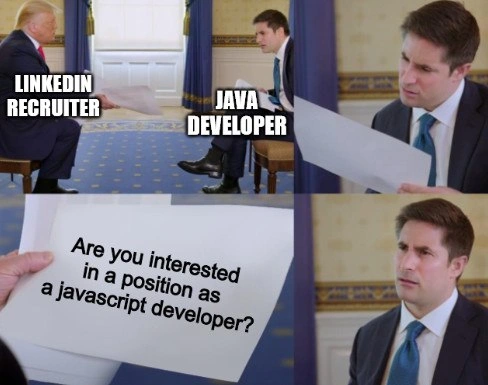
LinkedIn recruiter pitches JavaScript role to bewildered Java developer in meme
Career HR Post #3143, on May 19, 2021 in TG

LinkedIn recruiter pitches JavaScript role to bewildered Java developer in meme

Why is this Career HR meme funny?

Level 1: A Different Ballgame

Imagine you’re really good at soccer, and you’ve been playing on a soccer team for years. One day, a coach from a basketball team comes up to you and says, “Hey, I hear you’re great with a ball. Want to come play basketball for us?” You’d probably give them a confused look, right? Soccer and basketball both use a ball, but they’re completely different games with different skills!

That’s exactly what’s happening in this meme. The recruiter is basically saying, “You do Java? Then you can do JavaScript!” But Java and JavaScript are as different as soccer and basketball. The poor Java programmer is sitting there thinking, “This isn’t what I do at all,” just like a soccer player being asked to dunk a basketball. It’s funny (and a little frustrating) because someone clearly didn’t understand the difference, and we can all laugh at how silly that mix-up is.

Level 2: Java != JavaScript

Let’s break down why this situation is such a mix-up. Java and JavaScript may sound related, but they’re completely different programming languages with distinct purposes. The meme hinges on the recruiter not understanding that difference. Here’s what each of these languages actually is:

  • Java: A robust, class-based programming language introduced in the mid-90s by Sun Microsystems. Java code is compiled into bytecode that runs on the JVM (Java Virtual Machine), which means Java is designed to be cross-platform (the slogan was “write once, run anywhere”). Java is statically-typed (you have to define the type of each variable and it’s checked at compile time) and is often used for big enterprise applications, Android app development, and server-side systems. Think of things like banking software, large e-commerce backends, or Android mobile apps – that’s Java’s wheelhouse. Its syntax looks a bit like C/C++ and it emphasizes object-oriented principles (lots of classes and objects).

  • JavaScript: A lightweight, dynamically-typed scripting language that was originally created in 1995 for web browsers (by Netscape). JavaScript code is typically executed by the browser’s JavaScript engine (like V8 in Chrome) or by runtimes like Node.js on a server. It wasn’t built for the same kinds of things Java was – its original purpose was to make web pages interactive (think form validations, animations, responding to button clicks). Over time, JavaScript grew up: now it can also be used on the server side (with Node.js) and for mobile or desktop apps (with frameworks like React Native or Electron). But importantly, JavaScript code is not compiled ahead of time to machine code the way Java is; it’s usually interpreted or JIT-compiled at runtime. And unlike Java, you don’t have to declare variable types – a variable can hold a number one minute and a string the next.

In short, aside from both being programming languages (and sharing “Java” in their names), these two have very different syntax, runtime environments, and use cases. A common joke in the developer community puts it this way:

“Java is to JavaScript as car is to carpet.”

In other words, the names might sound similar, but the two things aren’t related. Java won’t help you write complex front-end web code, and knowing JavaScript won’t enable you to maintain a large Java enterprise codebase. They require different skill sets. A Java developer typically spends time in IDEs like IntelliJ or Eclipse, worrying about things like object models, type hierarchies, and JVM performance tuning. A JavaScript developer might be deep into VS Code or a browser debugger, dealing with HTML/DOM manipulations, asynchronous callbacks or async/await, and the quirks of different web browsers. These roles aren’t one-size-fits-all; they’re more like different tracks in the programming world.

Now, about LinkedIn recruiters: these are folks (or sometimes automated systems) who search for candidates on LinkedIn to fill job openings. They often use keyword searches to find people – which is where things go wrong here. If a recruiter’s tool is set to look for “Java”, it might surface anyone who listed Java or JavaScript on their profile. Some recruiters might not realize there’s a crucial difference, especially if they’re not technical. So you get messages that feel like irrelevant job offers to the recipient. This is a classic case of an outreach that wasn’t properly targeted. It’s like casting a wide net – sometimes too wide.

For example, a recruiter might send a message like:

Recruiter: “Hi, I saw you have extensive Java experience. We have an exciting opportunity for a JavaScript Developer at [Some Company]. Let me know if you’re interested!”

To the recruiter, that might sound perfectly reasonable if they don’t know the tech. But the Java developer reading it is puzzled: “I’m not a JavaScript developer... why are they asking me this?” It comes off as tone-deaf. This kind of mix-up is often talked about in the HiringHumor and CareerHumor circles because it happens so frequently. Developers vent about it online, sharing screenshots of badly matched job pitches as a form of relatable humor. It highlights a gap in understanding: one side sees “Java = all things Java/JavaScript,” while the other side very much does not.

Let’s put some key differences in a quick comparison table for clarity:

Aspect Java 💻☕ JavaScript 💻📜
Type System Static – types are declared and checked at compile time. Dynamic – types are inferred and checked at runtime.
Execution Compiled to bytecode, runs on the JVM (Java Virtual Machine) on any platform. Executed by a JavaScript engine (in a web browser or Node.js); originally interpreted, now often JIT-compiled.
Primary Use Cases Server-side applications, Android apps, large enterprise systems. Example: banking software, inventory management, Android games. Front-end web development (making interactive websites), and also server-side with Node.js. Example: dynamic web pages, single-page applications, scripting tasks.
Syntax & Style Rigid, verbose syntax (curly-brace, class-based OOP). You’ll see lots of public static void main(String[] args) and class definitions. Flexible syntax (also curly-brace, but prototype-based OOP). You’ll see functions like function greet() { ... } or arrow functions, and you can change types on the fly.
Name Origin Originally named “Oak,” later renamed Java (after coffee!) in 1995. The name is just a name – no relation to JavaScript. Created in 1995 as LiveScript, it was quickly rebranded to JavaScript to ride Java’s popularity. The name caused endless confusion, but technically there’s no lineage.

As you can see, they’re as different as two programming languages can be. So a Java developer might not have any experience with the frameworks and tools a JavaScript role needs (like React or Angular on the front-end), and vice versa, a JavaScript specialist might not know their way around Java’s Spring or Hibernate libraries. They each live in distinct sections of the programming universe.

The meme’s joke is basically pointing out this lack of distinction in the recruiter’s approach. The Java developer in the meme is bewildered because he’s being asked about a job that doesn’t match his profile at all. It’s not just a small tweak – it’s an entirely different job category. Anyone who’s been in software development for a while has likely run into this: you specialize in one thing, yet recruiters contact you for something else just because the names sound alike (or because you happened to mention a technology in passing on your profile). It’s a mix of poor communication and misunderstanding.

This is why developers often advise recruiters (and sometimes even HR departments) to learn at least the basics of the technologies they hire for. It saves everyone time. A little knowledge would tell you that Java vs JavaScript is a language comparison where the two sides are truly apples and oranges. When that knowledge is missing, you get awkward moments like this meme – funny to observers, but a bit annoying to the person on the receiving end. Still, the situation is so common it’s become a running joke in the industry, which is why this meme strikes a chord with so many people in tech.

Level 3: Type Error: Found Java, expected JavaScript

On the surface, this meme shows a LinkedIn recruiter eagerly offering a job to a bemused Java developer, but the position is for a JavaScript developer. That blank, unamused stare from the Java guy? Pure developer disbelief. It’s the classic java_vs_javascript_confusion gag taken straight from everyday tech recruiting. In the world of Career_HR and TechRecruiting, this scenario is painfully common – and that’s exactly why it’s funny. The humor lands because it highlights a communication gap so absurd that every engineer who’s been on LinkedIn has a story about it. The recruiter basically saw “Java” on the resume and thought, “Hey, close enough!” – a bit like assuming car and carpet are the same thing because they share four letters. Spoiler: having “Java” in “JavaScript” doesn’t magically tie the two technologies together.

This meme riffs on a well-known recruiter_email trope: mass emailing or messaging candidates based on questionable keyword matching. Recruiters under pressure often use broad searches ("Java" hits anything from Java to JavaScript to JavaBeans), blasting out what amounts to linkedin_recruiter_spam. The result? Irrelevant job offers like a JavaScript role sent to a pure Java specialist. It’s a volume-over-quality strategy: send 100 messages and hope a few stick. From the recruiter’s angle, Java and JavaScript might live in one big fuzzy bucket of “programming stuff.” But from the developer’s perspective, this is a type mismatch of the highest order – the professional equivalent of a ClassCastException in Java (trying to use one type where another is required). The Java dev’s expression in the final panel says it all: “Did you even read my profile? Java ≠ JavaScript!”

Behind the laugh is a real industry pattern. In tech hiring, non-technical recruiters sometimes lack the nuance to distinguish between similarly named skills. Java and JavaScript share five letters and a tangled history of naming, but in practice they occupy entirely different realms of software development. The meme exaggerates this language comparison fail: our Java developer isn’t just being picky – he’s being asked to do a different job in a different ecosystem. Imagine spending years tuning a Spring Boot backend or optimizing JVM garbage collection, only to have someone aggressively push a front-end web developer role at you. It’s equal parts frustrating and comical. Many of us have learned to chuckle and shrug it off, because correcting every recruiter can be a full-time job in itself.

There’s some tech history contributing to this confusion. Back in the mid-90s, when JavaScript was first created at Netscape, it was originally named LiveScript. The “JavaScript” rebrand was a marketing ploy to ride on the hype of Java, which was the hot new language from Sun Microsystems at the time. Cue decades of confusion: non-developers have been mixing them up ever since. Seasoned engineers know that aside from the four-letter name prefix, Java and JavaScript have about as much in common as a ham and a hamster. Yet here we are in the 21st century, still getting messages like, “I see you’re a Java expert – have you considered this JavaScript role at our startup?” It’s a relatable humor moment precisely because it’s true — countless Java devs have had to politely explain, “No, I don’t do JavaScript,” while pinching the bridge of their nose in exasperation.

The meme’s punchline resonates with developers who’ve been on the receiving end of these misfires. It shines a light (with a smirk) on how communication breaks down between technical and non-technical worlds. In an ideal scenario, recruiters would tailor their outreach with a basic understanding of the skills they’re pitching. But in reality, incentives in the recruiting game often favor quantity over quality. Recruiters get measured on how many candidates they contact, not how deeply they understand each programming language. So the same broken record plays on repeat: “Java, JavaScript, what’s the difference?” From the developer’s side, this comes off as tone-deaf. It’s a recipe for developer frustration – you start to wonder if the person messaging you even knows that Java and JavaScript aren’t two versions of the same thing. Over time, these mix-ups contribute to a jaded, cynical attitude in tech folks toward recruiter messages. (How many of us have mentally filtered “JavaScript” to spam if we’re Java developers, or vice versa?)

In the end, this meme hits a nerve because it’s a true-to-life comedy of errors. It encapsulates the feeling of being reduced to a keyword in a database rather than a human with a specific skill set. The Java developer’s deadpan look at the question “Are you interested in a position as a JavaScript developer?” is basically every programmer’s face when they get that one-size-fits-all form letter. It’s equal parts “Not again…” and “You’ve got to be kidding me.” As a community, developers share these anecdotes as a form of catharsis – laughing so we don’t cry. And who knows, maybe a few recruiters have seen this meme and double-checked the difference between Java and JavaScript before hitting send. We can only hope.

Description

Four - panel meme using a well-known interview template: Panel 1 shows two suited men seated across from each other in an ornate blue-and-gold room; the man on the left is labeled "LINKEDIN RECRUITER" while the man on the right is labeled "JAVA DEVELOPER." Panel 2 zooms on the recruiter handing a sheet of paper to the developer. Panel 3 is a close-up of the paper, which reads: "Are you interested in a position as a javascript developer?" in bold black text. Panel 4 cuts back to the developer, staring blankly and clearly unamused. The joke highlights how recruiters on LinkedIn often ignore language distinctions - confusing Java (a JVM language) with JavaScript (a browser/runtime scripting language) - creating frustration and misaligned job outreach for seasoned engineers
Comments

15
Anonymous ★ Top Pick Recruiter’s boolean search: (java OR script) → “Perfect match!” My career: 15 years tuning JVM GC, now throwing ClassCastException at their inbox
  1. Anonymous ★ Top Pick

    Recruiter’s boolean search: (java OR script) → “Perfect match!” My career: 15 years tuning JVM GC, now throwing ClassCastException at their inbox

  2. Anonymous

    After 15 years of explaining that Java and JavaScript are as similar as car and carpet, you realize the real enterprise pattern here is RecruiterFactory.getInstance().setComprehension(null) - and yes, it's a singleton because they all share the same broken understanding

  3. Anonymous

    A tale as old as time: recruiters who think Java and JavaScript are related because they share four letters. It's like asking a cardiac surgeon if they're interested in doing open-heart surgery on cars because both involve 'engines.' The Java developer's expression perfectly captures that moment when you realize the recruiter's entire understanding of your decade of JVM expertise, Spring Boot mastery, and concurrent programming knowledge boils down to a keyword match in their ATS

  4. Anonymous

    LinkedIn search treats 'Java' and 'JavaScript' as the same hash bucket; collision resolution is 'message them anyway'

  5. Anonymous

    Recruiters proving typeof recruiter.knowledge === 'undefined' since 1995

  6. Anonymous

    Recruiter sourcing pipeline: query = (java OR javascript), BM25 with wildcard, recall=1.0 and precision ~0 - an ATS microservice optimized for throughput over relevance

  7. @furqan 5y

    "Java and JavaScript are as same as a Car and a Carpet" - Anon Might have worded a bit different.

  8. @azizhakberdiev 5y

    How to name new language? Add "script" part to name of existing.

    1. @affirvega 5y

      JavaScriptScript

      1. @RiedleroD 5y

        BashScript

        1. @azizhakberdiev 5y

          AssemblyScript

      2. @slxvx 5y

        LMAO

      3. @CaptainImpact 4y

        JavaScriptScriptScript

        1. Deleted Account 4y

          JavaScriptScriptScriptScript

    2. Deleted Account 4y

      PythonScript

Use J and K for navigation