DevOps Love Poem: When Roses Are Red But Your Build Turns Green
Why is this BuildSystems CICD meme funny?
Level 1: Love in Plain Sight
Imagine you and your friend are cleaning up a big mess in your house. First, everything is a disaster – toys are everywhere and even something spilled and it feels like the room is on fire (that’s like the red part of the comic, where everything is going wrong). Your friend, however, stays calm and helps you pick up the toys and fix the problems one by one (that’s the blue part – calm and steady). Finally, just before your parents come to check, you manage to tidy everything up. The room looks perfect and you even put a big green sticker on the chore chart saying “All done!” (that’s the green part – everything looks good in the end). Then you and your friend are so tired from the cleanup chaos that you both flop down on the floor, completely exhausted, but happy that the room is clean in time. The meme is funny because it’s showing that in a developer’s world, even if they go through a crazy, messy ordeal, all that matters at the end is a simple green sign that says “Yay, it worked!” It’s like a little poem saying: things were crazy (red like a rose, blue like a violet), but we fixed it and now everything is okay (green means good). Just like you’d be proud of that clean room sticker, developers feel proud (and relieved) when they see that green “build passing” sign after a hard night. The joke is that this is their version of a love poem – instead of loving a person, they “love” seeing their work finally succeed! It’s a silly way to show how happy a passing result can make someone who’s been through a tough time.
Level 2: Build Pipeline Blues
Let’s break down what’s happening in this comic and why developers find it funny. First, DevOps is a term for blending Development and Operations work into one smooth process. In traditional IT, software developers would write code, and a separate operations team would deploy and maintain it. DevOps culture says: "Hey, let's work together (or be the same team) so we can ship software faster and more reliably." A big part of DevOps is taking responsibility for code from start to finish – that includes building it, testing it, releasing it, and keeping it running in production. People in DevOps or SRE (Site Reliability Engineering) roles often have to deal with everything from code bugs to server outages. This comic shows exactly that kind of world: developers and ops dealing with chaos, but aiming for a common goal.
Now, what’s a CI/CD pipeline? CI/CD stands for Continuous Integration and Continuous Delivery/Deployment. It’s a practice (and a set of tools) where every time developers make changes to the code, those changes are automatically integrated, built, and tested in a pipeline (a sequence of steps). Think of it like an assembly line for code changes:
- Continuous Integration (CI): As soon as you push your code changes, a server (like Jenkins, CircleCI, or GitHub Actions) checks out the new code, compiles it (if needed), and runs a bunch of automated tests. This ensures that your changes work well with everyone else's changes and nothing is broken. If something is broken – say a test fails – the CI process stops and marks that build as failed.
- Continuous Delivery/Deployment (CD): If all tests pass (meaning CI is green), the pipeline can automatically deliver the new build to environments. Continuous Delivery usually means it's ready to go to production, and someone just needs to hit deploy, while Continuous Deployment means it goes straight to production automatically.
In these systems, we use color conventions for status: green generally means success (everything passed), and red means failure (something went wrong). You've probably seen this on apps or websites where a little dot or icon is green when things are good and red when there's an error. Many projects even show a "build passing" badge (often bright green) on their repository or README page. It’s literally a little label saying "build: passing" or "build: failing" to show the current health of the main code branch. Developers treat a green build as a point of pride – it says "all our tests are currently passing". Conversely, a red build shouts "uh-oh, something’s broken – needs fixing!" This comic plays with that idea using the colors of the panels.
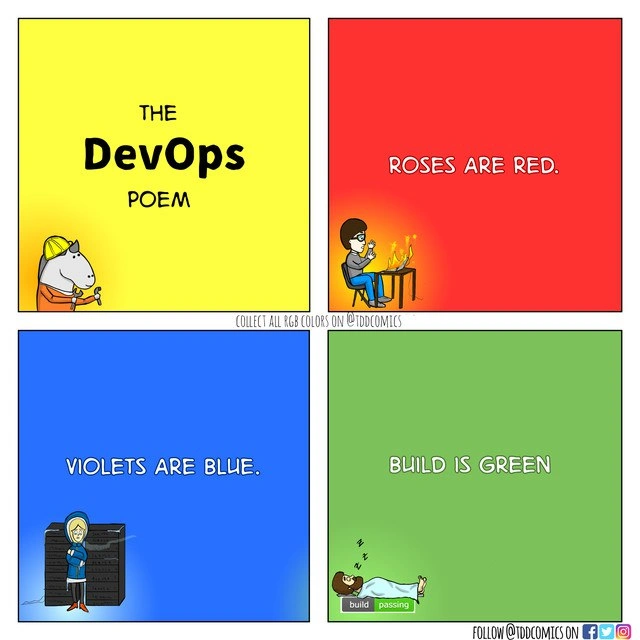
In the top-right red panel, we see the text "ROSES ARE RED." and a developer in a hoodie panicking at a laptop that’s on fire. Of course, laptops don’t usually catch fire in real life (we hope!), but it's a funny exaggeration. In developer slang, saying "X is on fire" means something is dramatically wrong. For example, "Production is on fire" means the live system (the software that real users are using) is broken in a big way – maybe the website is down or a critical bug is causing chaos. The poor guy with the burning laptop represents a developer dealing with a critical failure. Maybe his code deployment went terribly wrong, or a bug is causing everything to crash. The red background fits because red = error or danger, just like how error messages or failing test indicators are often colored red. And of course, it's riffing on the classic poem start "Roses are red." So the situation is: something bad and urgent is happening (red alert!).
In the bottom-left blue panel, it says "VIOLETS ARE BLUE." Here we see an operations engineer (the person wearing a hoodie or jacket, standing calmly next to a big server rack). This is a nod to the other side of the house: the Ops/SRE side. Servers are literally the computers (often in racks) that run applications. The ops engineer is standing there looking chill, meaning they might have things under control on the server side. Blue is a calm, cool color. In many status displays, blue can indicate normal operation (for instance, some systems use blue or green interchangeably to show "okay" status). The phrase "violets are blue" just continues the poem, but in this context it suggests "things are cool and stable over here." It could be hinting that while the developer’s code might be on fire (red panel), the infrastructure (servers, network) is fine (blue panel). Or it could simply show the ops person being the calm one, in contrast to the panicking dev. In DevOps, developers and ops need to work together. When there's a crisis, developers troubleshoot the application or code issue, and ops engineers ensure the systems and hardware are working and maybe assist with deployments or rollbacks. The comic artist chose blue for this panel probably because of the poem line, but it conveniently aligns with the idea of stability (blue skies, no storms).
In the bottom-right green panel, we get the line "BUILD IS GREEN". This is where the poem deviates from the original "roses are red, violets are blue" (which usually continues with something like "sugar is sweet, and so are you"). Instead of a romantic or sweet ending, we get a very techie ending: "build is green." A green build means our continuous integration tests have all passed; the software build is successful with no errors. In the image, there's a green badge with the text "build passing" – that’s exactly what CI services display when everything is good. Next to it, an engineer is lying on the ground, seemingly asleep or utterly exhausted. This suggests that it took a lot of hard work (and an all-nighter maybe) to get that build to pass. The poor engineer probably is the same guy from the red panel, now so tired he just conked out on the floor. This is funny because it’s true to life in a lot of cases: the team may have spent all night fixing issues and putting out fires (like the code bug or system error) just to make sure by morning the CI pipeline shows green (all tests passing). In tech teams, seeing that "green build" in the morning is like seeing the sun rise after a stormy night – it means things are okay at least for now.
So, essentially, the comic is a parody of a love poem where the thing everyone loves is a passing build. It’s poking fun at the fact that in the DevOps world, we often measure success with these automated build statuses. The line "BUILD IS GREEN" is the happy ending that every developer or ops person wants to see after a lot of trouble. The reason it’s funny is a bit tongue-in-cheek: outsiders might expect the last line to be something mushy or romantic, but here it’s super technical. DevOps folks joke that nothing is more beautiful than a green build after you've struggled – not even roses or violets! The inclusion of RGB colors (Red, Blue, Green, plus the yellow title panel) is an extra geeky touch. RGB is the color model computers use to mix colors (Red, Green, Blue), and the caption "Collect all RGB colors on @TDDComics" suggests the artist might have other comics in different colors. It’s like a fun side challenge, but also, here they literally used those primary colors to match the poem lines. The yellow panel at the top-left with "THE DevOps POEM" and the little hard-hat wearing character is just the intro. The character in the hard hat is presumably a mascot or just a construction motif – maybe symbolizing that DevOps engineers are builders (hence the hard hat). Or it could just be a cute way to present the title. (In Test-Driven Development lingo, TDD in TDDComics stands for Test-Driven Development, which is about writing tests – fits well with the theme of builds and tests, but that might just be the name of the comic series.)
To a newcomer: the big takeaway is that developers and operations engineers often go through chaotic situations (like emergencies and late-night bug fixes) in order to achieve a smooth result (all systems go, tests passing). The poem format exaggerates it humorously. Roses red = something’s wrong on the dev side, violets blue = ops side holding steady, build green = in the end the automated system says "we're all good". It’s funny to people in this field because it’s a creative, colorful way to say, "We had a rough time, but at least the software build succeeded." It also lightly mocks how proud we are of a green build, almost like it's a beloved thing (hence a love poem). If you've ever been part of a project where the team cheers seeing all tests pass after a tough fix, you'll relate to this comic immediately.
Level 3: Burning the Midnight Pipeline
This four-panel comic strikes a chord with every seasoned DevOps engineer who’s ever battled a 3 A.M. outage. It’s styled as a playful poem – a riff on "Roses are red, violets are blue..." – but instead of sweet nothings, it delivers bitter somethings about CI/CD life. "ROSES ARE RED" is splashed on a red background where a panicked developer in a hoodie watches his laptop and desk go up in flames. We’ve all been that developer at some point: deploy goes out, metrics spike, alerts blare, and suddenly your laptop feels like it’s literally on fire. The red color isn’t just for the rose; in tech, red is the universal sign of failure or error. Build failed? Red light. Tests failing? Red X. Production down? Big red banner. That panel’s basically PagerDuty in a picture. It nails the DevOpsPainPoints – the adrenaline of realizing "Oh no, everything’s burning!" and frantically trying to extinguish the production flames while your heart rate hits new records. It’s comedic now because it's drawn as a cartoon, but ask any on-call engineer: in the moment, nothing is funny about a 500 error raining on your dashboard like confetti.
Next, "VIOLETS ARE BLUE." The comic’s blue panel shows a calm operator standing by a rack of servers, hands in pockets, just chilling. Blue is a cooler color – it suggests stability, calm, the "all systems normal" vibe. There’s a bit of an inside jab here. Historically, the CI tool Jenkins (granddaddy of automation servers) used a blue ball to indicate success (fun fact: in some cultures, blue, not green, symbolizes "go"). So a blue success, a green success – pick your color – the point is something is running smoothly in this quadrant. The operator character in the blue panel is likely meant to be the Ops half of DevOps, or a seasoned SRE who’s seen it all. Notice how they’re not panicking; the servers behind them are presumably humming along. This could imply that the infrastructure is fine (the hardware/network isn’t the problem), or it might suggest that Ops folks have learned to stay cool under pressure. While the developer’s hair is (figuratively) on fire in the red panel, the Ops engineer is the picture of "keep calm and carry on." This contrasts the classic dynamic: developers freak out when code breaks, operators methodically troubleshoot when systems act up. In DevOps culture, we strive to blend those roles, but in stressful incidents you often still see that personality split. The comic plays on this: "violets are blue" gives us a breather, a false sense of calm sandwiched between crises.
Finally, we hit the punchline in the green panel: "BUILD IS GREEN." Green is the color of OK: tests passing, pipeline successful, deploy ready. There's a big green badge that literally says build passing (the coveted words every developer loves to see on their CI dashboard or project README). Beside it lies an exhausted engineer, flat on their back, probably the same poor soul from the first panel now collapsed from all the heroic efforts. This is darkly comic gold for anyone in DevOps or Build Automation. We’ve all been there: after hours of fighting build errors, flaky tests, environment misconfigurations, and deploying fixes for that one damn bug, you finally get the green light. The pipeline’s all checkmarks, Slack is celebrating “Build succeeded!”, and you… you are completely wrecked. It’s DevOps humor 101 – the notion that we’ll sacrifice our sleep, sanity, and maybe a few laptops to get that reassuring green status. The code is fine now, but the coder is in dire need of coffee or a bed. The comic exaggerates it to the point of an engineer literally sleeping on the floor next to the green badge. It’s funny because it’s true: a green build at the cost of developer burnout is a tale as old as continuous integration. We laugh so we don’t cry.
The combination of these panels paints a tongue-in-cheek love story: DevOps folks "love" a green build so much, they’ll walk through fire (red panel) and keep their cool through blues (blue panel) just to court that glorious green outcome. It's a satirical take on priorities: sure, the data center was moments away from a meltdown, and yes, the team is running on three cans of Red Bull and a prayer, but by dawn the CI pipeline says "All checks passed" and that makes it all worthwhile... or so we tell ourselves. The tagline "When Roses Are Red But Your Build Turns Green" captures this contrast: reality versus the goal. No matter how red (dire) things get, we strive to end on green. CI/CD pipelines are basically the nervous system of modern deployments – when something breaks (goes red), the whole team feels the pain until it’s fixed. Culturally, many teams have a rule: the build must stay green. Broken builds are treated as stop-everything emergencies. So the comic isn’t far off – people really will jump on a failing build at midnight to fix it because leaving it red until morning is almost an existential horror for a disciplined DevOps team. There’s a peer pressure angle too: nobody wants to be the one who "broke the build". It’s like stepping on the team’s collective LEGO – you’ll hear about it.
Now, behind the scenes, why do these fires happen? The senior perspective recognizes a few classic culprits: maybe a last-minute merge introduced a nasty bug that tests didn’t cover. Perhaps an environment difference (works on my machine, blows up in CI or prod) turned into a blaze. Or it could be that deployment itself had an issue (missing config, database migration gone wrong). The dev in the red panel could be frantically reading stack traces or log files, trying to pinpoint why everything blew up. Meanwhile, the Ops engineer might be checking server resources or network issues – maybe the server is fine (hence the calm) and the bug is in the code. This highlights a DevOps mantra: collaboration. In real incidents, dev and ops team up, each bringing their expertise (one debugging code, the other ensuring infrastructure holds up or rolling back changes) to tame the fire. The poem panels in sequence actually tell that story: initially panic (dev in red), then steady problem-solving (ops in blue), resulting in resolution (green build). It's a happily-ever-after achieved through blood, sweat, and shell scripts. Senior engineers smile at this because it's a too-real fairy tale of their working lives.
The humor also lies in the absurdity of celebrating a green build when you’ve practically had a near-death experience achieving it. It’s poking fun at the CI/CD culture we’ve built: we set up these pipelines and dashboards to ensure quality, but we sometimes obsess over the green status as if it’s the ultimate trophy. The reality may be that our code only works after we kicked and punched it into shape at the eleventh hour. There's an implicit critique: maybe we rely a bit too much on that green badge to feel secure, and maybe we’re too willing to put out fires ad-hoc instead of preventing them. But the shared understanding is, even with best practices, things will go wrong. The measure of a team is how fast they turn red back to green. Google’s SRE culture, for example, talks about MTTR (Mean Time to Recovery) – not avoiding failure entirely, but recovering quickly. In the comic, the recovery happened (we got green) but the toll is visible on that passed-out engineer. Every senior DevOps person recognizes that face-down-on-the-floor exhaustion. It’s basically an emoji in our world. The meme artist cleverly wraps this truth in a bright, meme-friendly format. The primary colors (red, green, blue, plus the yellow title panel) even allude to RGB, the color model for light that every screen uses – a little tech inside joke "collect all RGB colors" indeed. It’s a nod to how our life revolves around dashboards and monitors glowing red, blue, or green. We chase the green glow like a kind of holy grail.
In summary, this meme tickles the war-weary DevOps soul. It says: Yes, we see you. Your servers can be literally on fire, you’re chugging coffee as a lullaby, but darn it, you got that build to pass. The senior perspective finds it funny because it’s a dramatization of Continuous Integration reality – success tinged with chaos. It’s the DevOps love poem we live out sprint after sprint. And like any good love story, it comes with trials by fire, a loyal partnership (dev + ops), and a final triumphant moment... followed by a well-deserved nap.
Level 4: Green Spots & Blind Spots
At a theoretical level, a green build is just a comforting illusion of perfection. In formal terms, it's verification by sampling: we run a suite of tests and if none fail, we declare success. But any experienced engineer knows this is not a formal proof of correctness. We're practically begging Edsger Dijkstra to roll in his grave; as he famously pointed out, testing can show the presence of bugs, never their absence. A CI pipeline can’t explore every path through the code – that's basically the halting problem wearing a DevOps hoodie. Modern systems are so complex (microservices, distributed databases, third-party APIs) that no finite test suite covers all the weird edge cases. A build passing indicator is green, but it isn't mathematical truth – it's more like a statistical guess that things might work. In theoretical computer science, we'd talk about soundness and completeness: our tests are not a sound or complete proof system, they are heuristics. In plain English, "build green" ≠ "bug-free".
There’s also a whiff of Goodhart's Law in this obsession with green. Goodhart’s Law warns: when a measure becomes a target, it ceases to be a good measure. Here the measure is the build status. Teams laser-focus on keeping that indicator green, sometimes at the expense of reality. Flaky test failing? Mark it as ignored just to get back to green. Production burning? Quickly apply a hotfix and force the tests to pass so the dashboard looks good by morning. The SRE old-timers call this “painting the roses green.” We veteran DevOps folks know the blind spots: a passing test suite can lull everyone into a false sense of security, even as lurking bugs skitter in the shadows where the tests don’t reach. Without deeper practices (like static analysis, property-based tests, or even formal verification methods like TLA+ or Coq proofs), the CI/CD pipeline is inherently limited. It’s a bit like Schrödinger's build – until you really exercise the code in the wild, it's simultaneously “all good” and one deployment away from catching fire. The humor here has a dark edge: we laugh because we know the comforting green light might be a liar, but it's the best reassurance we have in an imperfect world of software entropy. As any grizzled DevOps sage will tell you, "Everything works in theory. Not everything works in production."
Description
A 2×2 comic grid uses solid RGB colors to form a tongue-in-cheek DevOps poem. Top-left yellow panel says “THE DevOps POEM” with a hard-hat cartoon animal peeking in; the top-right red panel reads “ROSES ARE RED.” while a hoodie-wearing developer watches his laptop and desk literally on fire. The bottom-left blue panel declares “VIOLETS ARE BLUE.” beside a calm operator standing next to a server rack, and the bottom-right green panel states “BUILD IS GREEN” while an exhausted engineer sleeps beside a green badge labeled “build passing.” Footer text adds “COLLECT ALL RGB COLORS ON @TDDCOMICS” and “FOLLOW @TDDCOMICS” with social-media icons. The strip lampoons CI/CD culture, highlighting how DevOps teams will endure production fires and midnight heroics so long as the pipeline ultimately shows a reassuring green build
Comments
34Comment deleted
Nothing sums up enterprise DevOps like a pipeline glowing green while the Grafana dashboard reenacts a lava lamp - congrats, you’ve successfully shifted the fire left
After 15 years in the industry, you realize the most beautiful poetry isn't Shakespeare or Frost - it's a green build status at 4:59 PM on a Friday, right before that critical deployment everyone said couldn't wait until Monday
Every DevOps engineer knows this poem by heart: Roses are red, violets are blue, the build was green in dev, but production's on fire and the rollback queue is backed up because someone merged directly to main at 4:47 PM on Friday
DevOps in RGB: build’s green, deploy’s blue‑green, laptop’s red - the only SLA we hit is “dashboard looks pretty.”
CI says 'build: passing', which is DevOps for prod is burning in a different color space - somewhere between Jenkins blue and PagerDuty red
In DevOps, 'build succeeding' is the only commit message that guarantees a full night's sleep - no PagerDuty wake-up calls
Political spectrum Comment deleted
Political speedrun Comment deleted
Political compass Comment deleted
Sounds like utopia Comment deleted
согласен, мемы в этой группе - полная хуйня Comment deleted
@RiedleroD do it Comment deleted
yesh Comment deleted
Please only speak english in here! No russian. Comment deleted
ok, sory Comment deleted
Ok, u bought an ad in group with russian memes. What u expect? Comment deleted
That people use english when prompted. Comment deleted
Yes, it's russian group with english memes Comment deleted
Belarussian actually. Comment deleted
That’s international channel and group, so please, follow simple rules Comment deleted
it would be interesting to run poll about languages people knows, with multiple variant selection Comment deleted
+ Comment deleted
+ Comment deleted
I only know 3.5 Comment deleted
This guy only wanted to make his own meme in here. But he mistakenly chosen either group or language Comment deleted
And since it attracts people from countries further than former USSR, it makes total sense to use English as a language of common understanding. Comment deleted
Ee ka hai betichod Comment deleted
Burchodi bhai kuch samajh nahi aadat hai Comment deleted
Some have their own simple rules for international groups Comment deleted
Didn't get it Comment deleted
But yes +1 for the poll Comment deleted
hokku Comment deleted
Nvm... Comment deleted
can you agree that memes in this group are fucking shit Comment deleted