Debugging: The Unwinnable Game of Charades
Why is this Debugging Troubleshooting meme funny?
Level 1: Invisible Puzzle
Imagine you’re playing a game where you have to act things out, and someone tells you to show solving a hidden problem. You can’t actually show the problem itself because it’s all in your mind. Maybe you’d scratch your head or shrug your shoulders to try to show you’re confused. But would anyone watching understand you’re “fixing a problem that no one can see”? Probably not! That’s exactly what’s happening in this meme. The person got a charades phrase that basically means “fix a computer problem” – something you normally do by thinking hard and typing, not by moving around. There’s just no good way to show that with hand motions. So he ends up just shrugging, because it’s an impossible challenge. It’s funny because he was asked to do something that can’t really be acted out, and we all recognize that stumped feeling of not even knowing where to start.
Level 2: Acting Out Code
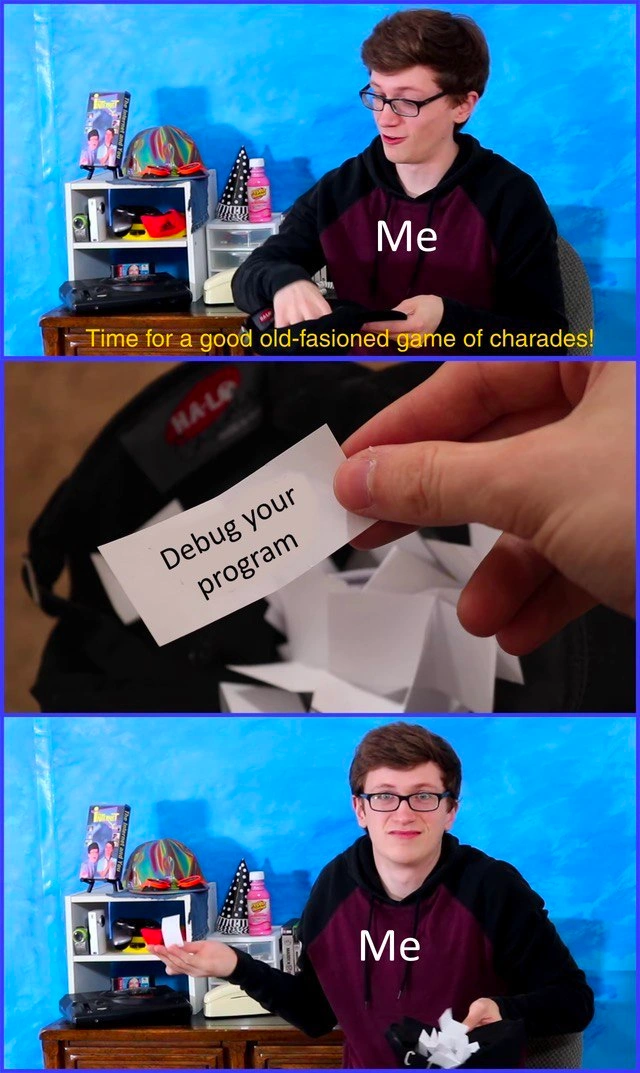
If you’re a newer developer or just starting out, let’s break down why this meme is funny and what’s going on. Charades is a party game where one person draws a phrase or idea (often written on a slip of paper pulled from a hat) and then acts it out using only gestures. No speaking or writing is allowed – you have to mime the concept, and everyone else tries to guess what it is. Usually, charades prompts are simple actions or titles, like “playing basketball” or “a sneezing cat.” In this meme’s panels, however, the charades prompt drawn is “Debug your program.” That’s a highly technical task, not a normal charades phrase at all, which immediately sets up the joke.
Now, what does “debug your program” mean? In coding, a bug is any mistake or error in a program that causes it to behave the wrong way (for example, a game might crash or a calculator app might give the wrong answer because of a bug). Debugging is the process of finding that bug (or bugs) in your code and fixing it. Think of it like being a detective for code: you investigate why the program isn’t working correctly and try out ways to solve the issue. This can involve reading error messages, going through your code line by line, and testing different possibilities to see what went wrong. It’s an essential part of troubleshooting in software development. In fact, a huge part of daily coding life is not just writing new code, but debugging it when things go wrong. Every coder spends a lot of time debugging – it’s just part of the job when working with software bugs.
Here’s why that prompt is so hard to act out: debugging isn’t a visible action. It’s mostly thinking and typing. Imagine trying to show “finding a logic error in a program” without using any words or screens. You might pretend to type on an invisible keyboard or rub your chin and frown, trying to indicate deep thought. But to someone watching, those gestures could mean anything! In the meme’s final panel, the person labeled “Me” is shrugging with a bunch of blank slips of paper in hand, basically saying “I have no idea how to show this.” That’s exactly how a developer might feel if asked to demonstrate fixing a tricky bug on the spot – a bit lost on how to even begin, especially without using a computer or any explanations. The blank slips flying around comically represent all the possible actions the poor developer might consider (or maybe all the failed guesses and ideas that didn’t pan out), but none of them clearly communicate “debugging” to the audience.
This scenario is super relatable for anyone who has tried to code, because we all know the feeling of a tough bug that leaves us throwing our hands up. It’s not that we don’t want to fix the problem – it’s that until we methodically dig into the code, we might not even know what’s causing it. If a non-technical friend or a project manager (PM) watches you debug, they might just see you sitting quietly, furrowing your brow at the screen or scribbling notes. To them, it looks as mysterious as a silent performance. That’s why the meme caption jokes, “When PM plays charades with you.” It’s poking fun at the idea that someone like a PM, who isn’t immersed in the coding, might suggest a task (fixing a bug) as casually as if it were a quick game. But for the developer, it feels like being put on the spot with an impossible task — just like drawing a hopeless charades prompt that you have no clue how to act out.
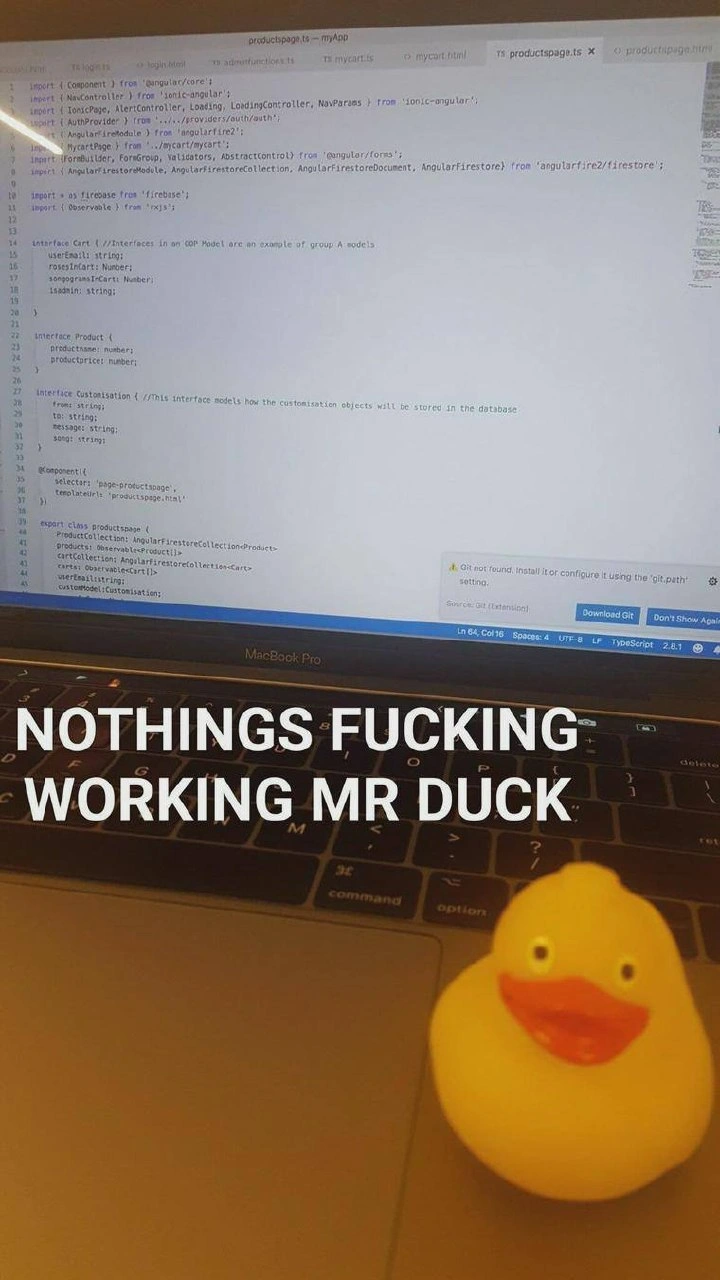
In real programming work, how do we actually debug a problem? We use tools like debuggers (which let us pause the program and inspect what’s happening step by step), or we add extra logging (printing out values and messages in the code) to see where things might be going wrong. We might also talk through the problem out loud or discuss it with a teammate — there’s even a technique called rubber duck debugging where you explain your code to a rubber duck on your desk to help find the flaw (yes, it sounds silly, but it actually helps!). All of these methods rely on careful thought, observation, and sometimes communication. None of them would translate well to a silent pantomime on a stage. So the meme is funny to developers because it highlights that disconnect: debugging is a complex, thinky process, and trying to physically act it out is both ridiculous and futile. It’s a lighthearted reminder of just how much of programming happens in our heads, out of sight.
Level 3: Breakpoints on Broadway
Picture this scenario: you’ve been coaxed into playing charades at the company offsite by an overly enthusiastic project manager. You draw a slip from the hat, and it reads "Debug your program." Immediately, every seasoned developer in the room either snickers or groans. Debugging in real life is a deeply abstract, cognitive process: combing through hundreds of lines of code, scanning log files for clues, setting breakpoints in a debugger, watching variables change, and maybe whispering please, just work this time at the screen. None of that is visible action; it’s all happening in your mind or on a computer. So how on earth are you supposed to pantomime that on a stage?
The meme nails this absurdity through its three panels. In the first panel, the developer (labeled "Me") cheerfully announces, "Time for a good old-fashioned game of charades!" — setting us up for a lighthearted scenario. In the second panel, the close-up reveals the charades prompt: "Debug your program." For those of us familiar with debugging frustration, this prompt is the ultimate curveball. It’s akin to being asked to act out an invisible battle. Solving a nasty software bug is like sleuthing through an intangible maze in your head. There’s no obvious gesture for “I’m methodically reading a stack trace and dying inside with each failed attempt.”
By the third panel, our poor developer is shrugging helplessly, blank slips of paper scattering from their hands — the universal body language for “I have no clue how to show this.” This exaggerated shrug is instantly recognizable to any developer who’s been in a meeting where someone non-technical says, "Can’t you just fix the bug? Like, now?" It’s a nod to the everyday frustration senior devs feel when asked to "just fix it" as if debugging were a five-minute task. The humor here stems from the disconnect between appearance and reality. To an outsider (maybe that optimistic PM), debugging might seem as straightforward as playing a little game. But in developer reality, tracking down a tricky bug is anything but straightforward — it’s hours of invisible troubleshooting work with nothing flashy to show on the outside.
This meme draws directly from our collective experiences with debugging and troubleshooting pesky software bugs. Every veteran engineer knows that hunting down a bug often looks like this to others: you sitting silently, staring at code, occasionally flailing your arms or pulling your hair in frustration. To the untrained eye, you might as well be playing charades because they can’t see the mental heavy-lifting you’re doing. That’s why this scenario is such classic developer humor. It takes a core part of coding life — the tedious, methodical process of finding a bug — and puts a ridiculous spotlight on how non-visual and non-obvious it really is.
For the senior folks, there’s an extra layer of inside joke here. Think of the notorious Heisenbug that disappears when you try to observe it, or the classic "works on my machine" bug that only shows up on the client’s computer. Now try acting those out in charades! You’d be pretending to run a program that crashes only when no one’s looking, or pantomiming confusion when everything runs perfectly under your gaze. Good luck to any teammate guessing that scene. By presenting debugging as an impossible party game prompt, the meme humorously underscores just how impossible some debugging tasks feel in real life. It’s cathartic comedy for anyone who’s spent hours steeped in debugging pain — chasing a bug deep into the night — only to have someone else think it’s no big deal. We’re laughing because it’s true: our hardest work in debugging is largely invisible, a mystery performance that only makes sense in our heads, certainly not on a charades stage.
Description
A three-panel meme featuring YouTuber Scott Wozniak, also known as the 'Scott the Woz' meme format. In the first panel, Scott, labeled 'Me', cheerfully says, 'Time for a good old-fashioned game of charades!' as he prepares to draw a slip of paper from a hat. The second panel is a close-up of the paper he has drawn, which reads, 'Debug your program'. The third and final panel shows Scott again, labeled 'Me', with a look of resignation and helplessness, shrugging as if to say 'what can you do?'. The post caption 'When PM plays charades with you' adds context. The meme humorously portrays the feeling developers get when faced with a debugging task. What might be presented as a simple 'task' (like a game) is in reality a potentially grueling and unpredictable process that no one is ever truly enthusiastic about starting
Comments
7Comment deleted
A PM asking you to 'quickly debug something' is like a game of charades where they act out a car crash and you have to guess which specific line of code in a million-line legacy system failed
When the PM pulls “debug your code” in charades, I mime tailing a 3-GB log, unroll an invisible thread dump like a scroll, toggle an imaginary feature flag to OFF, and the room immediately guesses “Heisenbug in prod.”
The only charades where everyone knows exactly what you're acting out - a developer slowly losing their sanity while printf debugging in production because the debugger 'works on my machine' but nowhere else
Ah yes, the classic game of 'Debugging Charades' - where you draw a card, spend three hours acting out the symptoms to your rubber duck, and the answer is always 'it was a race condition.' The real twist? Unlike charades, you can't just skip your turn and pass the bowl to the next person. That crumpled paper is your sprint commitment now
When Heisenbugs vanish under scrutiny, but charades lets you reproduce them in full dramatic glory - crowd-sourced distributed tracing, senior edition
Charades prompt: ‘Debug your program’ - I mime tailing logs, git bisect, and a rollback; nobody guesses because the bug only appears with cold caches and real prod traffic
Charades for senior engineers: pull “Debug your program,” stare at an imaginary terminal, add one invisible log line, and everyone shouts “Heisenbug.”