Skip to content
DevMeme
370 of 7435
The Meeting Hero: Taking Pedantic Arguments Offline
Meetings Post #433, on Jun 4, 2019 in TG

The Meeting Hero: Taking Pedantic Arguments Offline

Why is this Meetings meme funny?

Level 1: Stopping a Silly Fight

Imagine you’re at a birthday party and all the kids are excited to play games. Suddenly, two kids start a silly argument about something small — like which superhero is stronger, Batman or Superman. They’re getting really caught up in this tiny detail, and the argument is holding up the fun for everyone. Now picture one of the parents coming over with a gentle smile and saying, “Hey, you two can talk about that later. Let’s get back to the game so everyone can play.” The parent is doing exactly what “take this offline” means in a meeting. In our story, that parent is like the knight stepping in to stop the pointless fight, and the rest of the kids are like “everyone else in the meeting”, happy and relieved to get back to the main activity. It’s funny because we all know how good it feels when an adult or a leader helps end a pointless squabble so the group can continue having fun. In simple terms, the meme is showing a hero stopping a small fight so that the whole team can carry on together happily ever after.

Level 2: Staying on Track

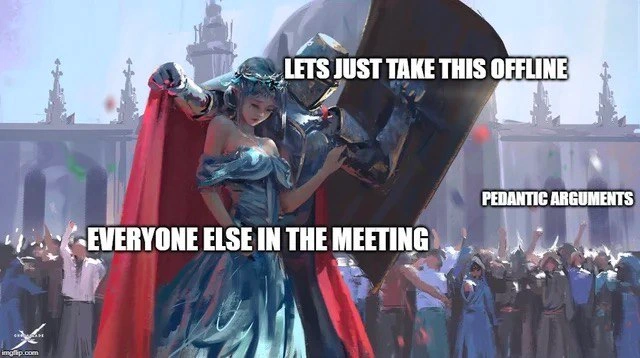
So what does it actually mean to “take something offline”? Despite how it sounds, it’s not about unplugging any cables or going off the grid. In a workplace or meeting context, “let’s take this offline” means “let’s discuss this outside this meeting, at a later time or in a smaller group.” It’s a handy phrase used to keep a meeting from going off on a tangent. In the meme’s image, the knight blocking arrows is a metaphor for this very idea. The knight represents a person in the meeting (often a lead, manager, or any facilitator) who steps in to stop an off-topic or overly detailed debate. The big shield with “LET’S JUST TAKE THIS OFFLINE” written on it is the tool they use — basically the phrase itself acting like protective gear. And those arrows or projectiles labeled “PEDANTIC ARGUMENTS”? They symbolize the nitpicky questions, trivial objections, or super-specific technical points flying around that can distract everyone from the meeting’s main goal. The lady in the blue dress behind the knight (labeled “EVERYONE ELSE IN THE MEETING”) stands for all the other attendees who are not involved in that heated mini-debate. They’re the innocent bystanders, the folks who just want to get through the agenda without getting bogged down. When the knight says “we’ll handle this offline,” it’s as if he’s physically shielding those people from the onslaught of unnecessary detail. They can breathe a sigh of relief and continue with the meeting, grateful that they don’t have to sit through that arcane argument.

Let’s break down the key terms and why this is so relatable in MeetingCulture. A pedantic argument is basically a nitpick: it’s when someone is overly concerned with tiny details or showing off minute knowledge, often missing the bigger picture. For example, imagine in a team discussion about a new feature, two developers start arguing intensely about the correct spelling of a variable name or a very narrow technical definition. That’s pedantic – it might be technically correct or interesting to them, but it’s not really important to the broader discussion that everyone is there for. New engineers or team members quickly learn that these kinds of debates can consume a lot of time. They’re often called bikeshedding in developer lingo (referring to a trivial topic that anyone can opinionate on, like what color to paint a bike shed, taking up more time than the important stuff). “Taking it offline” is the polite way to say, “We acknowledge this point, but let’s not use everyone’s time right now to sort it out.” It might be discussed later between the relevant people (maybe after the meeting, over email, on a Slack thread, or during a one-on-one chat). Or sometimes, honestly, it just never gets discussed further if it turned out to be not that important – and that’s usually fine! The goal is to keep the meeting moving forward and keep everyone focused on the primary agenda (that’s meeting efficiency 101).

In practice, saying “let’s take this offline” is a communication tactic. It helps prevent what we call scope creep in conversations. Scope creep usually refers to projects slowly expanding with more and more ideas (think of a simple app that grows into a monster because people kept saying “couldn’t we also add…?”). In a meeting context, scope creep is when the discussion starts to wander off from the original topic. For instance, a team meeting about quarterly goals might veer off into a super detailed discussion about one specific bug. That’s not on the agenda, and while it might matter, it doesn’t need the whole room’s immediate input. One or two people could handle it separately. By parking that issue for later (sometimes teams literally use a “parking lot” list on the whiteboard or shared doc for off-topic ideas), the facilitator makes sure the meeting stays on track. This benefits everyone else in the meeting – especially those who were getting bored or confused by the tangent. It cuts down on communication overhead (extra time spent in meetings or emails that isn’t strictly necessary) and spares the team from miscommunication and frustration. After all, when too many people talk at once or debate endlessly, the main messages can get lost. A newcomer to corporate life might not have heard “take it offline” before and could be momentarily puzzled (“We’re all online... what do they mean?”). But soon you recognize it as professional shorthand. It’s basically “let’s discuss privately later.”

This meme is funny to developers because it exaggerates a common office scenario with a creative twist. Meetings and their quirks are a huge part of WorkplaceHumor. If you’re a junior dev, you might initially feel like every single issue raised in a meeting must be solved by the whole team right then and there. It can be overwhelming when a simple discussion suddenly dives into obscure technical details. But it’s perfectly okay – even encouraged – to defer those side conversations. Effective teams learn that not everything needs to be a full-group discussion. Often, two people hashing out a minor detail after the meeting is way more efficient. The phrase “take this offline” might sound a bit like corporate buzzword bingo, but it’s genuinely useful. It shows that the team values everyone’s time. The moment someone says it in a meeting, you can almost feel the collective relief. Heads nod, the main discussion resumes, and the irrelevant tangent is safely tucked away (at least for now). The meme just illustrates that feeling in a dramatic, medieval fantasy way: a brave knight has saved the day, and everyone else can carry on without distraction. As a new developer, once you see this in action a few times, you’ll likely start appreciating and maybe even using the phrase yourself whenever a collaboration challenge like this pops up.

Level 3: Bikeshedding's Bane

In a room full of engineers and project managers, not all heroes wear capes — some wield corporate jargon as their sword and shield. The meme’s fantasy tableau perfectly captures a software team meeting under siege by pedantic arguments. A valiant knight (the facilitator or team lead) holds up the mighty shield emblazoned with “LET’S JUST TAKE THIS OFFLINE”, deflecting a barrage of trivial debates. Those incoming arrows labeled "Pedantic Arguments" represent the nitpicky tangents and endless bikeshedding that threaten to derail the agenda. Behind the knight, cowering like a princess saved from a dragon, is “Everyone Else in the Meeting” — the rest of the team, relieved to be spared another 30-minute detour into the weeds. The humor here is a knowing nod to meeting culture: we've all silently cheered for the person who steps in to stop the madness and keep things on track.

This scenario plays out in countless Meetings across tech companies. One developer might latch onto a minor API naming detail or launch into a monologue about some edge-case — the very definition of a pedantic argument. It’s a classic case of Parkinson’s Law of Triviality, famously known as the bikeshed effect: a group will spend disproportionate time on trivial issues (like picking a bikeshed color) because they’re easier to grasp than the big complex problem at hand. In real life, this means a planning meeting can spiral into a bikeshedding debate over 2 spaces vs 4 spaces indentation, while the critical design decisions get sidelined. Everyone else in the room starts exchanging pained glances or furtively checking emails under the table, thinking “Here we go again.” This meme resonates as developer humor because it satirizes that WorkplaceHumor moment when someone finally intervenes to slay the beast of triviality. The phrase “Let’s take this offline” is the meeting equivalent of hitting the emergency brake. It’s essentially a polite way of saying: “This detail isn’t relevant to everyone right now, let’s not waste the whole team’s time on it.” In other words, let’s park this issue and handle it later.

From a seasoned engineer’s perspective, the take_this_offline tactic is a cornerstone of sane meeting management. It addresses several key CollaborationChallenges in tech teams: keeping discussions on-topic, avoiding runaway scope creep, and minimizing communication overhead. Scope creep isn’t just a project management term for features ballooning out of control; it can happen conversationally in meetings too. One minute you’re reviewing sprint goals, and the next you’re in the weeds debating the folder structure of a single module — an epic side quest no one planned for. That’s where our armored facilitator shines. By tabling that discussion (another fancy term similar to parking lot or taking offline), they shield the agenda from being overrun by unimportant details. This spares the whole team from a communication breakdown and ensures the meeting delivers value instead of churning in place. The rest of the attendees (the lady in blue, labeled "everyone else") are effectively saying, “Thank you, kind sir, for saving us from that never-ending debate!”

Importantly, experienced folks know that “taking it offline” isn’t just about escaping a boring tangent – it’s also about choosing the right forum for the discussion. Not every issue needs to be solved with 10 people in the room (or on a Zoom call). Some highly technical or pedantic issues are better addressed by a smaller subgroup or in an async chat thread. This meme cleverly glorifies the facilitator as a Paladin of Productivity, doing battle against the forces of distraction. It’s a little tongue-in-cheek: the knight’s armor is shining, the onlookers are cheering, and our hero has basically cast Shield against the spell of miscommunication. In reality, the phrase “Let’s just take this offline” might sound mundane, but in the realm of CorporateCulture and meeting etiquette, it’s a magical incantation. It’s how effective teams stay on track. Seeing that phrase plastered on a knight’s shield is funny because it feels as lifesaving in the office context as a literal shield in battle — it has rescued many a meeting (and ingrained itself in our collective MeetingHumor). Every senior dev can recall a war story of interminable design reviews or planning sessions, and how one timely “offline” saved the day. The meme gets a smirk and a nod because we’ve all been the grateful crowd, silently applauding the brave knight who finally says it. And if you haven’t met this hero yet in your team’s meetings... then tag, you might need to be the knight next time!

Description

A meme using a fantasy art template known as 'Knight Protecting Princess'. The image depicts a large, heavily armored knight with a massive shield and a red cape, protectively holding a delicate princess in a blue gown. A large crowd is visible in the background. Text overlays assign roles to the characters and the action. The knight is labeled 'LETS JUST TAKE THIS OFFLINE'. The princess he is protecting is labeled 'EVERYONE ELSE IN THE MEETING'. The large shield is positioned to block something, and that unseen threat is labeled 'PEDANTIC ARGUMENTS'. The meme humorously illustrates a common workplace scenario where a meeting is derailed by a detailed, often irrelevant, technical argument. One person, acting as the 'hero', steps in to suggest the discussion be 'taken offline' (handled outside the meeting by the relevant parties), thereby saving the time and sanity of everyone else present. This is a highly relatable situation for senior engineers who value productive and focused meetings

Comments

7
Anonymous ★ Top Pick The two most powerful phrases in corporate engineering are 'Let's take this offline' and 'It's a known issue'. Both mean 'We are never speaking of this again'
  1. Anonymous ★ Top Pick

    The two most powerful phrases in corporate engineering are 'Let's take this offline' and 'It's a known issue'. Both mean 'We are never speaking of this again'

  2. Anonymous

    “Let’s take this offline” is the human-layer HTTP 202: everyone’s payload feels accepted, but the background job quietly times out

  3. Anonymous

    Two senior engineers arguing for 45 minutes about whether to use eventual consistency or strong consistency, while the rest of the team just needs to know if we're shipping the feature this sprint

  4. Anonymous

    The classic 'let's take this offline' maneuver - where two engineers turn a 15-minute standup into a 45-minute architectural philosophy debate about whether to use tabs or spaces, while the rest of the team contemplates their life choices and wonders if they could have just been an email. Bonus points when it's a recurring discussion that's been 'taken offline' for three sprints running, yet somehow always finds its way back into every retrospective

  5. Anonymous

    “Let’s take this offline” is the meeting’s circuit breaker - when bikeshedding pegs the CPU, we fail fast and reroute the thread to a Slack queue with eventual consistency

  6. Anonymous

    'Let’s take this offline': the distributed systems escape hatch turning synchronous pedantry into eventual email consistency - or blissful oblivion

  7. Anonymous

    Let's take this offline - the circuit breaker that stops pedantic tangents from DDoS-ing the rest of the meeting

Use J and K for navigation