The devastating comeback to a developer's irrational hope
Why is this Debugging Troubleshooting meme funny?
Level 1: Pressing the Elevator Button
Imagine you're waiting for an elevator that isn't coming. You press the elevator button once, and nothing happens right away, so you press it over and over again hoping the elevator will arrive faster. But we all know that pressing the same button repeatedly doesn't make the elevator move any quicker – the elevator will come when it's ready, no matter how many times you mash that button. This meme is joking about programmers doing the exact same kind of thing with their code. In simple terms, the developer keeps re-running the program without changing anything, kind of like pressing that elevator button a bunch of times. Of course, just like with the elevator, doing the same action again and again doesn't change the result. It’s funny because it shows a very human side of programmers: when we get frustrated, we sometimes try the exact same thing repeatedly, secretly hoping that maybe this time something different will happen.
Level 2: Same Code, Same Result
Now let's break down what's happening in simpler terms. Compiling code means translating the program you wrote (the source code) into a form the computer can run (machine code or an executable). When you compile a program, the compiler goes through your instructions and builds the application. If there's a bug – which is an error or flaw in the code that causes the program to crash or behave incorrectly – simply running or compiling the program again without changing the code won't fix that bug. You'll just get the same result every time because nothing new was introduced into the program. The computer isn't going to suddenly produce a different outcome out of thin air.
In this meme, the developer is repeatedly hitting the "compile" or "build" button without writing any new code or fixing anything. It's like he's hoping the computer might just magically do something different on the next run. The text calling this out – "You recompile without making a change and expect a different outcome" – points out the silliness of that behavior. It's essentially saying, "Hey, you didn't alter anything, so why would you expect a different result?" This is a common situation in debugging when someone is frustrated or stuck: they run the program again and again, even though they haven't fixed the problem, perhaps hoping the error was just a one-time fluke. (We've all been there, staring at the screen, pressing Build as if the 10th run might suddenly work by miracle.)
To put it plainly: if your program crashed due to a mistake in the code, it will keep crashing in the exact same way until you go back and change the code to address the issue. For example, imagine we have a small C program that crashes because we made a mistake (like using a null pointer). Compiling and running it twice in a row without editing the source will not yield a new result:
$ gcc buggy_program.c -o buggy_program # compile the program (successfully builds an executable)
$ ./buggy_program
Error: segmentation fault (core dumped) # the program crashes at runtime due to a bug
# (Now the developer does *not* change any code, but tries compiling and running again out of hope)
$ gcc buggy_program.c -o buggy_program # recompile the *same, unchanged* source code
$ ./buggy_program
Error: segmentation fault (core dumped) # unsurprisingly, it crashes in the exact same way
As you can see, the outcome didn't change at all on the second run. The code had a bug, and we didn't fix that bug before running it again, so of course the result was the same crash. The meme uses a funny cartoon to remind us of this basic logic.
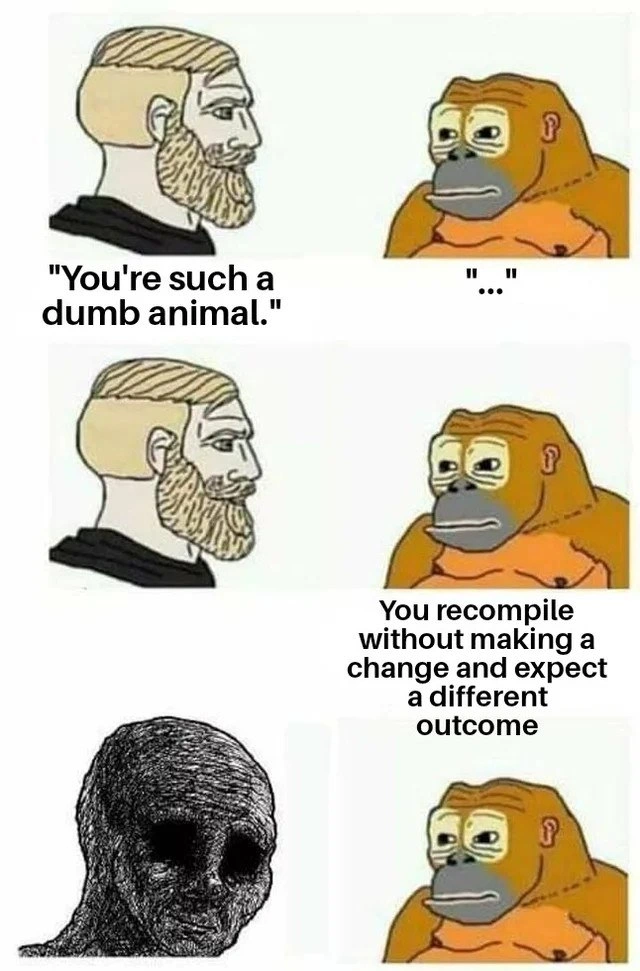
The characters in the cartoon add an extra layer of humor. In the first panel, a buff Chad character arrogantly calls the other character (an ape) a "dumb animal," implying the ape isn't smart. But in the later panel, a spooky, skull-faced figure (basically reality itself) tells Chad that he is doing something dumb: recompiling without changes and expecting a different result. The joke flips the situation around and compares the frustrated developer to the "dumb" ape because of that irrational action.
For a new developer (or anyone learning to code), the lesson here is pretty clear: if your program has a problem, you need to change something – your code or your approach – to solve it. Merely re-running the same unmodified program won't magically fix anything. It's a lighthearted way to poke fun at the debugging frustration we all feel when something isn't working. Instead of methodically finding and fixing the cause, we might fall into the trap of just trying the exact same run one more time and hoping for a miracle. The meme exaggerates this to show how silly it looks from the outside. It's a friendly reminder (through cartoon sarcasm) that when we're stuck in a loop of failure, doing more of the exact same thing isn't the answer.
Level 3: The Definition of Insanity
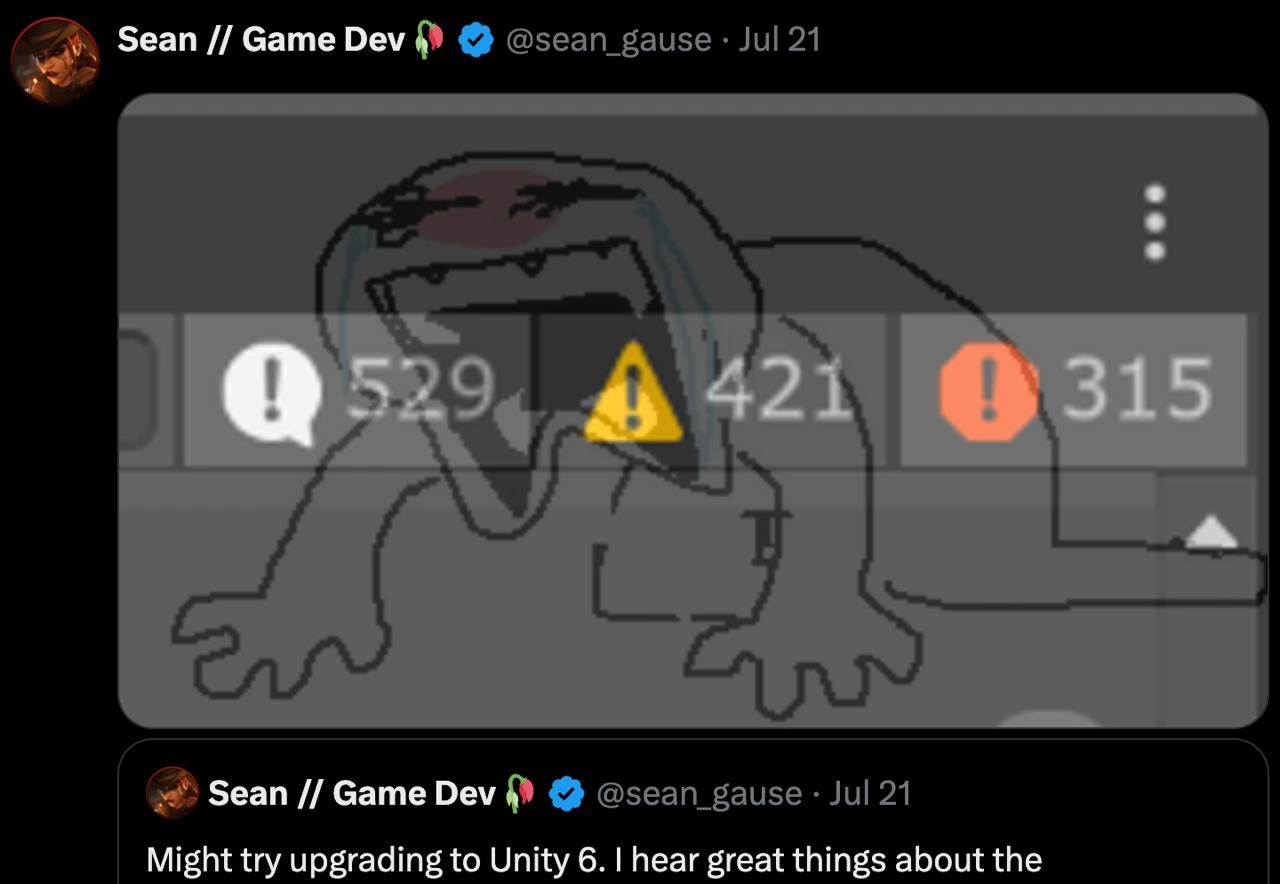
At the senior developer level, this meme highlights the infamous definition of insanity in a coding context: recompiling your code without making any changes and expecting a different outcome. It's a scenario every seasoned coder finds darkly funny because we've all witnessed (or even committed) this futile ritual during intense debugging sessions. It's late at night, a bug is stubborn, and out of sheer frustration you hit Build or re-run the program again, half hoping some cosmic ray flips a bit or the computer simply changes its mind. Spoiler alert: it doesn't.
This four-panel cartoon uses the Wojak/Chad meme characters to deliver its punchline. In the first panel, a confident bearded "Chad" mocks someone as a "dumb animal." By the final panel, a spooky skeletal figure (representing a harsh reality-check or the developer's inner voice) turns the insult back on Chad: "You recompile without making a change and expect a different outcome." In other words, the developer is revealed to be the one doing something foolish. The meme jabs at that special blend of programmer superstition and developer frustration that surfaces under pressure. It's poking fun at a coder debugging like a headless chicken – repeating the same action and praying for a miracle. Any experienced developer recognizes this exact scenario and likely cringes with empathy.
From an engineering standpoint, a compiler is a deterministic beast: given the same source code and environment, it will produce the same machine code every time. No change in the code means no change in the output – period. There's no hidden lottery inside gcc or javac that will one day compile your bug away. Yet under stress, devs sometimes fall into this trap anyway. Maybe the test failed due to a flaky network or an ephemeral environment glitch; hitting compile/run again can feel like pulling a slot machine lever, hoping for a lucky break. But this approach is essentially a dubious debugging coping mechanism, not a real fix. We chuckle (and groan) because this insanity loop – compile, run, crash, repeat – almost never works for actual code errors. The meme is a sarcastic reminder that doing nothing different yields nothing different. It's a truth every battle-scarred engineer learns eventually: if you want a different result, you actually have to change the code (or at least sacrifice a coffee to the debug gods!).
Description
A three-panel Wojak comic strip. In the first panel, a confident, bearded 'Chad' character tells a calm orangutan, 'You're such a dumb animal.' The orangutan is silent. In the second panel, the orangutan delivers a devastating comeback: 'You recompile without making a change and expect a different outcome'. The third panel shows the 'Chad' character replaced by a hollow-eyed, withered Wojak, staring into the void, utterly defeated. The meme is a sharp commentary on a common developer behavior born of desperation: rerunning a build or compilation without any code changes, hoping a different result will magically appear. It's a tech-centric version of the definition of insanity, and the orangutan's observation is so cuttingly accurate that it shatters the developer's sense of superiority, a feeling many senior engineers recognize from their own moments of debugging despair
Comments
13Comment deleted
The definition of insanity is recompiling with no changes. The definition of a senior engineer is doing it anyway, but this time with the '--verbose' flag, just in case the compiler feels like talking about its feelings
It’s not insanity, it’s a Heisenbuild - keep recompiling the same code until the race condition collapses into a passing state right before the CTO’s stand-up
The real insanity is knowing that deterministic compilation will produce identical output every time, yet still hitting 'make clean && make' like it's a slot machine, because deep down we all believe in compiler gremlins that only appear when the PM is watching the demo
The monkey puppet just delivered the most devastating technical roast in software engineering: calling out the universal developer ritual of running 'make clean && make' three times in a row, each time genuinely expecting the linker error to magically disappear. We've all been there at 2 AM, convinced that *this time* the compiler will have a different opinion about our undefined references, despite zero code changes. It's the programming equivalent of checking the fridge multiple times hoping new food appeared - except we have CS degrees and should know better. The real kicker? Sometimes it actually works due to race conditions or stale build artifacts, which only reinforces this Pavlovian response and makes us question our understanding of deterministic systems entirely
Non-deterministic builds: where your makefile channels quantum superposition, collapsing to 'works on my machine' only
Recompile without changes? It’s stochastic debugging - reseeds entropy, reshuffles link order, flushes caches, and sometimes the Heisenbug picks a happier timeline
It’s not insanity; it’s Monte Carlo debugging for a non-hermetic build - keep recompiling until the cache happens to align
Sometimes works Comment deleted
IT DOES SOMETIMES WORK !!!! Comment deleted
pov: interpreted language user (for example, python when not pypy) Comment deleted
I don't see what difference would JIT make there. The classes of bugs where you don't have reliable reproducibility are most frequently race conditions, dependency on external resource and uninitialized memory access and only the former two occur in memory safe languages like Python (ignoring native modules). Tests that sometimes fail is also good way to have Hypothesis scream at you. :-] Comment deleted
Did you perhaps mean mypy (the typechecking framework) instead of pypy (optimizing implementation with just-in-time compiler)? But unfortunately the types in mypy aren't powerful enough to save you from races. Comment deleted
some desktop wpf projects actually require it Comment deleted