Skip to content
DevMeme
3476 of 7435
Zero-Based Counting: A Family Matter
CS Fundamentals Post #3811, on Oct 12, 2021 in TG

Zero-Based Counting: A Family Matter

Why is this CS Fundamentals meme funny?

Level 1: When Dad Overreacts

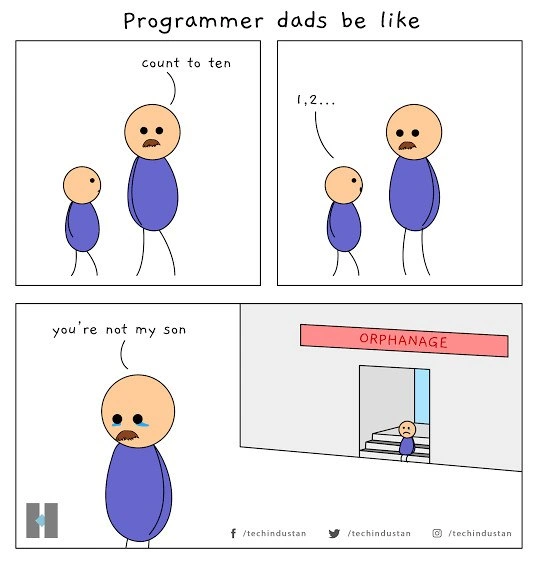
Imagine a dad who is super obsessed with his special way of doing things. He tells his kid to count to ten. The kid starts counting normally: “1, 2, 3…” But the dad wanted him to start at zero (because that’s how computers do it). The dad gets comically angry and says “You’re not my son,” even taking the child to an orphanage as a joke. Of course, in real life no parent would abandon their kid over something so silly! The humor is in the overreaction: the dad’s being ridiculously strict about a tiny detail. It’s funny because the dad cares more about his quirky counting rule than common sense, which is a very silly reason to get mad. So the meme is like a big dad-joke: a playful take on a small difference (starting from 0 instead of 1) turned into an absurd situation. Even if you’re not a programmer, you can laugh at how ridiculous the dad is acting over nothing important.

Level 2: Counting from Zero

Let’s break down the technical joke. The dad in the comic is a programmer, and programmers often count from 0 by habit. In programming, arrays and lists are collections of items, and in most languages the first item is at index 0 (zero). This is called zero-based indexing. For example, if you have an array of ten numbers in a language like Python or Java:

numbers = list(range(10))  # this creates a list [0,1,2,3,4,5,6,7,8,9]
print(numbers[0])  # prints 0, the first item
print(numbers[9])  # prints 9, the tenth item (since indexing starts at 0)

Here, numbers[0] is the first element and numbers[9] is the tenth element. If you tried to access numbers[10], you’d get an error because there is no “eleventh” element – the indices 0 through 9 already cover ten items. Beginners often find this a bit confusing, because in everyday counting “10” seems like the tenth item, but in code the tenth item has index 9. That confusion is exactly what off-by-one errors are: mistakes made by counting one too many or one too few. For instance, writing a loop that runs one extra time or forgetting that the last index of an array of length N is N-1.

Now, in normal life, if someone says “count to ten,” a kid will naturally go “1, 2, 3, … 10.” That’s one-based counting – essentially how humans learn numbers (first element is 1, second is 2, etc.). Some programming languages and environments use one-based indexing too. For example, MATLAB and R index their arrays starting at 1. In those, the first element of an array A would be A(1) (MATLAB uses 1-index, and you’d get the first element). But in a language like Python, the first element is A[0].

The meme’s humor comes from the dad expecting the zero-based approach. When he says “count to ten,” he wanted to hear “0, 1, 2, … 9” (which are ten numbers total). The child, not knowing about code at all, starts with “1, 2…” like any normal person. To a programmer, this seems like the child made a mistake – starting at 1 instead of 0. Of course, in reality no reasonable parent would care about such a thing, but the dad in the comic is acting like a strict code reviewer. By saying “you’re not my son,” he’s humorously implying “I can’t believe you don’t even count correctly (like a programmer)!” This is a playful take on inside jokes among developers, who often say things like “Real programmers count from 0.” It highlights a language quirk in a silly way: mixing up normal counting and coding conventions.

To a junior developer or someone learning to code, the key takeaway is: most programming languages use zero-based indexing. That means when you’re accessing the “first” item of a list, you use index 0. It’s a fundamental concept in CS (Computer Science) and one of the first little twists you learn when entering the programming world. And because it’s so fundamental, programmers often joke about it. The comic exaggerates it to make it funny — turning a simple counting difference into a family crisis!

Level 3: Zero-Based Parenting

In this meme, a programmer dad treats counting like an array index, expecting his child to start from 0 instead of 1. It’s poking fun at the classic quirk of zero-based indexing in computer science. Most programming languages (like C, Java, Python, JavaScript) use zero-based indexing, meaning the first element of an array or list is at index 0. But in normal human life, we count starting at one (1, 2, 3, ...). This mismatch creates the joke: the dad, so steeped in coding culture, is horrified that his kid began counting at 1. The punchline has the dad disowning the child with the line “you’re not my son” – an absurdly extreme reaction, which makes it funny. It’s a satire of how seriously programmers pretend to take these trivial conventions.

Why is this so relatable to developers? Off-by-one errors are a running gag and real headache in coding. An off-by-one error happens when a loop or index goes one too far or one short, often because of confusion over starting at 0 versus 1. It’s one of those infamous bugs that can crash programs or cause subtle mistakes. Seasoned devs have been burned by forgetting that a loop iterating 10 items should go from 0 to 9 (and not to 10). So, we joke that starting counting at 1 is practically a cardinal sin in programming – of course the “zero-index purist” dad would be scandalized! The meme exaggerates this into the realm of parenting: imagine a dad so strict about tech principles that he has zero tolerance for a child who counts like a normal human. It’s humor through exaggeration of a real developer mindset.

This comic also hints at language and culture wars in programming. Historically, not all languages count from zero. Older languages like Fortran or math-focused ones like MATLAB and R use one-based indexing (first element is index 1). Meanwhile, languages influenced by lower-level memory addressing (C and its descendants) stuck with 0 as the first index. Developers sometimes rib each other over these differences. If you’ve ever switched from a 1-indexed environment to 0-indexed (or vice versa), you probably experienced that “Wait, why am I off by one?” confusion. This dad’s overreaction is a tongue-in-cheek nod to those tiny but persistent CS fundamentals that trip people up. It’s inside humor: only in programming would starting at 1 be considered “wrong” enough to joke about disownment!

Under the hood, there’s a solid reason why many languages start counting at 0. In low-level terms, an array’s index often represents an offset from a base address in memory. Index 0 means “zero offset” – referring to the very start of the array. Index 1 would be an offset of one unit. Many early languages (like C) adopted zero-based indexing because it made the math simple and the implementation efficient. Of course, none of that matters to a child counting to ten, which is why the scenario is ridiculous. But to a veteran coder, the dad’s stern face in panel 3 (“not my son”) humorously echoes every code review comment that ever nitpicked: “Actually, arrays are 0-indexed.” The meme captures that shared developer experience: we all laugh because we’ve met colleagues who insist on these details – or maybe we are those colleagues! And deep down, most of us have jokingly corrected a friend or family member with “Well, technically it should start at 0…” at least once. This comic just takes that to the extreme for comedic effect. In summary, the humor comes from a programmer culture clash: applying a strict coding rule to a normal life situation (parenting) leads to an outrageously disproportionate response, a classic formula for geeky humor.

Description

A four-panel comic strip in the style of Cyanide & Happiness, titled 'Programmer dads be like'. In the first panel, a father figure tells his young son, 'count to ten'. In the second panel, the son begins counting, '1, 2...'. The third panel shows the father crying, saying, 'you're not my son'. The final panel depicts the sad-looking child sitting alone on the steps of a building with a red sign that reads 'ORPHANAGE'. The joke is a classic in the programming community, revolving around the concept of zero-based indexing, where arrays and lists in many programming languages start their index from 0, not 1. The father, a stereotypical programmer, expects his son to start counting from zero. The son's failure to do so leads to this extreme and humorous reaction, highlighting a fundamental disconnect between a programmer's mindset and the conventional way of counting
Comments

14
Anonymous ★ Top Pick That kid will never understand the off-by-one errors he just introduced into his life
  1. Anonymous ★ Top Pick

    That kid will never understand the off-by-one errors he just introduced into his life

  2. Anonymous

    Kid started counting at 1, so Dad moved him to OrphanageService - around here, off-by-one errors are handled by garbage collection

  3. Anonymous

    The real tragedy isn't the orphanage - it's that the kid will grow up using MATLAB or Fortran where arrays start at 1, forever bringing shame to the family's git history

  4. Anonymous

    This perfectly captures the existential crisis every programmer faces when asked to count naturally - after years of `for(int i=0; i<n; i++)`, starting at 1 feels like a syntax error in real life. The orphanage ending is the logical conclusion when your parent-child relationship throws an IndexOutOfBoundsException because you're not at position 0

  5. Anonymous

    House policy: loops are [0, n); start at 1 and you’re adopted by MATLAB and Lua

  6. Anonymous

    Parent calls exit(0) sans waitpid(): kid's now init's headache, orphanage edition

  7. Anonymous

    Programmer dad turns “count to ten” into a boundary test: expected [0,10), kid returned [1..10]; classic off-by-one - reassigned to the MATLAB team

  8. Deleted Account 4y

    I know company, which uses 1 as an first array index, instead of 0, in their apis. And that is really confusing.

    1. @Daler_XYZ 4y

      Bruh

    2. @nuntikov 4y

      Matlab moment

    3. Deleted Account 4y

      lua lua

    4. @Agent1378 4y

      Pascal, pl/sql and others do that too. The C is the only reason everybody does it like this now. And C does that because it is actually assembly for lazy people and it does not care. And the array index is just used for relative adresing, so obviously it starts with 0.

      1. @CcxCZ 4y

        https://python-history.blogspot.com/2013/10/why-python-uses-0-based-indexing.html?m=1 Languages that use associative arrays exclusively like AWK and Lua do not care, they could start at "A" like spreadseets and it'd be all the same, it's just a convention. And then there is Ada where range of allowed indices is part of the type signature of the array and it could go from 5 upwards if you really wish. Or index with any enum.

        1. @Agent1378 4y

          Yes, in pascal you can also define any range and use it.

Use J and K for navigation