Skip to content
DevMeme
5482 of 7435
The Code Review Cycle: A Machine for Turning Pull Requests into Unresolved Threads
CodeReviews Post #6009, on May 16, 2024 in TG

The Code Review Cycle: A Machine for Turning Pull Requests into Unresolved Threads

Why is this CodeReviews meme funny?

Level 1: When Help Feels Heavy

Imagine you finish your homework and proudly turn it in, but an hour later the teacher hands it back with 43 sticky notes of corrections. That’s basically what happened here with the programmer’s code. The developer handed in their work (like homework) and immediately got 43 comments back, each telling them something to fix or change. The skeleton struggling to lift a heavy barbell shows how weighed down and tired the programmer feels with all that feedback – it’s as if each comment is a weight added to their load. The joke is that asking for someone to review your work turned one task into many tasks, which feels like too much to handle. It’s funny because it’s an exaggerated version of a situation we all recognize: you think you’re all done, and then you find out there’s a bunch more to do. The meme makes us laugh at that “Oh no, more work!” moment, because every coder knows that feeling. Sometimes the only thing you can do is chuckle about it and start lifting those “weights” one by one.

Level 2: Code Review Overload

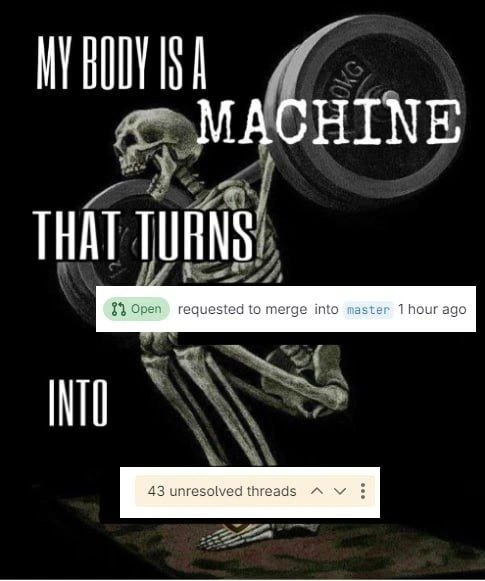
Let’s break down what’s going on in simpler terms. In modern Version Control workflows (using tools like Git and platforms like GitHub or GitLab), when a developer wants to contribute changes, they open a Pull Request (PR). A pull request is basically the developer saying, “I’ve made some code changes on a separate branch. Can we merge them into the main branch?” In this meme’s case, the PR is trying to merge into the master branch (which is usually the main line of code for a project). The snippet in the image that says Open – requested to merge into master 1 hour ago is showing that a new PR was opened just an hour ago and is targeting the master branch. The green Open badge indicates the PR is active and awaiting review.

Now, whenever you open a PR, your teammates will perform a code review. That means other developers look at the code you wrote and check if everything is okay. They might ask questions, suggest changes, or point out mistakes. This is done to maintain quality and catch problems early. On platforms like GitHub/GitLab, they leave comments directly on the PR. Often, comments can turn into discussions – for example, a reviewer comments on a line of code, you reply to explain or commit a fix, and maybe another reviewer chimes in. These discussion blocks are shown as threads in the PR interface. (Here, “threads” doesn’t mean computer threads or processes – it means conversation threads, like a string of messages on a forum focused on one topic.) Each thread in a code review is a back-and-forth about a specific point in the code. When the issue in that thread is addressed, the thread can be marked “resolved.” If not, it stays “unresolved,” signaling that this point still needs attention.

The meme prominently shows 43 unresolved threads. That means there are 43 separate comment discussions on the PR that haven’t been resolved yet. In other words, the reviewers have raised 43 points that the developer still needs to deal with. Unresolved threads count is basically the length of the to-do list coming out of the code review. It will shrink as the developer makes fixes and the reviewers mark each thread as resolved. But seeing a number as high as 43 is pretty extreme! Especially for a PR that was opened only an hour ago. It suggests the code attracted a lot of feedback almost immediately.

Let’s clarify a few terms from the meme, one by one:

  • Merge into master: “master” is the name of the main branch in many repositories (some now use the name main). Merging into master means you want your changes to become part of the main codebase. Changes going into master are often crucial, so they get reviewed carefully.
  • Open (Pull Request): When a pull request is open, it means it’s active and awaiting review/merge. The PR in the meme has an Open status, showing it’s a live request that was made 1 hour ago. It hasn’t been merged or closed yet.
  • Threads in code review: In this context, threads are discussion threads on the PR. Each thread starts with a comment on a specific part of the code. For example, a reviewer might comment, “Hey, you should rename this variable for clarity.” That comment plus any replies form a thread. It’s not related to CPU threads; it’s more like a chat thread focused on one issue in the code.
  • Unresolved threads count: This number (43 in the meme!) tells you how many of those discussion threads are still open/unresolved. “Unresolved” means the issue raised hasn’t been fixed or agreed upon yet. If the developer changes the code to satisfy that comment (or the team decides it’s not an issue after all), the thread can be marked resolved, and it would drop out of that count. A high unresolved thread count means there’s a lot of work left to do on that PR before it can be approved.

All of this adds up to a code review overload. It’s a review with so much feedback that the poor developer is swamped. Imagine you’re a new developer who just submitted code for the first time. Getting a few comments from a reviewer is totally normal – maybe you forgot to handle an error case or your coding style needs a small tweak. But getting 43 comments in the span of an hour would be overwhelming for anyone! It means you now have 43 separate issues or questions to address in your code. You’d probably feel like, “Oh wow, I thought my code was okay, but I have a lot to fix or explain.” The meme captures that exact feeling in a humorous way.

The skeleton in the image represents how the developer feels: absolutely buried under the weight of all those review comments. Each “unresolved thread” in the review is like another weight on the bar, making the load heavier. It’s a playful exaggeration, because in reality 43 comments on a single pull request is quite uncommon (unless it’s a massive change or something went really awry). The meme creator chose such an over-the-top number to make it immediately clear that this is an extreme case of feedback overload.

If you’re new to this process, don’t panic — 43 comments in an hour is not something you see every day. That’s part of why it’s funny. Usually, a pull request might get a handful of comments, maybe a dozen on a large change with multiple reviewers. And those are typically addressed one by one, leading to an improved final code. Code reviews are meant to help make your code better and catch mistakes early, so they are a good thing, even if getting a lot of critique can sting a bit. The meme is just pointing out that it sometimes feels like you open a simple door (“here’s my code!”) and a tidal wave of feedback crashes through.

So, this meme is all about a relatable developer experience: the moment when a simple code submission suddenly turns into a giant list of fixes. “My body is a machine that turns open merge requests into 43 unresolved threads” is a tongue-in-cheek way of saying, “Every time I put my code up for review, it ends up with a ton of comments.” It exaggerates the scenario to make us laugh. And one day, if you continue in development, you’ll likely encounter some form of this (albeit maybe not 43 threads at once!). Eventually, you’ll also be on the other side – leaving review comments on someone else’s code – and you might recall this meme with a knowing smile. At its heart, the joke reminds us that asking for a code review often means more work before you’re truly done. It’s something all programmers learn, and we cope by sharing a laugh about it in memes like this.


Level 3: Bone-Crushing Feedback

In the meme image, a skeleton is doing a heavy barbell squat. The caption at the top says: “My body is a machine that turns ___ into ___.” The blanks are filled with actual Git UI snippets. The first blank is replaced with a snippet reading Open requested to merge into master 1 hour ago — i.e. the input is a freshly opened Pull Request aimed at the master branch (the main code line). The second blank shows 43 unresolved threads — meaning the output is an avalanche of code review comments. Combined, the caption now reads: “My body is a machine that turns open merge requests into 43 unresolved threads.” This immediately evokes that feeling of a PR transforming into a mountain of feedback. It’s a darkly comic exaggeration of real life: you submit a fresh merge request and bam! you’re instantly crushed under dozens of review comments.

To a battle-scarred senior engineer, this scenario is all too familiar — just another Tuesday in code review hell. The PR was opened just one hour ago, yet it already has 43 unresolved threads. That number is comically high – it implies an avalanche of nitpicks, suggestions, and must-fix issues descended almost immediately. (Some jaded devs might even joke that 43 threads is nothing; they’ve survived reviews with triple-digit comments. But for most of us, 43 in an hour is plenty to feel crushed.) It’s like a pack of reviewers descended on the new PR, each tossing another 20kg plate of feedback onto the bar for the author to lift. Code reviews are meant to improve quality, but here we see the painful side: the sheer quantity of critique is overwhelming. The meme blows it out of proportion to highlight the absurdity – one moment you’re confident about your code, the next you’re staring at an itemized list of 43 things you apparently need to fix. Classic. We laugh (with a wince) because we’ve all been that skeleton at some point: excitedly pushing code, only to end up feeling dead inside under a heavy load of critique.

The phrase “my body is a machine that turns X into Y” is a twist on the classic programmer joke about turning coffee into code. In this cynical remix, instead of churning out productivity, our machine (the developer, or the development process itself) is spitting out more work – a flood of unresolved threads. It implies that no matter what you feed into the system (even a decent piece of code), the output is a barrage of comments requiring action. It’s humor born from exasperation: of course my simple PR turned into a thread-fest… just my luck!

Notice the target branch here is master. Merging directly into master (often now called main) is usually high stakes – that’s the main codebase, often what goes to production. Teams tend to enforce stricter reviews on such PRs; nobody wants broken code hitting the primary branch. So a PR into master invites extensive scrutiny. If your changes aren’t rock solid (and let’s face it, they rarely are), reviewers will point out every little issue: logic bugs, style violations, missing tests, you name it. It’s no surprise then that this fresh PR spawned an explosion of threads. Hitting “43 unresolved threads” in just an hour suggests either multiple colleagues swarmed it at once, or one ultra-thorough reviewer left comments on practically every other line. Seasoned devs chuckle at this because they know a code review can sometimes be more exhausting than writing the code itself – it’s basically debugging and refining your code in public, while others pile on observations.

Let’s break down those 43 threads. They could range from minor nitpicks to major flaws, for example:

  • Style Nitpick: “Please use camelCase for this variable, per our style guide.”
  • Design Suggestion: “Have you considered splitting this function? It’s doing too much at once.”
  • Bug Catch: “This will throw a null-pointer exception if user is null. Better add a check.”
  • Documentation: “Can you add a comment explaining why this loop is needed?”
  • Testing: “We need a unit test for this new logic before we can merge.”

And on and on... Each bullet above could represent one “unresolved thread.” For the author, that means their one PR has spawned 43 mini-tasks to handle. The code won’t be approved until every thread is addressed or resolved. It’s like turning a single chore into 43 sub-chores. No wonder the meme’s using a skeleton under a barbell — the weight of all those comments can suck the life out of you! The 20 KG plates in the image symbolize each hefty chunk of feedback. One or two comments are easy to carry, but 43 of them? That’s a bone-crushing load on anyone’s shoulders. The skeleton visual is a tongue-in-cheek way of saying the developer feels absolutely drained and burdened by this review.

There’s a layer of ironic pride in the caption’s wording too. It implies the developer’s “body” (or workflow) is almost designed to perform this grim alchemy: turning PRs into piles of comments. It pokes fun at the reality that in some teams, this outcome is practically expected — as if the code review process is a machine that inevitably generates a huge list of issues to address. It’s a bit of gallows humor among developers: we half-joke that anytime you open a PR, you’re going to get a ton of feedback. That’s just how the system works, like a law of nature or a grisly ritual we’ve all come to accept. Experienced folks will nod knowingly at this. It’s a highly relatable scenario in software teams. The meme perfectly captures that shared “ugh, here we go again” moment. Ultimately, we find it funny because it rings true: the pain points of code reviews are very real. A thorough review can feel like a heavyweight bout – you versus all those critiques – and the meme nails that feeling with dark humor. You laugh because it’s better than crying under the weight... and as every veteran knows, sometimes laughter is the only workout for the soul that gets you through the code review grind.


Description

A meme based on the 'My body is a machine that turns...' format, featuring a skeleton lifting a heavy barbell. The text on the image reads, 'MY BODY IS A MACHINE THAT TURNS... INTO...'. The first blank is cleverly covered by a screenshot of a GitHub pull request status, which says, 'Open requested to merge into master 1 hour ago'. The second blank is covered by another GitHub UI element showing the result: '43 unresolved threads'. The meme humorously portrays the developer's body as a machine that transforms a simple, hopeful act of creating a pull request into an overwhelming number of comments, questions, and required changes during the code review process. It's a deeply relatable joke for engineers about how the review cycle can sometimes feel like a grueling, soul-crushing workout that generates endless discussion instead of a quick merge
Comments

16
Anonymous ★ Top Pick I've started measuring my PRs not in lines of code, but in 'Unresolved Threads Per Hour'. It's a much better metric for my descent into madness
  1. Anonymous ★ Top Pick

    I've started measuring my PRs not in lines of code, but in 'Unresolved Threads Per Hour'. It's a much better metric for my descent into madness

  2. Anonymous

    Opening a “minor refactor” PR feels like enabling Kafka with infinite retention - suddenly 43 consumers are holding onto every message, and not one of them commits an offset

  3. Anonymous

    After 15 years in the industry, I've realized my most consistent architectural pattern is converting well-intentioned pull requests into distributed systems of unresolved comment threads, each with their own eventual consistency model and Byzantine failure modes

  4. Anonymous

    The modern developer's metabolic process: consume caffeine and optimism, produce pull requests, and through the mystical alchemy of code review, transform them into 43 unresolved threads debating whether that variable should be named 'data' or 'datum'. Bonus points if 38 of those threads are about formatting that your linter should have caught, and the remaining 5 are philosophical debates about whether your perfectly functional solution violates the spirit of SOLID principles that nobody on the team actually follows consistently

  5. Anonymous

    Open a 200‑line MR and watch it deterministically transform into 43 unresolved threads - review throughput scales O(reviewers^2) while merge latency approaches infinity

  6. Anonymous

    43 unresolved threads? That's just Tuesday - real vets ship when it hits 430 after the weekend rebase

  7. Anonymous

    After two decades, I’ve learned approvals are eventual consistency - the real SLA is how many GitHub threads you can deadlift before merge

  8. @furry_onko 2y

    ;0

  9. @ColonelPhantom 2y

    Based

  10. @graduated_vernier 2y

    Just need to find someone who can brocept your MRs.

    1. @realVitShadyTV 2y

      It works only on friendly companies where nobody want configure GitHub actions.

  11. @AmindaEU 2y

    what platform are we discussing? I guess you can make a file ending .desktop and type your magic there? or is it that weird Windows where you do magic like Windows+R shell:appsfolder and then drag something to desktop through right mouse button? I don't know, I am not normal either.

    1. @affirvega 2y

      windows most probably making shortcut is as easy as Options > Create > Shortcut or copy file / link, then Options > Paste shortcut

  12. Deleted Account 2y

    hell naw an animal don't even know how to duplicate a file

  13. @affirvega 2y

    Meow

    1. @AmindaEU 2y

      Meow

Use J and K for navigation