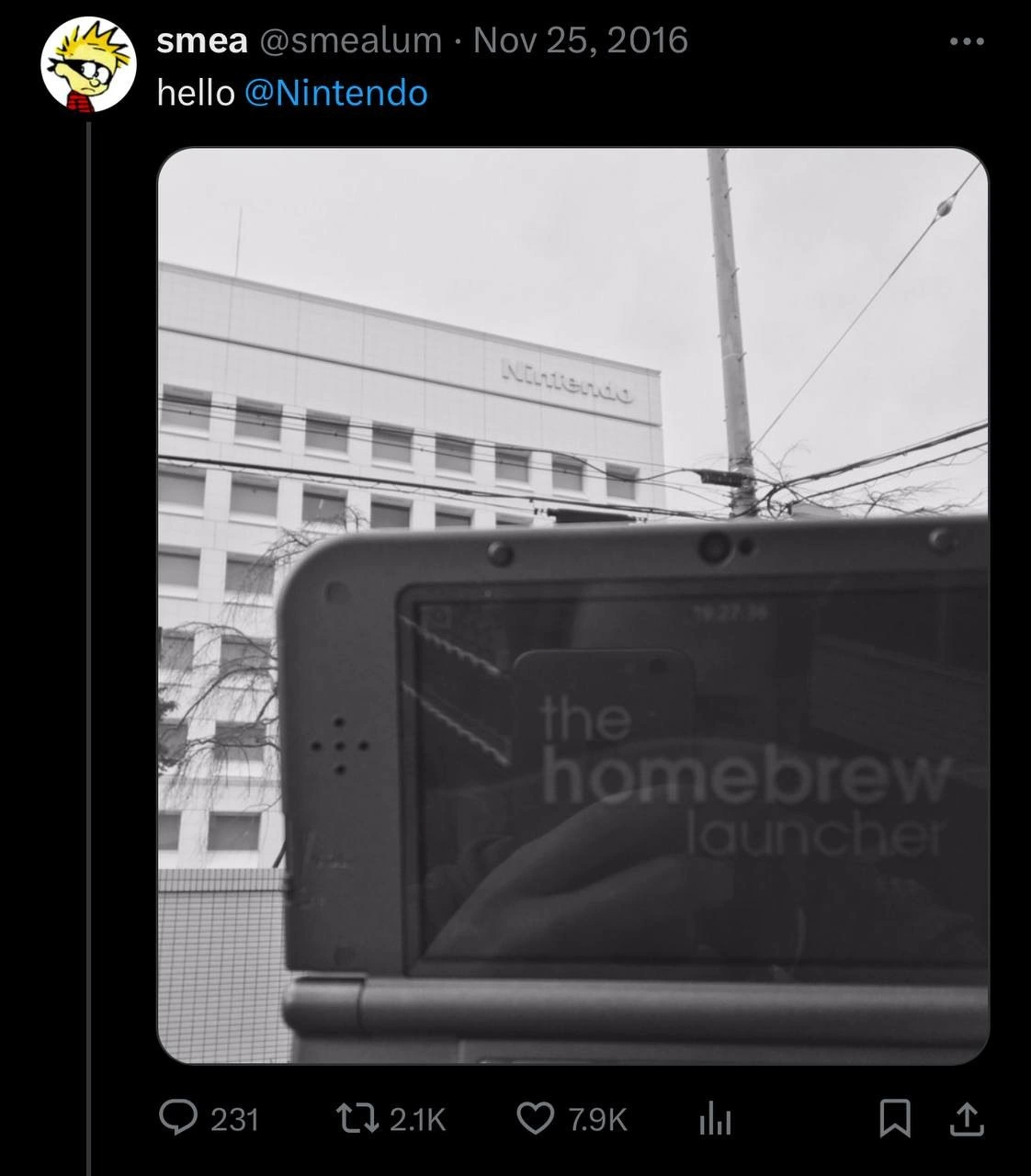
History Repeats: Switch Hacker Recreates Iconic Homebrew Photo at Nintendo HQ
Why is this Security meme funny?
Level 1: Candy at the Dentist’s Door
Imagine a dentist who is very strict about not eating candy because it’s bad for your teeth. Now picture a kid standing right outside that dentist’s office, happily munching on a big candy bar and waving with a grin. It’s a cheeky way of saying, “I’m doing the thing you told me not to do, and I’m doing it literally in front of you!” In this meme, Nintendo is like the dentist (they set the rules for the game console), and the hacker is like the misbehaving kid. Nintendo says “don’t run unapproved software on our game machine,” but the hacker not only does it, he even shows off that he did it right at Nintendo’s own building. It’s bold, a little bit funny, and kind of like a playful dare. Even if you don’t get the tech details, the feeling is clear: it’s about someone confidently breaking the big guy’s rule and saying “Look at me, I did it!” in a fun, rebellious way.
Level 2: Switch Hacking 101
The Nintendo Switch is a hugely popular handheld game console – you might know it as the system that runs games like The Legend of Zelda: Breath of the Wild or Mario Kart. Normally, a Switch only runs official Nintendo software. Nintendo designs the system so that you can’t change the built-in programs or run your own games on it. Imagine it like a locked box: only things approved by Nintendo are supposed to work on the device. However, some very clever programmers and tinkerers in the GamingCulture found ways to unlock that box. They discover security vulnerabilities (basically mistakes or loopholes in the Switch’s software/hardware) that let them install custom firmware. Custom firmware (CFW) means an alternative operating system or modified system software that isn’t from the device’s manufacturer. In this case, the custom firmware is called Atmosphère. It’s an open-source project (meaning the code is publicly available and created by the community) that lets Switch owners run all kinds of unofficial software, often called homebrew. Homebrew can be anything from fan-made games and emulators to useful apps and system tweaks that Nintendo’s original firmware wouldn’t normally allow. Essentially, Atmosphère gives the user more control over the console – it’s like breaking the locks put in place by the manufacturer.
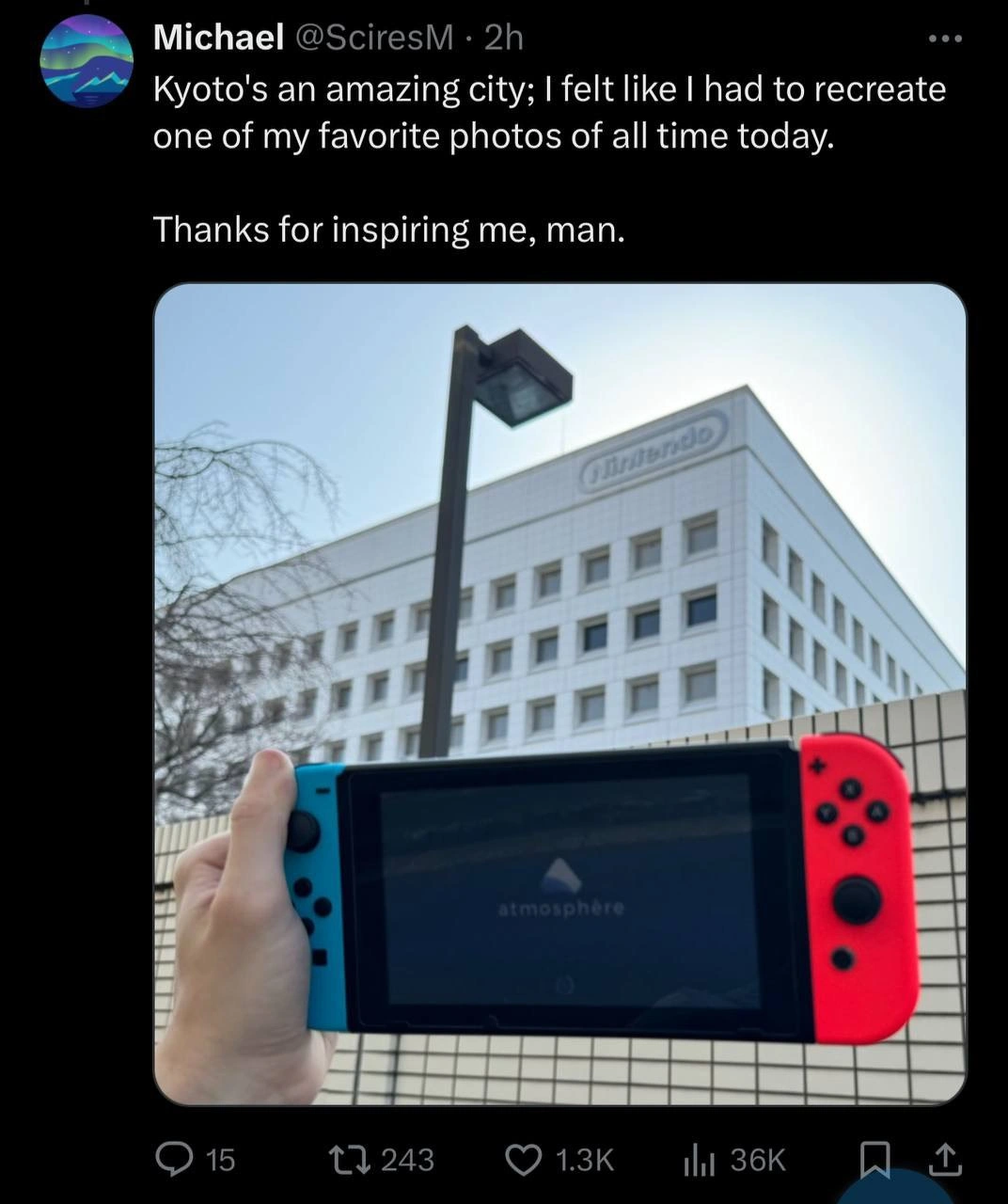
What’s happening in the photo is a bit of HardwareHumor and geeky bravado. The person in the image (Michael, known as SciresM online) is a well-known developer who helped create Atmosphère. In his left hand he’s holding a Nintendo Switch, and on the screen you can see the Atmosphère logo (a little white triangle above the word “atmosphère”) showing that the console is running this unofficial software. And where is he holding it? Right in front of Nintendo’s main headquarters in Kyoto, Japan! That big white building in the background with the Nintendo logo is basically Nintendo’s home office – the center of their operations. So, why is this funny or significant? Because he’s proudly displaying that he has hacked his Switch to run community-made software in the one place where Nintendo absolutely would hate to see it. It’s a playful kind of defiance. Nintendo tries hard to keep their consoles secure and closed-off to prevent piracy and unauthorized modifications. They don’t want people messing with the system’s software for both security and business reasons. Yet here is a guy who not only did exactly what they forbid (installed custom firmware), but he’s also cheekily showing it off at Nintendo’s front door. It’s like saying, “Hey, look what I can do with your device!” in the most direct way possible. This image resonates with HackerCulture and OpenSourceCulture enthusiasts because it highlights the freedom to tinker. It took a lot of skill in SecurityResearch and exploit development to make Atmosphère work on the Switch – people had to figure out how to get around all the roadblocks Nintendo built into the system. This tweet basically celebrates that achievement. And judging by the Twitter metrics visible (hundreds of retweets and over a thousand likes in just 2 hours), a lot of folks online found this demonstration both amusing and epic. Even if you’re new to console hacking, you can appreciate the message: the creator of a big Switch hack is effectively giving a friendly nod (or some might say, a gentle razz) to Nintendo right at their headquarters, saying “Thanks for the great hardware, we had some fun unlocking it!”
Level 3: Cat-and-Mouse at Kyoto
For seasoned developers and gamers, this scene is the embodiment of the age-old cat-and-mouse game between hardware makers and hackers. In the foreground, we have a Nintendo Switch proudly booted into Atmosphère, an open-source custom firmware. In the background, looming large, is Nintendo’s famously boxy white headquarters building in Kyoto – essentially the heart of the Big N’s operations. The humor here comes from the sheer audacity: a hacker is literally showing off a hacked Switch right under Nintendo’s nose (or more precisely, right outside their front gate!). It’s a playful HackerCulture victory pose. The tweet’s author, Michael (known online as SciresM), is actually the lead developer of Atmosphère. He’s not just any user who jailbroke his device; he’s the very person who helped create the software enabling this shenanigan. By holding up that modified console in front of Nintendo HQ, he’s making a tongue-in-cheek statement: “Look, I can run my own software on your console, even here in your hometown.” It’s akin to a magician’s apprentice pulling a rabbit out of a hat while standing in front of the old master’s house – equal parts homage and harmless provocation.
This tweet references GamingCulture and hacker lore: SciresM mentions recreating one of his “favorite photos of all time,” thanking someone for the inspiration. Long-time console hackers likely recall similar legendary pics or moments. (Perhaps an earlier hacker once snapped a photo flaunting a modded device outside a big console maker’s office – a symbolic “I did it!” moment remembered in the community.) By emulating that, SciresM nods to a tradition of HardwareHacks one-upmanship. It’s a proud tradition: every time console manufacturers tighten security, the HackerCulture finds a way in, and often celebrates with a bit of flair. Seniors in the industry have seen this pattern repeat over generations of devices. From the early days of putting modchips in the original PlayStations and blowing into cartridges, to the modern era of software exploits on the Switch, the cycle continues. Companies like Nintendo build higher walls; enthusiasts sharpen their ladders. The open-source Atmosphère project itself is a testament to this: rather than a secretive piracy tool, it’s a publicly developed OpenSource firmware, born from collaboration and reverse-engineering skills. It enables homebrew apps, fan translations, custom mods, and all sorts of tinkering that official firmware wouldn’t allow. For experienced devs, there’s a bittersweet relatability here: the "users will do what the system forbids if they’re determined enough" ethos. Many of us have faced locked-down systems or draconian DRM and felt that itch to regain control of hardware we own. This scene captures that emotion perfectly – it’s about rooting a device and then light-heartedly flaunting that freedom.
From an industry perspective, there’s also irony and tension. Nintendo, as a company, is notoriously protective: they issue DMCA takedowns on fan projects, ban hacked consoles from Nintendo Switch Online, and even pursued legal action against commercial hack sellers (remember the Team Xecuter saga). Seeing the lead hacker of a major Switch exploit stand cheerfully outside their HQ is the kind of thing that would give Nintendo’s lawyers mild heartburn. 😅 It’s all done in good humor though – SciresM isn’t selling anything illegal; he’s a respected SecurityResearcher sharing knowledge and tools freely. In a way, his open-source approach highlights a philosophical stance: if you buy a piece of hardware, you have the right to tinker with it. Seasoned engineers recognize this as part of the broader OpenSourceCulture and right-to-repair movement. But at the same time, they know why Nintendo hates it: custom firmware can be a double-edged sword, often enabling piracy or cheating, which could hurt Nintendo’s business and the gaming ecosystem. Thus, the “cat-and-mouse” dynamic isn’t just technical — it’s economic and legal too. Nintendo will patch vulnerabilities, release new revisions of the Switch that close exploits, and update software to detect CFW. Hackers in turn will look for new cracks in the fortress. Each side is full of smart people, and each new console generation or firmware update is like a renewed chess match. This tweet is like a checkmate move in one round of that ongoing game, captured in a single image. It’s both celebratory and a bit cheeky: a reminder that for every locked-down system, there’s a curious mind out there finding a key, and having a little fun with it – even if that means flying across the world to snap a bragging-rights photo in Nintendo’s own backyard.
Level 4: Chain-of-Trust Takedown
Deep inside the Nintendo Switch, a carefully orchestrated secure boot process is supposed to prevent exactly what we see in this photo: unapproved software running on the hardware. The Switch’s boot sequence establishes a cryptographic chain-of-trust – an unbroken succession of signature checks from the immutable BootROM up through the operating system. In theory, only code signed by Nintendo’s secret keys can execute. However, the community of console hackers found an Achilles’ heel in this chain. A now-infamous vulnerability in the NVIDIA Tegra X1’s BootROM (cheekily nicknamed fusee-gelee, or “frozen rocket”) exploits a classic buffer overflow. By sending an oversized payload in USB recovery mode, they can overflow a stack buffer and seize control before any signature verification kicks in. This is a textbook exploit development scenario: a low-level flaw that completely bypasses high-level crypto defenses. Essentially, the BootROM’s role as the root-of-trust is subverted — the Switch will execute a custom payload loader as if it were valid Nintendo code. Once you’ve hijacked that foundational stage, the entire system is yours: you can boot into a custom firmware like Atmosphère with full privileges. Atmosphère replaces or patches parts of the Switch’s OS (named Horizon) right from the start, disabling enforcement of Nintendo’s locks. The brilliance (and irony) here is that strong encryption and hardware fuses mean nothing if a bug in the bootloader lets you skip the signature check entirely. The engineers at Nintendo likely poured over formal proofs and silicon-level security, but as any security researcher knows, one overlooked memory boundary (just a few bytes off) was all it took for the homebrew community to crack the system wide open. It’s a triumph of SecurityResearch ingenuity over theoretical protection — a low-level SecurityVulnerability in the heart of the machine enabling complete freedom. And because that BootROM is baked into the chip (read-only and unpatchable after manufacture), every vulnerable Switch unit is effectively permanently open to this hack. Nintendo did revise the hardware in later units to fix the bug, but the cat was out of the bag: millions of early Switch consoles can forever be run with custom code. In summary, this daring photo is made possible by some serious under-the-hood wizardry: the console_hacking community has performed a surgical strike on the Switch’s trust hierarchy, turning a mass-market gaming device into an open sandbox — much to Nintendo’s chagrin.
Description
This image is a screenshot of a tweet by user Michael (@SciresM). The tweet reads, 'Kyoto's an amazing city; I felt like I had to recreate one of my favorite photos of all time today. Thanks for inspiring me, man.' The attached photo shows a person holding a Nintendo Switch console with red and blue joy-cons. The Switch's screen displays the logo for 'Atmosphère', a popular custom firmware. In the background, the Nintendo headquarters building in Kyoto is clearly visible. This tweet is a direct homage to a famous 2016 photo by another hacker, smea, who did the same with a Nintendo 3DS running the homebrew launcher. SciresM, the creator of Atmosphère, is a prominent figure in the Switch hacking scene. This act is a modern-day continuation of the tradition of playfully taunting Nintendo by showcasing successful console exploits right at their doorstep, celebrating the ongoing efforts of the security research and homebrew communities
Comments
7Comment deleted
Nintendo's physical security seems top-notch, but their ARM TrustZone implementation could've used another penetration test
Nothing says “robust secure-boot pipeline” like someone running unsigned Atmosphère outside headquarters - call it CI/CD: Continuous Irreverence / Cease-and-Desist
Standing outside Nintendo HQ with a jailbroken Switch is the hardware equivalent of deploying to production on Friday afternoon - technically possible, ethically questionable, and guaranteed to make someone's weekend interesting
When a prominent Switch homebrew developer makes a pilgrimage to Nintendo HQ running Atmosphere CFW on their console, it's the ultimate 'I built my career on your platform, just not the way you intended' flex - like showing up to Oracle headquarters with a laptop covered in PostgreSQL stickers
Peak senior energy: run the open‑source boot chain in front of the vendor’s root‑of‑trust and call it on‑prem testing
Booting Atmosphère outside Nintendo HQ is the nicest code review ever - Secure Boot says “no,” Boot ROM says “RCM,” and Kyoto quietly replies “LGTM.”
Atmosphere at Nintendo HQ: where unsigned code gets the best architecture review - in person