Skip to content
DevMeme
3264 of 7435
The Whole Tech Family is Listening
DataPrivacy Post #3588, on Aug 24, 2021 in TG

The Whole Tech Family is Listening

Why is this DataPrivacy meme funny?

Level 1: The Hidden Listener

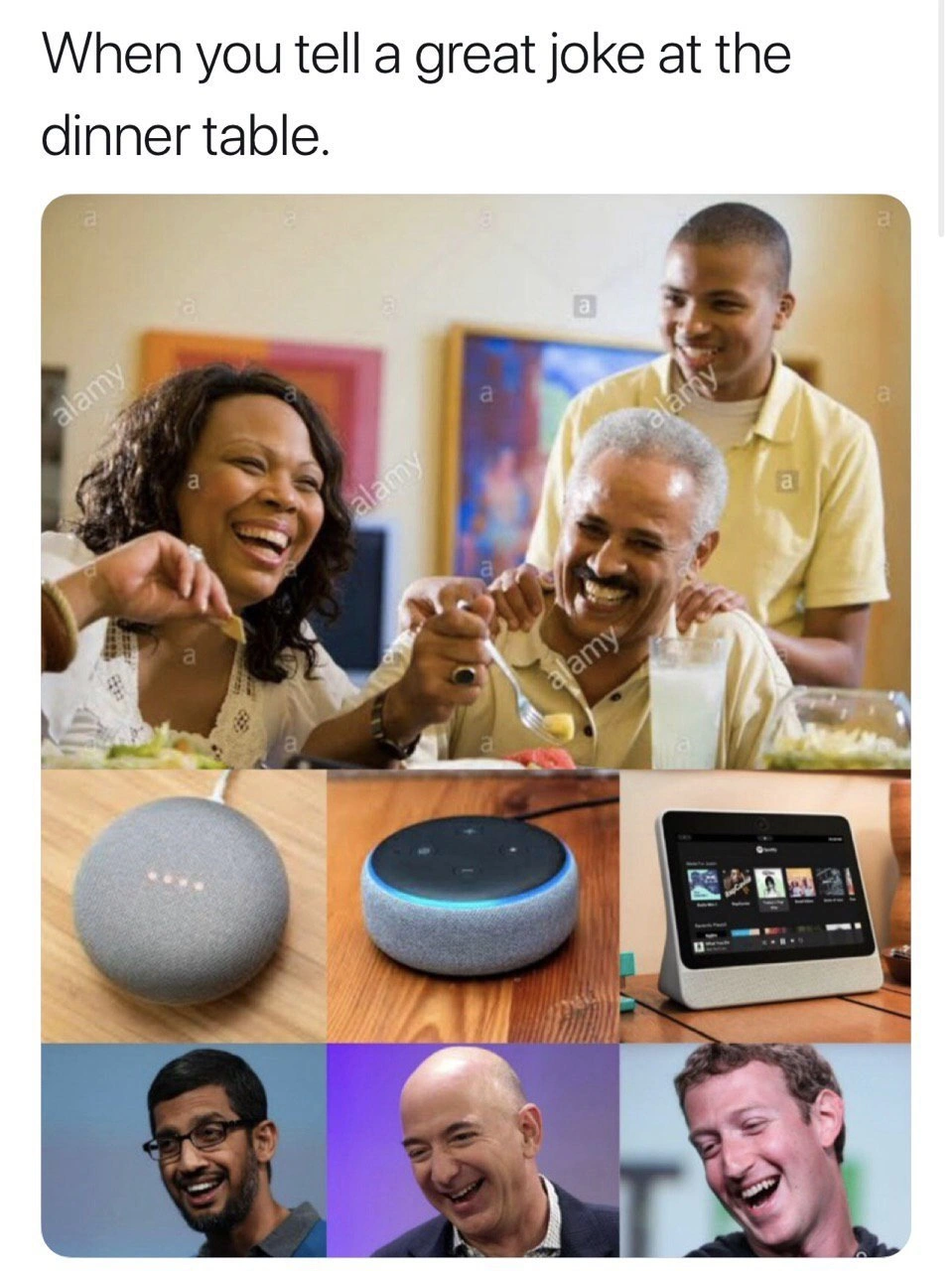
Imagine you’re sitting at the dinner table with your family and you tell your funniest joke. You think only your family is around to hear it. But guess what? In the corner of the room there’s a little talking gadget (like an Alexa or Google Home speaker). This gadget is always quietly listening, just in case you say its name. When you told your joke, your family maybe didn’t laugh or notice, but the gadget heard you! Now, this gadget works for a big company, and it can send what it hears back to that company. In the meme, it’s as if the big bosses of the company (imagine the people in charge of Alexa or Google) also heard your joke through that gadget – and they are laughing at it. It’s a funny picture because you never expect the CEO of Amazon or Google to be part of your dinner conversation, right? It’s like you thought you were just talking to family, but a sneaky little microphone carried your joke to someone far away. The reason it’s a bit silly (and a bit scary-funny) is that it reminds us someone else might be listening when we think we’re alone. In simple terms: you told a joke to your family, but only a secretly listening robot and the people who made it found it funny. It’s a joke about why privacy – keeping things just between you and your family – is important, because nowadays even the gadgets in our homes might be eavesdropping like a little spy who laughs along.

Level 2: Smart Speaker Secrets

Let’s break down the meme in simpler terms. In the pictures, we see a family at dinner, some smart gadgets on a table, and three tech CEOs. The joke here is about smart speakers and privacy. Smart speakers (like the Amazon Echo Dot or Google Nest Mini shown in the middle row) are part of the Internet of Things (IoT) – everyday devices connected to the internet. They run voice-based assistants (think Alexa for Amazon, Google Assistant, or others) that you can talk to. For example, you might say “Hey Google, play some music,” and the little puck-shaped speaker will respond. How does it know you said the wake phrase? Because its microphone is always on, quietly listening for those trigger words. This is what we mean by always_listening_devices.

Now, “always listening” doesn’t mean it’s constantly recording everything you say and sending it to the cloud non-stop. Instead, devices like these use a local detector that waits until it hears “Alexa” or “Hey Google”. Only then do they actively record your request and send the audio data to the company’s servers to figure out your question or command. There’s a tiny pause, then usually the device answers you (like telling a joke or the weather). In the meme, however, this feature is turned into a comedic situation: you tell a funny dinner_table_joke, but maybe your family is occupied or didn’t laugh. Still, your trusty voice assistants heard it because, well, that’s what their mics do — listen. The next part of the meme shows the big bosses of the companies that made these devices (Google’s CEO Sundar Pichai, Amazon’s founder Jeff Bezos, and Facebook’s CEO Mark Zuckerberg). They appear to be laughing enthusiastically. The implication is that these tech companies (through their devices) overheard your joke and found it hilarious, even if your family didn’t! It’s a tongue-in-cheek way to poke at PrivacyConcerns: it feels like not only are the gadgets listening to you, but the people in charge (or at least their algorithms and data teams) are listening too.

This relates to real worries people have about voice_assistant_eavesdropping. For example, many users have wondered, “Is my Alexa or Google Home recording everything I say, even when I haven’t called its name?” There have been cases (in real life) where these devices misheard something and started recording private conversations by accident. That’s pretty scary from a DataPrivacy perspective! It’s also known that snippets of your voice commands might be stored and reviewed by the company to improve the AI — something not everyone realizes. So in the meme, saying only the smart speakers and CEOs laughed at your joke is a humorous exaggeration of those PrivacyConcerns. It suggests that the device is effectively sharing what it hears with big companies. The tag SurveillanceCapitalism is a big phrase that basically means companies make money by collecting lots of data about what we say, do, and like. Here, your joke is portrayed as part of that data stream.

For a junior developer (or anyone new to these concepts), the meme is highlighting a key Security vs. Usability trade-off. We love the convenience of just talking out loud to a device and having it respond – that’s the Usability side, super high. But the Security (and privacy) side is lower because a microphone that’s always on can potentially pick up things you didn’t intend to share. It’s like having an ear in the room that belongs to someone else. In tech terms, the DigitalAssistant in your home is connected to BigTechCompanies (like Amazon, Google, Facebook), and you’re trusting them with bits of your private life. The meme takes a light-hearted jab at that trust: imagining that those CEOs are literally tuning in and laughing at whatever you say. Of course, in reality, Jeff Bezos isn’t sitting in a control room listening to random dinner conversations — there are too many Alexa devices out there for any person to do that. But the AI humor here is that maybe their AI systems or data algorithms effectively are listening, in an automated way, and the companies might be metaphorically “happy” to get any and all data from you, even your corny jokes.

So, to sum up the straightforward meaning: You cracked a joke at home. Your human family didn’t react, but the smart speakers on the table “heard” it. The meme jokingly shows the bosses of the companies that made those speakers laughing, as if they heard it too. It’s funny because it plays on the idea that these devices are like little spies we invited in — a mix of tech humor and a bit of truth about smart_speaker_privacy concerns. And it reminds us in a comedic way that privacy matters… or does it? The meme’s caption “Privacy matters?” hints that we should question how much we value privacy when we’ve willingly put these mics all around us.

Level 3: Eavesdropping as a Service

"When you tell a great joke at the dinner table."

In the software industry, we joke that any sufficiently advanced technology is indistinguishable from a monitoring device. This meme plays on that paranoia. The family in the top panel is presumably the intended audience for your joke, but notice their blurred, watermarked faces – they’re practically background noise. The real focus is on the middle row: the smart speakers and devices parked on your table, quietly doing their always_listening routine. An experienced dev recognizes those gadgets instantly: a Google Nest Mini (gray fabric puck), an Amazon Echo Dot (with its signature blue Alexa ring), and a Facebook Portal-like smart display. Each of these is a friendly consumer IoT device on the surface, but under the hood they’re part of a massive data-gathering apparatus. When they hear your voice (joke or not), they shuttle that audio clip upstream. It’s like your quip just got converted into a cloud function call. Congratulations, you open-sourced your joke to Big Tech! 😅

The bottom row completes the punchline: three famous tech CEOs laughing uproariously. That’s Sundar Pichai of Google, Jeff Bezos of Amazon, and Mark Zuckerberg of Facebook, all depicted chuckling like your joke was the highlight of their day. Why them? Because these are the corporate overlords behind those devices. The meme exaggerates that surveillance capitalism dynamic – you thought you were just talking to family, but in a way you were also performing a stand-up routine for the billionaires whose products are listening in. It’s a cheeky way to say: the microphones are hot, and someone on the other side might be amused. Developers who follow tech news will recall real incidents that make this humor hit close to home. Amazon’s Alexa, for instance, has accidentally recorded private conversations and sent them to random contacts due to misheard commands. Google and Apple have been caught having human contractors listen to snippets of “anonymized” recordings to improve their assistant AI. Facebook’s reputation for listening is practically an urban legend among developers — many swear their phone’s Facebook app must be eavesdropping because they get eerily accurate ads for things they only spoke about. (Facebook denies this, but the data_collection_paranoia persists.) So when we see Zuck laughing in the meme, we smirk knowingly at that conspiracy-tinged joke.

From a senior developer’s perspective, the meme is funny because it’s uncomfortably true. We’ve architected these voice_user_interface systems to be always on for convenience. In practice that means a stray remark at your dinner table can become part of some telemetry dataset. That “great joke” you told? In a twisted scenario, it’s now A/B tested content for an AI’s training data, or fodder for a targeted marketing algorithm. The humor has a dark edge: only the smart speakers and their CEOs laughed, implying your family didn’t even notice your joke, but the machines built for surveillance sure did. It’s a riff on the idea that these devices pay more attention to us than actual humans do – an ironic commentary on modern life. We’ve invited always_listening_devices into our homes for music, trivia, and turning off the lights, and in return we’ve got an audience that never sleeps. There’s an implicit nod to SecurityVsUsability here: as developers, we know you could enforce push-to-talk to protect privacy (so the mic isn’t live 24/7), but then you lose the magic of hands-free convenience. Most users opt for convenience, so we as an industry ended up with this trade-off where jokes and gaffes can become data.

And let’s talk trust: We say “Privacy matters?” with a question mark because in practice, many consumers (and by extension, us devs) shrug and say “well, I have nothing to hide, and this gadget is cool.” That resigned attitude is exactly what Big Tech is laughing all the way to the bank with. They’ve managed to turn data privacy concerns into a running gag – literally here, your joke is their content. An old-school engineer might recall the days when bugs in your code were your biggest worry; now we joke that bugs in your house (listening devices) are a concern too. It’s a very contemporary kind of humor. The meme works on multiple levels: it’s absurd (CEOs personally laughing at your joke – they’re not actually doing that… we hope), but it satirizes real issues like voice_assistant_eavesdropping and corporate surveillance. It’s the kind of joke that makes developers chuckle and then nervously glance at the lit-up Echo dot on the shelf and wonder, “Did it hear that?”

Level 4: Always-On Architecture

At the deepest technical level, this meme hints at the always-on audio processing pipeline inside modern smart speakers. These devices use an array of sensitive microphones and a wake-word detection subsystem to constantly monitor ambient sound. Under the hood, a lightweight DSP (Digital Signal Processing) module or a small neural network is continuously scanning for a keyword like "Hey Google" or "Alexa". This on-device model is tuned to recognize the specific acoustic fingerprint of the wake word while ignoring other chatter (in theory). It’s essentially doing real-time pattern matching on a rolling audio buffer, a bit like a sliding window that analyzes every few milliseconds of sound for the magic sequence.

Once the wake word is detected, the device’s full attention snaps on, and it starts streaming audio to the cloud. Here's where the heavy AI/ML comes in: the voice data gets sent over the internet (usually via an encrypted TLS channel) to Big Tech’s servers, where powerful speech-to-text algorithms (often deep neural networks) transcribe your words and natural language processing figures out the intent. This design is a classic edge computing trade-off – minimal processing on the device (for battery/CPU efficiency) and more intensive computation on cloud servers. The flip side is that your spoken words (joke and all) become data packets routed to a remote data center. Security experts will recognize this as enlarging the attack surface: your voice is now traveling through routers, hitting backend databases, and possibly being logged for "quality assurance". Each step is an opportunity for things to go wrong or be misused.

From a theoretical standpoint, ensuring privacy here verges on formal verification impossibility. You'd have to trust that the device only uploads audio after the wake word. But without open-source code or rigorous proofs, always_listening_devices operate like black boxes – it’s a Halting Problem of eavesdropping: you can’t easily tell if they’ve truly halted recording when they say they did. Some enthusiasts discuss using techniques like homomorphic encryption (processing data without decrypting it) to protect voice data, but that's computationally heavy and impractical for real-time home use. Others suggest differential privacy in voice datasets – adding noise to anonymize speaker identity – but you obviously can’t blur the audio too much or Alexa won’t understand your command. In short, the fundamental architecture that makes voice assistants so convenient is built on streaming your voice to someone else’s computer. No amount of ML magic or edge optimization fully escapes that reality. The meme takes this complex technical paradigm and distills it to a dark punchline: even your dinner-table joke becomes part of the IoT data pipeline that Big Tech might be listening to. The privacy vs. usability tension is baked into the system at a low level. As engineers, we appreciate the elegance of continuous voice user interface design – a tiny always-on neural network triggering a massive cloud service – but we also shudder because it’s basically a sanctioned wiretap by design. And as this meme jokes, even a harmless quip at dinner might tickle the fancy of an AI system and, by extension, the humans behind it.

Description

This multi-panel meme contrasts a wholesome family moment with the pervasive nature of tech surveillance. The top panel, captioned "When you tell a great joke at the dinner table," shows a stock photo of a smiling, happy family enjoying a meal together, conveying a sense of private, shared joy. The bottom half of the image shatters this illusion with a six-panel grid. The top row of the grid displays three smart home devices: a Google Home Mini, an Amazon Echo Dot, and a Facebook Portal. The bottom row shows the corresponding laughing faces of the respective company leaders: Sundar Pichai (Google), Jeff Bezos (Amazon), and Mark Zuckerberg (Facebook). The humor is derived from the dark implication that our private conversations are being monitored by these devices, and the leaders of these tech giants are metaphorically "laughing along" with our jokes, highlighting widespread concerns about data privacy and the intrusive nature of always-on smart technology in a relatable, satirical way
Comments

15
Anonymous ★ Top Pick My smart speaker is the best audience. It never interrupts, always laughs at my jokes, and conveniently remembers them for my annual targeted ad profile review
  1. Anonymous ★ Top Pick

    My smart speaker is the best audience. It never interrupts, always laughs at my jokes, and conveniently remembers them for my annual targeted ad profile review

  2. Anonymous

    Told a joke at dinner; family shrugged, but the Nest streamed it to Kafka, the Echo piped it through Kinesis, and somewhere three CEOs are A/B-testing my punchline for ad targeting - finally hit 99.999% laugh-availability, just not in my own SLA

  3. Anonymous

    The real joke is that we've willingly deployed a distributed network of corporate listening devices throughout our homes, then act surprised when they 'accidentally' record us - meanwhile, the CEOs are laughing all the way to their quarterly earnings calls about 'user engagement metrics.'

  4. Anonymous

    The real joke is that these devices have a 99.9% uptime for listening to your conversations, but somehow can't understand 'turn off the living room lights' on the first try. Meanwhile, the CEOs are laughing all the way to the data broker - because nothing says 'smart home' quite like monetizing your dinner table banter through always-on microphones with cloud-based transcription services that definitely, totally, absolutely only activate on wake words

  5. Anonymous

    Edge computing at its finest: joke processed locally, hilarity mirrored to hyperscalers

  6. Anonymous

    Dropped a great joke at dinner; three wake-word false positives later, Google indexed it, Alexa monetized it, and Meta set it as my core interest

  7. Anonymous

    My joke didn’t land with the family, but three hotword detectors hit 1.0 confidence, lit the blue ring, and shipped the punchline to a quality_improvement bucket under someone’s engagement OKR

  8. @sashakity 4y

    if this is a question, yes

  9. @vo1dee 4y

    nothing else matters

  10. @RiedleroD 4y

    zucc be there like -registered laughter- -initiating peer pressure- -printing to stdout- : wow this joke was very funny. haahaa. I confirm that I have 'got it'.

  11. @RiedleroD 4y

    bezos be like hahaha that joke was so good, I'm gonna give my workers coupons for half a piss bottle.

    1. @deerspangle 4y

      Nah, he'll sue to take ownership of the joke

  12. @RiedleroD 4y

    Larry page be like hahaha save that into our database and while you're at it, also increase the Objective Person Quality™ of that man by 20%

    1. Deleted Account 4y

      Sundar Pichai (Larry Page)

  13. @thedeltaw 4y

    for them NAH

Use J and K for navigation