A Mischievous Call to Escalate Problems to the Senior Developer
Why is this Juniors meme funny?
Level 1: Parent to the Rescue
Imagine you’re helping in the kitchen for the first time and you accidentally make a huge mess — say you put a metal cup in the microwave and it starts sparking, or you mix up salt for sugar in a cake and it’s now inedible. You’re just a kid trying your best, but suddenly there’s smoke and a ruined cake. What happens next? A grown-up (like your mom or dad) rushes in to save the day. They turn off the microwave, open the windows, calmly sort out the mess, and maybe even manage to fix the situation or start over. You feel a bit embarrassed, and you’re really glad they knew what to do. Later on, everyone jokes, “Remember when you nearly set the kitchen on fire and Mom had to step in?” It’s funny after the crisis is over.
This meme is just like that, but in the world of computer programmers. The “kid” in the analogy is a new developer who caused a problem in a software program (like the kitchen mishap), and the “parent” is the senior developer who comes in to fix everything (like cleaning up the mess and fixing the cake). It’s humorous because it shows a very human situation: a newbie makes a big oops, and the experienced person rescues the situation. We laugh because we’ve all been the newbie at some point, and we all appreciate having a calm expert to help when things go wrong. The meme is basically saying, “Oops! I made a mess, better get the expert.” It’s poking fun at that scenario in a lighthearted way, just like a family might playfully tease about the kitchen incident once the kitchen is safe again.
Level 2: Oops in Production
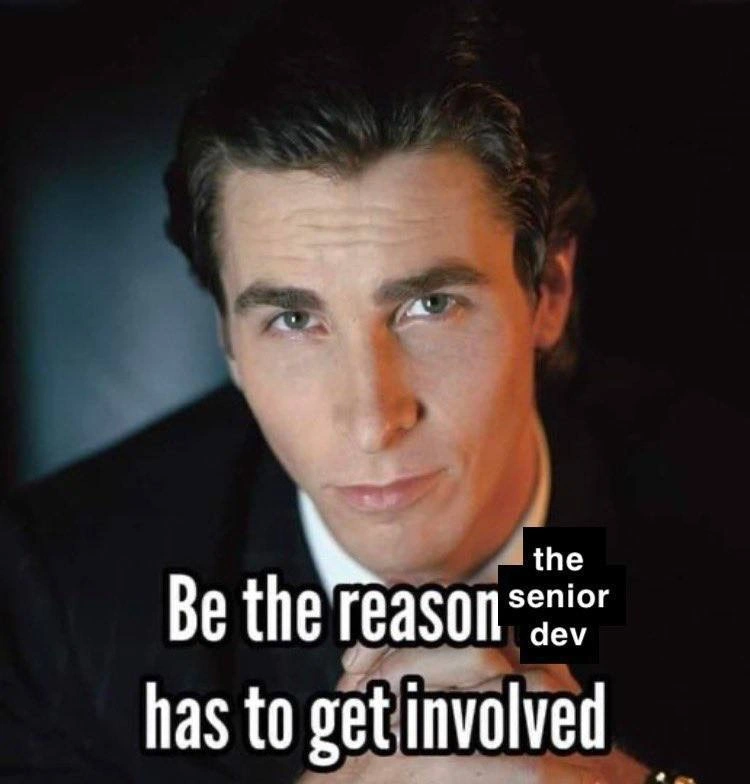
Let’s break down what’s happening in this meme for a less experienced developer. The phrase “Be the reason the senior dev has to get involved” is joking about a junior developer causing a serious problem in a live system. In software teams, a junior dev is someone new or with less experience, while a senior dev is a seasoned engineer who’s dealt with many problems before. The meme uses the well-known “Most Interesting Man in the World” image template — usually a distinguished-looking guy with a caption about outrageous exploits — but here it’s flipped into a tongue-in-cheek challenge. It’s basically saying: “Go ahead, write such buggy code that the most experienced developer on the team has to step in and fix it.” Of course, in reality no one wants that, but the joke is funny because it’s a situation that does happen often in real software projects.
Key terms:
- Bug: This is a mistake or error in the code that causes the software to behave unexpectedly or crash. For example, a bug could be as simple as using the wrong variable name, or as nasty as a logic error that corrupts data. In the meme’s context, it’s a bug big enough to cause a real problem.
- Production: This refers to the environment where the application or system is running for real users or customers. If something “breaks in production,” it means the live app or website is having issues (as opposed to a test environment). It’s a developer’s worst nightmare when something goes wrong in production, because it impacts real people and the company’s business.
- Senior dev gets involved: Usually, teams have an on-call rotation or just an understanding that if something goes really wrong, a very experienced developer will jump in to handle it. Senior developers have seen many issues and generally know how to troubleshoot effectively under pressure. They might not normally be involved in every little bug, but for a major incident (often called a “Sev1” or severity-one incident, meaning highest priority), they’ll take charge.
So the scenario is: a junior developer writes code and unknowingly introduces a serious bug. Maybe they didn’t realize an assumption was wrong, or they missed an edge case. For example, a newbie might write a piece of code that accidentally deletes more data than it should, or they could deploy a change without testing it properly. Everything might seem fine at first, but then that bug causes something to fail in the live system. It could be immediate (the website crashes) or it might slowly cause trouble (like the application getting slower and slower due to a memory leak). Eventually, an alert goes off — maybe an automated monitoring system starts sending out failure alerts, or a user reports “Hey, I can’t check out in the store anymore!” That’s when the senior dev is called in. This is often informally referred to as “firefighting” mode, because the team is scrambling to fix a burning issue.
For a junior dev, this situation is both terrifying and educational. You definitely don’t want to be the one who “broke prod” (broke the production environment). It’s embarrassing and stressful. But if it happens, the senior dev is like the firefighter or doctor arriving at an emergency. They’ll try to calm things down, figure out what the junior’s code did, and apply a fix or a workaround to get things running again. That might involve reading error logs (files or console messages that record what the software was doing when it failed), checking the recent code changes (using tools like git to see what was last modified), and maybe reversing the change (this is called a rollback). The senior dev might also involve others, like a database expert if the bug messed up data, or a DevOps engineer if servers need restarting.
The meme is relatable because almost every developer has been on one side or the other:
- As a beginner (newbie), you might inadvertently do something that causes a big problem. It’s usually not because you’re careless, but simply because you didn’t know better or didn’t understand some complex part of the system. Maybe you thought a command would do one thing, but in production it did something else entirely (we’ve all heard stories like someone running
DROP TABLEon the production database by mistake… yikes!). - As an experienced developer, you’ve been the “fixer” who gets that late-night call or urgent message: “Hey, we need you. Something is wrong and we can’t figure it out.” Senior devs have the knowledge of both the system and past incidents, so they often can troubleshoot faster. They might say, “Oh, this error message looks familiar. I bet it’s the payment service acting up because of that config change earlier.” Their calm and expertise is gained from having lived through many past mistakes (including their own early mistakes).
The text in the meme uses a bold white font and even pasted the words “the senior dev” over it in a blocky way. That visual style itself is like a quick hack – it’s as if someone literally took a piece of tape labeled “the senior dev” and slapped it on. This resembles how in real emergencies, fixes can be a bit improvised. Engineers sometimes talk about “duct-tape fixes” or “band-aid solutions” for urgent patches — meaning a temporary fix that might not be pretty but prevents the system from bleeding until a proper solution is made. A senior dev might do a quick workaround at 3 AM to stop the error, then the next day the team will come back and clean up the code properly.
In summary, the meme humorously captures a rite of passage in the programming world. It teases junior developers by saying “go on, be so proud of your bug that you become infamous for needing senior help,” knowing full well that no junior actually wants that. The joke works because every developer can nod and think, “Yep, I remember the time I broke something important,” or “I remember when my evening was ruined because a newbie broke the build and I had to fix it.” It’s half cringe, half laugh — and a learning moment for all.
Level 3: 3AM Hotfix Heroics
The meme’s tagline — “Be the reason the senior dev has to get involved” — drips with dark humor that only battle-worn engineers fully appreciate. It’s a twisted riff on the Most Interesting Man in the World meme, except here it’s suggesting an anti-achievement: causing such a gnarly bug that it triggers an immediate escalation to the on-call senior developer. Picture a production outage at 2 AM: dashboards blinking red, error logs spamming, managers panicking in Slack. The phrase “the senior dev” is slapped over the image with a makeshift black patch, much like a quick-and-dirty hotfix hurriedly applied to broken code. This visual gag is a nod to how seniors often have to patch things under pressure — inelegant maybe, but life-saving in the moment.
Seasoned developers recognize the scenario instantly. It’s the classic newbie mistake that slips through and detonates in an environment where real customers are impacted. Maybe the junior merged a change on Friday 5 PM (because of course they did) without running the test suite. Perhaps they introduced a subtle memory leak or an off-by-one error in a critical loop. Could be they didn’t realize their seemingly innocent code would deadlock a database connection pool under load. Suddenly the site is down or a key service is on fire, and the monitoring system is paging the senior in a Severity-1 incident response. This is the escalation_to_senior everyone dreads: when a late-night deploy or a hidden bug triggers full-on debugging_firefighting mode. The meme finds humor in this pain, essentially telling juniors, “Go on, be that developer — the one who crashes production and makes the senior earn their pay.” It's funny precisely because no one wants to be that person, yet it inevitably happens.
Why is this so relatable? Because software systems are absurdly complex beasts. In a large codebase or a distributed microservices architecture, a tiny flaw can cascade like a row of dominos. That one-line bug in the payment service? It queues up transactions infinitely, overwhelms a message broker, and suddenly breaks_production in a domino effect that only a proficient firefighter can untangle. Senior devs have war stories of production bugs that felt like hunting phantoms: a misconfigured ENVIRONMENT variable pointing to the wrong database, a rogue NULL pointer that only crashes on leap years, a caching issue that only appears under high load at 3:07 AM on a full moon. Experience teaches you to expect the unexpected — chaos engineering is practically a way of life. The veteran engineer has a mental catalog of these nightmare scenarios. They’ve learned that debugging often means reading between the lines of sparse logs and using every tool in the arsenal: stack traces, git bisect to find which commit introduced the fault, maybe attaching a live debugger or sprinkling in extra logging and redeploying in the middle of the night. They know that a bug can make it past all safeguards and lie in wait until the worst possible moment.
Speaking of safeguards, the meme also implicitly pokes at process failures. In theory, good DevOps practices (CI/CD pipelines, code review, automated testing) should catch a rookie’s blunder before it hits production. In practice, teams move fast and “move fast and break things” sometimes means breaking things in prod. That bold black rectangle covering the original meme text is ironically symbolic: it’s like a last-minute patch over something that wasn’t supposed to happen. It’s a bit of a Git blame badge. The senior developer’s involvement is the human equivalent of an emergency patch. They roll up with deep knowledge of the system’s arcane parts — maybe the legacy code with no documentation that only they understand — and apply surgical fixes to stop the bleeding. Often this involves not just coding but also coordinating: pulling in database backups, toggling feature flags off, or even doing the dreaded rollback of a deployment. Imagine a tired engineer muttering, “I’ve seen things you people wouldn’t believe…null values on fire off the shoulder of Orion,” while diving into spaghetti code that’s crashing. That’s the vibe.
Ultimately, the humor lands because it’s a relatable_developer_experience born out of shared pain. Every senior developer was once a junior who wrote something regrettable. And every junior fears (or perhaps darkly jokes about) writing the bug that wakes up their boss at midnight. The meme turns that anxiety into a dare and a laugh. It’s the camaraderie of DeveloperHumor: we’ve all broken something critical at least once, and we’ve all either made the panicked call or been on the receiving end of it. After the system is back up and the root cause (a missing null check, an unescaped string, a == that should have been ===) is finally found, the team might joke, “Well, you really were the reason the senior dev had to get involved.” In hindsight it’s funny — a rite of passage in software development, captured in one meme-worthy line.
# Hypothetical example of a junior-triggered bug in production (Ruby pseudocode)
def process_orders(orders)
orders.each do |order|
fulfill(order)
# Junior forgot to handle network failures and rollback properly
log "Fulfilled order #{order.id}"
end
end
# This works fine in tests, but in production a single network glitch
# could leave an order half-processed, requiring emergency fixes at midnight.
Description
A meme featuring a close-up shot of Christian Bale as Patrick Bateman from the film 'American Psycho,' looking intensely and directly at the viewer with a slight, confident smirk. Superimposed over the image is large, white, bold text that reads, 'Be the reason has to get involved'. A black box with the words 'the senior dev' is layered over the original text, clarifying the sentence to read, 'Be the reason the senior dev has to get involved.' The image's dark, serious tone contrasts with the humorous, chaotic suggestion in the text. This meme satirizes the dynamic within development teams where complex or critical issues are escalated to senior developers. It humorously advocates for causing just enough trouble - whether through ambitious but flawed code, breaking the build, or causing a production incident - to necessitate their intervention. For experienced engineers, it's a tongue-in-cheek reference to the inevitability of being the final backstop for problems, and a nod to the sometimes-destructive curiosity of less-experienced team members
Comments
19Comment deleted
My motto is 'move fast and break things.' The senior's motto is 'move slow and bill for the incident response consultation' after my last deployment
Introduce a Heisenbug in the distributed cache so sneaky the senior dev ends up whiteboarding Schrödinger’s TTL at 2 a.m
The only thing worse than being paged at 3 AM is realizing the root cause is that 'temporary' workaround you approved six months ago because 'we'll refactor it next sprint' - and now it's handling 10x the traffic it was designed for
Every senior engineer knows that moment when Slack lights up at 2 AM with 'I think I broke prod' from a junior who decided to 'just quickly' refactor the authentication service on a Friday afternoon. The real skill isn't writing perfect code - it's becoming the reason your tech lead has to explain to the CTO why the entire user base got logged out during peak hours. Bonus points if your fix involved a force push to main and a creative interpretation of 'backward compatibility.'
Junior's 'quick fix': the event that overflows a senior's strategic planning stack with recursive debugging calls
Be the reason a senior dev gets involved: say “Kafka is exactly-once so we can skip idempotency keys” and push to prod
Want the senior to materialize? Ship a Friday hotfix with a non-idempotent migration behind a “temporary” flag - eventual consistency plus DELETE without WHERE is basically a PagerDuty summoning circle
Be the reason the company has testers. Comment deleted
Be the reason unit-testing and, especially, regression testing was invented. Comment deleted
be the reason a pipeline gets blown up I'm not specifying which kind Comment deleted
Pipe bomb Comment deleted
Be the reason nobody gets fired Comment deleted
be the reason your boss gets fired Comment deleted
Be the reason you can't be fired because you're the only one who understands your code Comment deleted
Be the reason the server needs /votekick 🤓 Comment deleted
Oopsie Comment deleted
yea Comment deleted
Be the reason the blue team has to get involved Comment deleted
Be the reason the senior dev quits Comment deleted