The Harsh Christmas Morning Reality for Aspiring Prompt Engineers
Why is this AI ML meme funny?
Level 1: Coal in the Stocking
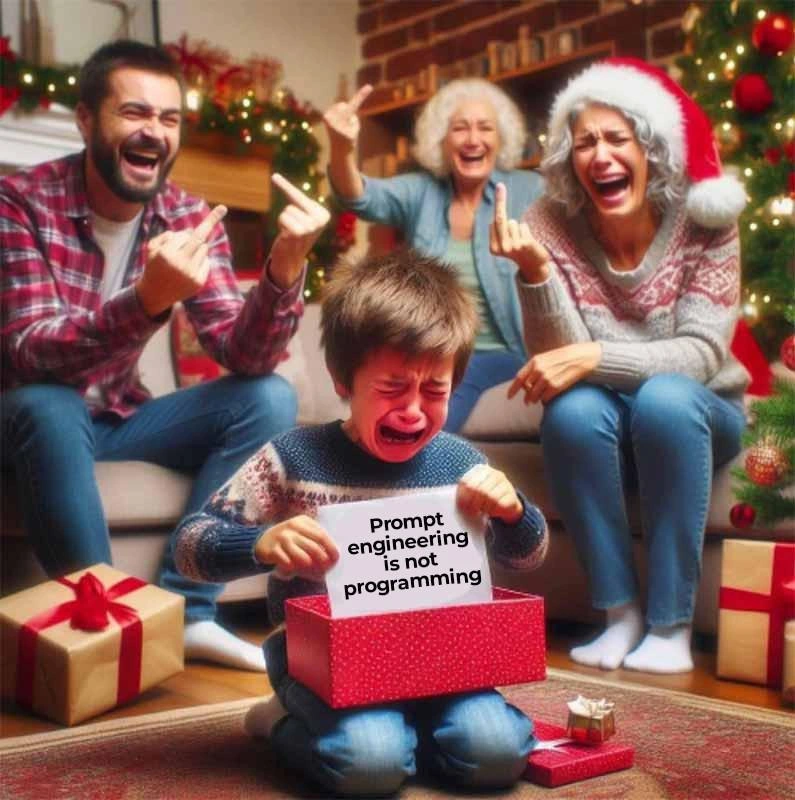
Imagine it’s Christmas morning and a little kid excitedly opens a gift box under the tree. But instead of a toy, inside the box there’s just a note that says, “Your favorite thing isn’t real.” Ouch! The kid bursts into tears because it feels like a really mean surprise. Now the whole family is upset – even Grandma and Grandpa are angrily shaking their fists or giving a big thumbs-down. Essentially, this meme is exactly that scenario, but with a tech twist. The kid’s note says “Prompt engineering is not programming,” which is like telling someone the way they’ve been having fun or doing something they love doesn’t count as the real thing. It’s funny in a cheeky way because you normally wouldn’t see a family all flipping the middle finger over a Christmas present! That over-the-top reaction is showing how strongly people feel about this idea. In simple terms, the meme is joking that saying “prompt engineering isn’t real coding” is a bit like spoiling someone’s joy – it’s a bad gift that nobody asked for, and everyone’s reacting with comical outrage. You don’t need to know the tech details to get the joke: it’s basically like giving a kid a gift that insults them and seeing the family understandably go wild with disapproval. The exaggerated emotional scene makes it clear why it’s funny – it’s highlighting how a single sassy statement can ruin the holiday mood and unite the whole room in saying “Not cool, man, not cool!”
Level 2: Coding with Words
Let’s break down what this meme is about in simpler technical terms. It’s contrasting traditional programming with something new called prompt engineering in the context of AI.
Programming (traditional coding): This is what we usually mean by writing code. A programmer uses languages like Python, Java, or C++ to write step-by-step instructions that a computer can execute. For example, if you want the computer to calculate 2+2, you might write a line of code like
print(2+2). The key is that the human programmer figures out exactly how to solve the problem and writes the correct syntax so the computer does it. It’s a bit like giving the computer a recipe with exact measurements and steps – you have to be precise, or you get errors (bugs).Prompt engineering: This term came up with the rise of AI models, especially LLMs (Large Language Models) like OpenAI’s ChatGPT or GPT-4. These models are trained on tons of text and can generate answers, code, or content based on a prompt (which is basically a user’s question or instruction). Prompt engineering means writing that instruction in a clever way to get the best result from the AI. Instead of writing code to solve a problem, you ask the AI to solve it or to produce the code for you. For instance, rather than coding the 2+2 example yourself, you could give the AI a prompt: “Hey AI, write a Python program that prints the sum of 2 and 2.” The AI might then output:
print(2+2)as the code solution. You haven’t written the code yourself; you described what you wanted in English, and the AI provided the code or the answer.
So why do some people say “prompt engineering is not programming”? Well, in traditional terms, when you’re programming, you are the one implementing the logic. When you use prompt engineering, the heavy lifting is done by the AI model. It’s more like you’re requesting or directing the computer to do something without manually coding it. You’re coding with words instead of with syntax. This requires a different kind of skill: you need to understand how the AI might interpret your request. For example, if your prompt is vague or ambiguous, the AI might give a poor or wrong answer. Prompt engineers learn tricks like providing clear steps, giving the AI some context, or examples in the prompt (this is called “few-shot prompting” when you give a couple of examples of what you want). It’s somewhat akin to phrasing a Google search cleverly, but more complex because the AI can follow instructions and context, not just keywords.
In the meme, a child opens a present and finds a card that flatly states “Prompt engineering is not programming,” and the whole family reacts negatively (flipping the bird and the kid crying). This reflects how controversial that statement is in the tech world, especially in developer communities interested in AI. Many people who have been coding for years feel that writing a prompt for an AI, while useful, isn’t the same as building a program from scratch. On the other hand, people who are excited by AI (or maybe not as experienced in coding) might feel that being good at prompting an AI is a valuable technical skill — after all, if you can get an AI to produce a working app or solve a coding problem with just a well-crafted prompt, that’s pretty powerful, right? It’s a bit of a pride and identity thing. Telling a room full of AI enthusiasts “that’s not real programming” is like telling a room full of guitar players that playing Guitar Hero isn’t really playing guitar – you’re guaranteed to get some boos or worse!
To connect it to the tags: AIHumor and AIHype are in play. There’s been a lot of hype about AI making programming easier, or even doing programming for us. Some startups even advertise tools where you just describe what you want in plain language and the software builds it – essentially selling the idea of prompt engineering replacing coding. This has created a bit of a backlash (AI hype backlash as the tags say). Seasoned developers may roll their eyes at the idea that you can skip learning to code. The meme uses a holiday_meme setting (Christmas gifts and family) to amplify the humor: imagine bringing up a nerdy argument like this during a cheerful family gathering – it’s ridiculous, right? But that’s the joke: it’s portraying the debate as so intense that even a grandma in a Santa hat is giving the middle finger 🙈. That hand gesture (yep, the family_reaction_gesture in the tags) is an over-the-top symbol of disagreement. It’s the family saying, “We do NOT accept this message!” in the most explicit way.
For a junior developer or someone new to this topic, the key takeaways are: Prompt engineering involves interacting with AI models by giving them good instructions, whereas programming involves writing the actual code logic yourself. They overlap (both require understanding problems and desired outcomes), but they’re not identical. The meme is riffing on the cultural clash between AI newcomers who lean on tools like ChatGPT and old-school programmers who spent years writing code. It’s a funny exaggeration – in real life, hopefully nobody’s literally crying or flipping tables over this debate, but feelings do run strong online. If you’ve ever seen arguments on Twitter or Reddit about “is HTML/CSS real programming” or “are no-code tools making developers obsolete,” this is cut from the same cloth. Developer humor turns those heated arguments into a joke to make us laugh at ourselves. And in this meme’s case, it uses the innocence of a Christmas morning and then bam! delivers a spicy tech opinion as the gift, and shows a family meltdown to illustrate just how not-well-received that opinion is.
Level 3: Hype-Driven Development
This meme lands squarely in the middle of a developer community culture clash. It humorously spotlights the ongoing debate (and meme-worthy drama) around AI hype vs reality. The image is a cozy holiday living room — twinkling Christmas lights, a kid opening a present — suddenly turned into a battleground of tech opinions. The “gift” is a card declaring, “Prompt engineering is not programming.” Instead of smiles, the family greets this statement with a unified middle-finger salute 😅. It’s an absurd contrast: a wholesome Christmas morning scene instantly morphs into a salty Reddit thread in real life. This exaggeration is funny because it captures just how viscerally some developers react to the claim that crafting prompts for an AI isn’t “real coding.”
Why such a strong reaction? In developer circles, calling something “not real programming” is the ultimate gatekeeping move. It taps into long-running tensions in tech: every few years, there’s a new tool or abstraction that sparks this same argument. (Veteran devs might recall fights over whether using Dreamweaver or drag-and-drop UI builders was “real programming,” or whether writing SQL is “real programming” compared to writing application code, or even whether high-level languages count if you didn’t suffer through assembly 😂.) Now the spotlight is on prompt engineering because of the meteoric rise of AI tools like ChatGPT. AI/ML advancements have enabled non-traditional “coding” tasks – for instance, you can ask an LLM to generate code, create content, or solve problems by describing what you need in plain English. Suddenly, people who don’t write a single line of Python or Java can produce working programs or at least prototype ideas. This has led to breathless IndustryTrends hype: companies listing high-paying positions for Prompt Engineers, tech influencers claiming “Anyone can be a developer now by just talking to the AI!” and so on. To seasoned developers who spent years mastering algorithms, debugging segfaults at 3 AM, and navigating ever-changing frameworks, this hype can feel somewhere between exciting, belittling, and downright infuriating.
The meme nails this dynamic: the family’s furious reaction is like the collective groan (or middle-finger) of experienced devs hearing yet another pronouncement that “your hard-earned skills can be replaced by a fancy auto-complete.” It’s peak DeveloperHumor to show even Grandma flipping the bird — as if every generation of this coding family is offended. In reality, around tech forums and DEV communities, the discussion can get heated. One side (often younger or more AI enthusiastic folks) might say, “Writing a clever prompt is a skill! If I can get the AI to build an app by describing it, why isn’t that programming? I’m getting the same result – a working program – without having to write the syntax.” The other side (often seasoned programmers) retorts, “Because you’re not implementing the solution’s logic yourself. You’re outsourcing the problem-solving to a pre-trained model. If that model gives a wrong answer or needs optimization, do you know how to fix it? Real programming means understanding and controlling the code, not just asking an AI and hoping for the best.” In short, it’s a debate about what counts as coding work versus just using a tool.
This tension is fueled by AI hype in the industry. We’ve seen cycles where new tech is hailed as making old skills obsolete. Remember when no-code/low-code platforms were supposed to let product managers replace dev teams? In practice, those platforms found a niche but didn’t kill programming jobs – they just changed how some software gets built for specific use cases. Similarly, the hype around LLMs has spawned a bit of a backlash. Many developers love using GitHub Copilot or ChatGPT as helpers (it’s undeniably useful to automate boilerplate and get suggestions), but they bristle at the suggestion that prompt-tweaking alone could replace understanding how software works. There’s also a fear of knowledge rot: a junior dev who only knows how to prompt might struggle if the AI gives incorrect code or if they need to optimize something for performance, security, or edge cases – things a trained programmer anticipates. The meme’s emphatic statement, “Prompt engineering is not programming,” echoes this worry. It’s basically the community’s tough-love way of saying: “Don’t think you can skip learning fundamentals just because you have an AI magic wand.”
On the flip side, the outrage in the meme also pokes fun at how protective and prideful developers can be about their craft. The family’s reaction is so over-the-top that it satirizes the gatekeepers, too. It’s as if the adults on the couch are veteran engineers who’ve had one eggnog too many and will darn well not let the phrase “not programming” slide without a gesture. It highlights a bit of absurdity: even during the holidays, we can’t escape a programming vs prompting argument! Uncle Bob isn’t arguing about politics at Christmas dinner – he’s arguing about GPT-3’s latest update, and Grandma (perhaps a retired COBOL programmer 😜) is just as fired up. This is a nod to how pervasive tech debates have become; even holiday memes reflect developer flame wars.
The DevCommunities angle here is strong. Online, you’ll see impassioned posts and memes about “AI will take our jobs” vs “AI is just a tool.” The humor often comes from hyperbole, and this meme delivers that: a united family literally giving the one-finger salute to a mere suggestion that their beloved AI prompting isn’t “real code.” It’s a comedic way to say: this topic really sets people off. In reality, most developers would (hopefully) react more civilly than giving the finger to someone at a family party, but internally, some might feel exactly that level of annoyance when they hear “prompt engineers are the new programmers.” The Christmas setting also implies a gift gone wrong scenario. We usually expect gifts to be uplifting, but here the gift is basically a troll: a statement that might ruin the day for someone who fancies themselves an AI-whisperer. It’s like a bad in-joke that the whole family rejects.
In summary, at the senior-developer perspective, this meme is hilariously relatable because it encapsulates a real friction in today’s tech world. It calls out the AI_hype_vs_reality gap with dark humor. Yes, prompting an AI is a valuable skill in the era of GPT models, but many of us seasoned coders will snort at the idea that it replaces the deep work of actual coding. The truth is likely somewhere in between: prompt engineering can be powerful, but understanding programming is still crucial. The meme exaggerates the polar extremes – and that’s exactly why it’s funny. It takes the serious industry trend of AI and the cultural moment of holiday gatherings, and mashes them together into an unapologetically rude but comical family reaction. In other words, it’s saying “Happy holidays, and oh by the way, respect the craft of coding, ya filthy animals!” with a wink and a well-timed middle finger.
Level 4: Sorcery vs Software
At an abstract computing level, the meme hints at a clash between traditional programming and prompt engineering for AI. When we write code, we're explicitly designing algorithms: step-by-step logic in a formal language with strict rules. Each line of code is an unambiguous instruction to the computer’s CPU, manipulated through compilers or interpreters. By contrast, prompt engineering means crafting natural language instructions to guide a Large Language Model (LLM) (like GPT-4) toward a desired output. Under the hood, an LLM is a massive stateful statistical engine—billions of parameters (learned weights) that encode knowledge and patterns from training data. Prompting such a model is less like writing an algorithm and more like tuning an input to coax the right behavior from a complex pre-trained system. In a sense, the “program” for an LLM is already embedded in its neural network weights; the prompt is a high-level cue or query that activates certain parts of that latent “program.”
From a theoretical standpoint, this raises a fun debate: Is a prompt effectively a form of source code for the model? Traditionalists might invoke notions of Turing completeness – a programming language can, in theory, compute anything given enough time and memory, provided you can explicitly code the logic. A prompt, however, doesn’t guarantee a specific procedure; it relies on the LLM’s emergent capabilities and probabilistic guesswork. There’s no formal grammar or compiler for English sentences to guarantee the same output every time – the model’s output can vary, and it interprets meaning based on its training, not on deterministic rules written by the prompter. This is more art than science, some would say. In academic terms, prompt engineering feels akin to operating a very advanced fuzzy logic system or performing a constrained search in the model’s knowledge space, rather than constructing an algorithm from first principles. It’s as if programmers suddenly got an incredibly powerful but somewhat unpredictable library and are now writing “spells” (prompts) to invoke its functionality.
All this theoretical musing underlies the meme’s joke: From the high-level perch of computer science theory, prompting an AI might appear as a form of meta-programming or domain-specific querying rather than classic programming. The meme’s blunt message — “Prompt engineering is not programming” — touches on this distinction. It’s essentially saying that telling a trained model what to do in plain English doesn’t meet the rigorous criteria of writing new algorithms. The family’s outraged reaction (even Grandma flipping the bird!) humorously implies that, academically or not, many folks disagree and take this claim personally. After all, if the LLM itself is essentially a program (just one that was trained rather than hand-coded), then feeding it prompts could be viewed as using a highly abstract programming interface. In other words, we’re arguing about what counts as “writing code” vs “using a smart code that writes itself.” The meme exaggerates this debate, showing that even in the realm of computer science concepts, distinguishing software engineering from sorcery (or AI magic) can spark passionate reactions.
Description
An AI-generated image depicts a dramatic and cruel family Christmas scene. In the foreground, a young boy is on his knees, crying uncontrollably as he opens a red gift box. He holds up a white piece of paper from the box with the text 'Prompt engineering is not programming' clearly written on it. In the background, seated on a couch in a festively decorated room, his family (a father and two grandmothers, one wearing a Santa hat) are laughing hysterically and flipping middle fingers at the distressed child. The image uses hyperbole to comment on a contentious topic in the tech community. The core joke revolves around the debate of whether prompt engineering - the skill of crafting inputs for AI models - is equivalent to traditional programming. This meme humorously sides with the gatekeepers, portraying the notion that prompt engineering is a lesser skill as a harsh truth delivered cruelly. For experienced developers, it's a satirical take on industry debates, professional identity, and the occasional elitism found in software engineering culture
Comments
17Comment deleted
Some call it 'Prompt Engineering,' I call it 'writing overly-specific JIRA tickets for a junior AI.' The results are about the same
“Prompt engineering isn’t programming? Tell that to the on-call who spent Christmas Eve rolling back one adjective in the system prompt that took the whole RAG pipeline offline.”
After 20 years of arguing whether HTML is a programming language, we've finally found something the entire engineering community can unite against: people who put 'Prompt Engineer' as their title on LinkedIn after discovering they can make ChatGPT format JSON correctly 60% of the time
The real tragedy isn't that prompt engineering isn't programming - it's that after 20 years of defending 'HTML is not a programming language,' we now have to explain why carefully crafting natural language instructions for a probabilistic token predictor doesn't qualify either. At least the kid learned about type systems the hard way: expectations are strongly typed, but reality returns Optional<Disappointment>
Prompts don't hallucinate here - just like no LLM survives a prod schema migration without 500s
Call it “not programming” all you want - once you need prompt versioning, eval suites, guardrails, feature flags, and a rollback for nondeterministic string concatenation, congratulations, you’re shipping software
“Prompt engineering isn’t programming” - until you need deterministic outputs, CI evals, prompt versioning, guardrails, and rollback; then you’re shipping YAML-with-feelings behind a pager
...yet Comment deleted
Well this meme created using AI prompt... how irony 😁 Comment deleted
how irony 😁 Comment deleted
what's the irony? Comment deleted
is it really on radeon m680? gimme link Comment deleted
This is post-irony Comment deleted
4 fingers out of 3 knuckles 👍 Comment deleted
efficient! Comment deleted
bullying HTML 2.0 Comment deleted
Departament of redundancy departament :) Comment deleted