True romance: when he asks about your vintage COBOL debugger on Computer Chronicles
Why is this LegacySystems meme funny?
Level 1: Old Toys, New Friends
Imagine you have a really old toy or a special hobby that almost nobody else cares about anymore. Maybe it’s a train set from the 1960s that still works, or a box of faded comic books that you love to read. Now, think about how you’d feel if a new friend came over, saw your old toy collection, and excitedly asked you to show it to them and how it works. You’d probably feel pretty happy, right? You’d think, “Wow, this person really likes me – they even care about this old thing that I love!” This meme is just like that, but for two grown-up computer nerds. The lady’s “old toy” is a very old computer program (called COBOL) and a tool she uses to fix problems in that program (a debugger). Hardly anyone today knows or asks about those because they’re from a long time ago. So when the man stops and asks her about it, it’s a bit like someone asking about your special toy – it shows he really values her and what she’s interested in. In simple terms: someone caring about what you love, even if it’s old or unusual, is a sign that they care about you. That’s the heart of the joke. It’s sweet and funny because it mixes love with super old computers. Even if you don’t know anything about coding, you can smile at the idea that on a nerdy TV show set, two people might just spark a connection over something as small as a blinking green text on a screen – kind of like bonding over a shared secret or an old favorite song.
Level 2: COBOL & Chronicles 101
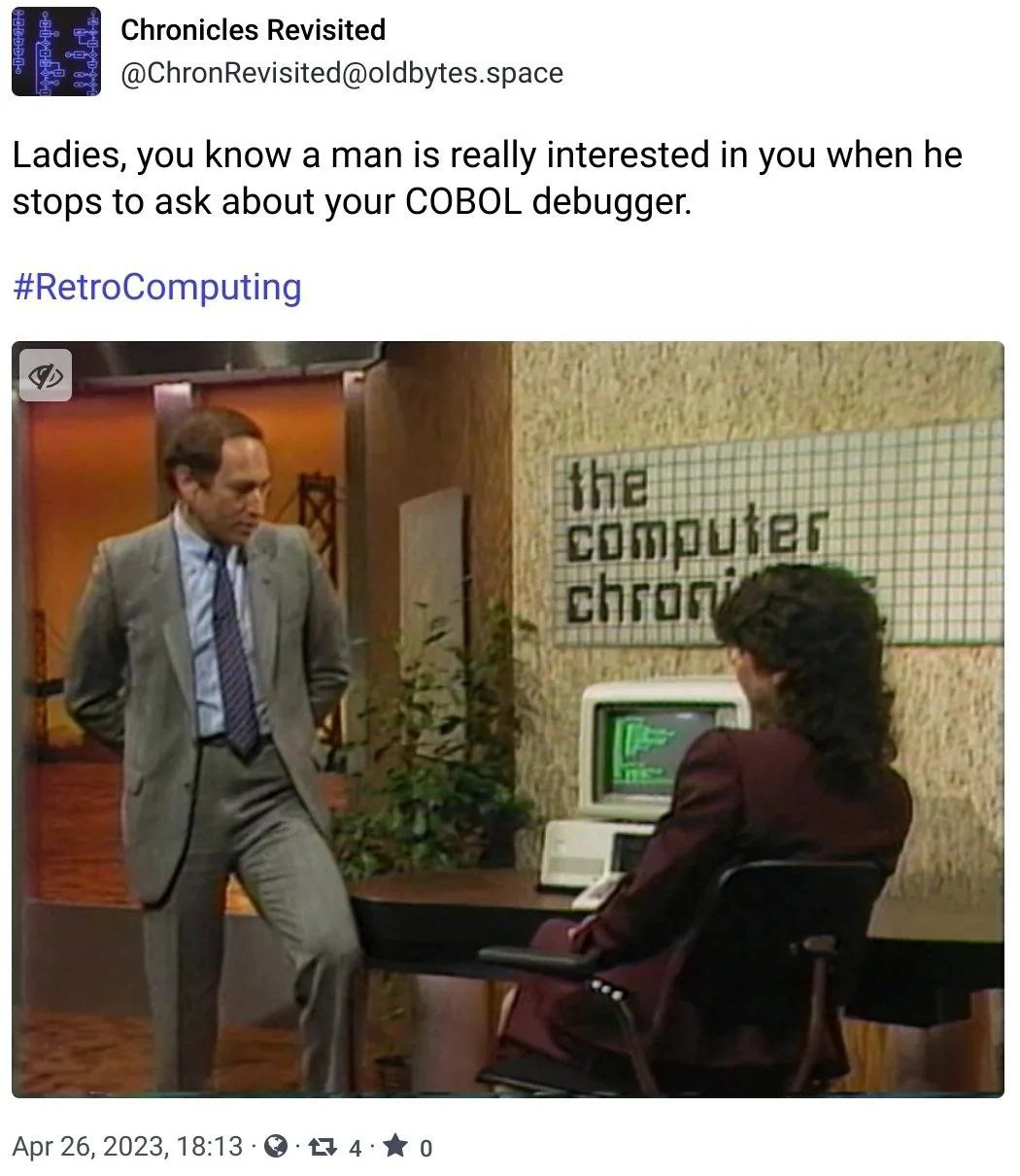
Let’s break down the basics of what’s going on here. COBOL (Common Business Oriented Language) is a computer programming language first created back in the late 1950s, and it became super popular for business applications through the 60s, 70s, and 80s. It’s a language often used on big corporate computers called mainframes – imagine an entire room’s worth of computer, run by large companies and governments for things like payroll, banking, and insurance. A lot of those old COBOL programs are legacy systems now (meaning old but still in use). A COBOL debugger is a special software tool that a programmer uses to test and fix COBOL code. Debuggers let you pause a program, look at what’s happening step by step, and figure out where things go wrong – kind of like playing a movie in slow motion to spot a blink-and-you-miss-it detail. In the 1980s, a COBOL debugger might have been pretty clunky by today’s standards: all text, no graphics, and you had to type commands to inspect variables or move to the next line of code. The screen in the image shows green text on a black background – that’s typical of an old CRT monitor (the big boxy screens before flat panels) running in text mode. They were nicknamed “green-screen” terminals because they usually only displayed one color of text (often green) on a blank (often black) background. This was common for computers of that era, especially for business and programming tasks. It wasn’t just a stylistic choice; the hardware literally only showed text and in one color due to limitations then. So what you see on that monitor is likely COBOL source code and some debugger prompt or output in bright green letters.
Now, The Computer Chronicles was a television show that aired in the 1980s (and into the early 90s) all about computers and technology. It was like a news-magazine style show where hosts would talk about the latest in personal computing, software, and even programming tools. Think of it as a YouTube tech channel or a podcast, but on TV and very 80s. The set in the image — with the tiled “the computer chronicles” sign — is a dead giveaway. The man in the grey suit is likely one of the hosts or a guest, and the woman in the burgundy blazer is demonstrating something on that computer (maybe a new COBOL development tool). The fashion and hair (big curls, shoulder pads) along with the chunky beige computer scream late 1980s style. For context, at that time seeing a woman programmer on such a show, confidently using a COBOL debugger, would have been notable – computer science had (and still has) fewer women, so it’s cool this show featured her expertise.
The text of the meme comes from a Mastodon post (Mastodon is a social network, kind of like Twitter). It says: “Ladies, you know a man is really interested in you when he stops to ask about your COBOL debugger.” This is a playful twist on a common idea: usually, you might hear advice like “you know someone’s interested in you when they take interest in what you care about.” Here, the thing “you care about” is extremely niche: your COBOL debugging tool! It’s poking fun at RetroComputing culture – people who love old computers and software. It’s as if among these retro tech enthusiasts, a genuine compliment or pickup line would be “Wow, is that a vintage debugging environment you’re using? Tell me more!” It’s humorous because normally, asking about someone’s debugging process in COBOL is not what you’d hear on a date or in casual chit-chat. But in this nerdy context, that question is basically flirting. The hashtag #RetroComputing flags that this is about old tech nostalgia. So, essentially, the meme is saying: if a guy pauses to ask a woman about an old programming tool (instead of, say, her favorite music or movies), he must be really into her (or at least into the super-geeky stuff she’s into). It’s a light-hearted joke for developers, especially those who appreciate or work with LegacyLanguages like COBOL. Even if you’re new to programming, think of it like a comic scene – two techies connecting over something very old-fashioned and specific. The humor comes from the contrast between romantic interest and ultra-nerdy conversation topics. If you’ve ever had a niche hobby or interest and someone showed genuine curiosity about it, you’ll recognize the warm, fuzzy feeling behind this joke.
Level 3: Legacy Love Language
“Ladies, you know a man is really interested in you when he stops to ask about your COBOL debugger.”
In this wry line, the meme blends TechHistory with tongue-in-cheek romance, playing on the idea that interest in arcane technology is an endearing show of affection among geeks. The image of a man in a grey suit casually leaning in on the set of The Computer Chronicles (a real 1980s tech TV show) and engaging a woman about her COBOL debugging setup reads like a scene from a LegacySystems fairy tale. Why is this funny to veteran developers? Because it’s riffing on a shared understanding: COBOL is a decades-old programming language often associated with banks, insurance, and government mainframes – the furthest thing from trendy tech. It’s the kind of thing younger engineers might groan about and assume is boring. So if someone actively asks about your COBOL debugger, they aren’t making small talk – they either genuinely care about your world of vintage code or really want to impress you. In the software industry’s unofficial dating rulebook, that’s a serious sign of interest! This is developer humor at its finest: replacing the cliché “asks about your day” with “asks about your COBOL debugger” creates an absurd, yet strangely wholesome scenario that only makes sense in our field.
Experienced programmers also catch the nostalgic cues. The setting screams late-80s TechNostalgia: a beige CRT monitor displaying green text, a burgundy blazer with shoulder pads, the blocky the computer chronicles sign on the wall – it’s like stepping into a time capsule. Back then, showing off a debugging tool on TV was exciting cutting-edge content for the Computer Chronicles audience, not unlike a new framework demo on YouTube today. Seasoned devs recall that era, or at least its lore, when LegacyLanguages like COBOL or FORTRAN still dominated big iron computing. Many current engineers started their careers maintaining systems written in COBOL (or inherited that duty unwillingly), so the phrase “COBOL debugger” hits a nerve – it conjures memories of tracking down a bug in a 10,000-line monolithic program running on an IBM mainframe at 3 AM. The joke hints that enduring such trials is practically a love language among legacy tech folks. There’s an unspoken camaraderie (and perhaps a bit of trauma) shared by those who have wrestled with ancient code: if you find someone who even mentions your debugger, they’re implicitly validating that yes, your painstaking work on this archaic system matters.
This meme also satirizes the generational gap in programming. Today, a hip young developer might compliment your GitHub project or ask about your side-hustle app. But the seasoned engineer? They’ll chat you up about that time you single-stepped through a COBOL batch job in ISPF. It’s poking fun at how what’s impressive or romantic in tech circles can be wildly different from mainstream norms. Legacy systems and modernization efforts have become a hot topic in recent years (with banks scrambling to find COBOL devs when systems fail), so there’s also a grain of truth: someone should be interested in that COBOL debugger, because it keeps critical systems alive. The humor, though, comes from framing that niche professional interest as a pickup line for programmers. It’s hyperbolic and sincere all at once – the kind of joke that makes veteran coders smirk and maybe reminisce about the “good old days” of green screens, while newer devs laugh at the sheer geekiness of it all. In a way, the meme says: true romance in developer land isn’t about roses and poetry; it’s about empathy for each other’s debugging struggles, even if those struggles involve a 60-year-old programming language.
Level 4: Green Screen Introspection
At the deepest technical level, this meme evokes the old-school debugging rituals of mainframe and mini-computer days. That bright-green text on a black screen isn't just a stylistic choice – it's a hallmark of a green-screen terminal (often an IBM 3270 or DEC VT series) common in the 1970s and 1980s. In that era, debugging a COBOL program meant interacting with a very different environment than today's VS Code or Chrome dev tools. You would likely be using a character-based COBOL debugger on a time-sharing system or PC emulator where you navigate with keyboard commands and function keys (no mouse, all text). Breaking into a running COBOL program on an IBM mainframe, for example, might involve setting a breakpoint via a console command or using a tool like IBM's Interactive Debug or Compuware Xpediter. Under the hood, the debugger would be catching the program’s execution in a controlled runtime environment, letting you inspect the contents of working-storage variables and step through procedural paragraphs one line at a time. COBOL’s structure (with divisions and sections) meant you often debugged by following the flow of PERFORMed sections rather than drilling into deep call stacks (since classic COBOL has a flat call model and lacked recursion support until more modern dialects). The screenshot’s green COBOL source code with prompts suggests the program is paused at a certain line – perhaps waiting for the developer to type a command to inspect a variable or continue execution. In these vintage debugging sessions, you might manually query the value of a data field, or watch how a loop iterates over a file’s records, all through textual feedback. It’s a far cry from today’s graphical IDEs: imagine debugging by essentially conversing with the program through a command-line interface. Yet, for its time, this was cutting-edge productivity – a step up from inserting extra DISPLAY statements or poring over core dumps on printouts. The meme’s core technical nostalgia is rooted in this intimate, low-level dance with the machine’s state. Seasoned engineers recognize the scene as an archeological dig into our industry’s past: the tools and interfaces may be primitive by modern standards, but they reveal the enduring bones of debugging – setting breakpoints, examining memory, and carefully stepping through logic. Even in 2023, these fundamentals haven’t changed much, though the visuals have. Here, the LegacySystems motif isn’t just about old code; it’s about the ancient rituals of interacting with a computer through a monochrome lens, patiently coaxes out bugs. The humor hides in plain sight: those who’ve wrestled with INDEXED files and mainframe job logs can’t help but smile at the idea that asking about such esoterica is a form of flirtation. It’s like two archaeologists bonding over the intricacies of hieroglyphs – only here the hieroglyphs are in COBOL, glowing green and blinking a prompt for the next debugging command.
Description
Screenshot of a Mastodon post by “Chronicles Revisited” (@[email protected]). The post reads: “Ladies, you know a man is really interested in you when he stops to ask about your COBOL debugger.” followed by the hashtag “#RetroComputing”. Beneath the text is a still from the 1980s TV show ‘the computer chronicles’; the tiled sign with the lowercase words “the computer chronicles” is clearly visible on the studio wall. A man in a grey suit (face blurred) stands casually with hands behind his back, speaking to a woman in a burgundy blazer who is seated at a desk in front of a beige CRT displaying bright-green COBOL source code and debugger prompts. The nostalgic setup, green-screen terminal, and reference to a COBOL debugger humorously highlight legacy-system courtship rituals familiar to seasoned engineers who still triage mainframe code

Comments
6Comment deleted
You know it’s serious when he volunteers to pair-debug your 30-year-old COBOL payroll job, fully aware the next breakpoint won’t hit until tomorrow’s batch window - at that point, it’s less a date and more a long-term support contract
Nothing says 'I'm marriage material' quite like knowing the difference between PERFORM UNTIL and PERFORM VARYING, and being able to debug a COMPUTATIONAL-3 packed decimal overflow at 3 AM while the batch job is holding up payroll processing
Finding someone who genuinely wants to discuss your COBOL debugger is rarer than finding a Y2K bug in 2024 - but when you do, you know they're either deeply committed to legacy system maintenance or have Stockholm syndrome from decades of enterprise banking software. Either way, that's true love in the mainframe world, where 'till death do us part' is just another way of saying 'this system will outlive us both and our children will inherit the technical debt.'
Anyone asking about your COBOL debugger isn’t flirting - they’re volunteering for the 3 a.m. batch-window S0C7 thanks to packed decimals in EBCDIC
Green flag: someone who can single‑step CICS in ISPF, read an S0C7 dump, and call waiting for the 2am JCL window a date
Why swipe right on JS devs when COBOL debuggers quietly process trillions daily without a single outage?