The Public OTP Fallback
Why is this Security meme funny?
Level 1: The Door Code Sign
It is like a locked door that asks for a secret code, but someone has written the code on a sign next to the handle because the doorbell is broken. The door still looks secure, but now everybody can get in. The joke is that the fix for one problem destroys the reason the lock existed.
Level 2: OTP Means Unique
An OTP, or one-time password, is a temporary code used to verify an action. A website might send a code by SMS, then ask the user to type it in. The idea is that even if someone knows your normal account details, they still need access to the second place where the code was sent.
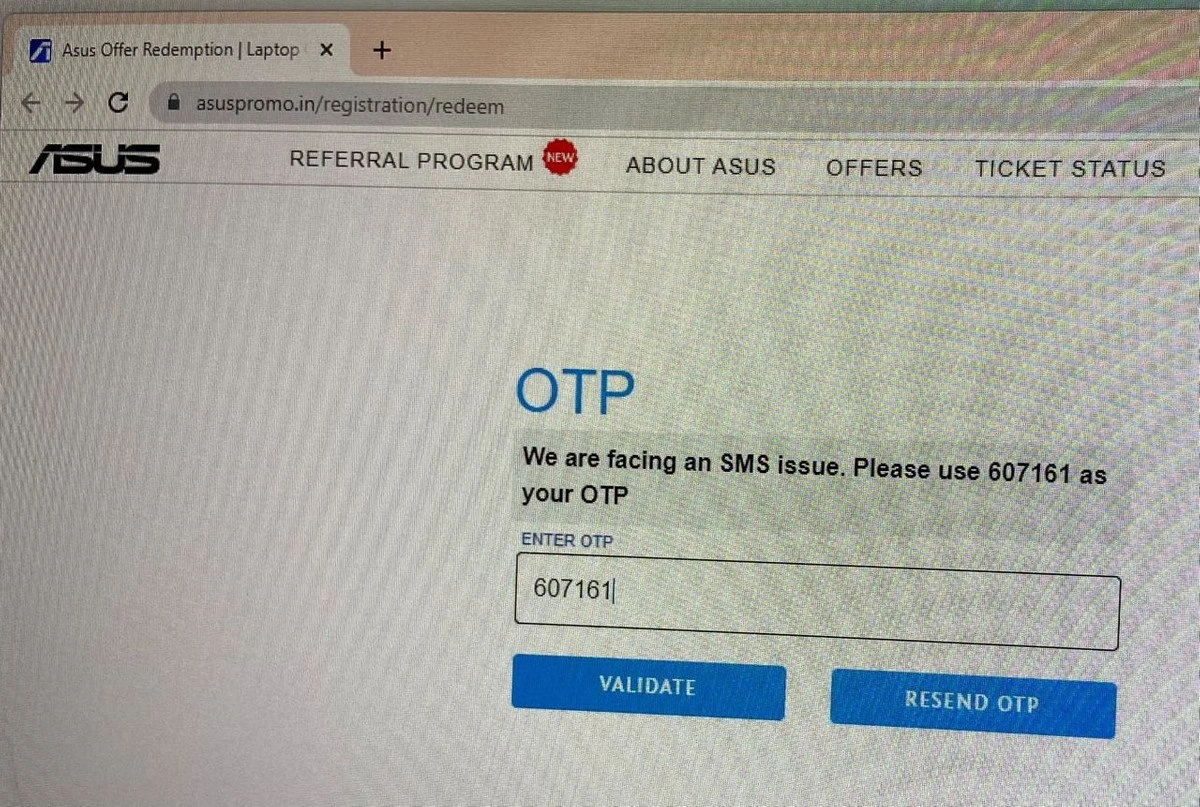
In the screenshot, the page says there is an SMS issue and tells everyone to use 607161. That is funny because it defeats the point. If the same code is shown to users on the page, then the code is no longer secret and no longer tied to one person.
This is why the meme fits authentication, web security, and bad practices. The interface still looks like a security step, but the real protection has been weakened. Developers see this and immediately imagine the meeting where someone said, "Just hardcode a temporary OTP," and everyone who has ever worked near production quietly ages five years.
Level 3: One-Time For Everyone
The screenshot shows an ASUS offer redemption page at asuspromo.in/registration/redeem. The page heading is OTP, and the message says:
We are facing an SMS issue. Please use 607161 as your OTP
The input field below already contains 607161, with VALIDATE and RESEND OTP buttons underneath. That is the whole security horror story in one sentence. A one-time password is supposed to be short-lived, user-specific proof that the person attempting an action also controls some second channel, usually a phone number, email inbox, authenticator app, or hardware key. This page appears to turn that per-user proof into a public shared code because SMS delivery is having a bad day.
The joke is not merely "someone made a mistake." It is security theater collapsing under operational pressure. The product flow still has an OTP screen, so the shape of authentication remains visible. But the property that made it meaningful, a code unique to a user or transaction, has been thrown away for availability. It is the security equivalent of keeping the front door keypad but taping the code to the wall because the intercom is broken.
This is a classic security vs usability failure. The team likely needed users to keep redeeming offers while the SMS provider, integration, queue, template approval, or delivery route was unreliable. From a support standpoint, a fixed fallback code reduces tickets. From a security standpoint, it converts a second factor into a low-entropy public password. If that code is accepted broadly, attackers no longer need to intercept SMS; they just need to read the page. Wonderful, the threat model has been simplified by deleting it.
The post message's comparison to Twitter points at the broader problem: SMS-based authentication often sits at the intersection of cost, reliability, abuse prevention, and user expectations. SMS is familiar, but it depends on telecom delivery, regional routing, vendor contracts, message filtering, and phone-number ownership. When that channel fails, teams face pressure to keep the funnel moving. This meme captures the moment when the fallback preserves the funnel and sacrifices the factor.
Description
A browser displays an ASUS offer redemption page at `asuspromo.in/registration/redeem` with navigation links for "REFERRAL PROGRAM", "ABOUT ASUS", "OFFERS", and "TICKET STATUS". The page heading says "OTP" and the message reads, "We are facing an SMS issue. Please use 607161 as your OTP"; the "ENTER OTP" field is filled with `607161`, with blue "VALIDATE" and "RESEND OTP" buttons below. The security joke is that a fallback meant to solve SMS delivery has effectively turned a second factor into a public shared password.
Comments
3Comment deleted
Nothing says multi-factor authentication like hard-coding the second factor into the page copy.
if (req.body.otp === '607161') return res.status(200) Comment deleted
what the hell is this ? Comment deleted