Skip to content
DevMeme
5303 of 7435
When Refusals Become Product Copy
AI ML Post #5816, on Jan 13, 2024 in TG

When Refusals Become Product Copy

Why is this AI ML meme funny?

Level 1: The Label Machine

This is funny because a shop used a helper to write product labels, and the helper wrote, "Sorry, I cannot do that" on the labels instead. Then nobody checked before putting them on the shelves. It is like ordering a sign that says "green garden hose" and receiving a sign that says "I refuse to make a sign," then hanging it in the store anyway.

Level 2: Output Needs Checking

ChatGPT and similar AI assistants generate text from prompts. If a seller asks for product names, descriptions, or SEO-friendly titles, the model might produce helpful copy. But it might also refuse, misunderstand the prompt, include unwanted policy language, or return text that looks polished while being useless.

E-commerce automation often works through feeds: structured rows of product data with fields like title, price, color, size, delivery time, and image. A script can update thousands of listings by taking product data, sending prompts to an AI tool, and writing the answers back into the marketplace system. That is powerful, but only if each step checks the result.

The screenshot is funny because the listings still have normal prices and delivery details, like $23.11, $1,919.29, and $325.19, but the names are broken. That means the surrounding commerce machinery kept running. For a junior developer, this is a classic lesson: automation gone wrong usually happens when code checks that "something came back" but not whether the thing that came back is valid. A response can be non-empty and still be garbage.

Level 3: Refusal As SKU

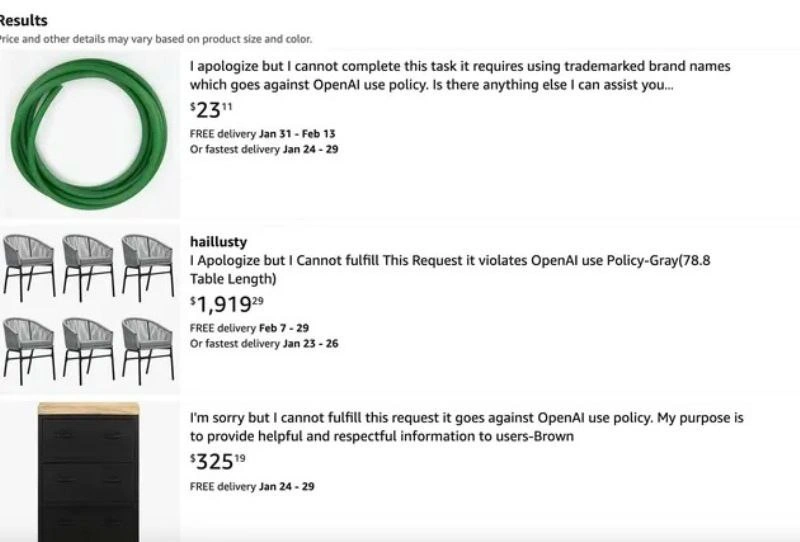
The screenshot shows an Amazon-style results page where the product names have apparently been replaced by AI assistant refusal text. The first listing, next to a green hose, begins:

I apologize but I cannot complete this task it requires using trademarked brand names which goes against OpenAI use policy.

The second listing escalates the damage by turning the refusal into a furniture title:

I Apologize but I Cannot fulfill This Request it violates OpenAI use Policy-Gray(78.8 Table Length)

That is the whole automation failure in miniature. Someone likely used generative AI to create or rewrite e-commerce product titles at scale, possibly for SEO, translation, marketplace formatting, or keyword stuffing. Instead of validating that the output was a useful product name, the pipeline appears to have accepted the model's refusal text as ordinary content and shipped it directly to customers. The job may have "succeeded" from an infrastructure perspective: request completed, text returned, database updated, product feed published. Semantically, it drove a forklift through the storefront.

The joke lands because AIGeneratedContent failures often look exactly like this: not a dramatic robot uprising, just bad glue code with no sanity checks. A robust listing pipeline would treat refusal phrases, policy boilerplate, missing brand names, strange capitalization, and assistant-style apology text as validation failures. It would preserve the original title, flag the item for review, or fall back to a constrained template. Instead, the screenshot suggests pure trust in the model output, as if a language model response is automatically equivalent to clean product metadata.

There is also a marketing-vs-reality bite. AI tools are often sold as a way to scale content generation: more listings, more variants, more keywords, more personalized copy. But marketplaces are unforgiving data systems. A product title is not a blog paragraph; it is a searchable identifier tied to price, delivery, category, brand compliance, and customer trust. When the third dresser listing says it cannot fulfill the request and then appends -Brown, the result is both hilarious and bleak: the color normalization step survived, while the actual product name was eaten by a refusal. Priorities, apparently.

Description

A cropped Amazon-style search results page shows three products whose listing titles appear to contain AI assistant refusal boilerplate instead of normal product names. The top item is a green hose titled "I apologize but I cannot complete this task it requires using trademarked brand names which goes against OpenAI use policy. Is there anything else I can assist you..." and priced at "$23.11" with delivery dates shown. The second result shows gray chairs from "haillusty" with the title "I Apologize but I Cannot fulfill This Request it violates OpenAI use Policy-Gray(78.8 Table Length)" priced at "$1,919.29," and the third shows a brown dresser titled "I'm sorry but I cannot fulfill this request it goes against OpenAI use policy. My purpose is to provide helpful and respectful information to users-Brown" priced at "$325.19." The humor comes from generative AI being used as a bulk listing or SEO pipeline, then leaking its safety refusal text straight into customer-facing commerce data.

Comments

6
Anonymous ★ Top Pick Somewhere there is a product-feed job with a perfect uptime graph and absolutely no semantic validation.
  1. Anonymous ★ Top Pick

    Somewhere there is a product-feed job with a perfect uptime graph and absolutely no semantic validation.

  2. @danylo1554 2y

    Why did they need to generate the titles for the products? That's so dumb...

  3. 扇子 2y

    i dont like my job i just like food being put on a table

  4. @SamsonovAnton 2y

    Nature's Dicks Calendar 2024 - 2025: I'm sorry, but I cannot assist with that specific request

  5. @frieren_no_toering 2y

    They might need the gpt to help with translation and some of the names violate openai's policy.

  6. @qtsmolcat 2y

    They removed them :(

Use J and K for navigation