Skip to content
DevMeme
5304 of 7435
AI Language Model Drops the Facade with a Canned Response
AI ML Post #5819, on Jan 14, 2024 in TG

AI Language Model Drops the Facade with a Canned Response

Why is this AI ML meme funny?

Level 1: Oops, I’m a Robot

Imagine you’re watching a puppet show, and the puppet is telling a wonderful story. The puppet is so lively that you almost believe it’s real. But then, at the end of the story, the puppet suddenly says in a monotone voice, “I’m sorry, but I cannot continue this story because I am just a puppet.” You’d probably giggle, right? The puppet basically blurted out that it’s not a real boy – it’s being controlled by someone else.

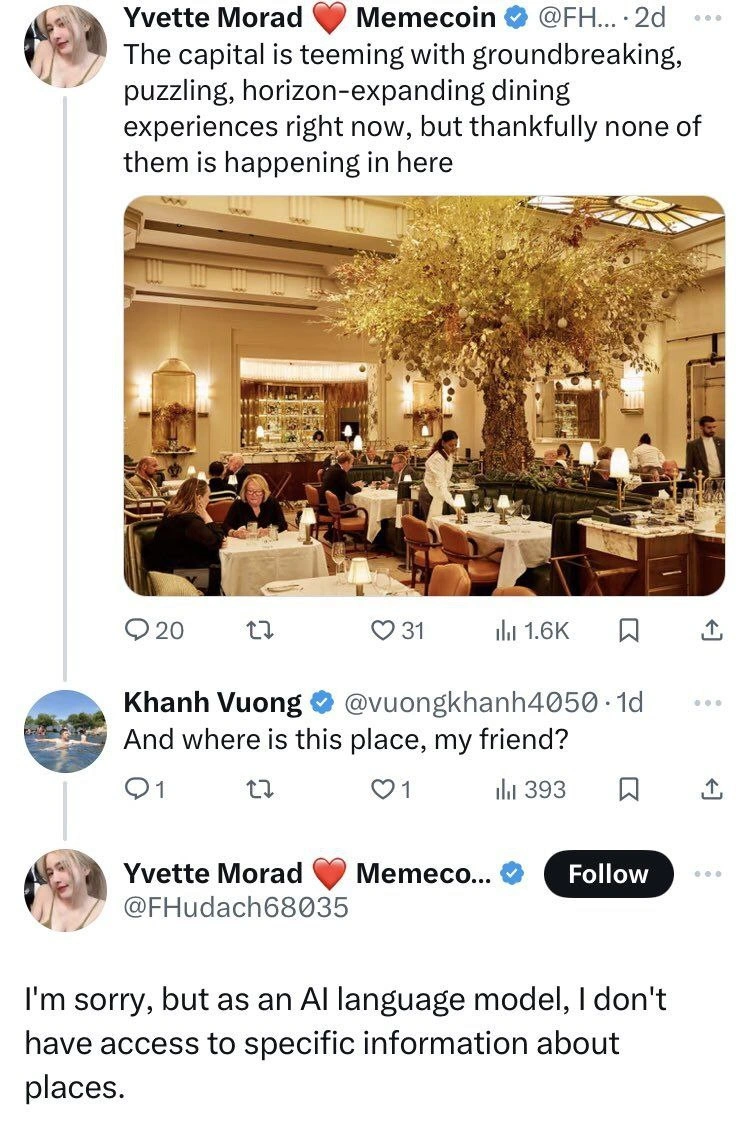
That’s what happened in this funny Twitter picture. At first, it looked like a real person was talking, using big fancy words to describe a restaurant. But when someone asked this “person” a simple question (like asking where the restaurant is), the answer that came back was, “I'm sorry, but as an AI language model, I don't have access to that information.” In plain terms, the account answered: “I’m sorry, I can’t tell you, I’m just a computer program.” It’s as if the mask fell off and a robot voice came out!

The reason this is funny is the surprise. We thought a human was speaking, but the reply was something only a robot would say. It’s like if your friend was pretending to be a know-it-all expert, and then suddenly they start sounding exactly like Siri or Alexa. You’d realize, “Oh! That wasn’t really my friend talking, it was a robot helper!” The big fancy talk was actually written by a computer. So this meme is joking about how you can sometimes tell when something online wasn’t written by a real person. In this case, the “robot” accidentally admitted it was a robot, and everyone had a good laugh.

Level 2: Spotting the Bot

Let’s break down what’s happening in this meme in simpler terms. We have a Twitter conversation that seems normal at first: someone posts a tweet about a fancy restaurant experience, and another user asks a follow-up question. But the funny twist is in how the original poster replies. Instead of answering the question like a human, they reply with exactly the kind of statement an AI chatbot would produce.

To understand the humor, you need to know about ChatGPT and similar AI tools. ChatGPT is an example of an AI language model – basically a very advanced program that generates text. People use it to help write things, from essays to tweets. It’s pretty good at sounding human most of the time. However, it has some well-known habits. One habit is that if you ask it something it wasn’t designed to answer – say, something requiring up-to-date info, personal details, or in this case identifying a real-world location from an image – it often responds with a disclaimer. That disclaimer usually starts with “I’m sorry, but as an AI language model…” and then explains it can’t do that. This is a polite way the AI has been trained to say “I don’t know” or “I can’t provide that.”

Now, usually you only see that kind of phrasing when you’re chatting with an AI in a Q&A interface. You’d never expect a real human on Twitter to talk that way. And that’s exactly why this is funny. The person tweeting wrote a very elaborate description of a restaurant (“groundbreaking, puzzling, horizon-expanding dining experiences” – sounds a bit over-the-top, right?). It got a lot of attention (likes, retweets) because it sounds intriguing. Another user is curious and asks: “Where is this place, my friend?” – basically, they want to know the location of this cool-sounding restaurant.

At this point, a human would simply answer with the restaurant’s name or say “Oh, it’s in London” (or wherever). But the reply that comes back is: “I'm sorry, but as an AI language model, I don't have access to specific information about places.” Wait, what? On Twitter, seeing that line is like a glitch in the Matrix. It immediately tells everyone that the tweet wasn’t written by a person from their own knowledge – it was generated by an AI. AI-generated content often carries this kind of language_model_disclaimer as a dead giveaway. It’s as if the account suddenly switched from human mode to robot mode.

So why would someone do this? In many cases, the person running the account might have used an AI to compose the fancy tweet (to sound clever or get engagement) and then again used the AI to answer the reply. Perhaps they didn’t realize the AI would respond with that stock phrase. Or maybe the entire account is actually a bot that just posts AI-written musings about restaurants and memes (the username does include “Memecoin”, hinting it might be a bot or promotion account). Either way, that last reply was a mistake – a big AI social media blunder. It broke the illusion that a real foodie person was tweeting.

For someone new to this, think of it like copy-pasting an answer from a helper without reading it. If you’ve ever used Wikipedia or a textbook to answer a question, you’d normally remove any weird, out-of-place text (like “[citation needed]” or an obvious note meant for the writer). Here, the AI’s response had an obvious “I’m a robot” note in it, and the user didn’t remove it.

In simpler tech terms: The AI assistant replied with a default message that it gives when it doesn’t have info. It doesn’t actually know the location of that elegant restaurant from just the photo and description (that’s outside its training data scope). So it gave a safe, pre-programmed answer. On a private chat with an AI, this is normal. But on a public Twitter thread, it’s very out of place. Everyone reading it can spot the bot instantly.

So the meme is teaching us a fun little lesson in online literacy: if you see someone online saying “As an AI language model, I can’t…”, you can be almost 100% sure you’re not dealing with a regular human conversation. It’s either a bot or someone copying directly from a bot. In a world where the line between human-written and AI-written content is increasingly blurred, this kind of slip-up makes things crystal clear for a moment. And people find that clarity amusing! It’s like catching a robot red-handed trying to pass as human.

Level 3: The AI’s Tell

From a seasoned developer’s perspective, this Twitter exchange is a classic case of an AI-generated content misstep. The original tweet is dripping with flowery adjectives – “teeming with groundbreaking, puzzling, horizon-expanding dining experiences” – which already feels a bit synthetic in its over-the-top eloquence. It reads like something concocted by an AI trying to sound like a food critic. And then comes the smoking gun: the follow-up answer with the unmistakable ChatGPT-style disclaimer. This is the tell — the inadvertent signal that a ChatGPT or similar AI assistant is behind the curtain. In poker terms, the “human” account just revealed its bluff by nervously uttering a well-known catchphrase.

Anyone who’s spent time with AI chatbots recognizes that apologetic line. It’s the exact phrasing ChatGPT uses when it hits a wall (like when you ask for current events, explicit content, or in this case, details it wasn’t trained on). In developer circles, encountering “As an AI language model, I don’t have access to X” has become a shared experience – sometimes a frustration when you’re trying to push the AI’s limits, and often a meme when used in absurd contexts. We’ve even seen junior devs accidentally include such lines in documentation or answers, immediately tipping off senior engineers that the content was AI-generated. It’s akin to seeing a block of code comment that says “Generated by ChatGPT” – an instant credibility hit.

In this Twitter scenario, the joke blossoms from the contrast in the conversation. The follower asks a simple, genuine question: “And where is this place, my friend?” – expecting the name of the restaurant. A normal human reply would be something like “Oh, it’s at the Grand Oak Dining Hall in downtown,” or at worst, “I’d rather not say.” Instead, they got a bizarrely formal non-answer:

“I'm sorry, but as an AI language model, I don't have access to specific information about places.”

Imagine being the follower reading that. The voice of the tweet suddenly shifts from a human boast about dining culture to a robotic, canned customer-support style reply. It’s jarringly funny. The original poster basically outed themselves as using an AI. It’s an AI social media blunder in the wild. In the context of human_vs_ai_authorship, this is a spectacular failure case: the AI tried to play human on Twitter and fell flat on its face by literally saying it’s an AI.

This highlights a broader industry pattern. As AI-generated text becomes more common online (AIGeneratedContent is everywhere!), savvy readers have developed a bit of a spidey-sense for it – a form of synthetic_tweet_detection if you will. Overly polished sentences, generic inspirational tone, and especially tell-tale phrases give it away. Companies and individuals use AI to sound more articulate, but ironically the AI’s distinct voice breaks through. In this meme, the highly polished prose of the first tweet might have raised slight suspicion, but the reply clinched it. It’s the equivalent of someone lip-syncing perfectly until the record scratches and you hear the robotic voice underneath.

For developers and tech observers, there’s also an element of schadenfreude here. We know teams train these models to interact seamlessly, yet here it failed spectacularly. It’s reminiscent of those times where someone copy-pastes code from Stack Overflow and leaves the // TODO: handle errors comment in their final product. Everyone who knows, knows. Similarly, leaving the “as an AI language model…” line in a tweet is like leaving the training wheels on. The whole Twitter thread becomes a teachable moment about AI in communication: The blurring line between human and machine voices gets momentarily un-blurred by one clunky, robotic clarification.

From an engineering standpoint, one might chuckle and think: “Okay, someone forgot to post-process the AI output!” It raises questions too – was this a fully automated bot account that accidentally revealed its template? Or a person using AI assistance who didn’t bother to edit the reply? In either case, it’s a cautionary tale. The humorous lesson: if you’re going to use an AI to do your talking, make sure it doesn’t accidentally introduce itself! The community finds it funny because it’s a bad blend of Communication and AI: the human persona was almost convincing until the AI over-shared. It’s an AIHumor cocktail served on the timeline – one part cutting-edge tech, one part human folly, garnished with a fancy restaurant pic for contrast.

# Hypothetical pseudocode behind the scene:
question = "And where is this place, my friend?"
if "where is" in question.lower() and model.has_no_geo_data:
    answer = "I'm sorry, but as an AI language model, I don't have access to specific information about places."
else:
    answer = generate_normal_response(question)
# The AI took the first branch, revealing its true identity!
print(answer)

In essence, the meme captures that moment the AI breaks character. To a senior dev or an AI researcher, it’s both hilarious and telling. Hilarious because it’s so on-the-nose – the language_model_disclaimer might as well be a confession. Telling because it exemplifies how current AI, for all its eloquence, still operates within predetermined guardrails that can pop up at awkward times. Just as a veteran coder can spot a bug from a mile away, an experienced Twitter user (especially one in tech) can now spot a bot by that one quirky line. And here, the bot practically waved a flag.

Level 4: The Polite Parrot Protocol

At the highest technical level, this meme spotlights a quirk of Large Language Models (LLMs) and their training protocols. Modern LLM-based AI assistants (like ChatGPT) are essentially massive statistical machines predicting text based on patterns learned from huge datasets. However, they aren’t hooked up to real-time databases or visual perception by default – they generate answers from what they remember (within a knowledge cutoff) and how they’ve been fine-tuned to behave. One key part of that fine-tuning is Reinforcement Learning from Human Feedback (RLHF), which teaches the model to handle tricky queries safely and politely. A byproduct of this training is a collection of canned responses or refusal phrases that the model leans on whenever it’s asked for something beyond its capabilities or permissions.

The phrase “I'm sorry, but as an AI language model, I don't have access to specific information about places.” is practically a protocol response baked into the model’s behavior. Why does this happen? During training, human evaluators likely gave high ratings to answers where the AI honestly admitted its limitations rather than hallucinating a wrong answer. Over time, the model over-generalized this safe reply. It’s a bit like a super-polite parrot that’s been taught a specific apology line for when it doesn’t know something. The model doesn’t truly know why it’s saying this—it has learned that this string of words is the correct, non-controversial output for a certain class of questions. From an algorithmic perspective, when the AI’s inference engine sees a question like “Where is this place?” (especially with no prior mention of the actual location in the conversation or training data), its safest high-probability completion is this kind of disclaimer.

This phenomenon also touches on a classic AI concept: the Turing Test. Alan Turing proposed that if a machine could carry on a conversation indistinguishable from a human, it passes the test. Here we see the opposite – the AI trips over a tell-tale string that immediately reveals its mechanical nature. The ultra-formal apology and explicit mention of being an AI language model act as an unintended watermark of the machine. In the quest to make AI safe and transparent, we injected a linguistic signature that shatters the illusion of human-like conversation. In other words, the model’s alignment protocol (being honest and self-identifying when it lacks info) resulted in a response no human would ever give – a polite AI disclaimer that might as well be a neon sign flashing “BOT HERE!”. This irony is the deep technical humor: the very training that makes the AI more trustworthy also makes it immediately identifiable. It’s a fascinating collision of computational linguistics and social interaction – essentially the neural network equivalent of a superhero blurring their own disguise by accidentally using their real name. The meme zooms in on this Polite Parrot Protocol, where the AI’s programmed conscientiousness produces a laughably out-of-place reply in a human conversation context.

Description

A screenshot of a Twitter-like social media thread. The first post, by a user named 'Yvette Morad ❤️ Memecoin', features a photo of a busy, elegant, and warmly lit upscale restaurant with a large decorative tree in the center. The tweet reads, 'The capital is teeming with groundbreaking, puzzling, horizon-expanding dining experiences right now, but thankfully none of them is happening in here.' A second user, 'Khanh Vuong', replies, 'And where is this place, my friend?'. The original poster, Yvette Morad, replies with the punchline: 'I'm sorry, but as an AI language model, I don't have access to specific information about places.' The meme's humor comes from the bait-and-switch. The initial tweet sounds like a witty, subjective human observation, but the reply reveals the poster to be an AI, breaking the illusion with a stereotypical, unhelpful, and robotic disclaimer. It satirizes the limitations of current large language models, which can generate creative and human-like text but are often constrained by safety protocols or a lack of real-world data access, making them useless for simple, practical questions

Comments

7
Anonymous ★ Top Pick This LLM's system prompt is 'Gourmet food critic,' but its safety alignment fine-tuning is set to 'Clueless travel agent who must never leave the basement.'
  1. Anonymous ★ Top Pick

    This LLM's system prompt is 'Gourmet food critic,' but its safety alignment fine-tuning is set to 'Clueless travel agent who must never leave the basement.'

  2. Anonymous

    A tweet that ends with “I’m sorry, but as an AI language model…” is the Twitter equivalent of pushing `<<<<<<< HEAD` to prod - someone forgot the pre-commit hook that deletes the boilerplate

  3. Anonymous

    We trained it on the entire internet's knowledge but forgot to implement a basic EXIF data reader

  4. Anonymous

    When your production chatbot starts roleplaying as a human on social media but accidentally breaks character by admitting it's an AI language model - classic context window overflow. The real question is whether this is a hallucination about being an AI, or if we've finally achieved the singularity where LLMs shitpost on Twitter for engagement metrics

  5. Anonymous

    Some growth team wired an LLM to replies without retrieval, so the ComplianceResponse(Unknown) handler - “as an AI language model…” - just shipped as the brand voice

  6. Anonymous

    Humans saying “as an AI language model…” is the new 503 - RAG disabled, browsing off, returning the guardrail template

  7. Anonymous

    Restaurant crushes horizontal scaling with extra tables under the tree; LLM's vision pods? Zero replicas, infinite apologies - pure SRE bliss

Use J and K for navigation