The Enterprise-Grade Nintendo Switch We Never Asked For
Why is this Networking meme funny?
Level 1: Not That Switch
Imagine you have a word that means two totally different things, and someone gets them mixed up – it can be pretty funny! Think about the word “switch.” In one world, a switch might be a boring black box in an office that helps computers talk to each other (that’s the Cisco switch – basically a serious computer box for networks). In another world, a Switch is a cool toy you play video games on (that’s the Nintendo Switch – a fun gaming console with colorful controllers). This meme is joking about how those two things got muddled together. It’s like if you asked for a cookie and someone handed you a computer cookie (the kind websites use) instead of a chocolate chip cookie – you’d be like, “Hey, not that kind of cookie!” Here, people expected one kind of switch (the one for computer networks) but got the other kind of Switch (the one from Nintendo). It’s silly because the only thing they really share is the name. The humor comes from that surprise: “Whoops, wrong switch!” Even if you don’t know the companies, you can giggle at the idea of a super serious company’s gadget turning out to be a playful video game machine. In everyday terms, it’s just a goofy mix-up – and that “huh? wait a second!” feeling is why we laugh.
Level 2: Two Switches, One Name
Let’s break down the joke for those newer to the tech scene. We have two very different devices here that confusingly share the name “Switch”:
Cisco Switch (Networking Hardware): This is an actual piece of network equipment. Picture a black or gray metal box with lots of little ports (holes) where you plug in Ethernet cables. Those cables connect computers, servers, and other devices in an office or data center. The job of a network switch is to act like a smart traffic director for data: when one computer wants to send information to another in the same network, the switch makes sure the data goes to the right destination. Cisco Systems (the company) is famous for making these devices (among many other networking products like routers and firewalls). Their switches are used in businesses and server rooms worldwide to create LANs (Local Area Networks). In short, a network switch is a somewhat heavy, often noisy (because of fans) hardware box that you usually tuck away in a rack or closet – definitely not something you’d play games on. The Cisco logo on the meme (those vertical blue bars that look like an RFID signal or bridge icon) is Cisco’s real logo, usually seen in IT departments and server racks.
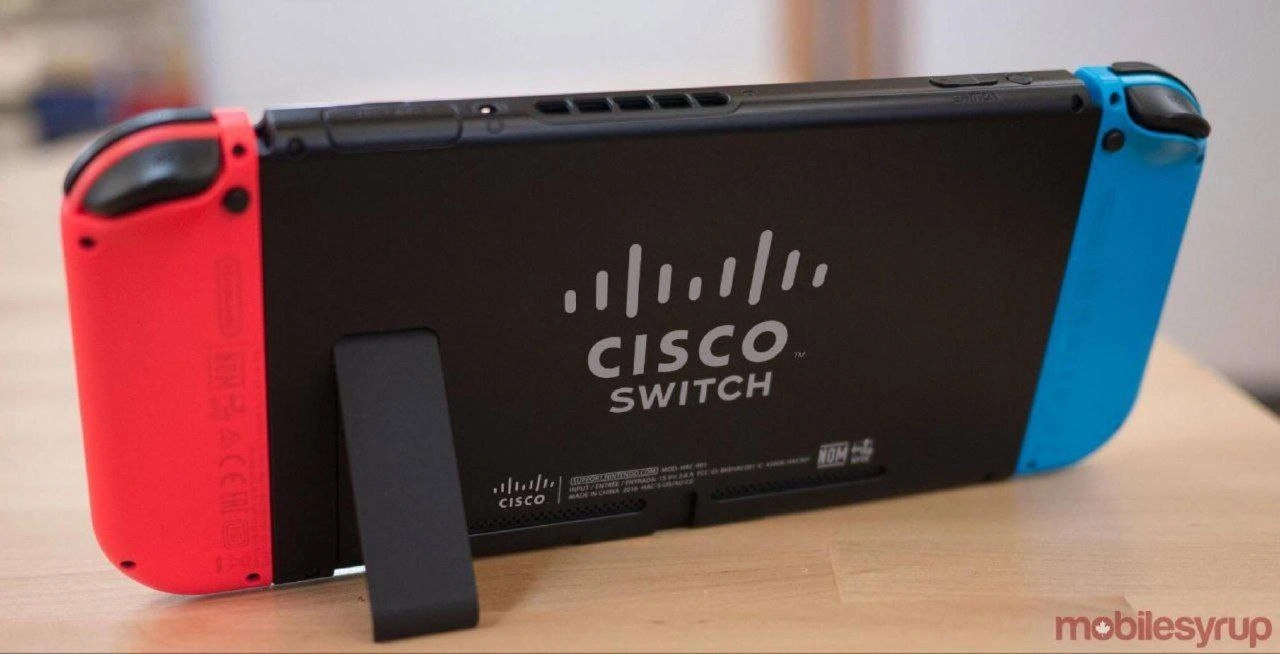
Nintendo Switch (Gaming Console): Now, this is a totally different kind of “switch.” The Nintendo Switch is a popular video game console made by Nintendo. It’s essentially a tablet-like computer that you can either hold in your hands or connect to a TV – hence the name “Switch,” because it can switch between handheld mode and TV mode. The console in the photo is exactly that: you can see the screen’s back and its little kick-stand propping it up. It has two colorful controllers attached (the red and blue pieces on each side, called Joy-Cons). People use a Nintendo Switch to play games like Mario, Zelda, or Animal Crossing, not to configure networks. It’s built for entertainment: lightweight, portable, with a big focus on graphics and user-friendly design. The logo normally on the back would be the word “Nintendo” or the Switch’s own logo, but here it’s been replaced with Cisco’s branding to create the joke.
So why is this funny? It’s because it’s a classic case of mistaken identity, or rather a terminology mix-up. In tech, certain words can mean very different things depending on context. The word “switch” in networking refers to that serious box that connects computer networks. The word “Switch” in gaming refers to a fun console you play with. They share the same name purely by coincidence, and normally no one confuses them because the contexts are so different. But this meme mashes up those contexts on purpose. It imagines that a group of network engineers (who deal with Cisco switches) announce they have a new Switch, and then – surprise! – it turns out to be a Nintendo Switch with a Cisco logo. That’s the “wait, wrong kind of switch” punchline spelled out in the title.
This kind of humor is TechHumor that thrives on knowing both sides of the reference. If you’ve ever heard a network admin talk about installing a new Cisco switch in the office, you’d have one picture in mind (a rack full of blinking lights and cables). If you also know what a Nintendo Switch is, you have a very different picture in mind (playing Mario Kart on the couch). The meme is funny because it collides those two pictures. It’s a brand mashup humor too – seeing the Cisco name (which we associate with business and IT infrastructure) on a Nintendo device (which we associate with fun and games) is immediately jarring and comical.
Think of it this way: it’s like seeing a serious corporate tool dressed up as a toy. For a junior developer or someone new to networking, here are a few key points to clarify the joke further:
- Networking vs. Gaming Context: In a work meeting, if someone says “we’re deploying a new switch,” they’re almost certainly talking about a networking device (Cisco or another vendor) to improve network capacity or replace old hardware. But if a friend says “I just got a Switch,” they are probably talking about Nintendo’s gaming console. Context is everything! This meme swaps the contexts for comedic effect.
- Visual Cue: The image is literally a Nintendo Switch console. Anyone who’s seen one will recognize the distinctive shape and the red/blue Joy-Con controllers. By changing the logo to “CISCO SWITCH,” the meme maker tells us, “Imagine if this gaming console were presented as a Cisco network switch product.” It’s as if Cisco, out of nowhere, decided to make a gaming device or if a techie confused their gaming gadget for office hardware.
- Wordplay: This is a textbook example of a wordplay pun. The humor comes from one word “switch” having two meanings. It’s similar to jokes where, say, a “mouse” could mean an animal or a computer peripheral. Here the double meaning is highly specific to tech culture, which is why it resonates with developers and network admins (who tend to enjoy these double-meaning jokes).
By standing the Nintendo console on its kick-stand and labeling it “CISCO SWITCH,” the meme is also implying a fictional scenario: “What if network engineers unveiled this as their latest hardware? Wouldn’t that be ridiculous?” The tiny regulatory text and little Cisco logo left on the bottom of the device in the image editing make it look surprisingly legit at first glance – as if Cisco really has a device that looks like a game console. It’s that extra level of detail that makes tech folks smirk and go, “Wait, did Cisco release a… ohhh, I get it!”
In summary, this meme is straddling the line between Networking hardware and Gaming culture. It’s pointing out in a lighthearted way that our tech vocabulary can be confusing – the same word can mean a super high-tech network device or a super fun game device. If you know both, you’re in on the joke. It’s a playful nod to those of us who live with one foot in the IT server room and the other in the living room playing Nintendo. In the end, it’s saying: “Hey, geeks, ever realize how a term in your networking job is also the name of your favorite console? Pretty funny, huh?”
Level 3: Bait-and-Switch (Literally)
For seasoned engineers, this meme hits on a hilarious terminology collision. In our day jobs, a Cisco Switch is a serious piece of enterprise networking gear – a metal box bristling with Ethernet ports, status LEDs, and maybe a noisy fan. It lives in a rack, running Cisco’s IOS firmware, silently handling our VLANs, ARP tables, and packet switching all day. We talk about these switches in meetings, discussing throughput, POE power budgets, and uptime. Now enter the Nintendo Switch: a sleek handheld game console with bright red and blue Joy-Con controllers, designed for Mario Kart and Zelda, not routing protocols. The meme mashes these two worlds together by literally slapping the Cisco logo onto the back of a Nintendo Switch. The result is a perfect “bait-and-switch” gag: it baits us with the promise of exciting new Cisco network hardware, then switches (pun intended) to a playful gaming device. It’s as if a network engineer went to unveil the latest cutting-edge Cisco Catalyst model and accidentally pulled out their kid’s gaming console instead!
This kind of tech humor lands because it plays on our dual knowledge of Networking and Games. Many developers, sysadmins, and network engineers are also gamers or at least steeped in pop culture. We instantly recognize the iconic Cisco waveform logo now emblazoned where the Nintendo logo should be. That logo usually appears on heavy-duty network devices mounted in server racks – seeing it on a portable console on a wooden desk is gloriously out of context. It’s corporate IT meets living room entertainment. In the enterprise setting, a “switch” means something entirely different (connecting computers and servers) than it does at home (connecting Mario and friends on the TV). The humor thrives on this incongruity. We’re essentially looking at a brand mashup humor masterpiece: the seriousness of Cisco’s brand transplanted onto the fun of a Nintendo product.
Experienced folks chuckle because we’ve seen our share of confusing jargon and miscommunications in tech. (How many times have we joked about the other kind of Java or Apple?) Here “Switch” is the star of the show as a homonym. The meme highlights how one word can live in two universes: in one, it’s all about LAN cables and IP traffic; in the other, it’s about Pokémon trades and Legend of Zelda saves. And ironically, even the name Nintendo Switch was chosen because the console switches between handheld and console mode – yet that meaning is totally unrelated to what a network engineer thinks of as a switch. This layered wordplay is what makes the image so delightful to tech insiders. It’s NetworkHumor 101: if you show this to a random person on the street, they might not get it, but show it to someone who’s configured a Cisco Catalyst 9300 at work and played Smash Bros at home, and you’ll get a knowing laugh (and probably an “OMG, yes!”). The meme lovingly pokes at the fact that in tech culture, we constantly live between hardware jargon and pop culture gaming references – sometimes flipping context as fast as… well, a switch.
And let’s be honest, the mere idea of a Cisco Switch with detachable Joy-Cons is comedy gold for the nerdy mind. “Is this how we’ll configure networks now, by playing a round of Mario Party?” one might quip. The wordplay pun here doesn’t just rely on text but is visual: the device in the photo looks like a toy but carries the label of a serious tool. That contrast is instantly recognizable to us and triggers that “I see what you did there!” reaction. It’s basically a PopCultureReference meets IT workplace reality. In a world where we often have to explain to non-techies what all these blinking boxes do, it’s refreshing and funny to see one of those boxes reimagined as something as universally understood as a Nintendo. This meme, in essence, is a nerdy inside-joke celebrating the collision of two worlds – reminding us that even as we deal with hardcore tech, we never truly outgrow the joy of gaming.
Level 4: From Data Link to Joy-Con
At the deep networking layer, a switch isn’t just a casual gadget – it’s a fundamental concept in data communications. In network theory, a switch operates primarily at OSI layer 2 (Data Link), intelligently forwarding Ethernet frames based on MAC addresses. What does that mean? Essentially, a Cisco switch learns which device is plugged into each port and switches incoming data to the correct output port, instead of shouting traffic to all ports like an old-school hub. Inside high-end Cisco switches, specialized silicon (ASICs) create a blazing-fast switching fabric. This fabric can forward millions of packets per second with microsecond latency, all while handling VLAN tagging, Spanning Tree calculations to prevent loops, and other hefty protocols. It’s hardcore network hardware engineering: tiny transistor gates flipping billions of times a second to shuttle our packets around.
Meanwhile, the Nintendo Switch sits at a very different layer of technology. It’s a full computer system built around a general-purpose ARM CPU and an NVIDIA GPU, running an entire operating system for gaming. Rather than forwarding network packets, it’s rendering 3D game worlds and tracking Joy-Con controller input. Yet, fundamentally, even this gaming console runs on countless microscopic switches—transistors—flipping on/off to process bits. In fact, every digital device, from a Cisco router to a Mario Kart game, relies on billions of silicon switches at the circuit level. This delightful irony means that, deep down, the serious network switch and the playful console both harness the power of switching – one routes data between computers, the other switches between handheld and docked gaming modes (as Nintendo’s “Switch” name suggests). It’s a convergence of tech semantics and silicon reality: two very different hardware worlds unified by the same elemental concept of turning signals on and off. The meme winks at us from this deep crossroads of technology – a reminder that in the grand scheme, everything from data link protocols to Joy-Con movements ultimately comes down to flipping the right switches.
Description
A photograph showing the back of a standard Nintendo Switch video game console, which has a black main body and the iconic detachable red and blue Joy-Con controllers on either side. The console is resting on a light-colored wooden surface, propped up by its built-in kickstand. The key element of the image is that the original Nintendo logo on the back has been photoshopped and replaced with the logo for Cisco Systems, a major enterprise networking company. Below the Cisco logo, the word 'SWITCH' is printed in a matching font. A smaller Cisco logo is also visible on the regulatory information sticker at the bottom. A watermark for 'mobilesyrup' is present in the bottom-right corner. The humor is a visual pun, creating a hilarious culture clash by branding a consumer gaming device with the identity of a corporation known for serious, high-end IT infrastructure. It plays on the double meaning of the word 'switch'
Comments
7Comment deleted
Finally, a Switch that supports VLANs and has a CLI for configuring the Joy-Cons. The annual Smart Net contract for online play is probably non-negotiable, though
At last, a Cisco Switch you can toss in your backpack - though in classic Cisco fashion, Layer-3 unlocks only after you buy the $199 “extra Joy-Con” license
Finally, a Cisco switch that supports hot-swappable modules without needing a CCNA certification - though the latency on this one is measured in milliseconds, not nanoseconds, and the only VLANs it supports are Mario Kart lobbies
When the network team finally gets budget approval for new switches but procurement misunderstands the requisition form. At least this one has better latency than our aging Catalyst 2960s, and the VLAN configuration is surprisingly intuitive - just press A to trunk all ports
Procurement mixed SKUs - our ToR “Cisco switch” arrived with Joy‑Cons; ZTP is now press A to trunk, press B to drop packets, throughput measured in 60 FPS per VLAN
Finally, a Cisco switch that runs RSTP and Mario Kart - shame the Joy-Cons still can't pass 802.1X
The ultimate LAN party rig: Cisco switching fabric meets Joy-Con drift for failover fun