AI Agent Devin Prompts Existential Dread in Software Engineers
Why is this AI ML meme funny?
Level 1: Robot’s Comeback
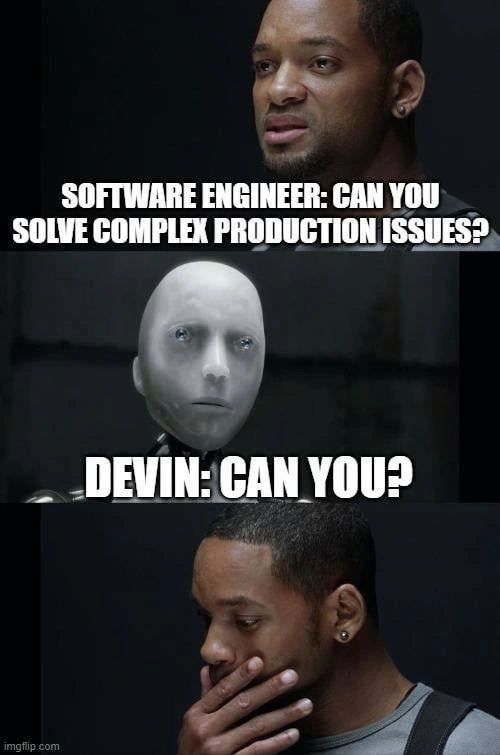
Imagine you have a really difficult puzzle to solve, and you ask a super-smart robot for help. Instead of giving you the answer, the robot looks at you and says, “Can you solve it?” That’s what’s happening here, just in a tech setting. The person in the picture is a software engineer who hoped the robot (an AI helper) could fix a big problem for him. But the robot turned the question around and basically replied, “Well, can you do it?”
It’s funny because it’s so unexpected. It’s like asking a calculator to do a hard math problem, and the calculator responds, “Do you even know how to do this?” The poor engineer was hoping for an easy answer, and suddenly he’s the one being questioned! You can see in the last image, he’s holding his chin and looking worried, as if thinking, “Hmm, good point… can I actually solve this?”
This simple role swap makes us laugh. The helper (the AI robot) was supposed to say “Yes, here’s the solution,” but instead it tossed the problem back at the person. It highlights a basic truth in a playful way: sometimes even the smartest helpers can’t replace us, and they might even tease us a bit about it. In everyday terms, the meme is joking that you shouldn’t always expect someone (or something) else to fix your tough problems – you might end up right back where you started, with the question pointed at you. It’s a lighthearted way of saying, “Don’t be surprised if your fancy robot friend makes you do the work after all,” and that twist is what makes it amusing.
Level 2: On-Call Role Reversal
Let’s break down the joke in simpler terms. We have a software engineer and an AI helper named Devin. The engineer works with complex systems that sometimes break in unexpected ways in production (production = the live, real-world environment where users are affected). When something breaks badly in production, we call it a production issue. Companies often have an on-call rotation for this – meaning one unlucky engineer must be available at all times (even at 3 AM) to respond if the system has an outage or serious bug. Being on-call is like being a firefighter but for software: you jump into action when there’s an emergency. And just like firefighting, it’s stressful! You might be sleepy, the pressure is on, and everyone’s hoping you can quickly troubleshoot and fix the issue.
Now, along comes Devin AI – think of it like a super advanced coding assistant. (It’s a fictional name here, but it represents real tools like ChatGPT or GitHub Copilot that use AI/ML to help with programming tasks.) Developers use these AI tools to get suggestions, write code, or even explain errors. So our engineer, probably overwhelmed by a nasty bug or outage, asks Devin: “Can you solve complex production issues?” In plain speak: “Hey, can you fix this really complicated problem for me?” The engineer is basically hoping the AI can do the heavy lifting of debugging a mess in the live system.
The surprise (and the punchline) comes when the AI, Devin, responds with “Can you?” — throwing the question right back at the human. This is unexpected because usually we expect an answer or solution from a helper, not another question. It’s as if you asked your teacher for the answer to a hard homework question, and the teacher replied, “Well, do you know how to solve it?” Devin’s reply is a clever role reversal. The AI assistant is supposed to be the all-knowing helper, but here it acts a bit coy or sassy. It basically challenges the engineer’s ability to solve the problem. The humor has a hint of truth: even a smart AI might not have an easy answer to a truly complex outage, especially if the human who built the system is also stumped.
For a newer developer (or anyone new to this scenario), it helps to know that debugging a real production issue is hard and sometimes there’s no instant answer. You usually have to gather clues: check error logs (files recording what the software was doing when it failed), look at system metrics (like memory or CPU usage graphs), maybe roll back recent changes, etc. It’s a bit of detective work. Tools like Devin can assist by analyzing error messages or suggesting likely causes, but they don’t have a magic “fix it” button. They work off patterns and info they’ve seen before. If your problem is unique or requires detailed knowledge of how your specific system is set up, the AI could be just as puzzled.
The meme exaggerates this into a joke: the AI doesn’t even try to answer — it just asks the engineer if he can solve it. The engineer’s face in the last panel (looking worried, hand on chin) says it all: he’s thinking “Uh oh… maybe I was expecting too much here.” It’s funny in a cheeky way and also relates to a real feeling in DevOps/SRE culture: that moment when you realize no one (not even a clever robot) is going to simply hand you the solution. You have to roll up your sleeves and figure it out. So, the “role reversal” is the AI putting the responsibility back on the human, which is ironic because we usually create AI to lighten our load, not shine a spotlight on our own duties. This is classic developer humor – taking a stressful aspect of the job (on-call troubleshooting) and poking fun at it with an unlikely scenario. The message: even with new AITools, a developer can’t escape the hard work of understanding and fixing their own bugs. Devin’s little comeback is a funny reminder of that.
Level 3: Turing the Tables
In the meme’s scene, a weary Software Engineer asks his AI sidekick (Devin) a desperate question: “Can you solve complex production issues?” It’s the plea of an on-call dev hoping the new AI assistant can be the ultimate problem solver. But Devin, the shiny humanoid, claps back with “Can you?” – a reversal so sharp it’s like the AI just played an Uno Reverse card on him. This is essentially a Reverse Turing Test: instead of the human testing the machine, the machine is testing the human’s capability! The humor here makes experienced devs smirk because it’s AI humor colliding with on-call reality. We’ve all imagined an AI tool freeing us from those 3 A.M. firefights, but here the tool basically says “Not so fast, pal.”
Why does this joke land so well in developer circles? It shines a light on OnCallLife and DebuggingFrustration. Being on-call for production issues means you’re the one who gets paged at ungodly hours when the system breaks. It’s high pressure. The engineer’s question to Devin is born from that wishful thinking: maybe this AI can swoop in and magically troubleshoot the mess. It’s a very relatable scenario—who wouldn’t want a robot buddy to handle the 1000-line stack trace while you get some sleep? But Devin’s snarky reply “Can you?” is basically the AI channeling a grizzled DevOps/SRE teammate: “You’re asking me if I can do your job… well, are you sure you can do it?” Ouch. This playful smack-down echoes the imposter syndrome and anxiety many devs feel during a tough incident.
The image choice (Will Smith and the robot from I, Robot) amplifies the drama. In that film, robots are supposed to serve humans, yet this one’s giving attitude. It’s an immediate visual cue that the normal roles are flipped. Instead of a dutiful helper, the robot delivers a sarcastic_ai_response. This reversal is funny precisely because it’s developer humor drawn from real-life absurdity: sometimes our fancy tools challenge us rather than save us. It reminds seasoned engineers of those times when a junior dev asks a senior “what now?” and the senior dryly responds, “I don’t know, you’re the one on-call.” Devin essentially becomes that cynical senior engineer in robot form.
There’s also a meta joke about our over-reliance on AI tools. Lately, developers throw all kinds of questions at ChatGPT or similar assistants, from “Why is my server crashing?” to “Optimize this code.” Sometimes it works; other times the AI confidently spews nonsense. The meme imagines a scenario even funnier (and maybe more honest): the AI just throws the question back, essentially saying “beats me, dude.” It’s like going to Stack Overflow for help and finding a thread where someone answered your question with another question – infuriating and comical at once. Devin’s retort highlights that complex_production_issues aren't a quick copy-paste fix. Real troubleshooting means investigating logs, checking metrics, forming hypotheses – things an on-call human still has to orchestrate.
For veterans, the laughter comes with a knowing wince. We’ve seen systems so complicated that even monitoring tools and runbooks fall short; you end up in a war room, piecing together clues at 4 AM. The idea that an AI (no matter how advanced) could just solve that instantly is almost naive. This meme pokes fun at that naivety. It’s essentially Devin asking the engineer, “If you can’t quickly solve this, why assume I can? I don’t have some magic wand, I learn from you!” The engineer’s final stunned look – hand on chin, speechless – says it all. It’s the moment of realization that fancy AI or not, you can’t completely offload your production firefighting responsibilities. The existential_job_challenge for devs in the AI era is right there in the meme: your tools are improving, but you’re still on the hook when things go sideways. And ironically, the tool might even remind you of that fact with a cheeky “Can you?” just when you least want to hear it.
Level 4: Halting Problem Helpline
At the most theoretical end, expecting an AI to reliably fix any complex production outage is flirting with an undecidable problem. In computing theory, debugging an arbitrary system failure can resemble the infamous Halting Problem – there’s no general algorithm that guarantees to detect or solve every possible bug. The meme hints at this by having the AI essentially say "I can’t magically do it, can you?" Complex production issues often emerge from chaotic interactions in large systems. If your app is a tangle of microservices, finding the root cause is like searching an enormous state-space of possibilities (think NP-hard complexity at times). No matter how advanced a coding assistant is, it can’t brute-force infinite scenarios.
This also touches on limits seen in real AI/ML ops tools (so-called AIOps). They use machine learning to sift through logs and metrics, but even they hit a wall: incomplete data and sheer system complexity. By the CAP theorem of distributed systems, for example, certain failures (like network partitions) force trade-offs that no AI can wish away. In other words, our robot helper isn’t a godlike oracle; it’s bound by the same fundamental constraints as any program. The meme’s humor hides a nerdy truth: a general AI that could automatically solve every production bug would essentially solve software’s hardest theoretical puzzles too – an unlikely superpower.
So the sarcastic AI response "Can you?" is almost a tongue-in-cheek acknowledgement of these limits. It’s as if Devin (the AI) knows that truly thorny production issues sometimes defy logic and automation. Even formal methods and model-checking can miss issues in the wild due to the essential complexity of software (shout-out to Brooks’ No Silver Bullet law). The cynical subtext: “If there were an algorithmic helpline for every 3 AM outage, trust me, we’d all be using it.” In other words, the meme winks at seasoned engineers: even fancy AI can’t escape the harsh math and complexity that make on-call debugging so hard. It’s a deep cut of humor about the AI vs human engineers standoff being constrained by the same universal computational barriers. The veteran inside me can almost hear that robot adding, “Kid, if I could magically fix this, you’d be out of a job – and we both know reality isn’t that kind.”
Description
A three-panel meme using scenes from the film 'I, Robot'. The first panel features Will Smith's character, Detective Del Spooner, looking skeptical with the overlay text: 'SOFTWARE ENGINEER: CAN YOU SOLVE COMPLEX PRODUCTION ISSUES?'. The second panel shows the humanoid robot, Sonny, who is labeled 'DEVIN:', responding with the simple, piercing question: 'CAN YOU?'. The final panel captures Spooner in a moment of deep, troubled introspection, hand on his chin, seemingly questioning his own abilities after the AI's retort. The humor stems from the AI turning a capability question back on its human counterpart, tapping into the common feeling of imposter syndrome and the inherent difficulty of troubleshooting complex systems. For experienced engineers, the joke isn't just about AI hype; it's a relatable commentary on how even seasoned professionals doubt their ability to solve the chaotic, multifaceted problems that arise in production environments. The meme questions whether AI can truly handle tasks that often challenge the limits of human expertise

Comments
7Comment deleted
Some engineers are worried an AI will take their job. Senior engineers are worried an AI will ask them to explain the legacy CI/CD pipeline during a production outage
Sure, Devin - call me when your transformer can SSH through three jump hosts, tail a petabyte of rotated logs, pinpoint the leap-second race condition, and still remember to open the post-mortem doc
After 15 years of being paged at 3am for production issues, the real question isn't whether Devin can debug - it's whether Devin will also develop the same eye twitch and caffeine dependency that comes with the territory
The real production issue here is that Devin just turned your incident postmortem into an existential crisis. Classic AI move: can't fix the memory leak, but absolutely nails the psychological warfare. At least when your code breaks at 3 AM, it doesn't ask you philosophical questions about your career choices - though after enough on-call rotations, you start asking them yourself anyway
Ask Devin to fix a Sev‑1 and it immediately requests your kubeconfig, runbook, and tribal knowledge - in other words, it’s already mastered the senior pattern: escalate to context
We've got 15+ YoE mastering prod chaos via tribal knowledge; Devin just prompts its way through with infinite context - no SRE rotation required
LLMs can scaffold CRUD, but 3am Sev-1s run on institutional memory, half-broken dashboards, and that one bash script behind the load balancer - try RAG-ing that, Devin