Skip to content
DevMeme
5480 of 7435
The Over-Engineered Complexity of Scala's 'Hello World'
Languages Post #6007, on May 15, 2024 in TG

The Over-Engineered Complexity of Scala's 'Hello World'

Why is this Languages meme funny?

Level 1: Different Ways to Say Hello

Imagine you have a bunch of friends from different countries, and you ask each of them to say “hello.” One friend confidently says “Hello!” Another says “¡Hola!” Someone else goes “Bonjour!” and another “Ciao!” – they’re all using different words, but they all mean the same thing: a greeting. Now, picture there’s also a super scholarly friend in the group who, instead of just saying “hi,” clears his throat and declaims, “Greetings and salutations, dear sir or madam, I humbly convey my sincerest hello on this fine day!” at the top of his lungs. Everyone else stops and stares for a moment – that was a lot of effort just to say “hello.” In this story, the simple “hello” in different languages are like all those normal print functions (printf, print, echo, etc.) – just everyday ways to do the same simple thing. And the over-the-top friend? That’s Scala. Scala’s way of saying “hello” (printing) is like using a whole paragraph of formal language and big words. It’s funny because all the other friends were pointing at each other like, “Ha, we’re basically the same, just speaking different languages,” while Scala is in the corner effectively screaming with complexity. The humor comes from how unnecessarily complicated that one friend made it, compared to everyone else. In plain terms: all the other programming languages in the meme have their own little word for “print this out,” and then Scala comes in with a full-blown dissertation. It’s the classic joke of something simple being made hilariously complicated by that one friend who just can’t keep it simple. The meme makes us laugh because we all appreciate that, sometimes, tech folks (or anyone, really) can over-engineer a solution when all we needed was a straightforward hello.

Level 2: Just Print It

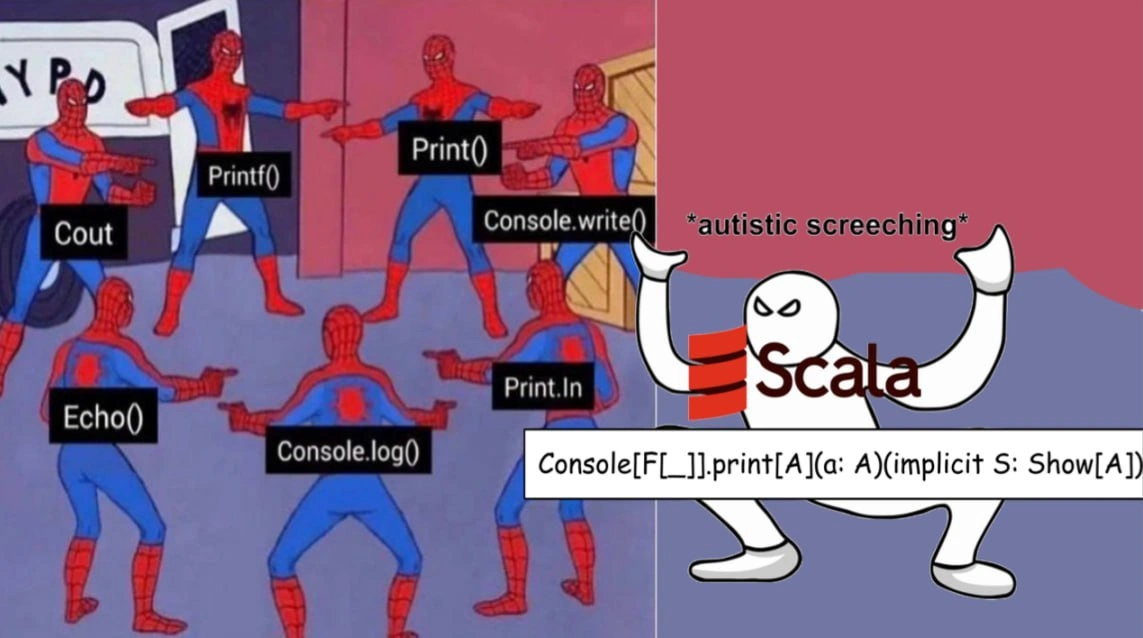
Let’s step back and identify the pieces of this joke in simpler terms. Every programming language has a way to display text to the user (usually in a console or terminal window). It’s often the first thing you learn – the classic “Hello, World!” example. The meme’s left side shows a bunch of Spider-Man characters, each labelled with a different programming language’s print command. Here’s what those labels mean in actual coding:

Language Typical print call
C printf("Hello, World!\n");
C++ std::cout << "Hello, World!" << std::endl;
Python print("Hello, World!")
C# / .NET Console.WriteLine("Hello, World!"); (similar to Console.write())
Java System.out.println("Hello, World!"); (a println function)
PHP echo "Hello, World!";
JavaScript console.log("Hello, World!");

(Each Spider-Man’s label corresponds to a function like these: Cout for C++’s std::cout, Printf() for C’s printf, Print() for languages with a direct print function (like Python), Console.write() (akin to C#’s Console.Write or WriteLine), Println (Java and others use println to print with a newline), Echo() for PHP’s echo, and Console.log() for JavaScript). All different names, but all doing the same job!

In the Spider-Man meme, multiple Spider-Men pointing at each other is a famous image used to poke fun at situations where several things are essentially identical but each one thinks the others are the impostor. Here, it implies that all these printing functions are basically mirror images of one another. A Python developer might playfully accuse a JavaScript dev, “Hey, you just copied our print() and called it console.log(),” while the C dev could say, “Ha, you all got the idea from our printf(),” and so on. It’s a humorous way to say: “Look, under the hood, it’s all the same—everybody is printing text, just with different syntax.” For a new developer, it’s useful to know this: console output calls (printf, echo, console.log, etc.) are one of the most basic features, and every language has its own twist on it. These are language quirks, little differences in naming or formatting, but they accomplish the same fundamental task. So the left side of the meme is basically a cross-language inside joke — a gentle ribbing that no matter how special each language’s print function claims to be, they’re all equivalent in purpose.

Now, what’s up with the right side and Scala? Scala is another programming language, and it has a reputation for being a bit… academic or complex, especially when you use it in a purely functional programming style. The meme shows a rage comic style character with the Scala logo, screaming “autistic screeching”. That phrase is a reference to an internet meme often used to humorously depict someone throwing a loud, incomprehensible fit. In this context, it suggests Scala is having an over-the-top reaction. Why? Because Scala’s way to do the same printing task can look insanely complicated! The text shown below Scala – Console[F[_]].print[A](a: A)(implicit S: Show[A]) – is a made-up (or exaggerated) Scala function signature that roughly translates to “a generic console print function that works for any type A in any context F, as long as there’s a way to convert A into text.” That’s a lot to take in, so let’s break it down in simpler terms:

  • Scala: It’s a high-level language that supports both object-oriented and functional programming. It runs on the JVM (so it can use Java’s libraries) and it’s known for a powerful type system. Scala often lets you do things in a very concise way or in a very abstract way, depending on your style. Here the meme focuses on the abstract side.
  • Type signature: That scary Console[F[_]]... stuff is basically the function’s definition and requirements in code. Think of a type signature as a recipe that tells you what ingredients (types, in this case) a function needs and what it will produce or do.
  • Console[F[_]]: In Scala, you can define a trait (interface) named Console that is generic (F[_] means it’s generic over some kind of container or effect). Without going too deep, imagine F as a placeholder for something like a box or context in which computing happens. If you set F to a specific thing (say IO for input/output operations or maybe just Id for doing it immediately), then Console[F] would be a concrete console that works in that way. It’s like saying “I have a console that works when I plug in a specific mode of operation F.” This design is used in functional programming so that you can swap out what “kind” of effect you’re using (real I/O vs testing, etc.) without changing your code logic. It’s abstract, but it gives flexibility.
  • print[A](a: A): This is the actual function: print something of type A. Instead of just printing text, it prints a value a which could be any type A (an integer, a string, a custom object, etc.). Many languages would just require you to convert that thing to a string first or they call a default toString. Scala can do that too, but here it’s being fancy: it wants to be generic over any type.
  • (implicit S: Show[A]): This part is the tricky bit. Implicit means Scala will automatically supply this parameter if it can. Show[A] is basically a type class (or interface) that says “I know how to turn an A into a String (show it).” So implicit S: Show[A] means “there must exist some way to convert A to text, and the compiler will provide it.” For example, if A is Int, there should be a Show[Int] defined somewhere, which knows how to take an Int and give back "42" or "99" as a string. If it’s a custom type like Person, you’d define how to show a Person (maybe return the person’s name). Scala’s compiler will find the right Show instance for A (if it exists) behind the scenes. This is how Scala implements type classes, a concept borrowed from Haskell. It’s a form of polymorphism that’s neither inheritance (OOP style) nor simple generics — it’s more like saying “any type that has this capability can be used here”.

Phew! So all that basically means: “I can print any type A within some effect F, as long as I know how to convert A to a string.” In contrast, something like Python’s print(x) would just call Python’s built-in conversion to string (via __str__ method) automatically, and it doesn’t care about effects or contexts – it just prints right then and there. The Scala approach shown is more verbose because it’s trying to be very explicit and flexible about what’s happening. It’s ensuring two things: (1) printing is abstracted (maybe you’re not printing to a real console, maybe you’re accumulating output in a test – Scala’s code can accommodate that by plugging in a different F), and (2) you have a well-defined way to turn whatever you’re printing into text (the Show[A] type class, instead of using a possibly unreliable default toString).

For a junior developer or someone new to Scala, seeing Console[F[_]].print[A](a: A)(implicit S: Show[A]) can be intimidating, even though it’s conceptually doing the same job as a simple print() in other languages. The meme plays on that intimidation factor – Scala is shown as literally screaming, which is how a newbie’s brain might feel looking at that code and trying to decipher it! It highlights the verbosity and complexity (the language complexity and verbosity tags hint at this) of Scala’s functional style compared to the straightforwardness of other languages’ print statements.

In terms of developer experience (DX), there’s a trade-off here. Other languages give you a quick, easy function – one command and boom, output on the screen. That’s great for convenience and learning; it’s very ergonomic. Scala’s more abstract approach is harder to read and write initially. It demands that you understand generics, implicits, and type classes, which is a higher cognitive load. Why would anyone do that? Because in bigger, more complex programs, those abstractions can help catch errors at compile time and make code more modular (for example, you could swap the real console with a dummy one in tests without changing your business logic code – neat, but again, advanced). The meme isn’t really saying one approach is objectively better; it’s focusing on the humor of the situation: “All these languages have their cute little print functions, and then Scala comes in screaming with this monstrous definition.” It’s a tongue-in-cheek commentary on Scala’s reputation for functional programming concepts that sometimes tied developers’ brains in knots.

Finally, the phrase “autistic screeching” in the meme is just an absurd caption commonly used in meme culture. It’s not literally about autism here; it’s internet slang to dramatize an overreaction. So picture the Scala character going “REEEEEE!!!” in a shrill voice because it simply cannot just quietly fit in with those other simple print functions – it has to yell about type safety and abstractions. Developers find this funny because it’s a bit true: Scala (and languages like Haskell) often do “yell” about types – the compiler certainly yells at you enough – while more scripting-style languages are chill about just printing whatever. It’s an exaggeration that points to a real difference in philosophy. And when you’ve experienced both sides (the ease of a quick console.log vs. the brain-bending generality of a Console[F].print), the contrast is absolutely comical.

Level 3: Print by Any Other Name

To an experienced developer, this meme hits on a familiar mix of language quirks and the spiraling complexity of certain paradigms. In the left panel, we have the classic Spider-Man pointing scene — except now it’s a whole Spider-Verse of print functions accusing each other of being the same. We see output calls from various languages: C++’s cout, C’s printf(), Python’s print(), C# or similar’s Console.write(), Java (and others) using a form of println, PHP’s echo(), and JavaScript’s console.log(). Each Spider-Man is labeled with one of these, and just like that famous meme, they’re all pointing at each other. The joke here is that despite different syntax, all these functions essentially do the same thing: print text to some sort of console or standard output. It’s a playful jab at how every language insists its way is unique, yet at the end of the day, printing “Hello, World!” is a universal ritual. Seasoned devs chuckle because they’ve written that trivial print statement in countless languages – the syntax changes, the name changes, but the concept is as identical as those Spider-Man clones. It’s a lighthearted nod to the LanguageComparison trope: many roads, one Rome (or many syntaxes, one outcome).

Then, on the right side, enters Scala, and the tone shifts from self-recognizing chuckles to an over-the-top scream. Scala is personified as a rage comic figure emblazoned with the Scala logo, arms raised, captioned with the meme-famous “autistic screeching”. In plain terms, the Scala figure is having a meltdown – and for comedic effect, it’s over its overly sophisticated approach to this same problem. The text below Scala reads Console[F[_]].print[A](a: A)(implicit S: Show[A]), which is a mouthful of a function signature. This stands in stark contrast to the one-word or one-function outputs on the left. It’s as if Scala looked at the simple print functions of other languages and said, “Hold my type parameters…” before unleashing its super-powered, template-rich version of a console print. This juxtaposition is hilarious to developers who have encountered Scala’s penchant for abstraction. It underscores a common developer experience gripe: Scala (especially in its advanced FP usage) can make simple things look bewilderingly complex.

Why would Scala do this? A senior dev reading this immediately recognizes the pattern: Scala’s code is leveraging implicits and type classes to remain generic and pure. In practice, Scala does have a plain old println (it runs on the JVM after all, so System.out.println or Scala’s Predef.println is readily available). But hardcore functional Scala programs – often using libraries like Cats or Cats Effect – avoid calling println directly, because that would be a side effect happening in the wild, outside the type system’s control. Instead, they wrap such effects in abstractions. Our meme’s Console[F] is exactly that: an abstraction of a console, parameterized by an effect type F (like IO or any monad that can perform I/O). When you see something like that in real code, it means the program is written in a way that any output goes through a controlled interface. It’s great for testing (you could swap out a fake console) and for purity (the function doesn’t perform I/O directly; it returns an effect that describes the I/O). But if you’re not used to this style, stumbling upon Console[F].print(a) with an implicit Show[A] can induce WTF-face pretty quickly. It’s as if a newcomer asks “How do I print a value?” and the answer is “Oh, just summon a Console[F] in the correct effect context and ensure you have a Show for the value’s type.” Cue the bewilderment.

This mismatch is the crux of the humor. All the Spider-Men on the left – from echo() to console.log() – are essentially pointing fingers at each other because they’re variations of the same straightforward act. This is a scene of familiar camaraderie to any polyglot programmer: we rib each other about whether it’s printf or cout or println, but we all know it’s basically the same “print to console” operation with a different coat of paint. Then Scala crashes the party like a scholar among pranksters, screaming in type theory because it just can’t dumb itself down to a one-liner. The meme exaggerates Scala’s verbosity by showing a ridiculously long signature – something a Scala functional programming purist might actually write or encounter using a library. It lampoons the language complexity Scala can introduce for even a simple task, highlighting the stark contrast in developer ergonomics.

For veterans, there’s also an implied history lesson: printing text is arguably the oldest thing we do in programming (the archetypal “Hello, World!”). Historically, each language created its own print function (often for good reasons at the time): C’s printf came from needing formatted output with limited type safety, C++’s std::cout stream was an attempt at a more type-safe, extensible I/O system, Python’s print() is just a built-in for ease of use, Java’s println is part of its verbose I/O library, and so on. By the time we get to Scala (born from academia and heavily influenced by functional programming concepts), the simple act of printing gets entangled with ideas of “how do we design this in a pure, generic way?”. The Scala type signature in the meme echoes patterns from Haskell’s influence (type classes like Show, effect types analogous to Haskell’s IO monad, etc.). Seasoned devs recognize this as both brilliant and absurd. It’s brilliant because it demonstrates powerful abstraction – one print function to work with any effect, any type (truly a “print by any other name would smell as sweet” situation, taken to its logical extreme). But it’s absurd because, well, it’s printing text! Do we really need to invoke the full type machinery for a hello world? The shared laugh is in acknowledging how something can be simultaneously technically elegant and practically comedic. This meme encapsulates that perfectly – every language’s print is basically the same (hence the Spider-Man standoff), except Scala, who is off in the corner having a type-class tantrum about it. It’s a scenario almost every experienced developer can relate to: the trade-off between keeping things simple and pragmatic versus over-engineering a simple task in the name of purity or architecture. We’ve all seen a piece of code or an API that made us go, “Why is this so needlessly complicated?” – and here Scala is the poster child of that sentiment, at least in the context of console output.

Level 4: Type-Class Tantrum

At the highest level of abstraction, this meme spotlights a clash between simple I/O calls and advanced type theory. The Scala side isn’t just being verbose for fun – it’s rooted in functional programming purity and type classes. In Scala’s purely functional idiom (inspired by Haskell), even something as mundane as printing to the console is generalized and abstracted. The snippet Console[F[_]].print[A](a: A)(implicit S: Show[A]) encodes ad-hoc polymorphism (via type classes) and higher-kinded types to achieve printing without compromising purity or generality. Let’s unpack this theoretical contraption:

  • Console[F[_]] is a higher-kinded type representing a console effect for some generic context F. In category-theory-flavored FP, you often carry around an abstract effect type F[_] (think of it like a parameter for your monadic context or effect container). This way, printing can work not just in a specific setting (like the real console) but in any effect type F (maybe an IO monad, a test simulator, etc.). It’s akin to saying “for any computational context F, we can have a Console capability” – a concept known as the tagless final or MTL style of programming.
  • print[A](a: A) is polymorphic in the type of value A to print. Rather than being limited to strings or numbers, it will accept any type A. But how can it print any arbitrary A? That’s where the next part comes in.
  • (implicit S: Show[A]) introduces a type class constraint. Show[A] is a type class (essentially an interface) that provides a way to convert an A into a human-readable String (much like Haskell’s Show type class or Rust’s Display trait). The keyword implicit in Scala means the compiler will automatically supply the correct Show[A] instance as long as one is in scope. So, the function only works if it can implicitly find a Show instance for the type A – i.e., a little helper that knows how to show A as text. This is ad-hoc polymorphism: the code works for any type, but each type can have its own custom “show” behavior defined separately.

This approach is academically elegant. It decouples the act of printing from any concrete effect or specific data type. The result is highly generic and composable. For example, you could have Console[IO] for real I/O or a Console[TestEffect] that collects output for unit tests, and Show[Int] or Show[User] to define how to print an Int or a User object. All these pieces fit together through the type system. No hard-coded global stdout or ad-hoc string conversions – everything is explicit in the types.

However, this elegance comes at the cost of verbosity and cognitive load. The meme humorously exaggerates Scala’s type signature obsession to the point of absurdity. There’s a kernel of truth: advanced FP libraries in Scala (like Cats Effect or ZIO) encourage using such abstractions for even the simplest “Hello World”-like tasks. This stems from a deep theoretical commitment: side effects (like printing) should be controlled and encapsulated in the type system to maintain referential transparency (one of functional programming’s core tenets). It’s a bit like enforcing a scientific protocol for an everyday task – an overkill from a practical standpoint, but conceptually pure. The humor emerges from the realization that something as straightforward as printing a line can morph into a polymorphic puzzle involving higher-kinded types, implicits, and category theory-tinged design. In other words, the meme points out the almost comical contrast between simple tasks and complex abstractions: Scala isn’t content with “just print the thing” – it must first solve printing in the most general form, in all contexts, for all types, with mathematical rigor. No wonder the Scala avatar is shown screeching; it’s the sound of abstraction overload meeting a fundamentally simple problem.

Description

A two-panel meme contrasting the simplicity of printing to console in various languages with the perceived complexity in Scala. The left panel uses the 'Spider-Man Pointing at Spider-Man' meme format, where multiple Spider-Men are labeled with common print functions from different languages: 'Printf()', 'Cout', 'Echo()', 'Print()', 'Console.write()', 'Console.log()', and 'Print.ln', all pointing at each other to signify their similar, straightforward nature. The right panel depicts a crudely drawn, angry white figure flexing under the text '*autistic screeching*'. This figure is labeled 'Scala' and is accompanied by a complex line of code: 'Console[F[_]].print[A](a: A)(implicit S: Show[A])'. The humor arises from the stark contrast, mocking Scala's verbosity and functional programming purity for a task that is trivial in most other languages. For senior developers, this resonates as a classic jab at languages that prioritize theoretical correctness and expressive power to a degree that can make simple tasks syntactically cumbersome, touching upon debates around developer experience and pragmatic design


Comments

28
Anonymous ★ Top Pick Most languages ask you to print something. Scala asks you to provide an implicit context, a higher-kinded type, and a proof that the universe in which you're printing even exists
  1. Anonymous ★ Top Pick

    Most languages ask you to print something. Scala asks you to provide an implicit context, a higher-kinded type, and a proof that the universe in which you're printing even exists

  2. Anonymous

    Everyone else bikesheds over print vs printf; Scala pauses the meeting until it has a higher-kinded witness that the very concept of “hello world” is monoidally lawful

  3. Anonymous

    The real autistic screeching happens when you realize you need three implicit resolutions and a Kleisli composition just to debug why your println isn't printing, then discover it's because you're in the IO monad and forgot to call unsafeRunSync()

  4. Anonymous

    When your 'Hello World' requires understanding higher-kinded types, implicit resolution, and type classes, you know you've achieved peak functional programming enlightenment - or you're just trying to print to stdout. Scala's print statement is basically a PhD thesis on why we can't have nice things: it's technically correct (the best kind of correct), completely type-safe, and absolutely nobody asked for it. Meanwhile, Python developers are over here with `print()` wondering why we're bringing category theory to a console.log() fight

  5. Anonymous

    Everyone else writes to stdout; Scala makes you summon a Show[A] witness in F[_] before a single byte escapes

  6. Anonymous

    Other langs: print('hello'). Scala: summon[Show[Any]] or watch your REPL summon the type error police

  7. Anonymous

    In the polyglot monorepo, printing is O(1) everywhere - except Scala, where it’s O(existential) over F with an implicit Show witness

  8. Deleted Account 2y

    Hahahahha

  9. @purplesyringa 2y

    Please use English in this chat

    1. @purplesyringa 2y

      tr.: I've always said Scala is crap

  10. @furry_onko 2y

    :3

    1. @viktorrozenko 2y

      Looks like some Trojan

      1. @furry_onko 2y

        nah its my syntax but i fucked this up and its so hard 💀

  11. @NoCountryForOldBuffet 2y

    I could have sworn scala just has regular print statements, am I going nuts?

    1. @denisndenis 2y

      But its IMPURE

  12. @furry_onko 2y

    if you have a problem

  13. @sylfn 2y

    We have the rules and we expect everyone here to obey them https://t.me/dev_meme/3667

  14. @procself 2y

    Is this really the function call or function declaration? 😐

  15. @WaterCat73 2y

    you can read last sentence in their bot reply

  16. @purplesyringa 2y

    No. Kicking out people who don't know Russian from the conversation just because you refuse to use an international language is.

    1. @callofvoid0 2y

      even in multiplayer games they refuse to cooperate and use English

  17. @glatavento 2y

    IO()

  18. @MDSPro 2y

    How to become trusted😊

    1. @affirvega 2y

      gain trust in this chat and admins here 🤓

    2. @SamsonovAnton 2y

      Install a TPM. 🤓

  19. @MDSPro 2y

    Bot🔫

  20. dev_meme 2y

    Nope, that’s a rule

  21. dev_meme 2y

    A very simple one, either you accept community rules or not is up to you

Use J and K for navigation