From Pseudocode to Python: A File Extension Away
Why is this Languages meme funny?
Level 1: Just Call It Python
Imagine you have a set of pretend instructions, like a recipe written in your notebook, and someone asks you to make a real cake out of it. The funny idea here is like just changing the title of the recipe to “Cake” and expecting a real cake to appear. 🍰 Of course, real life doesn’t work that way! Simply calling something the real thing doesn’t make it real. It’s like drawing a picture of a cat and writing “dog” on it – no matter what you label it, that drawing won’t bark or play fetch. In this meme, the team had some pretend code (a plan written out) and one guy basically says, “Hey, let’s just name it Python code and maybe it’ll run!” The others are shocked because it’s such a silly, laughable solution. We all know you actually have to do the work to turn the plan into a real program, just like you have to bake a recipe to get an actual cake. The humor comes from how ridiculous and simple the idea is – it’s a goofy way to show that Python code can look as simple as a recipe, but you can’t skip straight to the end just by changing the name.
Level 2: Pseudocode vs Python
Let’s break down the basics behind this joke. Pseudocode is like a rough draft for code – a mixture of plain language and generic programming-like instructions that outline how an algorithm or function should work, without strict syntax. Developers write pseudocode to plan out logic in an easy-to-read way. It might look something like:
Pseudocode Example:
FOR each item in list:
IF item equals target:
print "Found it"
This isn’t real code; it’s missing details and doesn’t follow a specific language’s rules strictly. There’s no actual variable declarations or exact syntax here – it’s more of a recipe or outline for the solution. You can’t run pseudocode in a Python interpreter or any compiler directly. It’s meant for humans to understand, not computers.
Now, Python code is the real deal – what you write in the Python programming language to actually execute those steps. Python files have the extension .py (for example, script.py), which tells your computer and text editor, “Hey, this is a Python program.” Inside a .py file, you have to respect Python’s syntax. For instance, that pseudocode above could be turned into actual Python like this:
# Python Code Example
for item in my_list: # loop through each item
if item == target: # check if the item matches the target
print("Found it") # print a message
See how the Python code is very close to the pseudocode? The structure is similar (for loop, if check, print statement). That’s a big reason this meme works – Python’s syntax is so clean and readable that it often looks like pseudocode with just a few minor tweaks. In our conversion, we had to add a real variable name (my_list), use the == equality operator, and put a colon : after the loop and if statements to satisfy Python’s grammar. We also put the print message in quotes and parentheses (print("Found it")) because in Python that’s how you call the print function. But aside from these details, the pseudocode and Python code line up in a very straightforward way. This is a hallmark of Python’s language design: it was created to be readable and concise, which hugely improves the developer experience when coding.
Now, why can’t we just rename a pseudocode file to .py and be done? The key is that a file extension (like .py) is basically a hint to the operating system or programs about how to treat the file – it doesn’t magically convert the file’s contents. If you take a text file that has pseudocode and simply rename it pseudocode.py, you’re telling Python to try and run it. The Python interpreter will then attempt to execute the contents as if they were Python code. But unless that pseudocode was already written in perfect Python syntax, the interpreter will get very confused and likely throw errors (SyntaxError is a common one). For example, pseudocode might use words like “FOR” or “END IF” or omit necessary punctuation – Python wouldn’t understand those. Renaming the file is a superficial change; the real heavy lifting is making sure the inside of the file is valid Python code.
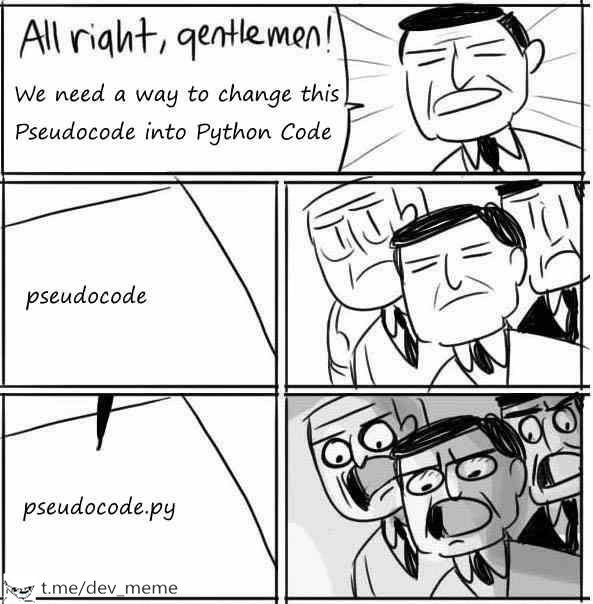
The meme’s second panel suggestion of writing pseudocode.py is a tongue-in-cheek hack proposal. It’s like someone saying, “Hey, maybe the computer will just do it if we name it Python!” It’s funny because it’s clearly not a serious or workable solution – any programmer knows you still have to implement the logic properly – but it riffs on the truth that Python code can be nearly as legible as the plan itself. This joke also highlights a common newbie mistake: sometimes beginners think changing a file’s extension can convert the file. For instance, renaming a document.txt to document.pdf doesn’t actually turn a text document into a formatted PDF; it just confuses your computer (or the PDF reader might outright refuse to open it). In the same way, renaming pseudocode to have a .py extension won’t automagically transform it into a working Python program. The shocked faces in the last panel are basically the team reacting like, “Did you really think it works that way?!”
To sum up, pseudocode is the plan and Python is one way to execute the plan. The meme humorously suggests skipping the whole coding step by exploiting Python’s simplicity – just rename the plan as code. It’s funny to developers because Python does let you get very close to that ideal (minimal syntax, easy translation from pseudocode), but it still isn’t literal magic. The laughter comes from recognizing both Python’s strength (simple syntax, high readability) and the absurdity of a one-step fix. This little comic is firmly in the bucket of coding humor and relatable developer experience. Anyone who’s had a manager or colleague drastically oversimplify a hard programming task (“can’t you just…”) will smirk at this scenario. It’s a gentle reminder: even with a powerhouse language like Python, you can’t skip the actual coding part by mere file renaming wizardry!
Level 3: Rename-Driven Development
The scene unfolds in a classic boardroom suggestion meme setup: a boss demands, “We need to change this pseudocode into Python code!” and the team scrambles for ideas. An over-eager engineer scrawls pseudocode.py on the whiteboard as the “solution,” implying we just slap a .py file extension on the pseudocode and call it a day. The final panel’s wide-eyed shock is priceless – it’s the stunned mix of “did he really just say that?” and “so crazy it might just work!” that fuels this developer humor. Why is this so funny to experienced devs? Because it pokes fun at Python’s reputation as executable pseudocode and the naïveté of quick-fix solutions.
In terms of programming languages and their quirks, Python stands out for its clean, minimal syntax. Seasoned developers often joke that writing in Python feels like writing in plain English or pseudocode. Indentation replaces curly braces, there are no noisy semicolons, and you can read Python code almost like an algorithm description. This meme takes that praise to an absurd extreme: What if turning design into code were as easy as adding “.py”! It satirizes the idea of Python being so high-level and intuitive that even raw pseudocode could run if you simply renamed the file. Of course, reality isn’t quite that magical – but the joke lands because Python does come closer to that ideal than other languages. (Try doing this with C++ or Java – adding .cpp to pseudocode would just give you a file full of compiler errors and relatable pain for days.)
There’s an undercurrent of relatable humor here about developer workflow and productivity. Converting pseudocode to actual code is usually a straightforward but necessary slog – essentially, you’re filling in real syntax and handling all the nitty-gritty that pseudocode glosses over. It’s a task every programmer knows: taking a high-level solution idea and translating it into a working program with correct syntax and semantics. A cheeky developer might quip in a meeting, “Hey, our plan is practically done – just rename the spec to .py and ship it!” Everyone knows that’s not a real solution, but it lightens the mood. The shocked faces in the meme mirror how your team might look if someone seriously suggested such a file-rename hack as a delivery strategy. It’s poking fun at the wishful thinking that coding could ever be that easy.
This comic also riffs on the gulf between developer experience ideals and reality. On one hand, Python’s simplicity boosts productivity – it’s true that you often can take a well-written pseudocode outline and implement it in Python almost line for line. On the other hand, there’s always more to do: real code needs proper variables, correct indentation, actual API calls, data types, error handling, and so on. The meme humorously ignores all those details, highlighting a common language quirk of Python: sometimes the pseudocode looks almost identical to valid Python code. It’s a tongue-in-cheek nod to Python’s design philosophy (“syntax so clean, even pseudocode feels at home”). The boardroom format exaggerates the scenario – imagine a high-stakes project meeting where someone proposes an absurdly simple fix. Experienced engineers recognize the tongue-in-cheek reference to those naive “just do X” solutions that management or newbies might blurt out, not realizing what actually changing pseudocode to real code entails. In short, the meme gets a knowing laugh from senior devs because it captures both the relatable dream of effortless coding and the absurdity of thinking a mere filename change could implement a feature. It’s the ultimate “if only it were that simple” inside joke.
Description
A six-panel, black-and-white comic strip. In the first panel, a manager-like figure announces to his team, 'All right, gentlemen! We need a way to change this Pseudocode into Python Code'. The second panel shows a piece of paper or a board with the word 'pseudocode' written on it. The third panel shows the team looking bored and unimpressed. The fourth panel shows the same paper, but now the text has been changed to 'pseudocode.py'. The fifth and sixth panels show the entire team with shocked, horrified, and wide-eyed expressions, as if witnessing something impossible or heretical. A watermark for 't.me/dev_meme' is in the bottom-left corner. The humor stems from the well-known characteristic of Python's syntax being so clean and high-level that it often reads like pseudocode. The joke exaggerates this by suggesting that the 'conversion' process is merely a matter of renaming the file with a '.py' extension. For experienced developers, this is a relatable and funny take on Python's readability and the sometimes absurdly simple solutions to seemingly complex requests

Comments
7Comment deleted
The difference between pseudocode and Python is that the Python interpreter is a bit stricter about indentation
Management loved renaming “algorithm.pseudo” to “algorithm.py” - right up until pylint, mypy, and the incident pager pointed out that readability ≠ runtime semantics
The same architect who convinced us to migrate from SOAP to REST by changing .wsdl to .json just discovered Python
Ah yes, the classic enterprise transformation strategy: rebrand the legacy system and call it 'cloud-native.' This meme perfectly captures that magical moment when management discovers that changing a file extension is somehow equivalent to a complete language migration - no refactoring, no type checking, no actual Python syntax required. It's the architectural equivalent of putting racing stripes on a minivan and expecting it to win Le Mans. Bonus points if they schedule a retrospective to discuss why the 'converted' code doesn't run and blame it on 'Python being too strict.'
Python: the only language where “convert pseudocode to production” is git mv pseudocode pseudocode.py and a calendar reminder to add type hints later
The ultimate transpiler for tight deadlines: `mv pseudocode pseudocode.py` - zero syntax errors, 100% 'production-ready' vibes
Our enterprise pseudocode-to-Python compiler ships as: mv pseudocode pseudocode.py - zero build time, infinite code review comments