Sleep Sort: The Genius of Inefficient Sorting
Why is this CS Fundamentals meme funny?
Level 1: Sorting by Alarm Clocks
Imagine you have a group of friends each holding a number, and you want them to line up from smallest to largest number. Instead of asking them directly, you give each friend an alarm clock. You tell each friend to set their alarm to ring after X minutes, where X is the number they have. Then all friends start their timers at the same moment. The friend with the number 1 sets their alarm for 1 minute, the friend with 5 sets theirs for 5 minutes, and so on. What happens? The friend with the smallest number’s alarm rings first (because a 1-minute wait is the shortest), so that friend yells out their number “1”. Next, the 2-minute alarm friend’s clock rings and they call out “2”, then the 3-minute folks go off, and so forth. In the end, the alarms will ring in increasing order of the numbers, so you’ll hear the numbers shouted in sorted order. Sleep Sort is just like that: it sorts numbers by letting each number “sleep” for that amount of time and then announcing itself. It’s a silly and roundabout way to organize things (imagine actually waiting around for the longest alarm!), but it’s funny because it does work in a cartoonish sense. It’s as if the computer takes a nap for each number and wakes up in the order of who had the shortest nap!
Level 2: Sorting by Snoozing
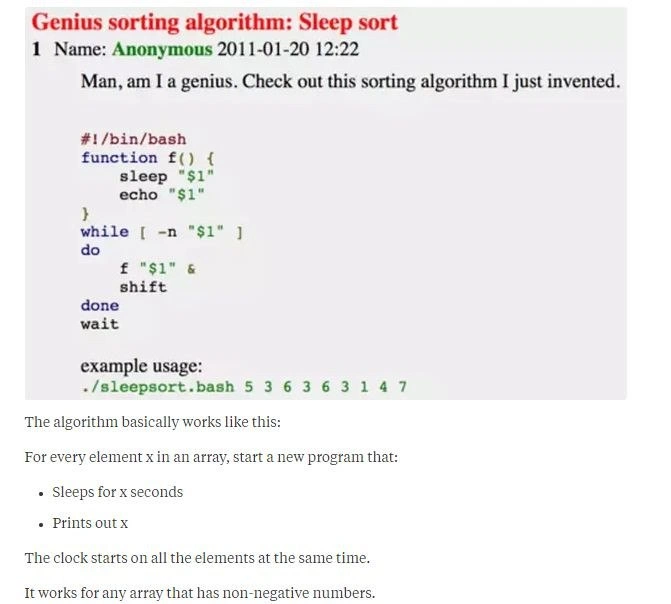
Let’s break down what’s going on in this Bash script for those newer to shell scripting and algorithms. First, Bash is a command-line interface (CLI) shell used in Linux/Unix systems, and you can write shell scripts (text files with #!/bin/bash at the top) to execute a series of commands. In this meme’s code, they wrote a Bash script called sleepsort.bash that can sort numbers. How? By using the Unix sleep command in a clever way.
The script defines a function f() that takes a number (let’s call it X). Inside f, it does two things: first sleep "$1" causes the program to pause for $1 seconds (if $1 is 5, it sleeps 5 seconds). Next, echo "$1" prints that number to the screen. So f 5 would wait 5 seconds, then output “5”. The cool part is how they use this function for sorting.
The main part of the script is a while loop that goes through each number provided as an argument to the script. Suppose you run:
./sleepsort.bash 5 3 6 3 6 3 1 4 7
Here the array of inputs is [5, 3, 6, 3, 6, 3, 1, 4, 7]. The script will take each of those numbers in turn and call f on it in the background (that’s what the & does in Bash — it says “run this command in parallel, don’t wait for it right now”). So it’s like starting a bunch of timers at the same time: one timer for 5 seconds, one for 3 seconds, another for 6 seconds, etc., all running concurrently. The shift command in the loop just moves to the next number each time, until we’ve started a timer for every number.
After launching all these background tasks, the script executes wait. wait tells the shell: “Okay, pause here and don’t finish the script until all those background jobs are done.” As each background job finishes sleeping, it echoes its number to the screen. So what happens when you run the example? All processes start nearly together:
- The ones sleeping for 1 second will wake up first and print “1”.
- The ones sleeping for 3 seconds will wake up after 3 seconds and print “3”.
- 4-second sleepers wake and print “4”, then 5, then 6, and finally the 7-second sleeper prints “7”.
So the output lines appear in increasing order: 1 3 3 3 4 5 6 6 7. Ta-da! The numbers are sorted! The trick works because shorter sleep = earlier print, which naturally orders the output from smallest to largest number.
However, there are some important practical notes that make this a humorous gimmick rather than a real-world solution:
- We rely on all numbers being non-negative (you can’t ask the computer to sleep a negative amount of time; that would either error out or just not make sense).
- If a number is
0, the function will print it immediately (0-second sleep means it doesn’t wait at all). That’s fine – 0 will just show up first in the sorted order. - This approach uses one separate process for each number. For a few numbers, that’s okay. But if you tried this with, say, thousands of numbers, your computer would try to start thousands of processes at once! That can slow down or even crash your system, because each process uses some CPU and memory. It’s like trying to juggle too many balls at once.
- The total time it takes to finish depends on the largest number. If your biggest number is 7 (like in the example, 7 seconds), it’ll finish in a little over 7 seconds. But if your largest number is 1000, you’d be waiting about 16 minutes for the sort to complete – not very efficient compared to normal sorting methods that could sort 1000 numbers in a fraction of a second.
In computer science class, when we talk about sorting, we usually learn algorithms like Bubble Sort, Merge Sort, or Quick Sort. Those involve comparing numbers directly in code and have well-known performance characteristics (like taking roughly proportional to n log n steps for Quick Sort on n items). Sleep Sort is a joke because it doesn’t do any comparisons or swaps in the code at all – it just turns each number into a waiting time. It’s more of a clever stunt or a puzzle than a practical algorithm. But it’s a fun way to think about concurrency (things happening at the same time). It shows that when you have multiple processes or threads, you can sometimes get surprising results by coordinating them – in this case, coordination via timed delays.
So, in simpler terms: Sleep Sort is a Bash program that sorts by letting each number “wait” for that many seconds and then shout its value. The smallest number waits the least and shouts first, the largest number waits longest and shouts last, so you hear the numbers in order. It’s a neat demonstration of how programming can interact with real time, but it’s definitely not how you’d sort data in a real application. The meme is popular among programmers because it’s an example of coding humor – doing something in a laughably inefficient or weird way just to prove it can be done (and to get a chuckle from those who understand the normal way to do it).
Level 3: Fork, Sleep & Conquer
For experienced developers, this meme hits on a couple of inside jokes in algorithm design and system hacking. The author proudly proclaims, “Man, am I a genius. Check out this sorting algorithm I just invented.” Seasoned engineers recognize the sarcasm: Sleep Sort is an infamous example of a novel but absurd solution. It does technically sort the numbers, but in the most inefficient way imaginable by abusing shell scripting and concurrency. Why is it funny? Because it’s like sorting your to-do list by writing each task on a separate alarm clock and setting each alarm to go off after a number of seconds equal to the task’s priority. It will work — the alarms will ring in ascending order of wait time — but any real engineer would cringe at the resource cost and unpredictability of such a method!
What’s happening under the hood? The Bash script uses the & operator to run each sorting task in the background, essentially spawning one subprocess per array element. In pseudo-code:
for each number X in the input:
sleep X seconds in a background process &
done
wait for all background processes to finish
Each background subprocess sleeps for X seconds and then echos X. Because all sleeps start at roughly the same moment, the ones with shorter durations finish first and print their number to standard output. By the time the longest sleep is done, all numbers have been printed in ascending order. The script then uses wait to pause the main script until all those background processes complete (ensuring the script doesn’t exit early). It’s a neat trick exploiting the fact that the OS scheduler can handle multiple processes concurrently, and their completion order in time corresponds to sorted order of the values. Essentially, it transforms the sorting problem into a race: each number triggers a timed race where smaller numbers finish sooner.
For a senior developer, the humor is that this “algorithm” is really just punting the work to the operating system and real time delays. We normally measure sorting efficiency in terms of comparisons or swaps (like QuickSort’s ~O(n log n) complexity). Here, the heavy lifting is done by the passage of time and OS-level parallelism, not clever data manipulation. It’s a bit of a cheat: instead of actively sorting, the program just sits back and waits for the answer to materialize as time passes. It’s the ultimate lazy evaluation! Seasoned folks also note the constraints: it only works for non-negative numbers (you can’t sleep a negative duration – the concept of sleeping “-5 seconds” is nonsensical). If you give it a 0, that process will print immediately (zero-second sleep means it’s done almost instantly) – that’s fine, it just means zero-valued elements appear at the very start as expected. Duplicate numbers? They’ll all try to print after the same delay. In practice, if multiple processes wake up at the exact same second, their output order might be jumbled relative to each other (one might print slightly before another depending on scheduling). But since 5 and 5 are equal, printing “5 5” or “5 5” – well, it’s the same sorted result (duplicates have no inherent order). The algorithm doesn’t ensure stability (preserving original order of equal elements), but nobody’s using this for serious applications, so who cares!
The absurdity of Sleep Sort is also educational: it underscores why we don’t judge algorithm efficiency by raw clock time alone or by using unlimited parallelism without cost. Sure, if you had as many processors as input elements and no penalty for spawning tasks, you could argue Sleep Sort runs in O(max_value) time which, for bounded small values, might look “okay.” But in reality, creating N concurrent processes has overhead. Context switching, memory for each process, and coordination (the final wait) all introduce costs. It’s an example of a joke algorithm often mentioned alongside things like Bogosort (which randomly shuffles until sorted) or the mythical “Sorting by playing cards falling” – entertaining, but impractical.
From a command-line enthusiast standpoint, it’s also a fun bit of Bash scripting magic. It showcases how a few lines of shell code can leverage parallel execution (& and wait) in ways many beginners might not realize. The script itself is concise and clever:
function f() { sleep "$1"; echo "$1"; }defines a helper that sleeps for the given number of seconds then prints the number.- The
while [ -n "$1" ]loop iterates over each command-line argument (each number provided to sort). f "$1" &launches that sleep-print function in the background for the current number.shiftmoves to the next argument (removing the already-launched number from the list).- After launching all numbers,
waitmakes the main script hold until all those backgroundfprocesses have finished outputting.
A veteran coder laughs because the author’s self-congratulation (“Genius sorting algorithm”) parodies the overconfidence of someone rediscovering a known goofy trick. This isn’t a standard algorithm you’d find in textbooks; it’s more like a hacky prank. If a junior developer tried to submit Sleep Sort in a code review or interview, the senior engineers would likely facepalm and then explain about efficiency and edge cases. It’s a classic example of something that is technically correct (it does output sorted numbers) but conceptually and practically wrong for real use. The humor shines through in the audacity: taking something as serious as sorting and solving it by literally taking a nap for each number! It reminds experienced folks of times they’ve seen overly complicated solutions to simple problems – or when someone “solves” a problem by offloading it in a quirky way (like using a spreadsheet as a database, or using DNS text records to pass messages – just because you can doesn’t mean you should).
In summary, Sleep Sort is esoteric code that turns sorting upside down: rather than sorting within the program, it sorts via the scheduler and the clock. Seasoned devs get a kick out of it because it highlights, in a humorous way, the difference between something that’s theoretically possible versus practically advisable. It’s a gentle reminder that while we adore clever hacks, there’s a reason algorithms classes don’t teach “just sleep on it” as a sorting strategy!
Level 4: Time Complexity, Literally
At the most granular level, Sleep Sort is a tongue-in-cheek demonstration of using physical time as a sorting mechanism. In a traditional algorithm, comparisons happen in code, but here each number’s magnitude directly dictates a real-world delay. This Bash script launches one concurrent process per input value – an abuse of the operating system’s scheduler – turning the sort into a parallel time-delay experiment. Every process calls the OS sleep syscall for X seconds (where X is the number’s value) and then outputs that number. The ingenious twist is that smaller numbers finish sleeping sooner, so their output appears earlier in real time. In effect, the timeline acts as the comparator: the sorted order emerges from the sequence in which sleeper processes wake up and print. This is almost like an analog computer using wall-clock seconds as a computational medium.
From a theoretical CS perspective, it’s fascinating because it breaks the usual model of counting steps in code. The time complexity here isn’t measured in CPU cycles or comparisons, but in actual seconds proportional to the largest input value. Formally, if M is the maximum number in the input, the algorithm’s running time is on the order of O(M) (since you must wait M seconds for the largest number to finish sleeping). This is highly unusual because typical sorting algorithms are analyzed in terms of n, the number of elements, rather than the numeric magnitude of data. In Sleep Sort, the data itself (the values) determines the running time. If someone gave you the number 10 million to sort this way, you’d literally be waiting 10 million seconds (about 115 days) for the result – a hilariously impractical scenario from a performance standpoint. Meanwhile, it spawns O(n) separate processes or threads, which is a heavy concurrency load. Modern OS schedulers can handle many processes, but launching one per array element is like using a cannon to kill a mosquito: it works, but it’s overkill and could overwhelm system resources if n is large (imagine forking thousands of processes at once – your CPU context-switches frantically and RAM usage balloons).
There’s also an implicit assumption of timing precision and fairness in the OS. Real operating systems have scheduling granularity and may not wake all sleepers exactly at their requested time if many are scheduled simultaneously. Tiny discrepancies or heavy load could mean two processes with the same sleep duration might not echo in the exact order they were started. Concurrency and system timing aren’t perfectly deterministic – if two elements have equal value, their order of printing is essentially nondeterministic (although since equal values can appear in any order and still be considered sorted, that’s not a logical error). This lack of control highlights that we’re bending the rules of algorithm design: relying on the OS and wall-clock time to do the work. In academic terms, Sleep Sort cheekily sidelines the usual comparison model of sorting and hands it off to the physics of time passage and OS scheduling. It’s a brilliant anti-pattern: a sort of distributed sort across time, reminiscent of those esoteric analog sorting tricks (like using parallel resistors or spaghetti lengths to sort numbers). But unlike serious parallel algorithms, which aim for efficiency, Sleep Sort trades computational complexity for conceptual simplicity in the most literal way possible — by making the wait time itself proportional to the number’s value. This makes seasoned engineers smirk, because it’s both clever and fundamentally constrained by the laws of physics and operating systems.
Description
A screenshot of a forum post, likely from an imageboard like 4chan, titled 'Genius sorting algorithm: Sleep sort'. The post, dated 2011-01-20, proudly presents a 'newly invented' sorting algorithm. The core of the post is a bash script. The script defines a function that takes a number as an argument, sleeps for that number of seconds, and then echoes the number. The main part of the script iterates through the command-line arguments, launching a background process of this function for each number. A 'wait' command ensures the main script doesn't exit until all background jobs are done. An example usage is shown: './sleepsort.bash 5 3 6 3 1 4 7'. The post concludes with a simple explanation: for each number, a new program sleeps for that duration and then prints it. The technical joke is that this is a famously impractical and inefficient 'sorting' algorithm. While it technically works for non-negative integers by leveraging the operating system's process scheduler, its runtime is determined by the largest number in the input array, it consumes a process for each element, and it's highly non-deterministic. For senior developers, it's a classic piece of computer science humor, a parody of overly clever but useless solutions

Comments
7Comment deleted
Sleep Sort is the only algorithm whose performance is measured in 'time to get a coffee'. It's also a great way to stress-test your OS scheduler and your patience simultaneously
Sleep sort: proof that with linear syntax, unbounded forks, and latency proportional to coffee breaks, you can trade O(n log n) for O(ulimit -n) Sev-1s and still call it “elegant concurrency.”
Sleep Sort: the only algorithm where your time complexity is O(max(n)) wall clock time, and explaining it in a technical interview guarantees you'll never have to explain why you left your last job
Ah yes, Sleep Sort - the algorithm with O(n) time complexity and O(max(input) seconds) wall-clock time. Perfect for when you need your array sorted by next Tuesday. It's technically correct (the best kind of correct), leveraging the OS scheduler as a comparison-free sorting mechanism. Just don't try explaining to your PM why the production deployment is sleeping on the job, or why your sort performance degrades linearly with input magnitude. Bonus points: it fails spectacularly with floating-point numbers and negative integers, making it the perfect interview answer for 'tell me about a time you thought outside the box... way, way outside.'
Sleepsort: O(n * MAX) time where 'parallelism' means your process table explodes before results arrive - prod-ready until scale hits
Sleep sort: delegating compare() to the kernel timer - O(n) processes, O(max(input)) wall clock, and an O(PagerDuty) alert when someone tries 86400
Sleep sort: trade O(n log n) for O(max(A)) and a production incident - outsourcing comparisons to the kernel scheduler and NTP, with undefined behavior for negatives unless you can fork into the past