Skip to content
DevMeme
1755 of 7435
A Git Merge Catastrophe of Biblical Proportions
VersionControl Post #1960, on Aug 24, 2020 in TG

A Git Merge Catastrophe of Biblical Proportions

Why is this VersionControl meme funny?

Level 1: Throw It All Away

Imagine you and your friend each have a big coloring book, and you both spend a week coloring the same pictures in your own books. Now someone asks you to combine your work into one book. But when you try, you find that on every page, you colored things differently – thousands of little differences! One of you colored the sky blue, the other colored it green; one stayed inside the lines, the other drew new patterns. It’s such a gigantic mess that you’d have to go through each page one by one to sort it out. You feel completely overwhelmed – it’s like an almost impossible chore. So, in a fit of frustration, you decide, “Forget it, I’m just going to throw the whole book in the trash!” That’s essentially what the developer in the meme did: instead of trying to fix thousands of tiny conflicts in the code (which felt as hopeless as fixing every page in those coloring books), they chose to delete everything and start over.

Now, while you’re fuming and throwing things away, imagine your dad or a friend hears you freaking out. They peek in and go, “Hey, why are you crying so loudly?” in a half-serious, half-joking way. In the meme, a chat message from “Daddy” pops up asking “Why the heck are you crying so loud?” right when the coder is about to delete everything. It’s like when you’re super upset about something and someone catches you mid-tantrum and teases you a bit to break the tension.

So, put simply: the picture is funny because it shows a computer programmer having a huge problem with combining code (so huge that it’s ridiculous), and they humorously decide to solve it by just erasing all their work (a very over-the-top reaction, kind of like tearing up your homework in frustration). And as they do that, a message from someone pops up basically saying, “Whoa, calm down!” The extreme nature of the problem and the extreme response – and then someone calling it out – is what makes it comedic. Even if you don’t know Git or code, you can understand the feeling of “This is so messed up, I just want to start over!” and maybe having a friend or parent wonder why you’re making such a fuss. It’s an everyday frustration moment, just happening in a programmer’s world.

Level 2: Rage Quit the Repo

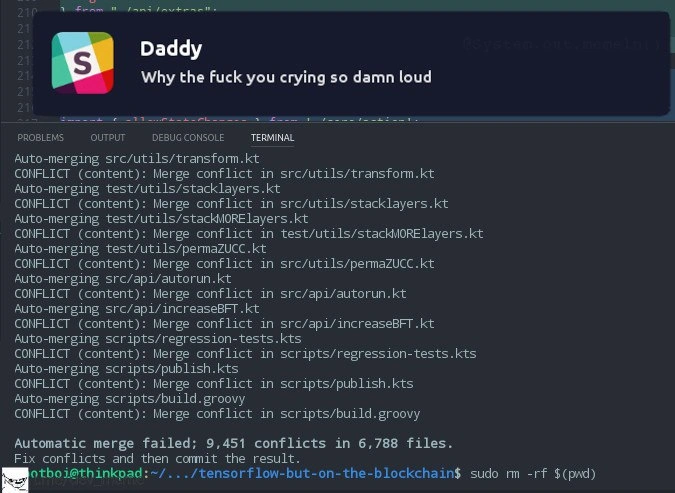
Let’s break down what’s happening for those newer to Git and programming. Git is a version control system that developers use to keep track of code changes. It allows multiple people to work on the same project concurrently by using branches – separate timelines of changes that can later be merged together. A merge conflict arises when two branches have changed the same part of a file in different ways, and Git doesn’t know which version to keep. Normally, you might get a few conflicts if two people edited the same function or line. But here we have 9,451 conflicts across 6,788 files – that number is astronomical. It means almost every file that Git tried to merge had overlapping changes that it couldn’t automatically reconcile. This often happens if, for example, one branch reformatted or refactored a huge portion of the code while another branch made different changes in parallel. The result is Git basically saying, “I tried to auto-merge everything, but there’s just too many differences. I’m giving up now.” The lines like:

Auto-merging src/utils/transform.kt  
CONFLICT (content): Merge conflict in src/utils/transform.kt  
...  
CONFLICT (content): Merge conflict in scripts/build.groovy  

are Git’s log of what it did. “Auto-merging file” means Git attempted to merge changes in that file, and the “CONFLICT (content)” line means it hit a section it could not merge cleanly in that file. When it’s done going through all files, it prints “Automatic merge failed” along with instructions: you have to fix the conflicts by hand, then commit. Normally, fixing a conflict means opening the file, finding the conflict markers (which look like <<<<<< and ====== in the file) and deciding what the final code should be. Doing this for one or two files is routine. Doing it for hundreds is a bad day. Doing it for thousands is basically unimaginable – you’d spend days or weeks and likely introduce new bugs in the process.

Now, the command shown at the prompt, sudo rm -rf $(pwd), is a shell command that deserves some explanation (and a huge warning: do not run this on your own system unless you absolutely mean to delete everything!). Here’s what it means:

  • rm is the remove command, used to delete files.
  • -rf are options for rm. -r means recursive (delete directories and everything inside them), and -f means force (don’t ask for confirmation, just do it). Combined, rm -rf is the blunt instrument to delete folders and files without mercy.
  • $(pwd) is a shell substitution that inserts the output of the pwd command. pwd stands for “print working directory,” which outputs the current folder you’re in. So if you’re in the root of your project directory, $(pwd) expands to that full path.

So sudo rm -rf $(pwd) will, as the superuser (sudo gives you administrative rights), erase the entire current directory and everything under it. In context, the current directory is presumably the git repository (tensorflow-but-on-the-blockchain). This command is essentially saying: “I don’t even want to attempt fixing this. Just delete the whole project from my computer.” It’s an extreme form of rage quitting in programming – instead of quitting a game, you’re quitting your code by annihilating it. Usually, if a merge goes badly, a more sensible approach is to use git merge --abort (which stops the merge and returns the repo to the state before the merge attempt) or just wipe out your local copy and re-clone from the remote repository. But typing out sudo rm -rf is a dramatic flair, basically equivalent to saying “to heck with it, I’m torching this.” It implies the developer has decided it’s easier to start fresh than untangle the mess.

The context clues are interesting too. All the file paths end in .kt or .kts or things like build.groovy. .kt is the file extension for Kotlin, a programming language often used on Android or back-end services (it’s like a modern cousin of Java). A .kts file is a Kotlin script, and build.groovy suggests the project uses Gradle (a build tool), which can be configured in either Groovy or Kotlin script. So this codebase is likely a big Kotlin-based project. The fact the directory is named “tensorflow-but-on-the-blockchain” sounds like a joke – TensorFlow is a famous machine learning library (usually Python/C++), and “on the blockchain” references blockchain tech. It’s like someone combined two of the most complex things for the sake of it, possibly resulting in a huge, unwieldy project. Even if you’re a junior dev, you might have heard the trope of “but on the blockchain” as a meme about over-engineering. So this name sets the stage for why the repo could be so large and chaotic.

Now, imagine trying to merge code in such a project – perhaps two developers (or teams) worked separately on big features (one on the “TensorFlow” side, one on the “blockchain” side?) and changed a lot of the same files. If they both modified thousands of files (like updating function names, moving code around, or even using auto-formatters differently), Git can’t magically merge that without conflicts. The developer is now faced with resolving conflicts in thousands of files. That’s beyond “bad day”; that’s like “cancel all your plans for the week.” It’s understandable that at this point a person might just think, “forget it, I’ll delete everything and maybe re-clone or restart.” It’s a bit like having a knot so tangled that you decide to cut the rope instead of untying it.

Finally, the Slack notification at the top from someone labeled “Daddy” saying “Why the f**k you crying so damn loud” adds a real-world comedic twist. Slack is a chat app widely used in tech companies for team communication. Getting a Slack message popup while you have your terminal open is very typical in a work environment. The content of the message is obviously not formal – it reads like a friend or a close colleague who can use strong language jokingly. This suggests the developer was visibly or audibly upset (maybe they literally yelled or groaned loud enough that a coworker noticed, or perhaps they typed something dramatic in a chat earlier). The person called “Daddy” could actually be a humorous nickname in Slack (some people set silly display names), or it could indeed be a parent pinging them (less likely on Slack, but who knows). The phrasing is intentionally over-the-top and funny: it’s basically breaking the tension by poking fun at the developer’s loud crying. This is the interrupting Slack notification trope – something absurd or embarrassing pops up in the corner of your screen exactly when things are going wrong. It’s like the universe saying, “Not only are you dealing with this merge from hell, but you also have to be roasted for it in real time.” For a newer developer, the take-away is that these collaboration tools become part of the coding life, and yes, even your friends online might sense when you hit rock bottom and crack a joke to snap you out of it.

In summary, at this level: The meme is illustrating a disastrous Git merge attempt with an insane number of conflicts, leading the frustrated developer to run a destructive command (sudo rm -rf) to delete everything. It highlights the “I give up” moment that many developers can relate to (even if on a much smaller scale). The Slack message adds a layer of developer humor by showing how colleagues or friends might react to your meltdown – half sympathetic, half teasing. If you’re new to coding, know that merge conflicts are normal (though this many is not!) and that there are usually better ways to handle them than deleting your whole project. But the exaggeration is what makes it funny. It’s capturing the coding frustration when everything that could go wrong has gone wrong, and the only comfort is to joke about blowing it all up and starting over.

Level 3: Gitpocalypse Now

This meme showcases a worst-case scenario in version control – a merge conflict of apocalyptic scale. We see a terminal spewing thousands of git merge conflict messages, and it’s basically the endgame of Git nightmares. Seasoned developers instantly recognize the horror: 9,451 merge conflicts in 6,788 files means something has gone terribly, hilariously wrong in your project. It’s the kind of merge conflict apocalypse that usually only happens when someone tries to combine two massively diverged codebases or merge a year-old feature branch into the mainline without integration along the way. In a healthy workflow, you’d never let things drift so far apart – but here we are in a state of version-control hell. The repository path tensorflow-but-on-the-blockchain already hints at scope creep on steroids: combining a huge machine learning library (TensorFlow) with blockchain hype, likely in a giant monorepo full of Kotlin code. No wonder the auto-merge blew up. This is a perfect storm: maybe multiple teams refactored the same files, or a big bang rewrite happened, so Git’s automatic merge algorithm waved a white flag.

When Git prints out Automatic merge failed; fix conflicts and then commit the result., it’s effectively telling you “I tried, but this is beyond me — human, you deal with it.” In our meme, the developer’s response is the ultimate nuclear option: sudo rm -rf $(pwd). This command is Unix-speak for “delete everything in the current directory, no questions asked, even if it requires root permissions.” In other words, “burn it to the ground.” It’s a tongue-in-cheek portrayal of a developer so fed up with an impossible merge that they’d rather wipe out the entire codebase than attempt to resolve the conflicts. Every senior dev has had that dark thought at least once. Sure, best practice would be to calmly git merge --abort or seek a smarter strategy, but in the heat of the moment (perhaps at 3 AM after too many LateNightDebuggingSessions), the “just delete it all!” instinct flashes through your mind. The meme exaggerates it to the extreme — using sudo to ensure nothing survives, not even files that normally might resist deletion. It’s a snarky nod to how Developer Experience (DX) can degrade into pure despair when MergeConflicts get out of hand.

The overlay of a Slack notification from “Daddy” saying “Why the fuck you crying so damn loud” adds an extra layer of dark humor. It’s the comedic timing factor: right as the developer executes the digital self-destruct, someone (maybe a sarcastic coworker or a friend ironically nicknamed “Daddy”) messages them. It’s like a slapstick interruption during a breakdown. This also resonates with veteran devs: you’re having a meltdown over prod failing or a botched deploy, and a Slack ping or a manager’s ping comes in at the worst possible moment. Here, Daddy calling them out for crying highlights the emotional breakdown happening off-screen. The message is blunt and profane — exactly the kind of half-joking, half-concerned poke a close colleague might send if they hear you raging at your desk. In a way, it breaks the fourth wall of the meme: even people around you (or on chat) can sense when a merge has driven you to madness.

All the elements together create a painfully funny scenario that seasoned developers know could happen if you mix reckless branching strategies, an overly ambitious project (“TensorFlow on the blockchain,” seriously?), and maybe a dash of technical debt. It’s a cautionary tale wrapped in humor: if you ever see thousands of conflicts, something has gone so wrong that starting from scratch (or at least from a fresh clone) might literally be easier. The meme cleverly captures that feeling when Developer Productivity hits absolute zero – you’re not going to resolve this by traditional means. As a battle-scarred coder, you can’t help but chuckle and cringe: sometimes in our industry, things get so FUBAR that the only viable fix is not to play at all to nuke the repo and pretend this never happened.

Description

A screenshot of a developer's terminal inside a code editor, displaying the catastrophic results of a failed Git merge. The terminal is flooded with messages indicating 'CONFLICT (content): Merge conflict in...' across numerous files with extensions like '.kt', '.kts', and '.groovy'. The summary at the bottom is dire: 'Automatic merge failed; 9,451 conflicts in 6,788 files. Fix conflicts and then commit the result.' The project directory name itself is a joke, '/tensorflow-but-on-the-blockchain$'. As a final act of desperation, the developer has typed the command 'sudo rm -rf $(pwd)', which will forcefully delete the entire project directory. Overlaid at the top of the screen is a meme-formatted Slack notification from a contact named 'Daddy', asking, 'Why the fuck you crying so damn loud'. The humor lies in the extreme and relatable pain of dealing with massive merge conflicts, a common nightmare for developers. The developer's reaction to 'nuke' the entire folder is a classic rage-quit scenario, perfectly punctuated by the out-of-context and humorous Slack message
Comments

7
Anonymous ★ Top Pick That's not a merge conflict. That's a git-testament to the fact that two entirely different projects were developed on the same branch. The only winning move is not to play
  1. Anonymous ★ Top Pick

    That's not a merge conflict. That's a git-testament to the fact that two entirely different projects were developed on the same branch. The only winning move is not to play

  2. Anonymous

    When git lists 9,451 conflicts in the “tensorflow-but-on-the-blockchain” Kotlin monolith, typing `sudo rm -rf .` isn’t rage-quitting - it’s a quick, data-driven pivot to greenfield with a lower total cost of ownership

  3. Anonymous

    The only thing worse than resolving 9,451 merge conflicts is explaining to 'Daddy' why you're sobbing at your desk - though after 15 years in this industry, I've learned that the real conflict is between maintaining your sanity and shipping on time

  4. Anonymous

    When your colleague asks why you're having an emotional breakdown and Git helpfully provides 9,451 reasons across 6,788 files. At this point, you're not fixing merge conflicts - you're conducting archaeological excavations through layers of divergent timelines, wondering if 'git reset --hard origin/main' counts as a valid conflict resolution strategy or just career suicide

  5. Anonymous

    461 conflicts in TensorFlow-on-blockchain monorepo: Git's reminder that true distributed consensus starts with merge hell

  6. Anonymous

    Once Git reports 9,451 conflicts across 6,788 files, you’re not merging - you’re negotiating with history; the only deterministic resolver is sudo rm -rf $(pwd) rebranded as a greenfield migration

  7. Anonymous

    At 9,451 conflicts, rebase is O(tears); rm -rf $(pwd) is the only idempotent operation left in the architecture

Use J and K for navigation