A Programmer's Impossible Request
Why is this Languages meme funny?
Level 1: Careful What You Wish For
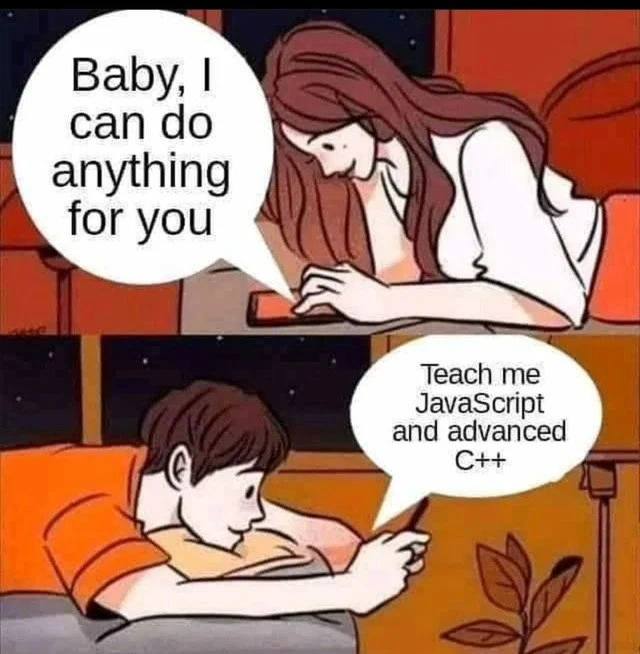
Imagine your friend excitedly tells you, “I’ll do anything for you!” You might ask for something simple, like help with your homework or playing your favorite game together. But instead, you think of the hardest thing possible and say, “Okay, teach me all the tricky stuff about how computers work!” 😄 Suddenly, a sweet offer turns into a massive homework assignment. In the meme, the girl offers to do anything out of love, and the boy cheekily asks her to teach him not one but two different languages of coding (which is super hard, like learning two different school subjects at the same time, but even tougher). It’s funny because his request is huge and unexpected – he took “anything” way too literally. It’s like if someone said they’d get you any present, and you replied, “Great, I want a rocket ship and a unicorn.” The big lesson: be careful what you wish for, especially if you say “anything” to a curious mind, because you might get a request that’s a lot more than you bargained for!
Level 2: Browser vs Bare Metal
Let’s break down what’s happening in simpler terms. In this meme, one character promises, “I can do anything for you.” That’s a very broad promise — basically offering any kind of help or favor. The punchline is that the other character immediately asks for something very technical: “Teach me JavaScript and advanced C++.” To someone new to programming, that means: “Please show me how to code in two different computer languages (one used for websites and one used for high-performance programs) at an expert level.” It’s an amusingly unexpected response to a romantic offer.
Why is that request such a big deal? Think of programming languages as tools or even as spoken languages – each has its own vocabulary and rules. JavaScript and C++ are two popular programming languages, but they are as different as a bicycle and an airplane. Here’s a quick comparison to illustrate the differences:
| JavaScript 🕸️ (for the web) | C++ ⚙️ (for high-performance) |
|---|---|
| Runs in web browsers (and also on servers via Node.js). It’s what makes web pages interactive (for example, showing alerts, updating content dynamically). | Compiled into machine code that runs directly on a computer’s hardware. Used for software where speed is critical (video games, operating systems, heavy-duty applications). |
| Dynamically typed: You don’t have to define variable types. A variable can hold a number, then later hold a string – the language is flexible and figures it out as it goes. Example: let x = 5; x = "hello"; // OK in JavaScript |
Statically typed: You must declare what type of data a variable holds (int, float, etc.), and it won’t allow you to change that type on the fly. The program won’t even compile if types don’t match. Example: int x = 5; x = "hello"; // ERROR in C++ (type mismatch) |
| Memory management: Automatic. It has a garbage collector that automatically frees up memory you’re no longer using. You don’t usually worry about allocating or freeing memory for basic tasks. | Memory management: Manual. You have to manage memory yourself. If you allocate memory (say, by using new or creating objects), you’re responsible for freeing it (delete) when done. If you forget, you get a memory leak, and if you free something twice or use freed memory, you might crash or corrupt data. |
Learning curve: Easy to start. You can write a simple program with just a few lines in a browser. But it has quirky parts that can confuse you as you go deeper (like the rules for this, or weird results like NaN meaning Not-a-Number, or how async code works). It’s like a road that starts out smooth then gets twisty. |
Learning curve: Steeper at the start. Even writing “Hello World” in C++ requires understanding a bit about compilers and the syntax. As you advance, it gets very complex (you deal with low-level concepts like pointers, and error messages can get very long). It’s like a climb that starts on a hill and ends on a mountain. |
| Typical use: Making web pages come alive. For example, checking form input in a browser, creating animations on a webpage, or building entire web applications (with frameworks like React or Angular). Also used on servers with Node.js to handle backend logic. | Typical use: Building software where performance and control matter. C++ is used for things like game engines (Unreal Engine), desktop applications (like Photoshop), and systems programming (parts of Windows, Linux, or device drivers). It’s chosen when you need the code to run super fast or use limited resources efficiently. |
In the context of the meme, asking one person to teach both JavaScript and advanced C++ is like asking for lessons in two different fields at once. It’s a bit like saying, “Teach me to paint and also teach me advanced engineering.” 😅 Both are challenging in their own right, and each requires time and practice to get good at.
Let’s clarify the phrase “advanced C++.” C++ has “levels” of mastery. Beginner C++ might be just learning to print text, use basic variables, and maybe simple classes. Advanced C++ goes into much tougher topics: for example, using templates (which let you write code that works with any data type, but can produce insanely complex error messages if you mess up), managing memory efficiently (to avoid leaks or crashes), writing multi-threaded programs (which run multiple things in parallel – very tricky to get right), and understanding the latest features added to the language (C++ has new versions every few years with more features). It’s hard. Many programmers find C++ one of the more difficult languages to master because it gives you a lot of power and flexibility — but with that comes a lot of responsibility and many ways to make mistakes. When you hear developers joke about “segfaults” or “memory leaks,” that’s often about languages like C++ where one wrong move can cause the program to crash.
Now, JavaScript, especially teaching it, has its own challenges. While you can start writing JavaScript with almost no setup (just open a browser console or use a simple text editor), teaching it properly means covering some non-obvious things. For example, JavaScript has odd rules about how functions and variables are hoisted (meaning you can call functions before where they are written, in some cases) and how the keyword this can change meaning depending on how you call a function. If you go into advanced JavaScript, you’d talk about things like closures (functions that remember the variables around them, which is a powerful feature but confusing at first) and asynchronous programming (because JavaScript often needs to wait for things like data from a server; it uses callbacks, promises, or async/await to handle that wait without pausing the whole program). And then there are all the modern tools and frameworks (like React, or bundlers like Webpack) that an advanced JavaScript developer might use — those are like an entire ecosystem of technology on their own.
So, the bottom line for a newer developer or someone learning: this meme is funny because the guy’s request isn’t like asking “Can you help me set up my email?” or even “Can you teach me one programming language basics?”. He basically asks her to be his full-time programming tutor for two very different languages, one of which (C++) is notoriously difficult at advanced levels. It’s such an over-the-top ask that it’s immediately understood as a joke. If you’ve ever tried to learn just one new language, you know it can take weeks or months to get comfortable. Imagine doing two at the same time, and not just basics — going deep into advanced topics. It’s overwhelming!
For context, many developers spend their whole career primarily using one of these languages. A web developer might do JavaScript for 10 years and still learn new things about it. A game or engine developer might use C++ for decades and still encounter surprises. So “Teach me JavaScript and advanced C++” is sort of like saying, “Teach me everything you know.” It’s both flattering (he trusts she’s that knowledgeable) and comedic (because no one could just grant that in a short time).
In simpler relationship terms: The girl offered to do anything out of love, probably thinking of something sweet or easy. The guy, being a programmer (we assume), turned it into a study request – and not a small one! It’s a mix of romance and nerdiness colliding in a single conversation. That mix is what makes it relatable and funny, especially if you’re in tech. Many of us have had our tech and personal lives blend in funny ways – like using "I <3 U" in code or explaining a joke about code to our significant others. Here it’s literal: love is expressed through a coding lesson request.
So to a newcomer: don’t worry if you don’t get all the details of JavaScript or C++ – the key is knowing they are two very different and complex things to learn. The humor is in asking for something so big in response to a loving “I’ll do anything” promise. It’s an exaggeration that highlights how learning programming (especially two languages at once) is a really big task – bigger than most “favors” you’d ask of a loved one. And that exaggerated mismatch is what makes it funny.
Level 3: Scope Creep in Love
At a high level, the meme is poking fun at how a sweet, open-ended promise can backfire spectacularly when taken too literally. It’s the classic case of “Be careful what you offer” – especially if you’re dating a developer! The top panel’s romantic setup – “Baby, I can do anything for you.” – sounds like a scene from a love story, but the punchline in the second panel flips it into a nerdy reality check:
Her: “Baby, I can do anything for you.”
Him: “Teach me JavaScript and advanced C++.”
This abrupt shift is where the humor lives. Seasoned developers recognize the absurdly steep request hiding under that seemingly innocent word "anything". In software terms, the girlfriend basically introduced infinite scope (“anything”), and the boyfriend treated it like a feature request with no boundaries. In project management lingo, he injected massive scope creep into the relationship. 😅 What was presumably meant as a romantic gesture instantly turned into a full-blown two-track education project. It’s a relatable scenario in tech circles: someone nonchalantly promises the world, and the “client” (here the boyfriend, tongue-in-cheek) asks for the moon and stars – in this case, comprehensive tutoring in two notoriously challenging programming languages.
Why is this so funny to developers? Because we’ve all experienced that moment where a task ballooned out of control. Here the ballooning is comically exaggerated: teaching JavaScript (often our introduction to programming’s wild quirks) and teaching advanced C++ (the stuff of nightmares and legend). The pair of languages isn’t random – they represent a full-stack gulf. JavaScript is typically used for front-end web development (think making interactive websites, dealing with user clicks and browser quirks), while C++ is used for low-level, high-performance systems (think building game engines, operating systems, or high-frequency trading systems). Each on its own has a steep learning curve (that tag LearningCurve isn’t an understatement!). Put together, it’s like asking one person to be both a JavaScript guru and a C++ wizard overnight. Even professional developers usually specialize in one or the other. The meme humorously compresses the entire spectrum of programming expertise into a single outrageous demand.
There’s also an in-joke about how different these two worlds are. Teaching someone “JavaScript and advanced C++” covers everything from the browser sandbox to the metal of the machine. Seasoned devs chuckle because they imagine the sheer cognitive whiplash of switching between explaining JavaScript’s undefined vs null issues one minute, and C++’s dangling pointers or template instantiation depth the next. It’s as if the boyfriend thought, “I’ll take this chance to get a free coding Bootcamp from my SO, covering multi_language_learning in one go.” Working developers will recognize the RelatableHumor: many of us have had friends or family half-jokingly say, “Hey, you’re a programmer, can you teach me to code?” Usually, we smile and maybe show them a “Hello World.” But advanced C++? That’s the kind of topic that sends experienced engineers running for the documentation (or the coffee machine). It’s not a casual favor; it’s practically a full-time mentoring job. The boyfriend’s request is the tech equivalent of, “Please solve world hunger and then colonize Mars.” It highlights, in a playful way, how non-tech folks (or newcomers) might underestimate the effort involved in serious programming education.
From an industry perspective, the meme also touches on the contrast in culture between these languages. JavaScript is famous for its beginners-welcome vibe: you can start coding with an interactive tutorial in a browser console, and within hours create something visible on a web page. It hides a lot of complexity behind the scenes. However, any senior JavaScript developer knows that truly mastering JS involves grappling with weird parts of the language (like the ever-mysterious this binding, the prototype chain, or the asynchronous event loop that can lead to callback hell). On the other hand, C++ has a reputation for being hard from the get-go: setting up a compile environment, dealing with compiler errors on your first Hello World, and learning about header files, pointers, and memory allocation. “Advanced C++” ups the ante: now you’re talking about things like template metaprogramming, efficient memory management with smart pointers, concurrency (think data races and deadlocks), and perhaps even familiarity with the latest standards (C++11/14/17 and beyond). There are seasoned C++ devs who still discover new gotchas or undefined behaviors years into their career. So when the boyfriend requests a lesson in advanced_cplusplus, experienced coders smirk because they know that’s not a one-Saturday-afternoon kind of lesson – that’s months or years of intense study and practice.
The juxtaposition is golden: JavaScript vs C++ (LanguageComparison). In developer jokes, these two often symbolize opposite extremes. It’s like asking, “Teach me to ride a unicycle on a tightrope and also how to fly a fighter jet.” Both are difficult in different ways, and mastering one doesn’t help you much with mastering the other. JavaScript’s challenges come from its flexibility and oddities (like how [] + [] becomes an empty string or how NaN is actually a number — quirky stuff that looks simple but trips you up). C++’s challenges come from its power and sharp edges (like accidentally causing a segmentation fault by dereferencing a null pointer, or deciphering template compilation errors that span multiple pages of text). The humor is that someone naive to programming might put these in the same bucket of “just some coding,” while a developer knows they are vast domains unto themselves.
Also, let’s not ignore the romantic_promises_in_tech angle: in techie relationships (those fun programmer_relationships), there’s a trope that heartfelt sentiments can turn into comically pragmatic or nerdy requests. One partner says something amorous or grandiose, and the other, being a literal-minded engineer type, takes it at face value and injects tech into it. Of course a developer’s idea of “I want something” could be “teach me to code better.” 😄 It’s endearing and ridiculous at the same time. The girlfriend probably meant “I’ll support you, do sweet things for you, maybe buy you your favorite dessert,” but the boyfriend’s mind went straight to code mode. It’s a playful commentary on how people in our field might inadvertently mix work/learning with personal life. The communities like r/DeveloperHumor love this kind of joke because it rings true — our passion for coding often bleeds into everything.
In summary, experienced devs laugh at this meme because it cleverly combines relatable tech truth with an everyday scenario. The promise of “anything” becomes an opportunity to highlight just how unrealistic and massive a favor teaching advanced programming really is. It’s humor born from the disconnect between romantic expectations and nerdy reality. The boyfriend’s request is simultaneously loving (he trusts her ability and wants to learn from her) and hilariously over-the-top. And the girlfriend, who might be a capable developer herself, is suddenly confronted with the prospect of basically running a dual-track full-stack training program for her love. It’s a comic exaggeration that underscores the vast scope of knowledge in our field — a scope so large that cramming two distant ends of it into one “anything” promise is laughably over-ambitious. Any developer who’s tried to teach_me_javascript to a newbie or struggled through an advanced C++ bug at 3 AM can appreciate just how epic that request is. The meme captures that “oh no, what have I gotten into” feeling in one snapshot.
Level 4: Prototypes vs Pointers
At the deepest technical level, this meme humor hinges on bridging two fundamentally different programming paradigms. JavaScript and C++ live on opposite ends of the abstraction spectrum, each with its own theoretical underpinnings:
Object Models: JavaScript uses prototypal inheritance – objects inherit directly from other objects (prototypes) rather than from classes. Under the hood, a JS object is essentially a dynamic hash map of properties linked to a prototype. In contrast, C++ is a statically-typed, class-based language. Its object model relies on vtables and pointers for polymorphism (dynamic dispatch). Teaching advanced C++ means diving into how virtual function tables work in memory, whereas teaching advanced JavaScript might involve explaining how the prototype chain is traversed when accessing a property. These are two very different mental models for how objects and inheritance work.
Type Systems: JavaScript is dynamically typed and duck-typed – the interpreter figures out types at runtime and variables can morph to hold any type. This flexibility stems from JavaScript’s design as a scripting language meant for quick iteration. C++, however, has a strong static type system enforced at compile time. An int is an
intand will only hold integers unless explicitly cast. Advanced C++ topics delve into template metaprogramming and type traits (e.g., SFINAE andstd::enable_if) which leverages the type system in complex ways at compile time. There’s a whole C++ template metaprogramming subculture turning the compiler into a theorem prover – a concept utterly alien to JavaScript’s runtime-oriented type flexibility. Bridging these in a lesson means one moment you’re explainingtypeof undefined === "undefined"quirks, and the next you’re reasoning about template specialization and Odr-Use rules in C++.Memory & Execution: C++ code is ahead-of-time compiled to native machine instructions, running directly on the hardware with manual memory management. That means to truly master C++, one must grok concepts like stack vs heap allocation, pointers (memory addresses) and references, cache locality, and the ominous specter of undefined behavior (doing something the C++ standard doesn’t define, often leading to crashes or security bugs). Teaching advanced C++ is almost an operating systems lesson: you end up discussing how the CPU executes instructions, how memory is laid out, and why a misuse of
deletecan corrupt the heap. By contrast, JavaScript typically executes in a virtual machine (like V8 or SpiderMonkey) with a Just-In-Time (JIT) compiler. JavaScript’s runtime handles memory automatically via a garbage collector, and it operates within a sandboxed environment (the browser or a Node.js runtime) that abstracts away the OS and hardware. Explaining advanced JavaScript involves concepts like the event loop (how JavaScript handles asynchronous events in a single thread), closures (functions remembering the environment where they were created), and maybe even JIT optimizations (e.g., hidden classes in V8). These are high-level runtime concepts far removed from the bare-metal manual memory management of C++.Concurrency Models: Modern C++ and JavaScript also take divergent paths in handling concurrency. C++ offers low-level threads, locks, and atomic operations – an advanced C++ lesson may introduce std::thread, mutexes, or lock-free programming, wading deep into the domain of the OS scheduler and CPU memory fences. JavaScript, on the other hand, uses an event-driven, non-blocking I/O model – in the browser (and Node), JS typically runs on a single thread with concurrency achieved through asynchronous callbacks or promises rather than raw threads. To truly “teach me JavaScript” beyond the basics, you’d have to cover how the event loop queues tasks and how
async/awaitworks under the hood (which internally involves something like a state machine or even generator functions). Essentially, you’d be comparing cooperative concurrency (JS’s async model where the programmer yields control via events) with preemptive concurrency (C++ threads that run in parallel, requiring careful coordination). This is a serious deep dive into computer science: one moment discussing callback microtasks and the next moment cache line false sharing in multi-threaded C++.
All these differences mean that teaching both languages at an advanced level is an incredibly multifaceted challenge. It’s not just two languages; it’s two entirely different worlds of thinking about programs. The meme sets up a scenario that highlights this absurd breadth: going from JavaScript’s prototype-based, garbage-collected, high-level scripting world to C++’s pointer-wielding, manual-memory, low-level systems world. Seasoned developers appreciate the almost theoretical contrast here. It’s as if someone said, “I want to learn everything from how a browser organizes the DOM with JavaScript, to how a CPU registers are manipulated with optimized C++ code.” It’s a full-stack knowledge span that touches every layer of computing, from high-level application logic down to the bits and bytes in memory. No wonder the proposition is laughably unrealistic — it’s like expecting one person to be fluent in two very different “languages” of the computer’s universe, a feat that borders on heroic (or insane) in scope. The humor has a kernel of truth in it: both languages can be mastered, but each individually can consume an entire career’s worth of learning. Doing both? That’s a Herculean ask, indeed.
Description
This is a two-panel comic meme depicting a text message exchange between a couple. In the top panel, a woman with long brown hair is shown looking down at her phone, with a speech bubble saying, 'Baby, I can do anything for you'. In the bottom panel, a young man in an orange shirt is lying down, smiling as he texts back. His reply in the speech bubble is, 'Teach me JavaScript and advanced C++'. The humor arises from the stark contrast between the woman's grand, romantic gesture and the man's extremely specific, difficult, and non-romantic request. For developers, the joke is layered: it highlights a programmer's nerdy priorities, and it humorously acknowledges the immense difficulty of mastering both JavaScript, with its dynamic quirks and vast ecosystem, and advanced C++, known for its steep learning curve and profound complexity. The idea of one person teaching both to an expert level is absurd, making the request a perfect test of the 'anything for you' promise

Comments
11Comment deleted
Her: 'I can do anything for you.' Him: 'Great, explain C++ template metaprogramming and the JavaScript event loop.' Her: '...seen'
She vowed she’d do anything, so I asked her to explain why `[] + {}` is `'[object Object]'` in JavaScript and then walk me through C++ template metaprogramming - if we’re still on speaking terms after SFINAE, I’ll buy the ring
The real relationship killer isn't asking for space - it's asking someone to explain why JavaScript's 'this' behaves differently from C++'s 'this', then watching their soul leave their body as they realize they'll need to cover prototype chains, arrow functions, RAII, virtual inheritance, and why '0.1 + 0.2 !== 0.3' all in one conversation
The real challenge isn't learning both JavaScript and C++ - it's the mental whiplash of switching from 'undefined is not a function' to segmentation faults, from prototype chains to RAII, and from npm's dependency hell to CMake's build configuration labyrinth. By the time you've mastered move semantics and perfect forwarding in C++, JavaScript has released three new frameworks and deprecated the one you just learned
“Anything for you” is romantic until it means explaining JavaScript’s coercion table and C++ template metaprogramming - two Turing‑complete footguns in one lesson
She prototypes eternal love in JS; he wants RAII and template metaprogramming - talk about a type mismatch
Teach me JavaScript and advanced C++ - one lets 'null == undefined' slide, the other won't let two types meet unless a concept chaperones them
Sorry, the best I can do is Smali Comment deleted
Cool topic, nice choice 🤔 Comment deleted
why not brainfuck? this is the most likely thing to happen) Comment deleted
she can't teach him her secrets or then he will know how to withstand them Comment deleted