Skip to content
DevMeme
2304 of 7435
A Computer Science Guide to Search Algorithms
CS Fundamentals Post #2563, on Jan 9, 2021 in TG

A Computer Science Guide to Search Algorithms

Why is this CS Fundamentals meme funny?

Level 1: Follow Your Stomach

Imagine you're playing hide-and-seek in a big house. One way to search is to go deep: you start at the door and run through a hallway into the basement, then keep going as far as you can down one path before coming back up. Another way is to go wide: you peek into every room on the first floor, then check every room on the second floor, and so on. Both methods will eventually find your friend, just in a different order. Now suppose you heard the instructions wrong and thought you were supposed to search for bread instead of a person. Instead of looking through the house at all, you dash out the front door and run to the bakery next door to grab a loaf of bread. In the comic, that's exactly what happens – the "search arrow" leaves the tree to chase bread. It shows how a simple mix-up (like a silly spelling mistake) can send a search in a completely wrong direction, with very funny results.

Level 2: Off-by-One Letter

This meme is playing with tree traversal algorithms using a fun series of spelling mistakes. If you're a newer developer or student, here's what's going on in simpler terms. We have a tree (like a family tree diagram of connected nodes — in fact it's a binary tree where each node has at most two children) and different ways to search through it, plus some goofy made-up variations:

  • Depth-first search (DFS): This method goes as deep as possible down one branch of the tree before backtracking. In plain terms, you start at the root and explore one path all the way to a leaf (the bottom) before you go back up and try a different branch. It's like exploring a cave by always taking the leftmost tunnel until you hit a dead end, then backtracking. Many beginners implement DFS using recursion or a stack structure (imagine a stack of books: you keep going down one book series until it's done, then pick up the next series).
  • Breadth-first search (BFS): This one goes wide (across the breadth of the tree) before going deep. You visit all the nodes one level down from the root first, then move to the nodes two levels down, and so on. Think of checking every room on the first floor of a building, then every room on the second floor, etc. BFS uses a queue to keep track of the order to visit nodes (like people waiting in line: first in, first out). This way, you're systematically covering the tree level by level.
  • Brepth-first search: Not a real algorithm! The word "brepth" is just "breadth" spelled wrong (swapping a couple of letters). The comic jokes that if you tried to follow this made-up method, the order in which you'd visit nodes becomes totally mixed up. The arrow in that panel squiggles around aimlessly, which is a funny way to say "this algorithm doesn't make any sense." It's like writing your code incorrectly and ending up with a very bizarre traversal order.
  • Deadth-first search: Also not real. This is "depth-first search" with a typo that hints at the word "dead." The joke is that a broken depth-first search might cause your program to die or freeze. For example, if your recursive DFS function never stops (no base case or a cycle in the graph), it can crash or hang your program – essentially a dead end. In the comic, the arrow goes crazy, implying the search got hopelessly stuck. It's a humorous way to warn: be careful with DFS, or you might end up killing your program's performance!
  • Bread-first search: This is the big punchline. It's "breadth-first search" minus the "th," turning breadth (width) into bread (the food). The panel shows the search arrow giving up on the tree and heading off to find a loaf of bread instead. Of course, in reality there's no algorithm for finding bread in a tree! This is just a silly pun. It shows that if you mispronounce or misspell "breadth" as "bread," you get something completely different. The comic takes that literally: the algorithm gets hungry. Think of it as the code misunderstanding your instructions and going on a snack break.

In summary, the meme first shows the correct BFS and DFS (which you learn in any Intro to CSFundamentals class), then it plays with those terms by altering a letter and imagining the goofy results. It's funny because just one small change (one letter of a word, or one character in code) can flip a logical process into nonsense. Anyone who's spent time debugging can relate to that! Plus, the idea of an algorithm abandoning its job to chase bread is a visual gag that even non-programmers find absurd. The lesson for a newbie programmer: details matter – and if you mess up a term like breadth-first search, you might end up with something as crazy as a bread-first search!

Level 3: Queue vs Stack vs Snack

This comic escalates a basic algorithm demo into pun-filled chaos, and experienced developers can't help but smirk. It starts with a binary tree being traversed correctly by the classic algorithms Depth-First Search (DFS) and Breadth-First Search (BFS) – staples of every CS_Fundamentals course – then gradually derails as typos creep in. The result is a series of increasingly absurd "algorithms": "Brepth-first search", "Deadth-first search", and finally "Bread-first search". It's a brilliant piece of AlgorithmHumor that riffs on how a single-letter glitch can turn a straightforward tree traversal visualization completely on its head.

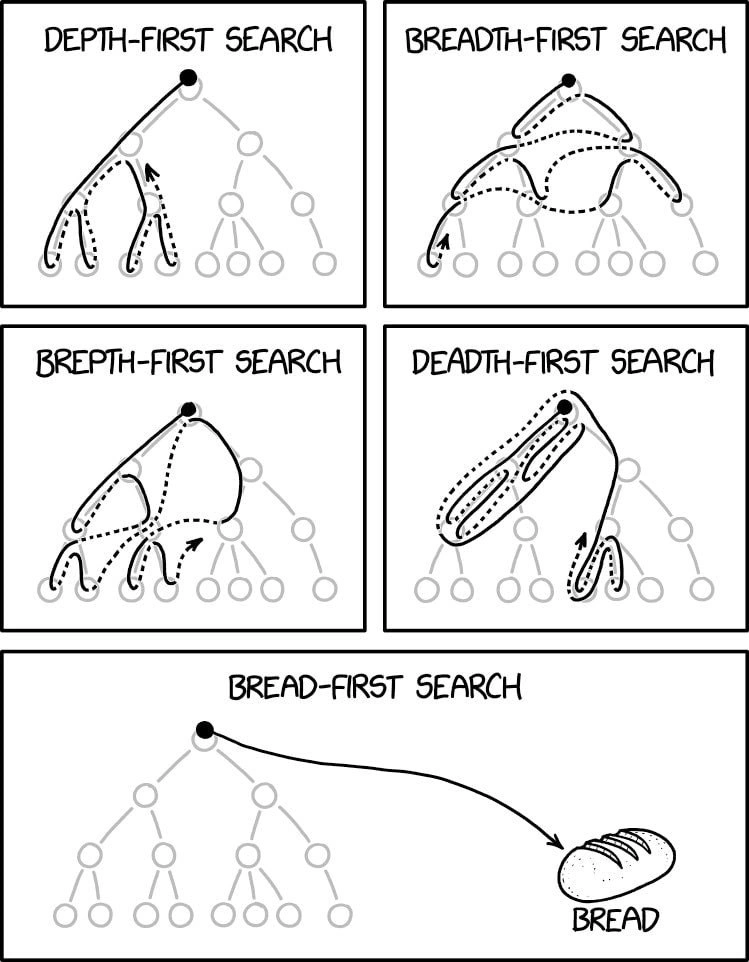
In the top-left panel labeled "DEPTH-FIRST SEARCH", the arrow starts at the root (the top black node) and plunges down the leftmost branch to the bottom before backtracking. That's exactly what real DFS does: it explores depth-wise, going as far down one path as possible (visiting children and grandchildren nodes) before retreating and exploring the next branch. Internally, a DFS uses a stack (often via recursion) to remember how to backtrack. If you've ever written a recursive tree traversal, this panel looks familiar – the arrow goes straight down into the tree’s depths, just as expected.

The top-right panel, "BREADTH-FIRST SEARCH", shows a different strategy. Here the arrow moves level by level across the tree, visiting all the root’s children first (the second layer of nodes), then the grandchildren (third layer), and so on. This is true BFS behavior: it uses a queue to manage the frontier of exploration, ensuring it traverses breadth-wise (i.e. across each tier of the tree before going deeper). In code, BFS typically enqueues all immediate neighbors then processes them in order – which naturally results in that wide, horizontal sweeping pattern you see in the comic. A seasoned developer recognizes this as the level-order traversal used to, say, find the shortest path in an unweighted graph or print a tree by levels. So far, so good – the first two panels are textbook visualizations of fundamental AlgorithmDesign techniques.

Now things get entertaining. The bottom-left panel is titled "BREPTH-FIRST SEARCH" – a nonsense word, presumably a cheeky typo of "breadth-first". The comic illustrates this made-up algorithm with a hilariously nonsensical squiggly arrow. It loops and backtracks in a way that no sane traversal ever would. This is poking fun at how a tiny spelling error or misunderstanding can completely wreck an algorithm. If breadth-first search means go wide, what would "brepth"-first even do? The arrow seems to double back on itself, as if the traversal got lost or indecisive. This evokes the kind of bug where your tree-traversal code doesn’t quite do DFS or BFS, but some buggy hybrid that revisits nodes or skips others because of an off-by-one error or a misused data structure. Seasoned devs have seen code that almost works like the intended algorithm but then veers off-course – brepth_first_search is the visual punchline for that scenario. It’s an inside joke for anyone who has accidentally created an infinite loop or weird traversal order due to a one-character typo or logic slip-up.

Next, in the bottom-middle panel, we have "DEADTH-FIRST SEARCH". Just one letter off from "depth-first", but that one letter spells doom. The dashed arrow shown here looks chaotic and aimless, almost like the algorithm is dying (hence "deadth"). This is a tongue-in-cheek nod to what happens when a depth-first search goes awry – perhaps you forgot a base case in a recursive function or neglected to mark visited nodes in a graph with cycles. The search might go on forever or crash the program (a deadly outcome for your process!). Deadth-first search could be the unofficial name for a DFS that causes a stack overflow or gets stuck in an endless loop, essentially killing your program’s responsiveness. In the comic, the arrow’s wild path suggests the traversal is "brain-dead": it's not following any recognizable order, maybe visiting nodes in a bizarre sequence or not terminating properly. This dramatizes that feeling when your algorithm’s logic is so broken that it might as well be controlled by some undead force. It's dark humor and a wink to any experienced coder who has hit "Run" only to watch their app freeze thanks to a runaway recursive call. (In a way, it's a punny reminder that debugging a faulty DFS can feel like resurrecting a dead program!)

Finally, the grand punchline: "BREAD-FIRST SEARCH". The bottom panel shows the arrow literally abandoning the tree and curving off-screen towards a drawing of a loaf of bread. This is the payoff for the spelling error gag – "breadth" minus the "th" becomes "bread". Instead of traversing nodes at all, the algorithm has decided its goal is a bakery item. It's a classic instance of ComputerScienceHumor: taking a dry technical term and twisting it into something deliciously literal. On a more technical note, this absurd final panel highlights how completely the meaning can change with a minor typo. It's like if you had a function intended to calculate the "breadth" of a graph but a typo made it return bread from your pantry. Obviously, no real search algorithm is going to veer out of a data structure to fetch food, but the loaf-of-bread gag is a metaphor for when code goes in a wildly wrong direction. Perhaps your pointer arithmetic went out of bounds and started reading from random memory (finding "bread" where tree nodes should be), or maybe it's simply saying: when your code is that broken, you might as well quit and go have a sandwich. 😅

The humor works on multiple levels. It's a pun on terminology (BFS vs. "bread FS") that tickles anyone who remembers learning these algorithms. It also captures a universal truth in development: tiny mistakes can lead to wildly off-course results. In practice, if you call the wrong function or mis-name a variable (imagine accidentally typing your function name as bread_first_search instead of breadth_first_search in code), you'll either get a runtime error or a very wrong outcome. The meme exaggerates this to an extreme for comedic effect. For veteran coders, it's a chuckle at countless DeveloperHumor moments where a single-character typo broke everything. For CS students, it's a cautionary tale wrapped in a joke: "spell breadth correctly, or your algorithm might start looking for baked goods!" In short, this meme is a playful mashup of serious search algorithm logic with silly pun_on_search_algorithms, capturing both the precision required in programming and the community’s ability to laugh at our own mistakes.

# Depth-First Search (DFS) implemented using recursion (stack-based approach):
def depth_first_search(node):
    if node is None:
        return
    print(node.value)              # Visit the current node
    depth_first_search(node.left)  # Recurse on left subtree
    depth_first_search(node.right) # Recurse on right subtree

# Breadth-First Search (BFS) implemented using a queue:
from collections import deque
def breadth_first_search(root):
    q = deque([root])
    while q:
        node = q.popleft()
        print(node.value)          # Visit the current node
        if node.left:
            q.append(node.left)    # Enqueue left child
        if node.right:
            q.append(node.right)   # Enqueue right child

# A typo like "bread_first_search" isn't a real algorithm – it's what happens when the programmer is hungry!

As shown above, DFS and BFS are well-defined procedures. But if you accidentally invent a "bread-first search", you're not following any known algorithm – you're just going off-script (or off to lunch). The final code comment is a playful nod: in a real codebase, calling a non-existent function or making a spelling mistake would normally throw an error, effectively saying "I don't understand what you're asking me to do." Here, it whimsically suggests the coder got hungry. It's the programming equivalent of the comic's last panel.

All in all, tree_traversal_humor like this resonates with developers because it combines fundamental concepts with everyday silliness. We've all had moments where our code did something completely unexpected, as if it had a mind of its own (or got distracted by snacks). This meme taps into those experiences in a light-hearted way. The next time you're implementing a search routine, double-check your spelling... or you might end up with Bread-First Search, and then you'll find your program literally out to lunch.

Description

A five-panel comic illustrating various tree traversal algorithms in the minimalist style of XKCD. The first two panels correctly depict 'DEPTH-FIRST SEARCH', showing a path that explores as far as possible down one branch before backtracking, and 'BREADTH-FIRST SEARCH', which explores nodes level by level. The next two panels introduce nonsensical joke variations: 'BREPTH-FIRST SEARCH' shows a chaotic, tangled path, and 'DEADTH-FIRST SEARCH' shows a path that seems to get stuck in a loop and terminate prematurely. The final, largest panel delivers the punchline with 'BREAD-FIRST SEARCH', where the traversal path starts at the root node of the tree and leads directly to a drawing of a loaf of bread, completely outside the data structure. The humor is a classic pun, playing on the similar-sounding 'breadth' and 'bread', a type of dry, nerdy wit that is very popular in developer and computer science communities

Comments

21
Anonymous ★ Top Pick My manager asked for a bread-first search of the codebase. I found a TODO from 2015 commenting on 'a slice of technical debt'
  1. Anonymous ★ Top Pick

    My manager asked for a bread-first search of the codebase. I found a TODO from 2015 commenting on 'a slice of technical debt'

  2. Anonymous

    We typo’d BFS as “Bread-First Search” in the design doc - now the crawler scales elegantly across bakeries, but the complexity is O(gluten) and the SRE runbook just says “BYO toaster.”

  3. Anonymous

    After 20 years of explaining BFS vs DFS to junior devs, you realize the real optimization is just following the smell of fresh bread from the office kitchen - O(1) time complexity for finding happiness

  4. Anonymous

    When your breadth-first search implementation is so hungry for optimization that it skips the entire graph traversal and goes straight for the carbs - because why explore O(V+E) nodes when you can achieve O(1) satisfaction at the bakery? Classic case of premature optimization meeting basic human needs

  5. Anonymous

    Brepth-first search: the traversal you get after a “perf refactor” that mixes DFS recursion with a shared BFS queue - nondeterministic order, heap thrash, and an on-call runbook for Deadth-first (then Bread-first)

  6. Anonymous

    We argue DFS vs BFS trade‑offs, but in production the only complete strategy is Bread‑First Search - a greedy algorithm that minimizes MTTR by maximizing pastry throughput

  7. Anonymous

    Death-First Search: chasing a bug deep through 47 microservices, only to hang in a circular dependency noose

  8. @lilshredder 5y

    Death first search

    1. @Vitalis11 5y

      +

  9. Deleted Account 5y

    last search

  10. Deleted Account 5y

    Please provide attribution when posting XKCD content, it's CC BY-NC

    1. @feskow 5y

      Bruh or else?

      1. Deleted Account 5y

        it's a copyright violation

        1. @feskow 5y

          And... Someone's gonna shut down the channel?

          1. Deleted Account 5y

            it's pretty easy actually

          2. @dugeru42 5y

            and some people will miss opportunity to check out discussions of this xkcd

            1. @feskow 5y

              I'm sure there's no person who doesn't knows the author or how to find the author

              1. Deleted Account 5y

                of course there are

              2. @dugeru42 5y

                ok, name every xkcd

  11. @ryankrage77 5y

    https://m.xkcd.com/2407/

  12. @OomatL 5y

    what is that?

Use J and K for navigation