Skip to content
DevMeme
2306 of 7435
Arduino Forecasting Without The Sensor Stack
EmbeddedSystems Post #2565, on Jan 10, 2021 in TG

Arduino Forecasting Without The Sensor Stack

Why is this EmbeddedSystems meme funny?

Level 1: Looking Outside With Extra Steps

It is funny because someone used a fancy little computer to do what a person could do by looking outside. If the board is wet, it is raining. If it is covered in ice, it is freezing. If it vanished, something very bad happened. It is like building a robot to tell you your shoes are muddy by making the robot stand in the mud.

Level 2: The Board Is The Sensor

An Arduino is a small programmable electronics board used for hobby projects, prototypes, and embedded systems. Normally, if someone built an Arduino weather station, the board would read data from sensors. For example, a temperature sensor reports warmth, a rain sensor detects water, and a wind sensor measures movement or airflow.

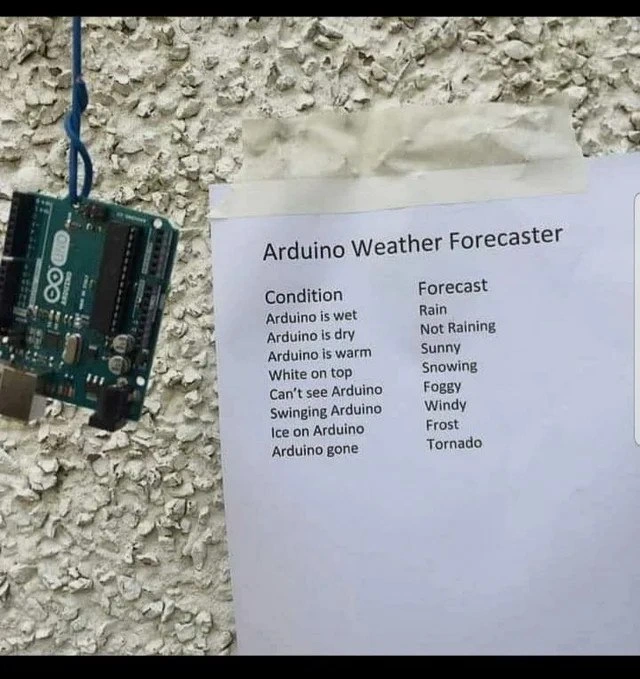
This meme skips all of that. The board is placed outside, and the paper tells the human what to infer from the board’s condition:

Arduino is wet  -> Rain
Swinging Arduino -> Windy
Ice on Arduino -> Frost
Arduino gone -> Tornado

That makes the project absurd but oddly practical. A beginner might spend days wiring parts and debugging code only to realize the simplest possible “weather API” is looking out the window. The hardware-versus-software joke is that developers love building systems to automate reality, even when reality is already presenting the answer very clearly.

The printed chart also mimics the logic of a program. It is basically a set of if statements in paper form:

if (arduino.isWet()) forecast = "Rain";
if (arduino.isGone()) forecast = "Tornado";

Of course, the real Arduino in the photo probably cannot call isWet() or isGone(). The human has to observe it. That gap between “smart device” branding and “please inspect the dangling board manually” is the source of the developer humor.

Level 3: Sensor Fusion By Suffering

The image shows a real Arduino board hanging outside beside a taped sheet titled Arduino Weather Forecaster. The chart maps physical states of the board to predictions: Arduino is wet means Rain, Arduino is dry means Not Raining, Arduino is warm means Sunny, White on top means Snowing, Can't see Arduino means Foggy, Swinging Arduino means Windy, Ice on Arduino means Frost, and Arduino gone means Tornado.

That is the whole joke: it looks like an embedded systems or IoT project, but the “sensor platform” is just the board itself being exposed to the weather. No humidity sensor, barometer, anemometer, temperature probe, camera module, Wi-Fi telemetry, dashboard, MQTT broker, cloud function, or mobile notification. The device is both the hardware and the sacrificial measurement instrument. This is technically edge computing, if by “edge” we mean “the wall outside where someone tied up a microcontroller and hoped for the best.”

Experienced developers recognize the satire because hardware projects often grow ridiculous layers around simple observations. A maker project can start as “measure whether it is raining” and somehow become firmware flashing, voltage regulation, waterproof enclosures, sensor calibration, debouncing, sleep modes, failed solder joints, serial logs, and a web UI nobody asked for. This meme bypasses the entire stack with a brutal question: if the goal is to know whether it is raining, why not just check whether the Arduino is wet?

The funniest row is Arduino gone to Tornado, because it is both useless and correct in the bleakest possible way. The failure mode is the signal. Real systems do this more often than we admit: a missing server implies an outage, a silent sensor implies power loss, a dead health check implies a deploy broke, and an empty queue might mean success or might mean the worker has died quietly in a corner. Observability often begins as careful measurement and ends as reading the scorch marks.

Description

A green Arduino board hangs outside on a rough stucco wall next to a taped-up paper labeled "Arduino Weather Forecaster." The paper has two columns, "Condition" and "Forecast," with the mappings: "Arduino is wet" to "Rain," "Arduino is dry" to "Not Raining," "Arduino is warm" to "Sunny," "White on top" to "Snowing," "Can’t see Arduino" to "Foggy," "Swinging Arduino" to "Windy," "Ice on Arduino" to "Frost," and "Arduino gone" to "Tornado." The humor is that an embedded weather station has been reduced to a passive physical artifact, bypassing sensors, firmware, wireless telemetry, and dashboards entirely. It is a very literal take on edge computing: put the edge device outside and look at what happened to it.

Comments

5
Anonymous ★ Top Pick The uptime is excellent, but the disaster-recovery plan starts and ends with `if (!arduino) tornado = true`.
  1. Anonymous ★ Top Pick

    The uptime is excellent, but the disaster-recovery plan starts and ends with `if (!arduino) tornado = true`.

  2. @no6ody 5y

    Arduino gone - Russia

  3. @no6ody 5y

    Yeah, that's an option too

  4. @kennyotsu 5y

    Arduino is D̴ ̠̪̬̺͠I̴̛̯̐͛S̷̡̙̪̫̦̒̑̈́S̵̙̤̗̟̐̾̍͘Ô̴̤̮̣͛Ļ̶̧̲̰̉̒̍V̵̚ ̜̔I̸ ͇̂Ń̴͕̑̏G Forecast: S A M O S B O R

  5. @Nizaya 5y

    Arduino gone - Black ppl around

Use J and K for navigation