Skip to content
DevMeme
5897 of 7435
When piracy sites become the ‘premium tier’ compared to YouTube ads
Google Post #6457, on Dec 15, 2024 in TG

When piracy sites become the ‘premium tier’ compared to YouTube ads

Why is this Google meme funny?

Level 1: Too Many Commercials

Imagine you’re watching your favorite cartoon on TV. But between every scene of the show, the TV makes you sit through a bunch of commercials – toy ads, cereal ads, you name it. You get so annoyed because it feels like you’re watching more ads than actual cartoon! Now, suppose there’s a secret DVD of that same cartoon (that you’re not really supposed to have) which lets you watch the whole episode straight through with no commercials. Watching the show on TV is like using YouTube today: it’s free, but it keeps interrupting your fun with ads all the time. Watching the secret DVD is like using a piracy site: it lets you see the show without any interruptions. The funny (and kinda sad) part of the meme is pointing out that, in 2024, the “official” way to watch (with all those ads) is actually more annoying than the “sneaky” way. It’s like your mom’s approved snack comes with a long advertisement you have to listen to, but the cookie you secretly took from the cookie jar comes with no strings attached. The meme makes us laugh because it’s true – sometimes the wrong way feels nicer than the right way when it comes to too many commercials. It’s saying, “Isn’t it crazy that the bad guy’s thing (pirate sites) is giving us a better time than the good guy’s thing (YouTube)?” So, basically: too many ads = frustrated viewers, and that’s why this comparison is both funny and easy to relate to, even if we know we’re not really supposed to use the “no-commercials” secret option.

Level 2: The Ad-Block Strikes Back

Let’s break down the technical and industry concepts behind this meme in simpler terms. At its core, the meme compares YouTube – a hugely popular, legitimate video platform – with piracy sites – those unofficial websites where you can watch shows or movies for free (illegally). The text on the meme, “actual piracy sites have less ads than YouTube now,” highlights how YouTube’s user experience has become ad-saturated (filled with ads), even more so than sites that are basically the black market of online video. This shocks people because you’d expect a big company’s site to treat you better than a sketchy piracy site, not worse. It’s a classic case of TechIndustryIrony: the trustworthy service pesters you non-stop, while the shady service (surprisingly) leaves you in peace (at least in terms of fewer ads).

YouTube ads come in several flavors:

  • Pre-roll ads: commercials that play before your video starts. You often see a countdown like “Video will play after ad.” Sometimes you get a “Skip Ad” button after 5 seconds, which is that little clickable button in the bottom corner letting you jump past the ad (if the advertiser allows skipping).
  • Mid-roll ads: these pop up in the middle of longer videos. Ever watch a 10-minute YouTube video and suddenly it cuts to an ad at minute 5? That’s a mid-roll. They’re placed at intervals (some creators manually place them, others let YouTube auto-insert).
  • Unskippable ads: short ads (usually 5-15 seconds) that don’t offer a skip button at all. You must watch them to continue. Often YouTube will play two ads in a row now – for example, an unskippable 10-second ad and then a 5-second skippable one. It’s like a one-two punch to ensure you’ve seen something.
  • Post-roll ads: ads after the video (these are less noticeable since your content’s done, but they exist too).

When the meme says “Welcome to 2024,” it hints that right now (in 2024) this ad situation on YouTube has peaked in a ridiculous way. Many users feel there are more ads than ever. Ad_overload is a great term for it: it’s when there are so many ads that it overwhelms the viewer. If you watch several YouTube videos without an ad blocker, you might feel like ads are popping up constantly – at the start of every video and frequently in between. It can feel just as bad as old-fashioned TV commercials, if not worse, because at least TV spaced them out to a few big breaks.

Now, piracy sites are websites that host copyrighted content (like movies, TV episodes, sports streams, or even re-uploads of YouTube content) without permission. They’re illegal, but people visit them to get content for free, especially if that content is behind a paywall elsewhere. Normally, the “price” you pay on a piracy site is dealing with a sketchy experience:

  • You might get pop-up ads (new browser windows or tabs that open suddenly, often with loud ads or inappropriate content).
  • You might see banner ads around the video player saying “Download now” or fake “Play” buttons that are actually ads.
  • Worst case, some try to trick you into downloading malware or give you a virus.

Given that sketchy background, it’s crazy to think a piracy site could ever feel “better” than YouTube. But the meme claims exactly that: these sites have less ads cluttering your screen than YouTube does now. How could that be? One reason is that YouTube has really ramped up the number of ads in the past couple of years, while some piracy sites actually cut back a bit to keep viewers. Another reason: if you use an AdBlocker (like uBlock Origin or Adblock Plus) on a piracy site, those extensions will block most of the pop-ups and banners. Surprisingly, many piracy sites don’t aggressively fight ad blockers – they’re under the radar and just happy to have visitors. In contrast, YouTube (being run by Google, whose primary business is advertising) has begun actively detecting ad blockers and preventing videos from playing if an ad blocker is on. They’ll show a warning that basically says “please disable your ad blocker or subscribe to continue.” This is part of the ad-tech arms race: as users employ tools to avoid ads, the platform employs counter-measures to force ads through.

Let’s clarify some terms and tools mentioned:

  • AdBlocker: This is a general term for software that blocks advertisements. For web browsing, these are usually browser extensions. uBlock Origin is a popular free extension that filters out ads and trackers. When active, it can hide the YouTube video ads, skip those pop-ups on shady sites, and generally clean up your web experience. Many developers and power users install an ad blocker as one of the first things on a new browser, because it makes websites faster and less cluttered (and safer, since it can block malicious ad domains).
  • Pi-hole: This is a bit more advanced tool that many WebDev and network-savvy folks use at home. Pi-hole is essentially a mini server (often running on a Raspberry Pi device, hence the name) that acts as a local DNS sinkhole for ads. In simpler terms, it’s a box on your network that intercepts any request your devices make to known ad servers and responds with nothing, effectively filtering ads at the network level. For example, when your phone app or your smart TV tries to fetch an ad from doubleclick.net (a Google ad server), the Pi-hole will block that request. The result: ads just don’t load at all on any device connected to your home Wi-Fi – whether it’s your laptop, phone, or even that smart fridge with a screen. Engineers love Pi-hole because it’s a one-and-done solution to nuke a lot of ads without configuring every device individually. However, even Pi-hole can’t easily block YouTube video ads, because YouTube serves ads from the same servers as the video content (making it tricky to distinguish ads from the video stream at the network level).
  • Google/YouTube’s anti-ad-block: Recently, YouTube started a campaign to thwart ad blockers. If their system detects you’re using one (say, the video ad fails to load when it should), YouTube will stop the video and show a message asking you to allow ads or subscribe to YouTube Premium (the paid, ad-free membership). This is a new tactic in the war on ads. It’s essentially YouTube saying “we notice you’re trying to skip our ads – not so fast.” This move upset a lot of people, especially technically inclined users who feel they have a right to control what their browser displays. It’s an ongoing cat-and-mouse game: ad blocker developers update their code to dodge YouTube’s detection, and YouTube changes something to detect it again.

The content_monetization_dilemma mentioned is an important concept here. It refers to the tough question: “How do we make money from content while keeping users happy?” YouTube’s approach has been to give content away for free and monetize via ads (and offer a paid Premium option for those who want no ads). Other platforms use subscriptions (like Netflix: you pay a monthly fee, but you get an ad-free experience). Each model has trade-offs. The dilemma is that if you push too hard on monetization (too many ads or too high subscription fees), you risk driving users away — sometimes into the arms of piracy or competitor services. This meme is basically saying YouTube has pushed so hard on ads that users joke even piracy feels like an upgrade.

From a junior developer or new IT professional’s perspective, this meme also resonates as a SharedPain because many of us often rely on YouTube for learning (tutorials, coding videos, conference talks). It’s frustrating to be in the middle of learning something from a video and suddenly “Sponsored by…” blares out, interrupting the flow. Early in your career, you might not have the budget for Premium subscriptions everywhere, so you stick with free services and suffer the ads. Eventually, many learn about ad blockers or browser tricks to improve things. The mention of uBlock or Pi-hole in the description is a wink at those “in the know” tools that more experienced developers use. The first time a junior dev discovers uBlock Origin, it’s like putting on glasses and seeing clearly – all the unnecessary adverts disappear, and the internet feels clean. It becomes almost a rite of passage in tech circles to say, “Oh, you still watch YouTube ads? Let me show you uBlock or how to set up a Pi-hole.”

Finally, let’s talk about the human side: IndustryTrends_Hype and MarketingVsReality. There’s been hype that advertising allows content to be free so everyone can access it. That’s the marketing promise: “ads support creators and keep the platform free for you!” In reality, that noble idea has been taken to an extreme. The number of ads and the aggressiveness of their delivery (tracking your behavior, personalizing ads, interrupting content) have made the experience worse and worse. The reality is some users feel like second-class citizens if they don’t pay. The meme is a comedic exaggeration of that reality: it implies we’ve crossed a line where even something known for being bad (pirate sites) seems good compared to what the legit platform is doing. As a junior web developer or just an avid internet user, it’s a cautionary tale: if you create a website or service, remember that balancing monetization and user experience is key. Too many ads or intrusive marketing, and you’ll drive your audience away – they might even prefer alternatives that are less ethical but more user-friendly. It’s a lesson many in the tech industry have learned the hard way: treat your users well, or they leave (and sometimes they leave for the arms of pirates!).

Level 3: Adpocalypse Now

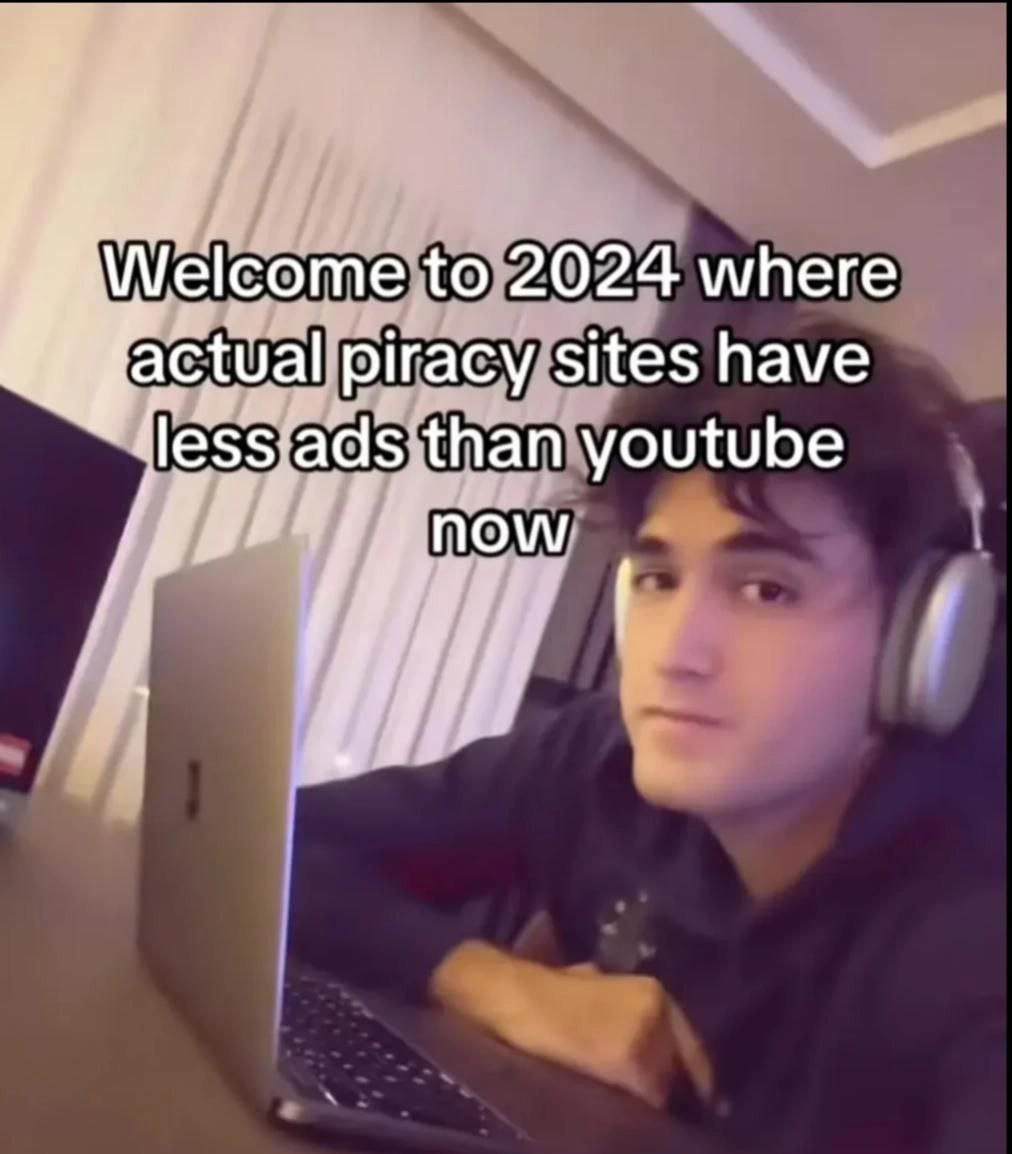
"Welcome to 2024 where actual piracy sites have less ads than YouTube now."

In the grand circus of AdTech, 2024 has delivered a plot twist worthy of a Kafka novel: the legitimate platform (YouTube, owned by Google, the world’s biggest ad company) is so overloaded with ads that piracy sites – yes, those sketchy, back-alley streaming sites – feel like the premium experience. The meme’s punchline lands because it’s dripping with IndustryIrony: the place that’s supposed to be illegal and riddled with pop-ups is now less annoying than the polished, mainstream service we all use daily. Seasoned developers and internet old-timers are nodding knowingly (and a bit bitterly): we’ve watched the content_monetization_dilemma flip the world upside down.

Consider the typical YouTube session these days. You click a video and immediately get hit with an ad_overload: perhaps two unskippable 15-second ads back-to-back (because one wasn’t enough), followed by a “Skip Ad” button teaser that appears only after 5 excruciating seconds on the next ad. If the video is long, expect mid-roll interruptions too – your content is diced up by commercials like it’s 1998 cable TV. And if you dare to watch a popular music video or movie trailer? Boom, another pair of YouTube ads. This onslaught has become so relentless that even the old TV commercial breaks feel merciful by comparison. It’s an ad-tech arms race out there, and users are caught in the crossfire. The meme captures this absurd escalation: “Welcome to 2024”, where the skip_ad_button is less a convenience and more a futile game of whack-a-mole, and where the official “free” service begs you to either tolerate a deluge of ads or pony up $12+ a month for YouTube Premium.

Now, the darkly funny part: actual piracy sites have less ads. It’s the ultimate Premium Paradox. These are sites operating outside the law, scraping together copies of Netflix shows or new movies. Historically, they’d bombard you with shady pop-ups or NSFW banner ads to make a quick buck, but many have learned a critical lesson in user psychology: if you drown viewers in ads, they’ll bounce (just like they’re doing from YouTube now). So the savvier pirate sites keep ads to a minimum – maybe a single pop-up or a banner – because their goal is retention, not scaring you off. Some even let you watch uninterrupted if you use a decent AdBlocker, because they don’t have the sophisticated anti-ad-block tech that a giant like Google does. The irony here is rich: a criminal streaming site run out of someone’s basement might now give a smoother, less interrupted viewing experience than a multi-billion-dollar platform. It’s like the Wild West saloon is offering better customer service than the fancy downtown hotel.

Why is this happening? SharedPain and frustration among users has been brewing for years as YouTube ramped up monetization. The content monetization dilemma is real: creators and platforms need revenue to survive. YouTube could charge everyone money upfront, but instead it went for the “free with ads” model to maximize reach. Over time, though, the pressure for profit grew. More ads = more $$$. Throw in algorithmic ad targeting, real-time bidding between advertisers for your eyeballs, and quarterly revenue targets, and you get today’s ad_overload. It didn’t happen overnight; it was a steady creep. IndustryTrends_Hype didn’t help either – every platform saw YouTube’s ad success and thought “let’s do that too!” Suddenly, you have pre-roll ads on videos, mid-rolls on 5-minute clips, even post-roll ads. It’s an all-you-can-eat buffet of annoyance.

The veteran developers behind the scenes aren’t blind to this problem. Many of us remember a cleaner web. Some of us built the very AdTech systems that now frustrate us! There’s an internal war between the engineering teams who want a good user experience and the business teams who want to maximize revenue. The result? A compromise that keeps tilting toward more ads until users push back en masse. We’ve seen threads on tech forums where even ex-Googlers joke that they use youtube-dl (a command-line tool to download videos) or alternative front-ends to avoid YouTube’s interface entirely. The meme channels that collective exasperation: how on earth did piracy become the lesser evil?

This is also a story of the AdBlocker revolution and the countermeasures against it. Tech-savvy folks long ago armed themselves with uBlock Origin, Adblock Plus, or network-wide blockers like Pi-hole to counter the flood of ads. In a perfect example of TechIndustryIrony, many engineers have a tiny device at home (often a Raspberry Pi running Pi-hole) whose sole job is to nuke ads and tracking domains at the DNS level – basically DNS filtering out anything like ads.youtube.com. It’s a nerdy mini-war: our personal DNS sinkhole vs. Google’s ad servers. And for years, that cat-and-mouse game let users enjoy YouTube largely ad-free. But in 2023–2024, the ad-tech arms race escalated: YouTube began detecting ad-block usage and hit viewers with ultimatums – “AdBlocker detected! Please disable it or subscribe to Premium.” They literally started denying playbacks unless you allow yourself to be advertised to. Talk about a dystopian twist: the skip_ad_button became a hostage negotiation.

So here we are – “welcome to 2024.” A bizarre world where legitimate platforms behave like overzealous marketers, and underground sites start looking user-friendly in comparison. The humor is laced with cynicism: it highlights a MarketingVsReality fail. Marketing says: “Enjoy your content with brief sponsor messages!” Reality: you’re spending more time watching ads than the content itself, unless you pay up. It’s a shared pain and a shared joke among web users and developers: when you find yourself saying “honestly, the pirate site is less painful,” something has gone terribly wrong (and terribly funny, in a sad way) with the state of the industry. The meme is essentially a mic-drop on modern web monetization: the ecosystem is so broken that the illegal workaround feels premium. It’s equal parts satire and truth bomb – a commentary on how an IndustryTrend (pushing monetization limits) backfired spectacularly.

Description

Vertical meme video frame showing a young person wearing large over-ear headphones, sitting at a desk in front of a slim silver laptop. A monitor sits just out of focus on the left. Bold white caption text (centered, all visible words captured verbatim) reads: “Welcome to 2024 where actual piracy sites have less ads than youtube now”. The creator’s face is intentionally blurred. Warm indoor lighting and neutral curtains form the background. Technically, the joke targets ad-saturated mainstream platforms - particularly Google’s YouTube - versus the unexpectedly cleaner UX of illicit streaming sites, highlighting the absurd escalation of pre-roll, mid-roll, and un-skippable ads that even seasoned engineers mitigate with Pi-hole, uBlock, or DNS filtering. It satirizes the ad-tech arms race, revenue pressures, and the perverse incentive that drives users toward gray-market alternatives despite the security and legal risks
Comments

33
Anonymous ★ Top Pick Remember when we worried torrent sites would inject malware? Now the bigger risk vector is accidentally clicking the 47th autoplay ad on a Google CDN
  1. Anonymous ★ Top Pick

    Remember when we worried torrent sites would inject malware? Now the bigger risk vector is accidentally clicking the 47th autoplay ad on a Google CDN

  2. Anonymous

    The real piracy is charging users for premium while simultaneously degrading the free tier until it's worse than a torrent site from 2005 - at least those had the decency to warn you about the malware

  3. Anonymous

    The real disruption in 2024 isn't AI or blockchain - it's when your CDN architecture becomes so ad-laden that torrents with seeders from 2008 deliver better latency and fewer interruptions. YouTube's product managers have somehow achieved negative value-add: each sprint makes the platform objectively worse for non-Premium users, proving that 'growth at all costs' eventually means the cost is your entire user experience. At this rate, we'll see 'Implemented YouTube-style monetization' as a red flag in system design interviews

  4. Anonymous

    2024 is when the pirate mirror ships a faster LCP than the official player because your Prebid auction, CMP, and anti‑adblock script formed a tighter monolith than your microservices

  5. Anonymous

    YouTube ads: the unskippable saga where even SponsorBlock can't keep up with the rolling deploys

  6. Anonymous

    Only in 2024 does the “compliant” site burn more CPU on CMPs, RTB auctions, and anti‑adblock telemetry than on H.264 decode - while the pirate mirror ships Nginx+HLS and accidentally meets the performance SLO

  7. @Wintercoresystem 1y

    You don't have to see ads if you've using adblocker

    1. @ygerlach 1y

      You dont have to pay for netflix if you just pirate it. And you get the movie to keep too.

    2. Ølеґsîū 🪬🕍🪬 1y

      Many sites nowadays have AdBlock-blocker or unblokable ads😔

      1. @Johnny_bit 1y

        uBlock Origin fixes this.

      2. @ZgGPuo8dZef58K6hxxGVj3Z2 1y

        You can report it and adblockers will solve it

      3. dev_meme 1y

        🤣 just use the custom filters, Luke

    3. @ZgGPuo8dZef58K6hxxGVj3Z2 1y

      You don't have to see ads if you hav modded apps🗿

    4. dev_meme 1y

      😎

  8. @anonusernametg 1y

    I love this meme format. Share some if your have more.

  9. @evankh 1y

    That just sounds like DVDs with extra steps

  10. @evankh 1y

    And also shittier, because it's just renting

  11. @Araalith 1y

    YouTube Premium costs just $10 a month or less.

    1. Kademlia 1y

      Sure, yet another subscription while this platform keeps demonetizing creators randomly, doesn't deal with scam/spambots in the comments and will hardly help when channels get hijacked, overall provides minimal help and sometimes still lets ads on premium through. Some could just use an adlock/alternative client and save 120$ per year or so.

      1. @Araalith 1y

        To be honest, I don't care much about the creators - if they choose YouTube, it means it works best for them compared to other platforms. I'm fine with paying for a service I use daily, as long as it's the most convenient option. This way, I can avoid dealing with ads on mobile YouTube, YouTube Music, embedded videos, background playback issues on mobile, and so on.

  12. Kademlia 1y

    And have the same or less scam ads than on yt

  13. @RiedleroD 1y

    they tried that with DRM already

    1. @TheFloofyFloof 1y

      They could do it again now that the hardware required is more common

  14. @siltstriders 1y

    Я из России, Google здесь запретил продажу и показ рекламы, поэтому можно считать, что вместе с санкциями мы получили YouTube Premium абсолютно без рекламы

    1. @phobosperi 1y

      this dude here is from 2022

  15. @RiedleroD 1y

    I do like the cyrillic anya tho :3

    1. @callofvoid0 1y

      it's Dina

      1. @RiedleroD 1y

        it looks like anya to my untrained eyes and that's what matters :P

        1. @endisn16h 1y

          Я551ДИ5 СДИТ ЯЕДD ТН15

          1. @Araalith 1y

            *ЯN551ДИ5

          2. @sylfn 1y

            "what is ya-pyatsot-pyatdesyat-ondin-di-pyat sdit yayedd tn-pyatnadtsat?"

          3. @azizhakberdiev 1y

            are summoning stalin's ghost?

  16. @azizhakberdiev 1y

    If a county has no youtube premium: + No ads - If something gets paywalled VPN is the only option

Use J and K for navigation