Skip to content
DevMeme
7330 of 7435
Jeff Dean, MapReduce Inventor, Asks 'What Is DSA Hard?'
Interviews Post #8034, on May 27, 2026 in TG

Jeff Dean, MapReduce Inventor, Asks 'What Is DSA Hard?'

Why is this Interviews meme funny?

Level 1: Asking the Chef About the Cooking Exam

A famous chef explains how he invented a new way to cook for thousands of people at once. A student asks, "How many of the super-hard timed cooking quizzes did you have to ace to do that?" — and the chef blinks and says, "What's a cooking quiz?" That's the whole joke: the person who built the real thing never took the test everyone else believes is the only way in. It's funny and a little freeing, like finding out the dragon guarding the castle was hired by the tour guides.

Level 2: Decoder Ring for the Thread

Jeff Dean is one of Google's earliest and most celebrated engineers — a Google Senior Fellow whose name is on most of the infrastructure papers that defined modern big data. MapReduce is a programming model he co-created: you describe your computation as a map step (process each item independently) and a reduce step (combine results per key), and the framework runs it across thousands of machines, handling crashes for you. It inspired Hadoop and, indirectly, most data-engineering tooling you'll touch.

DSA stands for data structures and algorithms; "DSA hard" borrows leetcode's Easy/Medium/Hard difficulty labels for interview problems, and grinding hundreds of them is the standard ritual for landing big-tech offers. The irony every junior eventually tastes: you binary-search your way through the interview, then spend your first year renaming variables and reading logs. The puzzles aren't useless — knowing what a hash map costs matters daily — but the timed-puzzle format measures preparation for the format itself.

Level 3: The Ratio of Theory to Practice

The exchange screenshotted here is a perfect collision of two engineering cultures. Vishnu Vivekanand asks, sincerely:

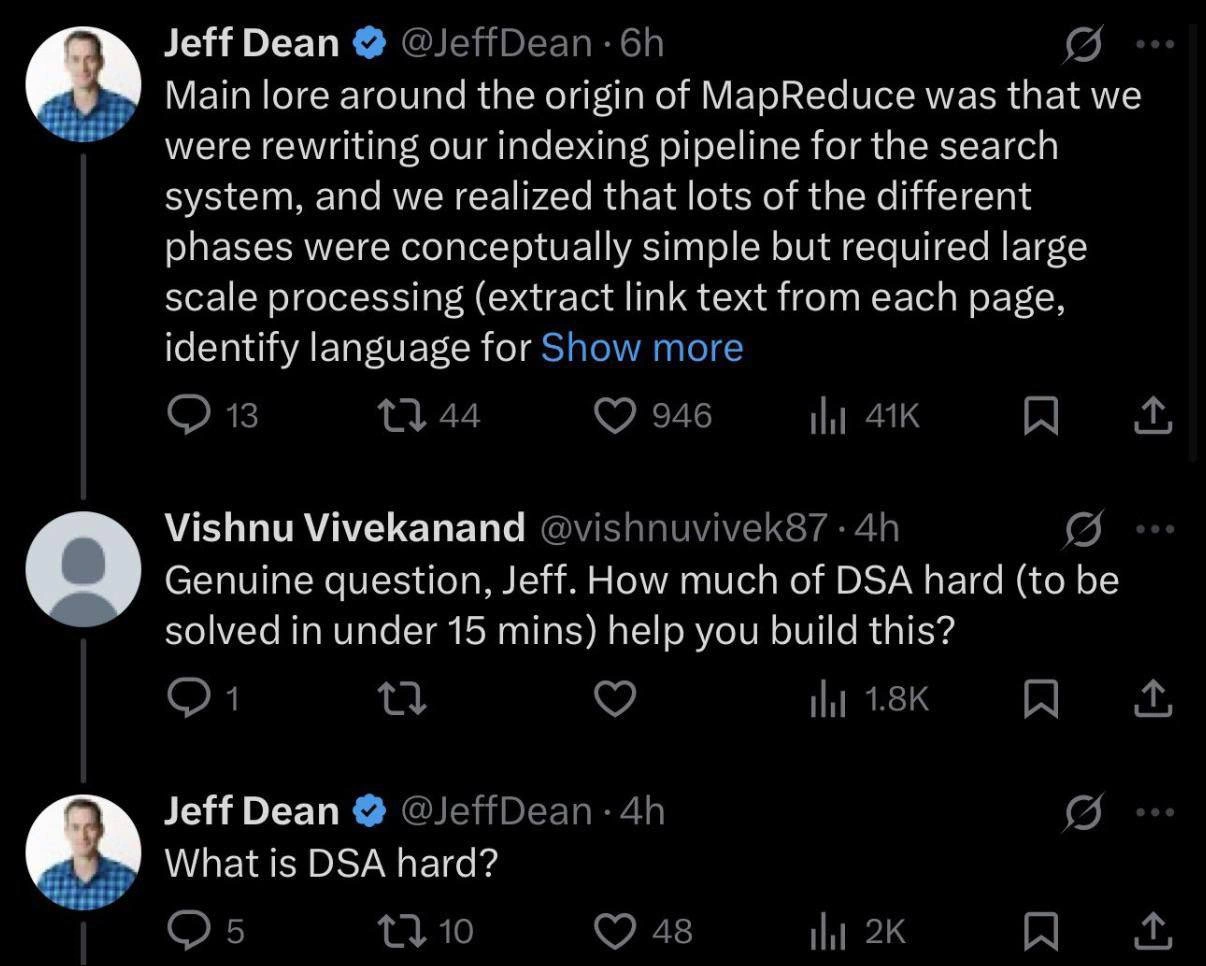
Genuine question, Jeff. How much of DSA hard (to be solved in under 15 mins) help you build this?

And Jeff Dean — co-author of MapReduce, BigTable, Spanner, TensorFlow; the man about whom "Jeff Dean facts" were the industry's Chuck Norris jokes — replies, with five words of devastating sincerity:

What is DSA hard?

The humor has two distinct blades. The surface reading: the engineer whose systems generate interview questions has never encountered the grinding subculture built around answering them. "DSA" (data structures and algorithms) as a noun, "hard" as a difficulty tier, "under 15 mins" as a performance bar — this is the vocabulary of leetcode prep culture, an entire shadow curriculum optimized for passing interviews at companies like the one Dean helped build. Dean isn't being snide; he genuinely doesn't share the jargon, which is funnier than any putdown. The engagement numbers visible in the screenshot (the reply pulling 2K views against the question's 1.8K) record the quietest ratio in tech history.

The deeper blade cuts at incentive structures. Interview prep culture exists because hiring pipelines need cheap, scalable filters, and timed algorithm puzzles are legible to interviewers even when they're orthogonal to the job. The result is a generation taught that engineering ability is the 15-minute hard problem — when the actual MapReduce origin story Dean tells in the first tweet is the opposite: the phases were "conceptually simple," and the achievement was taming scale, failure, and organizational reuse. The industry built an entrance exam about red-black trees for a job that is mostly about what happens when machine 4,096 catches fire mid-shuffle.

Level 4: Map, Reduce, Re-Execute

The thread's first tweet is worth taking seriously before laughing at the punchline. Jeff Dean writes that MapReduce emerged while "rewriting our indexing pipeline for the search system," when the team noticed many phases were "conceptually simple but required large scale processing (extract link text from each page, identify language for..." — and that observation is the entire intellectual contribution. MapReduce's primitives are stolen, proudly, from functional programming: map applies a pure function to every record, reduce folds the grouped intermediate values. The 2004 OSDI paper's insight was not algorithmic novelty but a separation theorem for engineering effort: if you constrain user code to pure, deterministic functions over key-value pairs, then fault tolerance, locality scheduling, partitioning, and load balancing can be solved once, in the framework, for every job ever written. Determinism makes worker failure recoverable by re-execution rather than checkpointing; commutative, associative reduction (via combiners) makes pre-aggregation legal; the shuffle's group-by-key is the only global barrier. The "hard part" lives in exactly the place leetcode never visits — tail latency from stragglers (hence speculative execution), atomic commit of task output to dodge duplicated side effects, and the brutal arithmetic of moving terabytes across a 2004-era network. None of these yields to a 15-minute whiteboard sprint; all of them yield to the kind of systems judgment that comes from watching a thousand machines fail in correlated ways.

Description

A screenshot of a Twitter/X thread in dark mode. Jeff Dean (verified, @JeffDean) explains the origin of MapReduce: while rewriting Google's search indexing pipeline, the team realized many phases were 'conceptually simple but required large scale processing (extract link text from each page, identify language for...' with a 'Show more' link; the tweet shows 13 replies, 44 retweets, 946 likes, 41K views. Vishnu Vivekanand (@vishnuvivek87) replies: 'Genuine question, Jeff. How much of DSA hard (to be solved in under 15 mins) help you build this?' Jeff Dean responds simply: 'What is DSA hard?' The humor lies in the legendary Google engineer who built planet-scale systems being completely unfamiliar with leetcode-style interview jargon, exposing the disconnect between competitive interview prep culture and actual systems engineering


Comments

17
Anonymous ★ Top Pick The man who invented MapReduce has never heard of 'DSA hard' - turns out building the thing the interview questions are about doesn't require passing the interview
  1. Anonymous ★ Top Pick

    The man who invented MapReduce has never heard of 'DSA hard' - turns out building the thing the interview questions are about doesn't require passing the interview

  2. @nyxiereal 1mo

    What

  3. @imDaniX 1mo

    But fr, what is DSA and why's it hard?

  4. @deadgnom32 1mo

    What is DSA hard?

  5. @Similacrest 1mo

    Everybody asks "What is DSA Hard?", nobody ever asks "Who got DSA hard?"

  6. @lb_ii 1mo

    What is DSA Hard?

  7. @MANGIAMONDI3000 1mo

    do you have a DSA hard in your pants or are you just happy to see me?

  8. @SwedishSock 1mo

    Dsa stands for data structure and algorithms right? Isn't that just what all programming is?

  9. @Sun_Serega 1mo

    https://www.reddit.com/r/ProgrammerHumor/comments/1rhlqju/comment/o80a76w/?utm_source=share&utm_medium=web3x&utm_name=web3xcss&utm_term=1&utm_content=share_button

  10. @Sun_Serega 1mo

    so it is leetcode-speak

  11. @Sun_Serega 1mo

    apparently there is some data struct and alg lvl with "Hard" difficulty and that have to be solved under 15 min

  12. @TheUnknown007 1mo

    You get taken out by the leetcode strike team

  13. @Sun_Serega 1mo

    idk don't ask me. the concept of retriable task with time limit baffles me too, but so does the rest of the leetcode, and they somehow still in business

  14. @Agent1378 1mo

    Thats a nice sarcasm. 2nd guy probably references standart hiring tests, which for google included math, dsa etc. etc.

  15. @b7sum 1mo

    a daily reminder to keep grinding your leetcodes

  16. @TheFloofyFloof 1mo

    The emacs user

  17. @RiedleroD 1mo

    me

Use J and K for navigation