They Live Sunglasses Reveal Google's Real Keynote Message
Why is this Google meme funny?
Level 1: The Magic Glasses
A man finds a pair of magic sunglasses. Without them, a big shiny billboard says, "Our lemonade stand just got even better!" With them on, the same billboard says, "We're watering down the lemonade — first the flavors you love, then all the rest." The funny part is the shock on his face, because deep down everyone already suspected the lemonade tasted worse — the glasses just made the stand admit it out loud. It's the laugh of catching someone saying the quiet part with a big cheerful smile.
Level 2: Sunglasses, Slides, and Platform Decay
Key concepts for the newer audience. Enshittification describes how platforms get worse over time on purpose: once a service has captured its users (your data, habits, and contacts make leaving costly — that's lock-in), it can shift value away from you toward advertisers and shareholders without losing you. Think of feeds that show fewer friends and more ads, or search results that bury the answer under sponsored boxes. AI Search refers to Google replacing or augmenting traditional links with AI-generated summaries (AI Overviews) at the top of results — convenient when right, problematic when wrong, and disruptive to the websites whose content gets summarized instead of visited.
The They Live template is the internet's standard tool for saying "here is the honest subtitle of this announcement." Glasses off = the marketing message; glasses on = the business model. A keynote is the staged corporate presentation (Google I/O being the canonical example for this stage design) where products are announced in relentlessly optimistic language. The skill this meme quietly teaches juniors: read announcements twice — once for what's promised, once for who pays for it and how. "Free" and "smarter" usually have a second slide.
Level 3: Obey, Consume, Accept AI Overviews
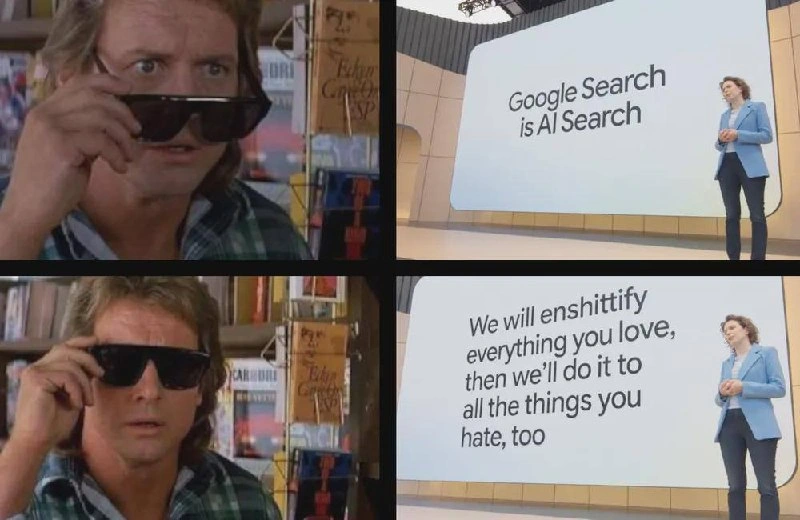
The format choice here is doing scholarly work. John Carpenter's They Live (1988) gave culture its most durable metaphor for ideology: special sunglasses that strip away advertising's surface to reveal the imperative underneath — billboards that secretly say OBEY, money that says THIS IS YOUR GOD. The four-panel adaptation is faithful to the mechanism. Top row: Roddy Piper at the magazine rack lowers his shades in alarm, and we see the Google keynote as broadcast — presenter in a blue blazer, immaculate pastel stage, screen proclaiming Google Search is AI Search. Bottom row: glasses on, same stage, same presenter, decoded message:
We will enshittify everything you love, then we'll do it to all the things you hate, too
The meme is, in effect, peer review of a keynote slide. Enshittification — Cory Doctorow's coinage, since canonized by actual dictionaries — names a specific lifecycle of platform decay: first the platform is good to users to achieve lock-in; then it degrades the user experience to favor business customers; then it squeezes those business customers too, keeping all surplus for itself; then it dies or becomes infrastructure too entrenched to leave. The joke's sharpest twist is the second clause. Standard enshittification discourse mourns the things you love. This decoded slide promises to also come for the things you hate — meaning even your low expectations will be missed. Degradation as a roadmap with full coverage; the techSavvyJoke writes itself about achieving platform parity downward.
Why does Google's AI pivot specifically attract this reading? Because search is the rare product where the conflict of interest is legible to everyone. The classic ten blue links made Google money only when you left — clicking an ad or a result. AI-generated answers keep you on Google's page, synthesizing publishers' content while sending them nothing, in a results page already dense with ads and SEO sludge that the AI was partly trained to summarize. Users complain that finding a plain webpage now requires appending "reddit" to queries; publishers watch referral traffic evaporate; and the keynote frames all of it as a gift. That gap — between the slide's serene declarative ("is AI Search," present tense, no choice offered) and the lived experience of the product — is exactly the gap They Live's sunglasses exist to close. The genius of using a real keynote screenshot as the "before" panel is that the satire barely has to exaggerate; the decoded message is just the original slide with the incentive structure made visible.
Description
A four-panel meme using the 'They Live' sunglasses format with Roddy Piper in a plaid shirt at a magazine rack. Top-left: he lowers his sunglasses, shocked. Top-right: a Google keynote stage where a presenter in a blue blazer stands before a giant screen reading 'Google Search is AI Search'. Bottom-left: he puts the sunglasses on. Bottom-right: the same stage now reveals the hidden message: 'We will enshittify everything you love, then we'll do it to all the things you hate, too'. The sunglasses-decode trope skewers Google's AI-first search pivot as Cory Doctorow-style enshittification - platform decay dressed up as keynote optimism
Comments
11Comment deleted
Google's roadmap finally achieves true platform parity: everything degrades at the same rate, loved and hated alike
can't wait to see AI DNS Comment deleted
and ai toilet paper Comment deleted
Thank god google search sucks for last 10-15 years, there is nothing to feel sorry for Comment deleted
I'm on ecosia since a while, but sometimes their results feels sub-par. Is Kagi worth paying for? Comment deleted
nope, kagi is an ai-first company. use duckduckgo.com, mojeek.com or marginalia-search.com Comment deleted
…ecosia is just reskinned bing Comment deleted
oh no, please dont cut me off from my daily meme dose 😂 Comment deleted
I personally use metager (with serper and mojeek backends) and mojeek Comment deleted
@RiedleroD any idea who this is? Comment deleted
no, but I've got a bad feeling about them Comment deleted