Skip to content
DevMeme
5896 of 7435
When Haskell evangelism derails the whole “shipping features” conversation
FunctionalProgramming Post #6456, on Dec 15, 2024 in TG

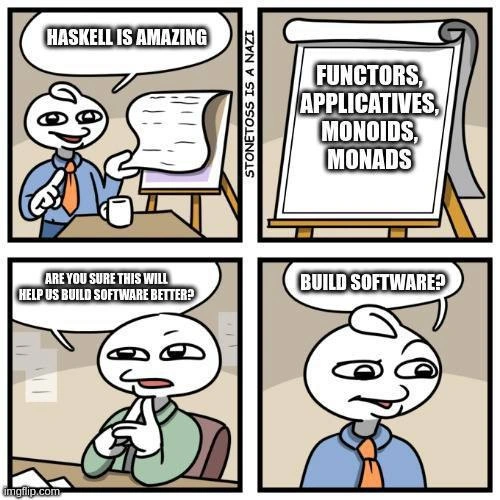
When Haskell evangelism derails the whole “shipping features” conversation

Why is this FunctionalProgramming meme funny?

Level 1: Fancy Recipe vs Dinner

Imagine you and your friends are really hungry and decide to cook dinner together. You’re thinking of making something simple and yummy, like spaghetti, so you can eat soon. But one friend – let’s call him Harry – just came back from a fancy cooking class and is super excited about it. Instead of helping you boil pasta, Harry starts talking about this amazing new technique he learned to sauté vegetables using scientific precision. He’s throwing out big cooking terms like “emulsification” and “Maillard reaction” (which are kind of like the cooking version of those big words functor and monad). He even pulls out a flipchart to diagram the perfect flavor profile.

While Harry is grinning and saying “This method is AMAZING!”, you and your other friend are checking the time and your rumbling stomachs. Finally, you ask, “Are you sure all these fancy tricks will help us get dinner ready faster or better?” Instead of answering directly, Harry smirks and says, “Get dinner ready?” as if that wasn’t even on his mind – he was just excited to show off the fancy techniques!

This is funny in a cartoon because, of course, the whole point of cooking dinner is to eat the food. If someone gets so carried away with fancy recipes that they forget about actually cooking, it’s silly. In the same way, in the meme, the Haskell fan got so carried away with cool programming concepts that he momentarily forgot the main goal: to build the software that people can use. It’s like being more in love with the idea of cooking than with actually eating the meal. The humor is in that little moment of “Oops, I guess I wasn’t focused on the real task!” It’s a gentle reminder: cool ideas are cool, but don’t forget why you’re doing it – whether it’s feeding hungry friends or delivering a working app to users.

Level 2: Functors vs Features

Let’s break down the jargon and scene for those newer to these concepts. The meme is contrasting functional programming buzzwords with the straightforward goal of making software for users. Here’s what’s happening in simpler terms:

  • Haskell is a programming language, known for being purely functional. That means instead of writing code with step-by-step instructions that change things (like in Python, Java, or C++), Haskell programs are built from functions that don’t have side effects. Think of it like math equations: given the same input, a Haskell function will always return the same output and won’t alter any hidden state or global variables. This makes Haskell programs very predictable and often free of certain bugs. But it also means doing everyday tasks (like reading a file, printing to the screen, or modifying a piece of data) requires a more indirect approach using the type system. Haskell is famous in computer science classes because it enforces rigorous thinking. It’s the poster child for FunctionalProgramming concepts. However, outside academia, it’s less commonly used than languages like JavaScript or Java – mainly because that rigor can make it harder to quickly write and ship features in a typical commercial environment with deadlines.

  • The terms on the presenter’s board – Functors, Applicatives, Monoids, Monads – are all important ideas in Haskell’s world:

    • A Functor in Haskell is basically “something you can map a function over.” Imagine you have a box with a number in it. A functor lets you apply an operation to the number without taking it out of the box. For example, a list is a functor: you can double every number in a list [1,2,3] by mapping a doubling function to get [2,4,6]. The list structure (the box) stays intact, you just changed the contents. Many data types in Haskell are functors (like Maybe, which is a box that might hold something or might be empty). Functor is a fancy word, but it boils down to a very common programming action: applying a function to values inside a container.
    • An Applicative is a step up: it’s like a functor, but even the function you want to apply can be in a box! If that sounds bizarre, think of having two boxes: one contains a value, another contains a function to apply to that value. Applicative lets you handle that scenario easily, applying the boxed function to the boxed value in one go. It’s a way to operate on multiple context-wrapped values together. This concept is a bit more specialized – newer devs might not encounter it unless they dive deep into Haskell or certain libraries.
    • A Monoid is a big word for a simple pattern: any set of things that you can combine together with a specific operation, and there’s an “empty” thing that does nothing in that combination. For example, think of strings: you can combine (concatenate) two strings ("Hello " + "World" = "Hello World"), and there’s an identity element (the empty string "" which, when combined with a real string, leaves it unchanged). That means “strings with concatenation” form a monoid. Many things in programming are monoids: numbers (with addition, identity 0), lists (with list-concatenation, identity an empty list []), etc. Haskell likes to recognize these patterns because if something is a monoid, you can use general tools to work with it (like combining a whole list of those things in one go). It’s a very reusable concept.
    • A Monad is one of the most talked-about (and feared) concepts in Haskell. Simply put, a monad is a design that lets you chain operations while carrying along some extra context. Think of a monad as a recipe for combining steps. Each step might produce a result and some context (like an error, or an effect like printing to screen, or just the fact it might fail). The monad ensures that if one step fails or has an effect, the whole chain handles it properly. One common monad example: Maybe. A Maybe type in Haskell is either Just something or Nothing. It’s used to represent “there might be a value or there might not be.” If you chain a bunch of operations that each yield a Maybe (perhaps a sequence of computations that could early-exit with Nothing), the Maybe monad will automatically stop the chain if any step returns Nothing. This prevents a lot of bugs — you don’t have to manually check for errors at each step; the monad framework does it. In more everyday terms, a monad is like a conveyor belt: you put a value on it, it goes through multiple stations (functions), and each station might transform it or decide to halt. The monad makes sure the process is orderly. Pretty neat, right? But if you’ve never seen it before, the theory can sound like “monad, monoid, endo-what-now?” It’s notoriously a bit hard to wrap your head around initially (there are countless blog posts titled “Monads explained for beginners” with analogies involving burritos, beer, or spacesuits – just to get the idea across!).
  • Now, why is the colleague skeptical? Because he’s thinking about building software better – which usually means writing code that users can benefit from, doing it on time, and with fewer bugs. From a newcomer’s standpoint, you might assume that using all these advanced tools would make software better – and indeed, the Haskell evangelist believes so. Haskell’s pitch is that if you use these structures, your code will be more correct and safer (less chance for certain errors). But the colleague is hinting at something important in the real world: there’s often a trade-off between ideal code and practical progress. Learning and properly using functors, monads, etc., has an upfront cost. If your team isn’t already familiar with them (and if your project isn’t already in Haskell), suddenly forcing everyone to adopt these concepts could slow development to a crawl at first. It’s like deciding to use a very advanced tool that nobody on the team has used before – sure, it might do the job with more precision, but only after a steep learning curve.

  • “Shipping features” is a phrase commonly used in software teams meaning delivering new functionality to the end user. It’s the whole point of most software companies – get new features or improvements out regularly, so users are happy and the product remains competitive. For a junior developer, the focus on shipping might be a new perspective: it’s not enough that code is clever or interesting; if it doesn’t help get the product out the door, it might not be the right priority at that moment. That’s what the person in green is concerned about. They are basically asking, “Will these big concepts help us right now with what we need to deliver?” It’s a very grounded, almost naive-sounding question, but it’s exactly the question that should be asked when someone goes on a tangent. In meetings, especially in startups or fast-paced teams, you’ll often hear phrases like “let’s not over-engineer this” or “what’s the minimal thing that works for now?” That’s the mindset of shipping features speaking.

  • Tech Evangelism vs Team Needs: When someone is a tech evangelist, it means they are very enthusiastic (almost religiously so) about a technology or methodology. They genuinely believe it’s great and they want everyone else to see the light. This can be a good thing when the tech actually solves the problem at hand, but it can be counterproductive when it misaligns with immediate goals. A junior dev might experience this when a teammate keeps insisting “We should really use XYZ library, it’s the future!” even if XYZ isn’t needed to solve the task. In the meme, Haskell (and its functors/monads) are the XYZ being pushed. The evangelist in blue is essentially saying “This approach is the best! Look at these impressive concepts!” The colleague is the one tapping the brakes, trying to ensure the team doesn’t go off on a wild tangent.

  • Why it’s funny: If you’re new, it might help to know that this exact tension happens a lot in software teams. It’s practically a rite of passage to witness (or participate in) a debate of theory vs practice. The humor comes from exaggeration: the presenter in the comic is so consumed by the theoretical greatness of Haskell that when asked about actually building software, he mischievously responds “Build software?” – as if that was a totally separate discussion. It’s funny because obviously, building software is the whole reason they’re there! It’s a playful jab at folks (we all know one!) who get so nerdy about a topic that they lose sight of the basic goal. If you’ve ever been in a group project where one member wanted to try something super fancy that wasn’t really necessary, you’ll likely chuckle at this. The meme is basically a humorous caution: don’t put the cart (fancy tools) before the horse (the actual project).

In summary, for a newcomer: the comic is showing a enthusiastic Haskell lover going on about complex programming ideas, and a skeptical teammate reminding him, “Uh, we have a job to do – is this actually going to help with that job?” The big words on the board are real concepts that advanced programmers care about, but the joke implies that maybe the team’s priorities have been forgotten. It’s poking fun at how tech discussions can sometimes derail into academic musings, leaving the practical folks shaking their heads (or in this case, clasping their hands in polite confusion).

Level 3: Monad Evangelism Syndrome

In practice, experienced engineers will recognize this scenario as a classic case of overzealous tech evangelism. The meme’s title, “When Haskell evangelism derails the whole ‘shipping features’ conversation,” says it all. A team meeting (perhaps meant to plan upcoming work or address a pressing problem) has been hijacked by a colleague’s passionate sermon on Haskell’s wonders. Instead of discussing how to deliver the next feature to users, everyone’s hearing about functors and monads. Every senior dev has seen a variant of this:

  • Lost in Abstraction: The developer in the blue suit is so deep into the abstraction rabbit hole that he’s forgotten the original question. It’s as if he answered “How do we speed up our web app?” with “Let me tell you about lambda calculus!” The smirking punchline “Build software?” in the final panel perfectly captures that disconnect. It’s an absurd reversal: he’s implying, half-jokingly, that building software was never the point of his monologue – learning and touting Haskell was. This playfully exaggerates reality; of course no one would admit that out loud, but sometimes it feels that way when a conversation goes off on an academic tangent.

  • The Ivory Tower vs The Trenches: Haskell is often perceived as an “ivory tower” language – very high-minded and academically pure. Meanwhile, shipping features is the gritty reality of product development. The colleague in the green sweater, looking skeptical and a bit concerned, represents the voice of pragmatism (or maybe a project manager with a looming deadline). His question, “Are you sure this will help us build software better?”, is the polite version of “How on earth is this relevant to our project right now?” Seasoned developers nod at this, because they’ve had to ask that very question in meetings when someone proposed a rewrite in the Next Shiny Language or introduced an architecture that was theoretically ideal but impractical. This is the essence of “abstraction_vs_delivery” conflict: balancing elegant design with actually delivering something users can use.

  • Patterns Over Product: The easel’s buzzwords – functor, applicative, monoid, monad – are legitimately powerful concepts. But to a team trying to say, launch a new feature or fix a critical bug, hearing a deep dive on those terms sounds like a distraction. The meme humorously implies that the presenter has fallen victim to “monad evangelism syndrome.” That’s when a developer becomes a preacher for a concept (monads, microservices, machine learning – pick your fad) and pushes it at every opportunity, even when it’s tangential to the problem at hand. The syndrome’s symptom: responding to practical challenges with theoretical solutions. Sure, monads can handle errors methodically, but first we need an actual program to run!

  • Shared Trauma and Eye-Rolls: Many senior engineers have a war story or two about projects derailed by technology holy wars. Perhaps someone insisted on using Haskell (or another niche tech) in a critical system without considering ramp-up time, hiring challenges, or integration issues. The result? Missed deadlines, frustrated team members, and often a partial retreat (“Maybe we’ll implement just one microservice in Haskell and the rest in something everyone knows…”). The knowing laughter this meme elicits comes from recognizing that little smirk in panel 4. It’s the same smirk a stubborn evangelist might flash when challenged – as if to say, “Oh, you wanted a practical solution? How dull.” It’s funny because it’s true: in real meetings, an outright “Build software? 😏” would be career-limiting sarcasm, but the thought has crossed people’s minds.

  • Reality Check – Will it blend (into production)? The subtext here is also about Haskell in production and the perennial academic vs practical skills debate. Haskell is often taught in universities; many CS graduates have heard of monads and pure functions in theory. But when building a quick web service or an MVP for a startup, Haskell’s advantages can turn into hurdles. A veteran dev might think: “Haskell is amazing, yes – amazing at making simple things complicated when we’re under the gun.” They’ve seen that shipping simple, maintainable code sometimes beats an ultra-clever solution that few can understand. There’s a sardonic saying in industry: “A solved problem is a solved problem – we don’t need a completely new paradigm right now.” If the current stack (perhaps Python or JavaScript) can deliver the feature by Friday, introducing Haskell and its steep learning curve might feel like inviting needless trouble. The meme pokes fun at that exact scenario – it’s not an anti-Haskell sentiment per se, but a jab at misapplied enthusiasm. Trade-offs are real: Haskell’s strong type system can prevent entire categories of bugs, but it also means you spend a lot of time wrestling with the compiler upfront. In a business meeting about shipping features, bringing up Monads might earn you a few blank stares or suppressed chuckles.

  • When Passion Derails Productivity: The comedic tension is heightened by the roles depicted: the presenter in a formal suit, presumably leading a discussion, versus the colleague’s casual attire and concerned posture. It suggests this might even be a manager or tech lead who went off on a tangent, leaving the team perplexed. Imagine a sprint planning meeting where, instead of triaging tasks, your lead engineer is diagramming a category theory solution on a whiteboard. It’s both hilarious and anxiety-inducing. The coffee mug detail on the desk adds to the everyday office setting – as if someone thought they were coming to a normal planning session and suddenly it turned into a theoretical computer science lecture. That mug might as well belong to an observer thinking, “I’m gonna need a lot more coffee to get through this.”

In short, from a senior perspective this meme nails the inside joke of modern software development: the eternal tug-of-war between fancy engineering idealism and down-to-earth product needs. The best teams strike a balance – they use great tools (maybe even a bit of Haskell where appropriate) but keep their eyes on the prize: working software. The humor here cautions (with a wink): if you focus too much on abstract purity, you might forget you were supposed to ship something. As veterans might say, “Cool tech is cool, but don’t let it make you miss your feature freeze.”

Level 4: Category Theory Overload

At the deepest level, this meme riffs on Haskell’s heavy use of abstract algebra and category theory concepts in programming. The presenter’s easel lists Functors, Applicatives, Monoids, Monads – all fancy mathematical abstractions that Haskell developers adore. Each of these terms comes loaded with academic pedigree:

  • Functors (in category theory) are structure-preserving maps between categories. In Haskell, a Functor is any type that can be mapped over. Think of a list or a Maybe value: you can apply a function to the contents inside without “breaking” the container. This relies on an abstract mapping operation (typically fmap) that must obey laws like identity and composition. The evangelist’s eyes sparkle with this idea because it’s so mathematically elegant – your code isn’t just code, it’s following a proven algebraic structure.

  • Applicatives and Monads are successive layers of this abstraction onion. An Applicative allows you to apply functions that are themselves wrapped in context (e.g. adding two optional values). A Monad is an even more powerful context handler – in category theory speak, “a monad is just a monoid in the category of endofunctors”. In plain terms, a monad provides a way to chain operations while carrying along some computational context (like handling potential failure, I/O, state, etc.). Monads enforce strict rules (the monad laws) that make these chains predictable and safe. To a Haskell purist, monads are a revelation: they solve the puzzle of how to do effectful things (like IO or randomness) in a pure functional world. This is deep computer science magic, originally formalized in research papers. For instance, the idea of using monads in programming was inspired by category theorist Saunders Mac Lane’s work and was introduced to FP by Eugenio Moggi and popularized by Philip Wadler. It’s brainy stuff – mixing lambda calculus with abstract algebra – the kind of theory that might get a programming language PhD very excited.

  • Monoids are another algebraic concept: a set of things with an associative binary operation and an identity element. In code, a monoid is a pattern where you can “combine” two values into one, and there’s a do-nothing value that leaves other values unchanged (like 0 for addition, or "" for string concatenation). Haskell uses monoids to allow elegant combination of results (e.g. combining logs, building up complex results piece by piece). It’s a simple concept from algebra, but in Haskell it becomes a powerful way to write generic, reusable code that “just works” for any data type that fits the pattern. It’s beautifully generic – write the combining logic once and reuse it everywhere.

All these abstractions mean that Haskell code can be incredibly concise, expressive, and provably correct. When a program is composed of functors, monads, and monoids, you’re leveraging decades of mathematical proof to ensure certain bugs can’t happen. For example, if you structure effects through monads, you won’t accidentally perform an operation out of order or forget an error check – the type system won’t allow it. This is why our enthusiastic presenter is grinning and declaring “HASKELL IS AMAZING”: from a theoretical standpoint, it is amazing. It’s like finding a blueprint that guarantees a building won’t collapse – a coder’s dream of absolute reliability and elegance.

However, here’s the catch that births the humor: these concepts, while powerful, are highly abstract. They can be hard to grasp, and even once grasped, they add layers of indirection to your code. There’s a famous tongue-in-cheek Haskell quote, “A monad is just a monoid in the category of endofunctors, what's the problem?” – often cited to poke fun at how impenetrable this stuff can sound. Indeed, to the uninitiated (and even to many initiated), a discussion of “endofunctors” and “monoidal functor categories” feels like needless word salad when you have a feature due Friday. The meme highlights a polarity: the presenter is lost in the clouds of categorical theory, intoxicated by the purity and rigor of Haskell’s type system, whereas the rest of the room might be thinking about more concrete concerns – like actual working software. The humor lands because there’s a grain of truth: deep in the category theory carnival, it’s easy to forget the pragmatic world of deadlines and deliverables lurking outside.

Description

Four - panel comic in the Stonetoss style. Panel 1 shows a beaming presenter in a blue suit and orange tie holding a sheet of paper, saying in a speech bubble: “HASKELL IS AMAZING”. A coffee mug sits on the desk. Panel 2 zooms to an easel where the presenter has written in bold letters: “FUNCTORS, APPLICATIVES, MONOIDS, MONADS”. Panel 3 cuts to a skeptical colleague in a green sweater, hands clasped, asking: “ARE YOU SURE THIS WILL HELP US BUILD SOFTWARE BETTER?” Panel 4 returns to the presenter, now smirking mischievously, answering: “BUILD SOFTWARE?” The humor contrasts Haskell’s elegant but abstract type-class machinery with the pragmatic goal of shipping working code, a tension senior engineers often face when academic purity meets production deadlines
Comments

9
Anonymous ★ Top Pick Sure, monads give you purity, composability, and a warm categorical glow - just don’t ask them to estimate story points
  1. Anonymous ★ Top Pick

    Sure, monads give you purity, composability, and a warm categorical glow - just don’t ask them to estimate story points

  2. Anonymous

    After 15 years in the industry, I've seen more production Haskell codebases in job postings than in actual production. The real monad tutorial is explaining to your CTO why the team spent three weeks implementing a feature that would take two days in Python, but hey, at least it's provably correct... assuming the requirements don't change

  3. Anonymous

    The eternal Haskell paradox: spending three months learning category theory to write a web service that could've been shipped in three days with boring imperative code. Sure, your monadic transformers are beautifully composed, but the product manager just wants to know when users can actually log in. At some point, 'elegant abstraction' becomes a euphemism for 'I'm solving problems nobody asked me to solve while the actual backlog grows.' The real monad is the friends we alienated along the way by insisting everything needs to be referentially transparent

  4. Anonymous

    In Haskell, delivery is a side effect - so the product stays trapped in IO

  5. Anonymous

    Monads compose effects; they still don’t compose five conflicting stakeholder requirements

  6. Anonymous

    Monads sequence effects flawlessly in Haskell - until your monolith needs a microservices refactor at scale

  7. @pavelars 1y

    @viktorrozenko relatable, isn’t it?

    1. @viktorrozenko 1y

      It is

  8. @purplesyringa 1y

    stonewall 💀

Use J and K for navigation