The Over-Engineered Bug Hunt: Spark Conspiracy vs. a Simple Typo
Why is this Debugging Troubleshooting meme funny?
Level 3: Conspiracy Board Debugging
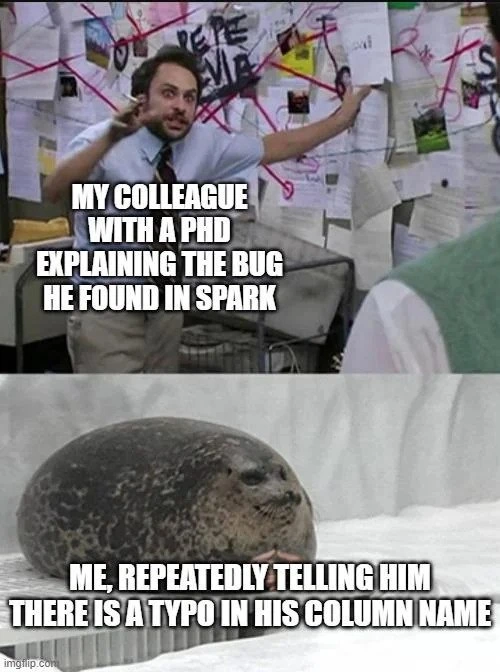
For experienced engineers, this meme hits on a too-real pattern in debugging_troubleshooting: sometimes we concoct wild theories for bugs in complex systems like ApacheSpark, when the root cause is embarrassingly simple. The top panel (the frantic man with the corkboard and red yarn) perfectly captures the overcomplicated_debugging mindset. This image is a famous meme of a character fervently explaining a conspiracy theory — he's got papers and red strings linking clues in a chaotic web. In our developer version, this is the PhD colleague going full detective mode, convinced he's uncovered a profound bug deep in Spark's internals. Perhaps he's saying things like, "It must be a data skew issue causing a partition to lose the column reference," or "I think there's a race condition in the DataFrame cache invalidation logic." He's leveraging all his advanced knowledge — citing distributed shuffle algorithms, executor memory management, maybe even alluding to academic papers on consistency in big data frameworks — to explain why the Spark job is failing. The humor is that all these elaborate fault trees are as overboard as that corkboard full of conspiracy connections. We recognize this pattern: a very smart person, maybe new to the messy reality of production code, assumes the fault lies in the complex system because their own code surely must be correct.
Enter the bottom panel: the expressionless seal lying flat, representing the other developer (the "me" in the captions) who’s utterly exhausted from repeating the obvious: "Dude... it's just a typo in your column name." The seal’s deadpan look and monotone persistence (“repeatedly telling him”) contrasts hilariously with the frenzied excitement of the PhD colleague. This is a classic BigData engineering moment of senior_vs_phd perspective. The senior engineer (or just the more pragmatic debugger) has likely seen dozens of these bugs where a variable name mismatch, a wrong file path, or a misconfigured setting was to blame. They've learned to "check the simple stuff first". They might even be amused (or slightly frustrated) watching the PhD colleague ignore the straightforward answer in favor of a grand theory. In real life, this could play out as multiple rounds of debugging meetings or long Slack threads. The PhD insists: "No, there’s something off in Spark’s dataframe API; maybe a library version issue. I have graphs and executor logs!" Meanwhile, the experienced dev is calmly pointing at the code: "Look at this df.select("total_revenue") — your data’s column is named totalRevenue without an underscore. It's a naming_convention_mistake."
The comedic tension comes from the overanalysis. In software, particularly in data engineering, big complex tools like Spark often get blamed for phantom_bugs. People say "Spark is acting weird" or "Maybe there's a bug in Spark," especially if the person debugging has deep theoretical knowledge; they trust their complex reasoning sometimes more than mundane reality. The meme resonates because every seasoned developer has been either on one side or the other: either passionately theorizing an elaborate cause when we were blind to a typo, or being the onlooker suggesting "maybe it's something simple" and being ignored. It's a shared laugh at ourselves and our colleagues for the times we've made life harder than it needed to be.
Let’s break down the scenario with a bit of role-play dialogue and logic:
PhD Colleague: "The job crashes only when I include this column! It might be a weird edge case in Spark's SQL parser or some unforeseen data type casting issue across the cluster. I have a PhD in distributed systems, and I've mapped out how the spark_dataframe execution might be pruned incorrectly by the optimizer... See all these logs and stack traces? It’s pointing to a faulty Catalyst plan!"
Me (Dryly): "Or... maybe the column just doesn't exist because there's a typo in the name? The error literally saysColumn not found. Why don't we double-check the DataFrame schema?"
PhD Colleague: "No, no, the data should have that column. If Spark says it's not there, something is off. Perhaps the dataset schema didn't propagate to all nodes, causing a phantom column scenario. It could be a timing issue with the broadcast variable that distributes the schema. In theory, if the cluster had a stale schema..."
Me: "...Buddy. Print the schema or just open the CSV header. It'scustomerIdin the data, but you're queryingcustomerID. See the difference? Capital D. Spark is case-sensitive by default with column names. It's not Spark's fault."
PhD Colleague: "... oh."
Level 4: Phantom Column Hypothesis
At the most granular technical level, this meme spotlights how a trivial naming mistake can masquerade as a deep systems glitch in a big data context. Apache Spark is a distributed data processing engine that uses a cluster of machines to crunch large datasets in parallel. Under the hood, Spark's Catalyst optimizer and query planner handle column resolution and transformation logic. When you write something like df.select("customerID") in Spark, the engine doesn't immediately fetch that column. Spark employs lazy evaluation: it builds an execution DAG (Directed Acyclic Graph) of transformations and only materializes results when an action (like show() or save) is triggered. This lazy approach can obscure where an error originates. If a column name is misspelled (say, customerId vs customerID), the error (often an AnalysisException complaining "cannot resolve column") might not surface until the job is running across the cluster. By then, a less experienced or highly theoretical troubleshooter might perceive the failure as a mysterious distributed bug. The colleague with the PhD is essentially formulating a Phantom Column Hypothesis: he suspects a subtle flaw in Spark itself—perhaps a bizarre edge case in the distributed query planner or a schema propagation issue across the cluster nodes. He’s drawing from deep theoretical knowledge of distributed systems, maybe considering scenarios like inconsistent schema metadata, node desynchronization, or even a rare Spark catalyst bug that could cause a column to vanish mid-computation.
From a purely theoretical standpoint, this scenario brushes against concepts of fault tolerance and debugging in distributed systems. Spark’s design assumes that tasks might fail due to genuine system issues (like out-of-memory errors or network partitions), but here the "failure" is man-made. The PhD colleague’s elaborate explanation might invoke the Heisenbug trope — a bug that disappears or changes behavior when you investigate it — suspecting that some obscure condition (like a data partition anomaly or an optimizer bug) triggers a Spark fault. In reality, Spark’s core (backed by years of open-source contributions and production use) is highly unlikely to have such an undetected fundamental bug. It's much more probable we have a classic PEBCAK scenario (Problem Exists Between Chair And Keyboard). In formal terms:
$$ P(\text{bug in Spark code}) ;\ll; P(\text{typo in user code})~, $$
meaning the probability of a new Spark engine bug is much smaller than the probability that a human simply made a spelling mistake. The irony is that all the PhD-level brainpower and distributed systems theory in the world can't override Occam's Razor here: the simplest explanation — a column_name_typo — is the correct one. The meme humorously contrasts high-level academic analysis with a mundane reality, akin to using quantum mechanics to explain why your data pipeline failed when, in truth, someone just misspelled a column. The sneaky column name typo is the ghost in the machine: a one-character slip causing an entire Spark job to fall apart, while our over-analytical friend is busy chasing ghosts in the cluster.
Description
This is a two-panel meme contrasting a complex, over-thought diagnosis with a simple, obvious solution. The top panel features the 'Pepe Silvia' conspiracy meme from 'It's Always Sunny in Philadelphia,' where a man gestures wildly at a board covered in notes and connected by red string. The text overlay reads, 'MY COLLEAGUE WITH A PHD EXPLAINING THE BUG HE FOUND IN SPARK.' The bottom panel shows the 'Awkward Look Seal' meme, a calm, round seal looking slightly to the side with a knowing expression. The text here says, 'ME, REPEATEDLY TELLING HIM THERE IS A TYPO IN HIS COLUMN NAME.' The joke is a classic tale in software development, especially in complex fields like data engineering with Apache Spark. It humorously pits the tendency to suspect deep, systemic bugs against the mundane reality that most errors are simple human mistakes, like a typo. It resonates with senior developers who have often seen brilliant colleagues go down a rabbit hole, only for a fresh pair of eyes to spot the trivial error
Comments
7Comment deleted
A PhD will write a dissertation on non-deterministic garbage collection behavior in the Spark driver, while a senior engineer just squints and asks, 'Are you sure 'UserID' isn't spelled 'UserId'?'
After three hours dissecting Catalyst plans and tuning shuffle partitions, I quietly typed `withColumnRenamed("cusstomer_id", "customer_id")`; cluster spend plummeted, his dissertation didn’t
After 15 years in the industry, I've learned that the probability of a bug being a typo is inversely proportional to the length of the root cause analysis document. The PhD's 47-slide deck on distributed system race conditions was impressive, but df.select('custmer_id') was never going to work
We've all been there: watching a PhD-wielding colleague architect an elaborate theory about Spark's internal execution engine, catalyst optimizer edge cases, and potential JVM memory corruption - complete with whiteboard diagrams and references to academic papers - only to discover the DataFrame column is named 'usr_id' in one place and 'user_id' in another. It's the distributed systems equivalent of spending three hours debugging a segfault caused by a missing semicolon, except now you have to gently explain that their 47-slide deck on Spark's shuffle mechanism wasn't necessary. The real bug was between the keyboard and the schema definition all along
Spark's Catalyst optimizer couldn't resolve the schema, but your PhD colleague insists it's a novel partitioning flaw - classic case of academic shuffle over simple string mismatch
Spark retro: an hour of df.explain(true) and shuffle-spill theory, fix was renaming the ‘timestmap’ column - turns out the cheapest optimizer pass is spellcheck
We traced it through Catalyst, Tungsten, and shuffle partitions - then fixed it with withColumnRenamed('custmoer_id','customer_id'); the most expensive missing “r” our cluster ever scheduled