The Existential Struggle of Debugging: Am I Testing the Code, or Is It Testing Me?
Why is this Testing meme funny?
Level 1: When the Game Plays You
Imagine you’re playing a game that’s really tricky. You try to beat a level, but every time you get close, the game suddenly changes the rules or does something you didn’t expect. It almost feels like the game is playing a prank on you, right? You start thinking, “Hang on, am I playing the game, or is the game playing me?” Of course, in real life a game or a puzzle can’t actually test you – it’s just a game – but when you keep losing or getting surprised, it feels like it’s testing your patience and skill. That’s exactly the feeling this meme is joking about. The computer code the person wrote is behaving in such a confusing way that the poor developer feels like he’s the one under test! It’s a funny way to say “this thing I’m supposed to be in control of is running me ragged.” We laugh at the idea because it’s a little bit silly and a little bit true: sometimes, the hardest part of working on something is how it tests you back.
Level 2: Tester Becomes Tested
Let’s break down the joke in simpler terms. Software developers often write unit tests – which are short programs or scripts that check if a small piece of code (a single unit like a function or module) works as intended. Think of a unit test as asking the code a question: “If I give you X and Y, do you really give me Z?” For example, if we have a function add(a, b), we’d write a unit test to confirm it behaves:
result = add(2, 2)
assert result == 4 # The test passes if add(2,2) returns 4
When all your unit tests pass, it’s a reassuring signal that your code is working for those checked cases. But when a test fails, it means the code gave an unexpected answer – a bug might be lurking. Debugging is what comes next: the process of investigating the code to find out why that test failed and how to fix it. Usually, tests are supposed to be straightforward: you write the code, you run the tests, and if something’s wrong, you identify the issue and correct it. Regression testing (another term often used) is about rerunning old tests when you make changes, to ensure you didn’t accidentally reintroduce an old bug – essentially checking that new code didn’t break existing features.
So why would a developer say, “Is the code testing me?” That sounds backwards! It happens when the testing process itself becomes frustrating and confusing. Imagine you run a test for your code and it fails, but when you try to figure out the problem, suddenly the test passes… You haven’t really solved anything, yet the issue magically vanished. Later, maybe it fails again. This inconsistent behavior is what we call a flaky test – it’s flaky like a bad lightbulb that sometimes flickers off even though nothing’s changed. Flaky tests can occur for various reasons: maybe the test depends on the time of day, or on some external system (like a web service) that isn’t always the same, or maybe two tests interfere with each other. It’s really frustrating because you never know if you can trust the results. You start to doubt: “Is there something wrong with my code, or is the test itself broken?”
There’s even a funny term developers use: Heisenbug. It’s a mashup of “bug” with the name of a physicist (Werner Heisenberg) who studied how observing particles changes them. A Heisenbug is basically a bug that seems to disappear or change when you try to observe it closely. For instance, say a test fails when you run the program normally. But if you run it in debug mode (stepping through line by line) or add some print statements to see what’s happening, the bug goes away and the test passes. You remove your debug statements or run it normally again, and the failure comes back. It’s like the bug is playing hide-and-seek with you! Developers named it after Heisenberg as a joke, because it’s like the act of watching the program makes the bug shy and it hides.
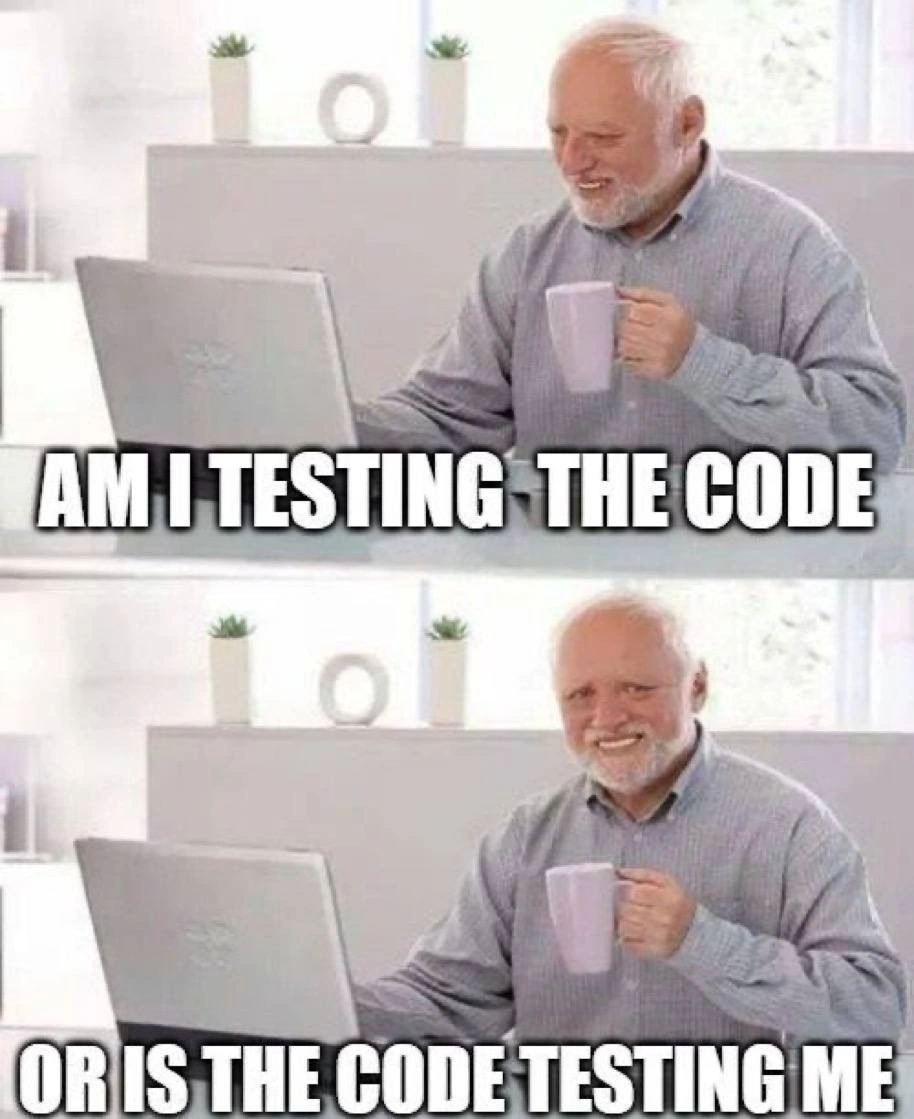
Now, picture the developer in the meme. In both panels, we see the same man at his laptop, holding a coffee mug, trying to smile. That man is actually a well-known meme figure nicknamed “Hide the Pain Harold.” People use him in memes because he has a smile that looks friendly enough, but his eyes and expression also seem a bit sad or in pain – like he’s pretending everything is okay while suffering inside. In the first panel, the text says “AM I TESTING THE CODE”, and in the second, “OR IS THE CODE TESTING ME”. This represents a moment of comedic exasperation. The developer (Harold) is asking a sort of trick question: normally, of course we test the code; code doesn’t literally test humans. But when you spend all day running tests and chasing a weird bug, you start to feel like you’re the one under test! It’s a playful way to say “this is driving me crazy; the code is giving me an exam now.”
Let’s connect this to real life with a simple analogy: imagine you’re trying to solve a puzzle, but the puzzle keeps changing every time you get close to finishing it. How would you feel? Probably pretty frustrated and puzzled yourself! You might start thinking, “Is this puzzle trying to test how patient I am?” In the programming world, the “puzzle” is the code and its bugs, and the “changing” part is how the bug sometimes shows up and sometimes doesn’t. The developer becomes unsure if they’re evaluating the code, or if the code is somehow evaluating them – their patience, their skills, their sanity.
This kind of humor falls under Testing Humor or Developer Humor. It’s the kind of joke you’d hear among programmers who have been debugging for hours. The reason it’s funny is because it’s relatable: many developers (even those fairly new to the job) have experienced a moment where a test or a bug just keeps them guessing. It’s also a bit of a coping mechanism – when faced with a maddening situation, sometimes you just have to laugh it off. By joking that “the code is testing me,” developers acknowledge that feeling of defeat in a lighthearted way. It’s like saying, “This silly code is really giving me a hard time!” and by sharing that joke, other developers nod and laugh, because they’ve felt the same way.
Also, notice the details: the laptop, the coffee mug, the calm-looking room. It’s a typical scene for a programmer – probably working from home or in a quiet office, sipping coffee while running tests. Everything looks normal and peaceful outside. But the joke is highlighting the inner turmoil. The coffee is almost a cliché: programmers practically live on coffee when they have to stay up late fixing issues. That smile on his face? Totally fake – we all know it. Inside, he’s thinking “Ugh, why won’t this work?!” but externally he’s like “No really, I’m fine 😐.” The meme exaggerates it by making him question reality (“Is the code testing me now?”), which is an absurd thought that makes us giggle.
In summary, the meme is saying: Sometimes writing or running tests on your code can be so frustrating and puzzling that you feel like you’re the one being tested. It’s a humorous take on the debugging frustration developers feel. If you’ve ever had a day where a piece of code just would not cooperate no matter what you tried, you’ll read this meme and likely chuckle, “Yep, I know that feeling.” It’s a little reminder that you’re not alone – even expert programmers have moments where they throw up their hands and joke that their software is out to get them.
Level 3: Breakpoints in the Matrix
Every experienced developer can relate to the surreal moment this meme depicts. The image uses the famously pained smile of "Hide the Pain Harold" – a stock photo of an older man smiling through apparent discomfort – as a stand-in for a senior developer maintaining composure while internally screaming. The captions, “AM I TESTING THE CODE” and “OR IS THE CODE TESTING ME”, perfectly capture that twilight-zone feeling during a tough debugging session or marathon QA round. It’s funny (and a little tragic) because we’ve all been there: after hours of chasing a stubborn bug or a failing unit test, you start to feel like a lab rat in your own experiment. Your unit tests (which are supposed to verify the code) are now seemingly tormenting you, the developer. It’s a classic case of role reversal in developer humor. We write tests to catch the code misbehaving, but when those tests start failing in unpredictable ways, suddenly it feels like we’re the ones under examination. Are we doing something wrong? Did we mess up? The code is fine one moment and bizarre the next, and you begin to question your sanity. This is the existential crisis of software testing: when a simple yes-or-no verification turns into a mind game.
Why does this happen? Often it’s because of those notorious flaky tests that pass on one run and fail on the next without any code change. Imagine a scenario any seasoned dev knows too well:
- A test that passes when run in isolation but mysteriously fails when the whole suite runs. Maybe two tests unintentionally share state or there’s a hidden dependency – like one test leaving the database in a dirty state that causes another test to break. You scratch your head thinking, "I swear I didn't change anything, how can it fail now?"
- A bug that vanishes as soon as you try to investigate it. You add some
console.logor run the debugger, and suddenly everything works perfectly. Remove the printouts, run normally, and the bug resurfaces. This is the hallmark of a Heisenbug. It really does feel like the code is saying, "Oh, you're watching? I'll behave..." - An issue that only appears in Continuous Integration (CI) or on someone else’s machine, but never on yours. “Works on my machine!” becomes your ironic battle cry. Different environment, OS, or timing could be at play. For example, your test might always pass at your locale, but fails when the CI server uses a different timezone or slower hardware. Now you’re forced to think like the code: what’s different out there that makes me fail?
- Tests that depend on random numbers, current time, or external services. Say a unit test calls a function that fetches live data or uses the current timestamp. Sometimes the network is slow or that 12:00 midnight edge-case hits, causing a failure. The code might be fine, but the test itself wasn’t written to handle variability, and it backfires on the tester.
Each of these scenarios leads to the same place: the developer staring at the screen in disbelief, much like Harold with his mug, wearing a pained grin. You start muttering, "What does it want from me?" as if the code had a will of its own. The meme is hilarious to us precisely because it’s too real. It exaggerates the feeling to an absurd question, but not by much. After the tenth run of a failing test, you really do start to feel like the software is deliberately messing with you.
And oh, that coffee mug in Harold’s hand? Essential equipment. By the time you’re asking if the code is testing you, you’re probably on your fourth cup of lukewarm coffee, desperately trying to stay calm. The pristine white desk and little potted plants in the image only amplify the contrast: everything looks peaceful and orderly in the environment, but inside the developer’s mind it’s chaos. That forced smile says, "Everything is fine" while nothing is fine. Harold’s expression has become an internet symbol for internal anguish behind a polite smile – exactly how a dev might look in a meeting right after their test suite threw 57 errors.
Beyond the humor, there’s a grain of truth: testing can indeed feel like a trial of the developer. A rigorous QA process or a comprehensive test suite will surface edge cases and bugs you never considered. It’s a humbling experience. You thought you understood the code, but then a weird failing test exposes a scenario you didn’t anticipate. In a way, the code is testing your assumptions. It’s teaching you where you got too confident. Ever hear the saying “the debugger doesn’t lie”? It means if the code’s doing something unexpected, the code is right (it does exactly what it’s written to do) and your expectations were wrong. Coming to grips with that can feel like a personal evaluation. It’s as if the software is looking back at you and saying, “Didn’t think of that case, did you?” – a bit of a smack to the ego for any programmer. Seasoned devs have learned to take this in stride (with a dash of dark humor). We joke about having impostor syndrome – like maybe we’re not good enough – when in reality even the best engineers get stumped by bizarre bugs. The difference is, senior folks have the scars and war stories. We’ve survived enough “code is testing me” moments to chuckle about them later (preferably over a beer or more coffee).
The meme’s caption "When Unit Tests Blur the Line Between Tester and Victim" nails this dynamic. It’s testing humor that resonates in stand-ups and code reviews. One minute you confidently run your test suite expecting all green; the next minute you’re the victim of a red failing test, begging for mercy. It reminds us of a simple dev truth: sometimes you’re not just testing the code – the code is also testing you, revealing how you cope with failure and forcing you to improve. It’s a tongue-in-cheek reminder to stay humble and expect the unexpected. After all, if Skynet ever does rise, it will probably start by randomly failing our unit tests just to watch us squirm.
# Pseudo-code for how it feels when the code has a mind of its own:
if developer_is_watching:
bug.hide() # Code runs fine when you inspect it closely
else:
bug.show() # Bug appears only when you're not looking
In reality, code isn’t sentient (we hope!), but when you hit that frustrating loop of test-fail-debug-fail again, it sure feels like the program is toying with you. This meme turns that feeling into a laugh – a knowing, I've-been-there laugh that veteran programmers and testers snicker at, while nodding their heads in sympathy.
Level 4: Heisenbug Uncertainty Principle
At the most technical level, this meme hints at the almost quantum-like behavior of software bugs during testing. In computing folklore, there's the concept of a Heisenbug – named after the Heisenberg Uncertainty Principle – which describes a bug that seems to change or disappear when you try to observe or debug it. It's as if the very act of running the test in debug mode or adding extra logging alters the program's timing or memory layout, causing that elusive bug to vanish. Under the hood, this often comes down to non-deterministic behavior in the code: things like uninitialized memory, race conditions in concurrent threads, or timing-dependent logic can produce different outcomes from one run to the next. When you try to probe these issues (say, pausing the program with a debugger or printing a variable to the console), you inadvertently change the conditions – much like measuring a particle in physics alters its state – and the bug might not manifest. The code behaves differently simply because you're watching it, giving rise to that eerie feeling that the code knows.
This "observer effect" in debugging means the software under test can feel almost self-aware. Seasoned engineers sometimes joke that tricky code has a mind of its own. In theoretical computer science terms, you can imagine the program as an adversary: whenever you, the tester, choose a strategy to catch the bug, the software finds a way to evade it. It's a bit like an inverted Turing Test scenario – instead of humans testing if a machine is intelligent, here the machine's erratic behavior is testing the limits of human patience and reasoning. There’s even a whiff of the halting problem in this situation: just as no algorithm can universally decide if any given program will finish running, no amount of unit tests can prove a complex program is entirely bug-free. You can only demonstrate the presence of bugs, not their total absence. So when the meme asks, "Am I testing the code, or is the code testing me?", it’s poking at this fundamental asymmetry. We set out to verify the code, but the complexity and unpredictability inherent in software systems end up challenging our understanding. In short, the meme exaggerates a deep truth: beyond a certain complexity, testing software can feel like wrestling with a chaotic system where the roles of tester and subject are blurred by underlying scientific and logical limits.
Description
This two-panel meme features 'Hide the Pain Harold,' an older man with a white beard and a pained, forced smile, sitting in front of a laptop while holding a coffee mug. The meme captures a universally relatable moment of developer frustration. The top panel has the text 'AM I TESTING THE CODE,' showing Harold looking at the screen with his characteristic strained grin. The bottom panel repeats the same image, but the text now reads, 'OR IS THE CODE TESTING ME.' The joke lands with senior developers who have experienced grueling debugging sessions where the code is so complex, buggy, or unpredictable that it feels like an adversarial force. It flips the script from the developer being in control to the code actively challenging their skills, patience, and sanity, turning a technical task into a psychological battle
Comments
7Comment deleted
That moment when you're deep in a race condition bug and you realize you're no longer testing the code. The code is testing your belief in determinism
Given how our “unit” tests spin up Kafka, three Docker containers, and my anxiety, I’m starting to think the suite is really just a liveness probe for the engineering team
After 20 years in the industry, you realize the real test coverage metric is how much of your sanity remains covered after debugging that one flaky integration test that only fails in CI on Tuesdays during a full moon
Every senior engineer knows that moment when your test suite becomes a Turing test for your own sanity - you start questioning whether you're validating the code's correctness or the code is validating your career choices. It's particularly acute at 2 AM when your integration tests pass locally but fail in CI, and you realize the real test was the friends we lost along the way to 100% code coverage
Our flaky integration suite isn’t testing the code; it’s benchmarking my exponential backoff and retry policy on the PR merge button
Our integration tests don’t verify the service - they A/B test my sanity against environment drift
The code isn't buggy - it's just running adversarial tests on your architectural assumptions