Code Comments That Seemed Funny Years Ago Hit Different Now
Why is this CodeQuality meme funny?
Level 1: Funny Then, Awkward Now
Imagine you wrote a silly joke in your notebook at school, thinking you were so clever. You even drew a little cartoon to go with it. It made you and maybe a couple of friends giggle at the time. Now, years later, you find that same notebook and show it to your new friend or teacher. You read your old joke and… oh no, it’s not funny anymore — it’s just weird and a bit embarrassing. You wonder, "What was I thinking back then?"
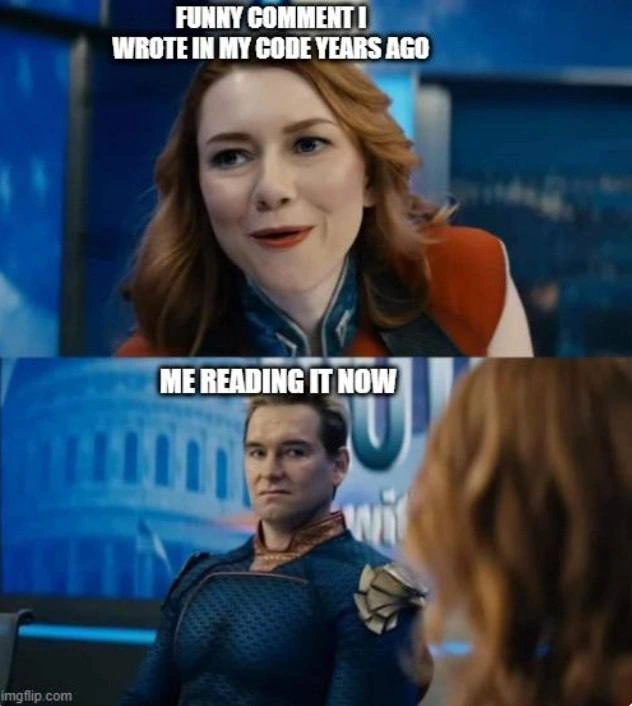
That’s exactly what’s happening in this meme, but with computer code. The top picture is like the old you proudly saying, “Look at this hilarious thing I wrote!” The bottom picture is the current you, staring at it with a cringe, feeling awkward that you ever thought that was a good idea. It’s funny to us because we’ve all been there: something that was funny back then is not so funny now, and we end up laughing at ourselves.
Level 2: Wit vs. Clarity
Let’s step back and explain why this situation hits home for so many developers. Code comments are those lines in source code prefixed with //, #, or /* ... */ that are meant for humans, not computers. Developers use comments to document their thinking: to clarify complex logic, indicate TODOs, or warn about pitfalls. However, sometimes they also slip in humor – maybe a witty one-liner or a pop culture reference – to make the work more enjoyable. That’s where the trouble begins: jokes age, and code often outlives the joke.
Legacy code is any old code that’s still in use (often mission-critical) but was written in the past, possibly by someone else or even by you, years ago. Maintaining legacy systems means reading and modifying code that might not follow current best practices or style. When you encounter a weird or funny comment in legacy code, it can be a head-scratcher. You find yourself thinking, “Huh, what’s this comment trying to tell me? Is it relevant or just the author being cute?” If it’s the latter, it doesn’t help you understand the code – it might even slow you down. That’s a CodeQuality concern: everything in the code should ideally serve a purpose for readability or maintainability. Extra fluff, like a joke that only 2018-you would laugh at, is like finding a goofy doodle in a technical manual.
Now, code reviews are a process where other developers (or future you) examine code changes to ensure they meet quality standards before merging. Picture doing a code review and stumbling on a comment that says, for example:
// [2018] Temporary fix: If this code is still here in 2025, something went wrong 😅
function quickHack() {
// ...some hacky logic...
}
In 2018, you added this cheeky comment to self-deprecate – acknowledging the code was a quick-and-dirty fix and joking that it should be gone by now. The "😅" emoji and casual tone scream DeveloperSelfDeprecation. It probably got a chuckle from teammates back then. But fast-forward to 2025 (which seemed hilariously far off at the time) and guess what? That “temporary” fix is still around in your LegacySystem, and now you are the poor soul reading it. The joke has become a cringe-inducing reminder that the code wasn’t cleaned up as planned. The comment basically says, “we never fixed this properly,” which is not a great look during a code review or maintenance session.
Comment rot is the term we use when comments become outdated or incorrect as code evolves. Perhaps the code was refactored, but the jokey comment remained untouched, now describing a scenario that no longer exists. Or the comment references a trend or technology that has since changed. For instance, a comment like // Uses Promises because callbacks are so 2015 😂 would sound pretty cringy if read in 2025 when JavaScript has long standardized async/await. What was once a cutting-edge joke is now just dated and confusing. This is why maintainable Documentation matters: comments should be updated or removed along with code changes, otherwise they turn into misleading clutter.
As a junior developer, it’s common to infuse code with personality — it humanizes the work and entertains your fellow coders. Maybe you leave a // Here be dragons 🐉 before a gnarly function, or // This is Spartaaa!! in a particularly intense bit of code, thinking everyone will appreciate the levity. At first, it’s all laughs. But when you grow into a more experienced role (or when new developers who weren’t in on the joke read the code), those attempts at humor can backfire. They don’t know the context or the movie reference, and it just looks unprofessional or puzzling. You end up spending time explaining or apologizing for these comments instead of discussing the actual logic.
In summary, the meme is joking about a universal developer experience: DeveloperNostalgia tinted with embarrassment. The tags like maintainability_shame and cringe_factor nail it — it’s that feeling when you realize something you created in the past doesn’t meet the standards you uphold now. The code still works, but the commentary you left alongside it hasn’t aged well at all. It’s a cautionary tale in the world of CodeQuality: write comments as if your future self or someone from the team will read them in a serious mindset. Because eventually, they will, and you don’t want a funny comment from yesterday undermining your hard-earned professional pride today.
Level 3: The Ghost of Comments Past
In the top panel of this meme, our younger developer-self (the caped hero) proudly proclaims a funny inline comment left in code years ago. In the bottom panel, the older, battle-hardened developer (blue-armored hero) stares back with a deadpan "what was I thinking?" expression. This contrast nails the humor: the past me thought a witty comment was a great idea; the present me is mortified reading that same comment during a serious code review. It’s a scenario every seasoned engineer recognizes with a mix of nostalgia and regret.
From a senior perspective, this meme highlights a classic CodeQuality issue: the evolution of our standards over time. What once seemed like harmless developer fun now feels like technical debt in the documentation. That bold, all-caps comment in the code was our attempt to be clever (maybe referencing a 5-year-old meme or a snarky remark about the code). Now, during a modern review focused on clean, maintainable code, that joke falls flat. In fact, it probably violates today’s clean-code guidelines by introducing noise and confusion. The humor has aged poorly – a textbook case of comment_rot (comments decaying in relevance over time).
Why exactly do these once-witty CodeComments make us cringe years later? Let’s break down the shared pain:
- Outdated Pop Culture References: That hilarious movie quote or 2019 meme you slipped into a comment? By 2025, new team members have no idea what “Winter is Coming” or “All your base are belong to us” means in the code. The inside joke has expired, leaving only confusion.
- Maintainability Shame: Jokes don’t explain what the code does or why it’s there. Future maintainers (which often end up being our future selves) see a wisecrack instead of useful info. It’s a missed opportunity for proper Documentation. Even worse, if the code changed and the comment didn’t, it could be outright misleading – a nasty LegacySystems side effect.
- Cringe Factor: There’s a personal embarrassment in realizing DeveloperNostalgia isn’t always flattering. Reading your own comment now, you sense the cringe factor: it’s like encountering a younger version of you who thought they were hilarious and extremely original at 2 AM. Spoiler: what felt like comedic genius then is now just maintainability_shame.
- Professionalism in Code Reviews: Modern code review culture emphasizes clarity and professionalism. A senior engineer examining code doesn’t want to sift through MCU one-liners or Reddit jokes embedded in mission-critical logic. It’s not that developers lack humor – it’s that in a serious review, jokes in the diff distract from substance. You might even get pinged: “Please remove or rephrase this comment for clarity.” Ouch.
In essence, the meme captures the inevitable maturity (and mild horror) that comes with being a long-time coder. As juniors, we decorate our code with personality (quirky comments, inside jokes, maybe a // TODO: change this if Skynet takes over here or there). Years later, we become the ones maintaining that code under pressure. At 3 AM, debugging a production issue, that cute comment from 2018 isn’t so cute anymore – it’s more like graffiti on the codebase that makes us roll our eyes. LegacyCode has a way of reminding you that code is written for humans to read, and tastes change. What was funny back then now just looks like clutter in a critical system.
The talk-show superhero imagery is perfect: it’s as if our past and present selves are facing off on live TV. The younger self (heroine, smirking) confidently thought the comment would stand the test of time. The older self (hero, deadpan) is essentially the code reviewer or maintainer now, giving a disapproving “really, dude?” look. It dramatizes that moment of private cringe every developer experiences upon rediscovering their own old code comment. We’ve all done a facepalm reading something we ourselves wrote. This meme turns that internal drama into a scene worthy of a sarcastic comic interview, highlighting the universal truth: code is easy to write, but hard to read – especially when you’re reading your own past jokes.
Description
A two-panel meme using characters from 'The Boys' TV series. The top panel shows a smiling woman (Firecracker) with the text 'FUNNY COMMENT I WROTE IN MY CODE YEARS AGO'. The bottom panel shows a stern, unamused man (Homelander) with the text 'ME READING IT NOW'. The meme captures the universal developer experience of finding old code comments that once seemed hilarious but now feel cringe-worthy or unprofessional, especially when you realize production code still contains things like '// here be dragons' or '// I'm sorry'
Comments
7Comment deleted
git blame reveals two types of developers: those who write professional comments, and those who have to explain to their manager why production code says '// TODO: fix this cursed abomination before it gains sentience'
Nothing ages faster than a pop-culture reference in a code comment - except the framework version you wrote it in
The only thing more permanent than a 'temporary' workaround is that joke you thought was hilarious when you wrote '// This code is so ugly, it could make a freight train take a dirt road' at 2 AM during a production hotfix
Ah yes, the classic 'TODO: Fix this hack before production' comment from 2019 that's now load-bearing infrastructure serving 10M requests per day. The real joke is thinking your witty comment about 'temporary workarounds' would age better than the actual workaround, which has now been promoted to 'architectural pattern' in the wiki
The real tech debt isn't untested features - it's comments proving your humor peaked before you cared about on-call rotations
That “temporary hack until Monday” punchline from 2017 now powers a critical-path service with an SLO - turns out humor has a shorter retention policy than prod
Comments are the long-tail API; that “lol this hack works” you shipped in 2016 is now Exhibit A in the SOX audit - write the why, or your future self will file a bug against your personality