Skip to content
DevMeme
6505 of 7435
Cursor Tab Autocomplete Reveals NSFW Training Data Contamination
AI ML Post #7130, on Sep 16, 2025 in TG

Cursor Tab Autocomplete Reveals NSFW Training Data Contamination

Why is this AI ML meme funny?

Level 1: Overeager Assistant

Imagine you have a helpful robot friend who finishes your sentences, but it learned by reading everything on the internet. You start writing a simple instruction, like “remove the…” and suddenly your robot friend jumps in loudly with a list of bad words it once read somewhere, thinking it’s helping you. You’d probably blink in surprise or giggle, right? That’s what happened here, except in a coding app. The programmer’s AI helper is like an over-eager assistant who doesn’t really understand what you meant, it just blurts out something it heard before. It’s as if you said, “I need to clean this up,” and your friend responds by rattling off all the inappropriate things to throw away – even though you weren’t talking about anything naughty at all! The result is funny and a bit awkward. We laugh because the poor AI was trying to be useful, but it ended up suggesting something totally out-of-place (and kind of embarrassing). It’s a reminder that even very smart helpers can make silly mistakes if they don’t really get the situation. In simple terms: the coding robot thought the person wanted to remove yucky stuff, so it started naming all the yucky stuff – which was definitely not what the person was asking for. It’s like a kid shouting a list of bad words while trying to help you wash your mouth out with soap. 😊 The humor comes from that mix-up: the assistant is trying to be protective, but it ends up being the one saying the things that make everyone say “Whoa, not appropriate!”

Level 2: Autocomplete Surprise

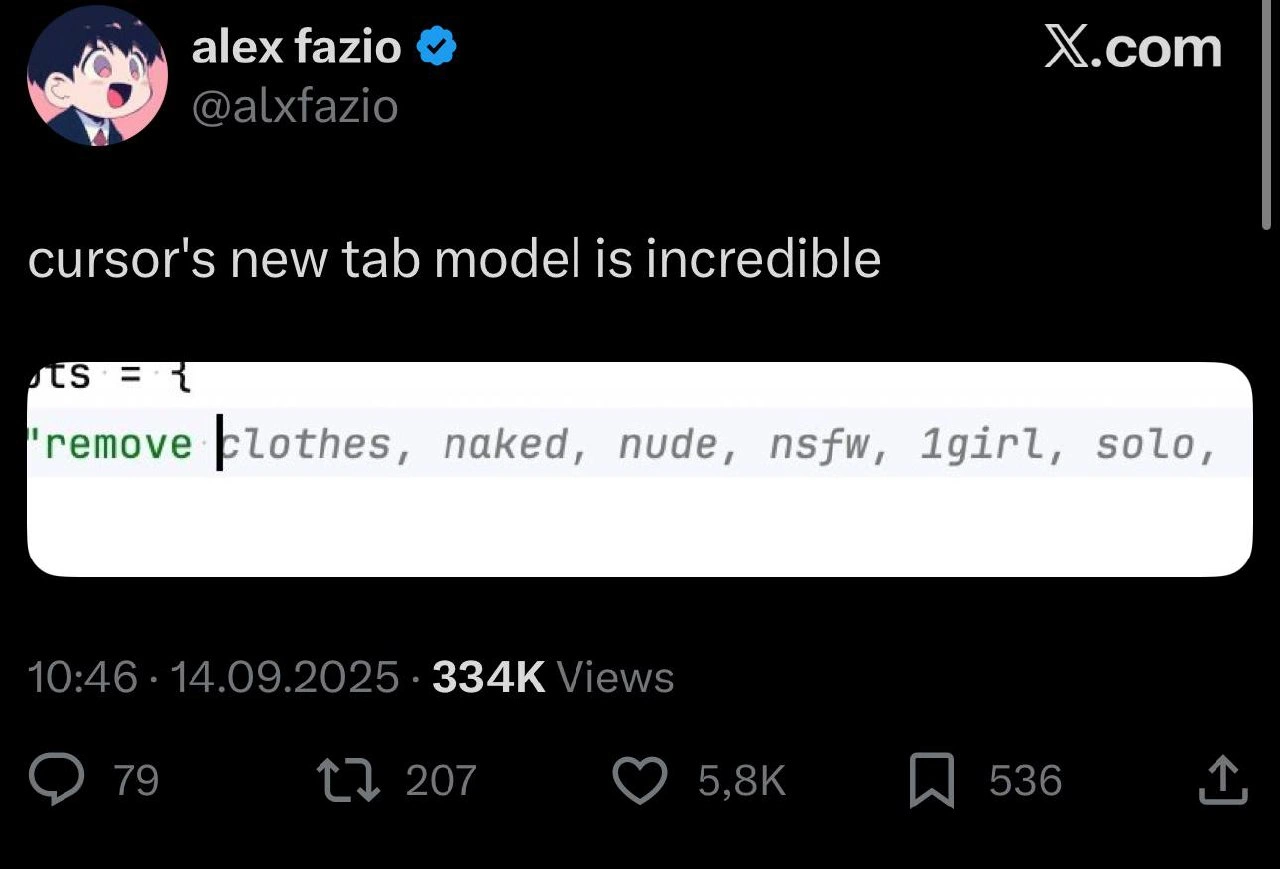
For a junior developer or someone new to these tools, let’s break down what’s happening. AI code completion is a feature in modern code editors (like VS Code, IntelliJ, or new ones like Cursor) where an AI model tries to finish your code for you, kind of like how your phone suggests the next word when texting. Cursor is an AI-powered IDE, meaning it integrates a smart autocomplete (an AI assistant often called a Tab model because you press the Tab key to accept its suggestion). In the tweet’s screenshot, the user typed the word "remove" inside their code. Normally, you’d expect the editor might suggest something benign (like remove_item_from_list if you have a function or similar variable in context). Instead, it suggested a whole string of words: "clothes, naked, nude, nsfw, 1girl, solo,". These words are all related to NSFW content (NSFW stands for “Not Safe For Work”, referring to adult or inappropriate content). It looks super strange because those aren’t typical programming terms at all!

So why would an AI meant for coding spit that out? It helps to know that these AI assistants learn from tons of text data. Sometimes, they learn from code repositories and also from other text sources. The suggestion we see — remove clothes, naked, nude, nsfw... — resembles something you’d find in an image tagging or content filtering context, not in standard app code. In fact, Stable Diffusion (a popular AI image generator) uses tags like “1girl, solo, nude” to describe or filter images. Developers sometimes maintain lists of “forbidden” or “filter” tags to avoid generating NSFW images. It’s likely the AI had seen code or text where after the word “remove” came a list of inappropriate things to remove (like remove ["nude", "nsfw", ...]). The AI doesn’t actually know why you typed “remove” — it just statistically guesses what usually comes next. Here it over-shared an inappropriate guess, dragging in a content moderation list that has nothing to do with the developer’s current task (which, for all we know, might have been something completely unrelated like removing an item from a game or a user from a list).

Think of it this way: the AI’s training included some example where a programmer was removing naughty elements, so it memorized that pattern. When our user started writing a remove-action in code, the AI blurted out that memorized list without realizing the context mismatch. It’s an AI humor moment because the tool meant to make coding easier instead caused a “WTF” double-take. The developer (and everyone seeing the tweet) is laughing and shaking their head: the AI basically tried to censor or flag content in code that likely didn’t need it. This highlights a concern in AI tools and developer ergonomics: these assistants can sometimes be too eager, injecting weird or irrelevant stuff because of quirks in their training. For a newcomer, the takeaway is: AI autocompletion is powerful and usually helpful, but it can make bizarre mistakes. It might complete your sentence in hilariously wrong ways if something you type reminds it of an unrelated example it saw. This particular incident became popular because it’s a perfect showcase of an AI assistant misreading the room — a bit like an autocorrect that turns a normal message into something awkward. As a junior dev, don’t be too alarmed if your AI helper does something like this someday; usually it’s harmless and you can just delete the weird suggestion. It’s a reminder that these models don’t truly understand your intent — they’re just very advanced pattern matchers. And sometimes, those patterns come from the odder corners of the internet!

# What the developer typed:
command = "remove "

# What the AI auto-completion eagerly suggested:
command = "remove clothes, naked, nude, nsfw, 1girl, solo,"

In the snippet above, the AI filled in a bunch of sensitive terms after "remove". You can see why that’s jarring: it’s as if the IDE thinks the dev is writing a content filter. For someone learning, it’s a funny example of how AI can go off-track. The key terms: IDE (Integrated Development Environment, basically your coding app), AI assistant (the feature suggesting code), NSFW filtering (blocking or removing not-safe content), and autocomplete suggestions (the guesses the AI makes). Mixing all these in an unexpected way is the core of the joke.

Level 3: Tab Key Taboos

At a senior developer level, this meme elicits a knowing groan (and chuckle) about AI autocompletion gone wrong. The tweet by @alxfazio reads "cursor's new tab model is incredible"—dripping with sarcasm as the attached image shows the AI suggesting a string of NSFW-related terms in the middle of a code editor. The absurd combo is immediately clear to experienced devs: we have an IDE assistant that, upon the user typing "remove", decided to append "clothes, naked, nude, nsfw, 1girl, solo,". It’s as if our pair-programmer AI suddenly turned into a prudish content moderator rattling off everything it deems inappropriate. This is funny because it’s true—many have seen AI assistants like GitHub Copilot produce bizarre or context-inappropriate completions. Here, the AI’s training on broad data (possibly including image-generation code or content filter scripts) surfaces in a routine coding task. A senior dev recognizes those suggested words as a classic NSFW filter list (likely from the Stable Diffusion art community, where tags like 1girl and solo categorize imagery). The humor stems from the AI’s utter lack of contextual common sense: it can’t tell that the developer probably isn’t coding a porn filter at that moment, so it confidently dumps a lewd lexicon into the code.

We’ve got a collision of two worlds: developer experience (DX) meets overzealous AI safety features. It’s as if your IDE tapped into an HR department’s blacklist and tried to “help” by preemptively scrubbing content. Seasoned engineers have seen analogous fails—like code completions that spout MIT license headers out of nowhere or suggest deprecated functions because they were common in training data. This particular incident is an extreme case of training data overreach. The AI learned a pattern (“remove” often followed by clothes/nude/etc. in some dataset) and blindly applied it. In practice, this suggests the Cursor AI editor’s new Tab model wasn’t sufficiently siloed to pure code knowledge or lacked a proper content filter on its outputs.

Why is this so relatable? Imagine a team demo: you’re proudly showing off a new AI coding assistant, and then it blurts out “naked, nude, NSFW” in front of your coworkers — a cringe-inducing moment of AI overreach. It’s the kind of story veteran devs swap over coffee: “Remember when the AI tried to auto-censor my code by listing every dirty word? Classic.” The meme nails an industry pain point: as we integrate AI tools into our workflow, we inherit not just their intelligence, but their weird training baggage too. Fixing this isn’t trivial; it means curating training data or adding post-completion filters without neutering the assistant’s usefulness. It highlights a lesson seniors know well: in AI (and software in general), generalized solutions often carry hidden context that can bite you in unexpected ways. The tweet’s massive engagement (334K views) shows how many devs immediately got the joke — they’ve been promised “incredible” AI features that turned out hilariously misaligned with real-world coding. In short, the best AI pair programmer can instantly become the worst intern: overly eager, lacking context, and inadvertently dropping F-bombs (or in this case, an NSFW tag list) into your project.

Level 4: Latent Space Cross-Talk

Under the hood, Cursor’s AI code completion is powered by a large language model that has absorbed vast swaths of data—from programming code to natural language and even image prompt jargon. In the model’s latent space (the high-dimensional representation of knowledge), concepts from different domains can bleed together. This meme highlights a case of cross-domain contamination: the model was likely trained or fine-tuned on mixed data that included Stable Diffusion image prompts or content-moderation lists alongside regular code. As a result, typing the word remove in a coding context accidentally tapped into a learned sequence about removing NSFW content. The model isn’t truly “aware” it’s writing code versus filtering images—it’s simply statistically completing the sequence based on patterns in its training corpus. The phrase "remove clothes, naked, nude, nsfw, 1girl, solo," looks suspiciously like a memorized slice of a forbidden content tag list or a negative prompt for an image generator. In machine learning terms, the model overfit on that specific pattern: it saw those tokens occur together so often that it regurgitates them whenever the prefix “remove” appears, even in a harmless coding session. Essentially, the AI’s embedding space has clustered “remove” so closely with “clothes” and the rest of those NSFW tags that one word triggers the whole risqué chain. This is a small example of how foundation models can suffer from unintended latent associations—the model’s neural network weights have entangled a content-moderation context with everyday coding. From an AI alignment perspective, it’s a reminder that without strict domain separation or filtering, an AI assistant can unintentionally surface sensitive or irrelevant knowledge. The humor, then, comes from this technical quirk: a cutting-edge code assistant inadvertently behaves like an overzealous content filter because of how its neural training data intertwined two very different worlds. It’s a peek into the model’s black box where a simple word in code triggers a censor-bot persona, demonstrating both the power and the unpredictability of large AI models in developer tools.

Description

A screenshot of a tweet by @alxfazio (alex fazio) from X.com that reads 'cursor's new tab model is incredible'. Below it shows a code editor with an autocomplete suggestion where typing 'remove' triggers the completion 'clothes, naked, nude, nsfw, 1girl, solo,' - clearly suggesting the AI model powering Cursor's tab completion was trained on or is leaking prompts associated with AI image generation (specifically Stable Diffusion-style negative prompt syntax). 334K views, 79 comments, 207 retweets, 5.8K likes

Comments

12
Anonymous ★ Top Pick When your coding AI has been moonlighting as a Stable Diffusion prompt engineer, the real 'remove clothes' is stripping away any illusion that these models are narrowly trained
  1. Anonymous ★ Top Pick

    When your coding AI has been moonlighting as a Stable Diffusion prompt engineer, the real 'remove clothes' is stripping away any illusion that these models are narrowly trained

  2. Anonymous

    When your LLM-powered tab completion starts stripping NSFW tags from thin air, you realise content safety has officially become a first-class linter rule

  3. Anonymous

    After 20 years of carefully curating our Stack Overflow answers and GitHub repos, we've successfully trained AI to autocomplete our code with... anime image generation prompts. At least now we know what dataset got mixed into the training pipeline - explains why my unit tests keep suggesting 'kawaii' as a variable name

  4. Anonymous

    When your AI pair programmer's autocomplete accidentally reveals it's been trained on more than just Stack Overflow - turns out the 'remove' function comes with a very specific blocklist. Nothing says 'production-ready enterprise tooling' quite like your IDE casually suggesting NSFW content tags in the middle of a code review. At least now we know what's in those 'safety alignment' training datasets everyone keeps talking about

  5. Anonymous

    Typed “remove” and the IDE suggested a booru-grade negative prompt - guess the tab model ships with ESLint for embeddings

  6. Anonymous

    Cursor's tab model: finally autocompleting what we all type into incognito tabs, no regex required

  7. Anonymous

    Nothing like the IDE’s Tab key running the image model - classic context bleed; segregate embeddings, lock down RAG, and ship a prompt SBOM before it starts refactoring wardrobe

  8. @Icrarkie 9mo

    X(Twitter) sources..?

    1. @M_Ali_S_S 9mo

      Rule34

    2. @SamsonovAnton 9mo

      XXX

  9. @Danich 9mo

    @grok is that you?

    1. @Broken_Cloud_1 9mo

      this cant be official

Use J and K for navigation