NPM: Could You Not Have Supply Chain Attacks For Five Minutes
Why is this Security meme funny?
Level 1: When Chaos Won’t Sit Still
Imagine you’re in a classroom and there’s one kid (let’s call him Donny) who just can’t sit still. Every few minutes, Donny knocks over a chair or pulls a prank, and the teacher (let’s call her Ms. Shrek) has to stop teaching to deal with the mess. Eventually, Ms. Shrek is so frustrated she yells, “Donny, could you please NOT cause trouble for just five minutes?!” The class finds it a bit funny because it’s true – Donny is always up to something, and poor Ms. Shrek just wants a moment of peace.
In this meme, developers are like that tired teacher, and the wild kid Donny is like the npm package system. Developers use a lot of little pieces of code from others (because it makes building things faster, like getting pre-made puzzle pieces). But sometimes, one of those pieces causes a big problem – kind of like a prank or an accident that breaks everything. It happens so often that developers feel like they can’t catch a break. The meme shows an ogre (the developer) begging the donkey with the npm logo (the source of all those little code pieces) to please behave, just for a tiny bit. It’s funny in the way a frustrated parent might jokingly beg their mischievous child or a naughty puppy to calm down. Everyone can understand that feeling – when you’re just asking for a brief pause in the chaos. The humor comes from exaggeration: of course, real software problems don’t happen every five minutes, but when you’re unlucky, it feels like it! Just like a kid constantly causing trouble, the npm system keeps developers on their toes, and sometimes you just have to throw your hands up and laugh at how absurd it can be.
Level 2: The Unruly Package Donkey
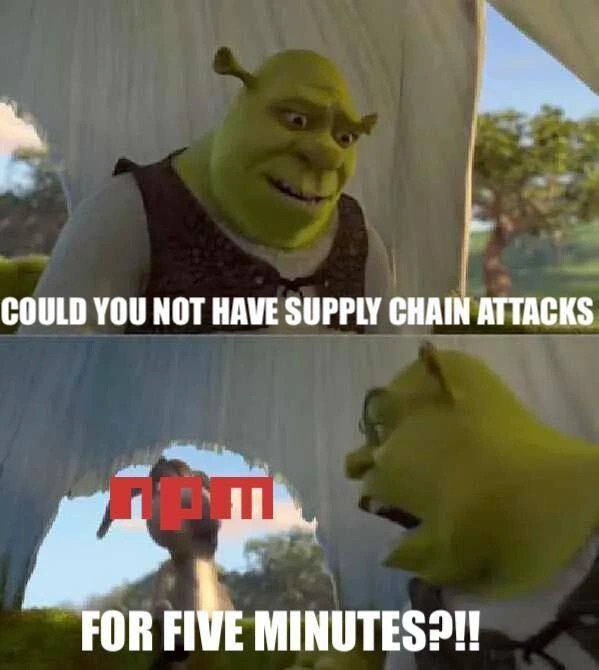
Let’s break down what’s going on in this meme. It uses a scene from the Shrek movie. Shrek (the big green ogre) is peeking out of his onion-shaped house looking annoyed, and Donkey (the talking donkey friend) is running outside causing mischief. The text has Shrek essentially yelling: “COULD YOU NOT HAVE SUPPLY CHAIN ATTACKS … FOR FIVE MINUTES?!!” with the npm logo slapped on Donkey. In this context, Shrek represents software developers, especially those managing projects with lots of dependencies. Donkey represents npm (Node Package Manager) and by extension the whole ecosystem of NpmPackages and open-source dependencies. Donkey is known in the film for being over-energetic and somewhat chaotic – a friendly nuisance. That’s how developers sometimes feel about the npm ecosystem: we love the openness and the vast selection of packages (Donkey is well-meaning), but we’re exhausted by how often it creates chaos (Donkey just doesn’t sit still).
Now, what are “supply chain attacks”? In software, a supply chain isn’t about physical goods, but rather all the components that go into your application. If you build an app, you likely rely on external libraries – that’s your software supply chain. A supply chain attack is when someone bad targets one of those components or the process of getting them. It’s like instead of attacking a castle’s walls (your app directly), they poison the well upstream (one of the libraries you drink from). In the JavaScript world (with npm), this could mean a malicious person sneaks bad code into a package that thousands of developers use. When those developers update or install that package, boom – the bad code runs in their apps, potentially doing things like stealing data or opening backdoors.
Why is npm frequently joked about in this context? npm is the default package manager for Node.js (and widely used for front-end packages too). It’s known for having millions of packages, a very low barrier to publishing, and a culture where even very small functionalities (like left-padding a string, i.e. adding spaces to reach a certain length) are packaged and reused. This means typical Node.js applications have a dependency tree with hundreds of nodes – lots of little packages depending on other packages. Every one of those is usually an open-source project maintained by someone out there. Most of the time it’s fine, but there have been multiple incidents of SecurityVulnerabilities where either a maintainer’s account got hacked or a new maintainer turned out malicious.
For example, the event-stream incident: Event-stream was a popular npm package. Its original author handed maintenance over to a stranger (because he wasn’t interested in maintaining it anymore). That stranger added a new dependency with malicious code targeting a cryptocurrency app. For a while, nobody knew – until someone noticed weird behavior. By then, that bad version had been downloaded thousands of times. Another case: ua-parser-js, a library to parse user-agent strings (used in many websites/apps), had an attacker publish a contaminated version that tried to install a cryptominer on your computer. People installing the latest version got a nasty surprise. These are classic supply chain attacks – attacking through the supply line of code.
There’s also something called a dependency confusion attack. This one’s clever: big companies often have internal packages not published on the public npm registry (like an internal library named our-core-lib). Developers might reference it like any other package. Attackers discovered they could publish a package to the public npm with the same name as some common internal ones, but give it a higher version number. Some package managers, if not configured carefully, will say “Oh, there’s a higher version on the public registry than our internal one, let’s grab that” – and then you’ve inadvertently pulled in the attacker’s code. This actually happened in real life (a security researcher demonstrated it by ethically “hacking” multiple big tech companies to prove the point). It’s called dependency confusion because your build gets “confused” about where the dependency should come from.
DependencyHell is a term newcomers might hear a lot. Traditionally, it refers to the frustration when dependencies have conflicts or a tangled web of requirements that are hard to resolve (like two libraries requiring different incompatible versions of a third library – yikes). In the meme’s context, it’s hinting that dependency hell now also includes the endless stream of security issues. Every time you add a dependency, you’re also adding risk. Keeping them updated is supposed to fix bugs and vulnerabilities, but as we see, updates can sometimes be the vulnerability if the source is compromised. It’s a catch-22: don’t update and you’re vulnerable to old bugs; do update and you might pull in a new surprise. No wonder Shrek (the dev) is frazzled.
The onion house scene from Shrek wasn’t chosen randomly. In Shrek, ogres are compared to onions – they have layers. The meme creator likely found it poetic because modern software also has layers and layers of dependencies (like an onion). Shrek pulling back the curtain and pleading with Donkey is like developers looking at the world of open-source packages and pleading: “Can we please not have another incident for a moment?!” Meanwhile, the npm (Donkey) is seen sprinting off, implying that nope, something’s probably already going wrong out there (“for five minutes” is all we ask!). This resonates especially with developers who lived through things like the sudden left-pad incident or the day half the internet panicked over a package compromise.
To manage these risks, junior devs are now taught about tools and practices: for example, running npm audit to check for known vulnerable versions in your project, using lockfiles (package-lock.json or yarn.lock) to freeze exact versions so you don’t accidentally pull a tainted update, enabling 2FA (two-factor authentication) on important package publisher accounts, and even services like Snyk or GitHub Dependabot that alert you when a dependency has a security issue. These are all responses to the very real supply chain problems that this meme is joking about. It’s a bit like a neighborhood watch after a series of break-ins – everyone’s on alert now. And still, new break-ins (exploits) happen, hence the meme’s resigned tone.
At its core, the meme is both funny and a tiny bit tragic: funny, because it uses a pop culture reference in a spot-on way (even if you haven’t seen Shrek, the imagery of someone begging a hyperactive friend to calm down for five minutes is clear); tragic, because it reflects a real frustration in the developer community. “No new supply-chain exploits today, please, npm” is the kind of thing you’d hear a senior dev joke after reading yet another incident report. Now that joke lives on in meme form, making everyone who’s been there nod and chuckle knowingly (and maybe go double-check their own dependencies, just in case…).
Level 3: Five Minutes of Peace
For seasoned developers, this meme hits home because it feels like we’re constantly fire-fighting npm package issues. Shrek’s exasperated line “Could you not have supply chain attacks for five minutes?!” perfectly encapsulates the collective groan of engineers after yet another npm fiasco. The humor comes from painful familiarity. We've been through the event-stream incident (where a popular npm package was hijacked to steal Bitcoin wallet keys), the ua-parser-js malware hack (where an attacker published a malicious update that installed crypto miners on users’ machines), and the memorable protestware meltdown (like when the colors and faker libraries were deliberately sabotaged by their maintainer to make a point). Each time one of these happens, developers have to drop everything, comb through package-lock.json files, rush out patches, and answer anxious questions like “Are we affected?!” from managers. It’s exhausting. Shrek’s weary face = our face when reading yet another security bulletin about an npm package gone wild.
The meme portrays npm as Donkey – the lovable but hyperactive character always causing trouble or at least never sitting still. The red npm logo plastered on Donkey sprinting away is so on-point it’s painful. NPM (Node Package Manager) is beloved for how it empowered JavaScript developers to share and reuse code. But it also created a bit of a monster: projects now pull in hundreds or thousands of tiny packages, each maintained by different folks (or sometimes not maintained at all). It’s a running joke that a simple “Hello World” web app might depend on 500 packages once you include all the sub-dependencies. With that many pieces, something is always breaking or getting exploited. Donkey just cannot sit still. The developer community (as Shrek) is essentially pleading: “Please, just a moment of stability, I beg you.” And in true Donkey fashion, the npm ecosystem seems to reply, “I’ve got to do something chaotic!” and dashes off into the next breaking change or vulnerability.
This is also commentary on DependencyHell in modern development. Every experienced dev knows the paradox: we heavily rely on open-source dependencies to be productive, but every dependency is a potential source of bugs, conflicts, or security holes. We joke that npm install is pulling in your entire production indirectly. That tiny library for left-padding a string might itself bring 10 other packages. One of those might suddenly get yanked or compromised. (Who can forget the great Left-Pad incident of 2016, when removing one 11-line package broke half the internet?) The Shrek meme exaggerates with “five minutes” for comedic effect, but some days it truly feels like you can’t even sip your coffee before Twitter or GitHub alerts you to a new supply-chain meltdown in progress.
Another layer to the humor is the open-source maintainer dynamic. Many maintainers are underpaid, overworked, or simply move on, and projects can fall into neglect. Attackers know this; they prey on abandoned projects (offering to “help maintain” them, as happened with event-stream) or exploit the fact that many developers blindly trust updates from npm. The phrase “could you not… for five minutes” also mocks the fact that these incidents are so frequent that we’d be grateful even for a short break. It’s like an on-call nightmare that never ends. Senior engineers have a bit of PTSD: hearing “npm” and “vulnerability” in the same sentence triggers memories of late-night patch sessions or emergency incident calls.
The Dependencies and Security categories frame the meme’s context: it’s about the entwined relationship of relying on third-party code (dependencies) and the security risks that come with it. In real-world terms, this is why companies are now investing in open source risk management – tools like automated dependency scanners, mirrors that vet packages, even hiring teams dedicated to auditing critical libraries. We’ve learned the hard way that the cost of prevention is worth it, because responding to a surprise supply-chain breach is brutally expensive (and stressful). The meme is funny to us because it candidly admits our collective fatigue. It’s the gallows humor of folks who have been burned but have to soldier on anyway. We laugh, a bit bitterly, because what else can we do? The next npm exploit is probably around the corner, and yes, we will drop everything to deal with it when it hits – again.
Level 4: Trusting Trust in Layers
At the deepest level, this meme highlights a fundamental trust problem in software ecosystems. In security theory, there's the classic concept of a chain of trust: every layer of our software supply chain (build tools, package registries, libraries, etc.) must be trustworthy because each layer depends on the integrity of the one below it. The JavaScript world, especially with npm, has layers like an onion – fitting since Shrek’s home is literally an onion hut. But each additional layer (each dependency or build step) is another link where a malicious actor could slip in.
In an ideal world, we’d cryptographically sign and verify every package, lock down dependencies with hashes, and use reproducible builds so that any tampering is evident. There are indeed serious efforts: the industry has projects like Sigstore and The Update Framework (TUF) to ensure packages are signed and logged transparently, and the concept of a Software Bill of Materials (SBOM) to catalog every component in your app. Yet, even with digital signatures, you’re still implicitly trusting the signer. If a maintainer’s system is compromised or they themselves go rogue, a valid signature can accompany malicious code. As Ken Thompson famously outlined in his paper "Reflections on Trusting Trust", you can’t even fully trust a compiler – an exploit can hide in the tools that build the tools. This onion of trust has so many layers that peeling it fully is practically impossible without tears.
Academically, ensuring no package is malicious is a problem that borders on the undecidable. Verifying arbitrarily complex code for malicious intent hits problems like Rice’s theorem – there's no general algorithm to prove what a piece of code will do in all cases. We can sandbox, we can scan for known bad patterns, but a clever exploit can hide its intent (even downloading payloads at runtime or triggering only under specific conditions). The meme’s exaggerated plea for “just five minutes” without a supply chain attack wryly echoes this theoretical futility: even if you momentarily secure all known vulnerabilities, the unknown unknowns lurk in the next layer down. Just like an ogre’s onion or a Matryoshka doll, each layer can conceal another surprise.
On a network and cryptographic level, SoftwareSupplyChainSecurity is trying to solve a distributed trust issue: how do you verify that code from a stranger on the internet (pulled in as a dependency) does exactly what you think and nothing more? Solutions like package signing, checksum verification in lockfiles (e.g., npm shrinkwrap or lockfiles with SHA-512 hashes for each package), and two-factor auth for publishers improve things but don’t eliminate the risk. Even if the packages themselves were mathematically proven safe (a Herculean task), the environment they run in (like Node.js) might have its own vulnerabilities. It’s a classic defense-in-depth nightmare: every layer you secure just pushes attackers to find cracks in the next layer. The meme’s humor carries this heavy truth: our modern development practices have created an enormously complex, interconnected system where ensuring absolute security is as fantastical as, well, an ogre and a talking donkey.
Description
A two-panel Shrek meme template. In the top panel, Shrek looks exasperated with the text 'COULD YOU NOT HAVE SUPPLY CHAIN ATTACKS'. The bottom panel shows Shrek yelling with the npm logo superimposed and the text 'FOR FIVE MINUTES?!!' The meme references the frequent security incidents in the npm ecosystem where malicious packages are published or legitimate ones are compromised, making supply chain attacks a persistent and recurring problem for JavaScript developers
Comments
7Comment deleted
npm install --save-dev existential-dread: because the real vulnerability was trusting strangers' code all along
At this point my CI pipeline spends more time running `npm audit fix --dry-run` than compiling, but sure - micro-services will save us
After the 47th npm audit warning this week, you realize the real distributed system wasn't your microservices architecture - it was the trust model where every junior dev's weekend project becomes critical infrastructure for Fortune 500 companies
The npm ecosystem's relationship with supply chain attacks has become so predictable that 'npm audit fix' is now considered a daily standup ritual rather than an emergency response. At this point, senior engineers have automated their vulnerability response workflows so thoroughly that they've essentially built a CI/CD pipeline just to keep their CI/CD pipeline secure - a delicious irony that would be funny if it weren't so existentially exhausting. The real question isn't whether your transitive dependencies have vulnerabilities, but rather how many layers deep you'll need to audit before you find the compromised package that 47 other packages inexplicably depend on
NPM supply chain attacks: enterprise-grade insecurity, courtesy of unvetted deps that turn 'npm install' into Russian roulette
Every time we plan a quiet sprint, npm’s transitive tree reimplements chaos engineering via postinstall, and our SBOM becomes a crime scene
We had SBOMs, lockfiles, and 2FA - then a single ^ bumped a transitive devDep and our build politely ran a stranger’s postinstall