When product managers label an overheating bug a hand-warmer feature
Why is this Bugs meme funny?
Level 1: Mistake or Masterpiece?
Imagine you helped your parents bake cookies, but you accidentally left them in the oven too long. Now they’re all burnt and black! 😟 That’s clearly a mistake, right? But instead of throwing them away, you suddenly say, “No, I did it on purpose – I made extra-crispy chocolate cookies, a special new kind!” You claim it’s a masterpiece feature of your recipe. Everyone can see the cookies are burnt and not how they are supposed to be. Of course, you’re just trying to make a bad situation sound good so you don’t get in trouble. It’s a bit silly and kind of funny because nobody really believes those burnt cookies were intentional.
That’s exactly what’s happening in this meme. Something went wrong with a gadget (it gets too hot when it shouldn’t), and the product manager is like the kid who doesn’t want to admit the mistake. He’s saying “Actually, it’s great that it gets hot – it can keep your hands warm in winter!” It’s as if he’s calling the problem a special feature. We laugh because it’s a playful way of handling a goof-up: turning a whoops 🤦 into a “wow!” 😃. But we also know it’s not true. Just like burnt cookies aren’t really a new delicious flavor, a charger that overheats isn’t really a good hand warmer. The humor comes from that pretend game – saying a mistake is actually a clever plan. It’s funny and a little bit cheeky, because deep down everyone knows the difference between something that’s broken and something that’s brilliant, no matter what you call it.
Level 2: Bugs vs Features 101
Let’s break down what’s happening in simpler terms. In technology (whether software or hardware), a bug means something is broken or not working as intended. It could be a coding error in software or a design flaw in hardware. In this meme, the bug is an overheating_issue with a power bank – that’s a portable battery you use to charge your phone. “Overheating” means the device is getting too hot when it’s used, more than it should. That’s bad because it can damage the device or even cause burns or fires if it’s severe. A feature, on the other hand, is something a product is supposed to do – a benefit or function that’s intended. For example, a feature of a power bank might be fast charging or a built-in flashlight. Features are the selling points that make you want the product.
Now, normally, if engineers find a bug (like the device running dangerously hot), they want to fix it. They might add better cooling, improve the circuit, or recall the product if it’s really unsafe. The Product Manager (often called a PM) is the person responsible for deciding what features the product should have and making sure it meets customer needs and business goals. They’re sort of a bridge between the technical team and the business/marketing team. A PM will prioritize features, set deadlines, and often they’re in charge of the product’s story. They usually don’t want a big bug to ruin the product launch or the user’s experience. The funny (and frustrating) thing is, sometimes instead of addressing a bug properly, a PM might downplay it or put a positive spin on it. Putting a spin on something means presenting it in a way that sounds better than it really is – kind of like marketing_spin.
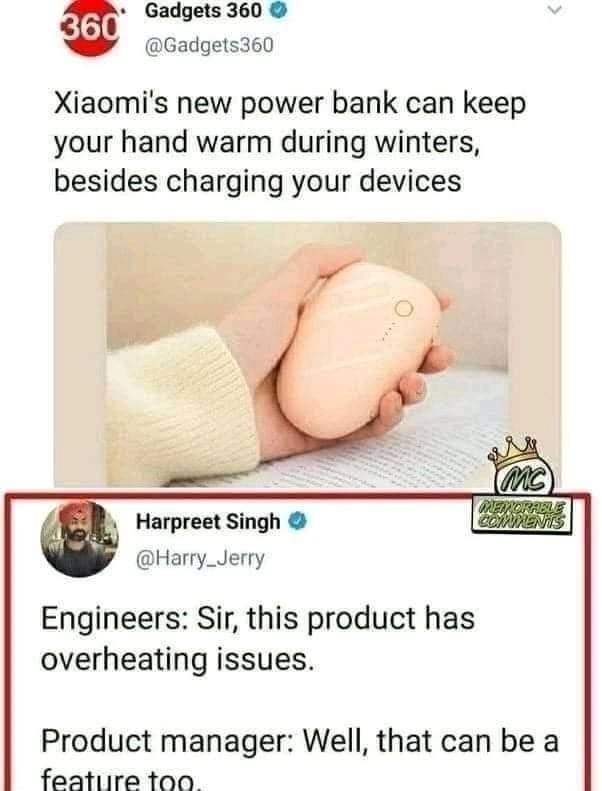
In this meme, the PM is doing exactly that: taking the overheating problem and rebranding it as if it were an intentional feature. The conversation shown is:
Engineers: “Sir, this product has overheating issues.”
Product Manager: “Well, that can be a feature too.”
In other words, the engineers are warning “This is a flaw,” and the PM replies “Maybe we can call it a perk!” He suggests that because the power bank gets warm, they could advertise it as a hand-warmer for winter. It’s like saying, “Our device runs hot – but hey, that’s great in cold weather!” This is a humorous exaggeration of real life. Usually, if a device gets warm, a company might say something subtle in the manual like “Device may become warm during use” to cover themselves. But they wouldn’t outright advertise “hand warming” unless it was truly designed for that. Here the joke is that the PM sounds totally serious about making this bug into a selling point.
For someone new to this kind of humor, it helps to know the common phrase: “It’s not a bug, it’s a feature.” This is a tongue-in-cheek saying in the tech world. People use it when an unexpected behavior or flaw is discovered, and instead of admitting it’s wrong, they jokingly claim they meant to do that. For example, if a video game has a funny glitch, the developers might joke, “That’s actually an Easter egg, not a bug.” It almost never literally becomes a real feature (especially if it’s something harmful), but it’s a way to laugh off the mistake. In the context of ProductManagementHumor, it pokes fun at how managers or marketing folks sometimes care more about perception than reality. A newbie engineer might be puzzled: “Why would you call a defect a feature?” The answer is, you normally wouldn’t – it’s a form of joke or, at times, a cynical commentary on bad management. It highlights a bit of truth: occasionally, under pressure, companies will try to reframe problems as acceptable.
Let’s put it in a straightforward scenario. Imagine you’re testing a new phone and it heats up a lot when charging. As an engineer, you’d log this as a bug to fix, because it could hurt the phone or user. A good product manager would likely delay the release or at least issue a warning. But a bad or cheeky product manager might say, “Maybe we can use this heat. It’s winter; customers might like a warm phone in their pocket!” It sounds silly, right? In reality no responsible company would officially do this with a serious issue like overheating, due to liability and safety. But in the world of developer jokes, we exaggerate to make a point. We’ve all experienced situations where someone in management seems to ignore a problem and instead tries to sell the narrative that everything is fine or even beneficial. This meme simply takes that to an extreme for comedic effect.
So, to sum up for a newcomer: The meme is showing an absurd conversation where a bug (overheating) is being called a feature (hand warmer) by a product manager. It’s funny to developers because it captures a grain of truth about workplace dynamics – the sometimes absurd lengths management might go to avoid admitting flaws. It’s a form of CorporateHumor mixed with developer inside-joke: turning bugs_into_features with a straight face, even though everyone (especially the engineers) knows how ridiculous that is.
Level 3: The Hand-Waving Hand Warmer
This meme nails a classic EngineeringHumor scenario: “It’s not a bug, it’s a feature.” Here we have engineers raising a red flag about an overheating_issue in a product – a portable charger (power bank) that runs hotter than it should. Normally, that’s a critical bug. Overheating can shorten the gadget’s lifespan, fry internal components, or worst-case, turn it into a mini bonfire. Any sensible engineer would treat this as a showstopper defect or a safety recall item. Enter the Product Manager (PM), whose response is basically: “Overheats, you say? Great, we’ll market it as a built-in hand warmer for cold winters!” – complete with a big grin and perhaps a high-five to the marketing team. This punchline is both hilarious and painfully familiar to anyone who’s been in tech long enough. It satirizes how ManagerExpectations can warp reality: instead of fixing the bug, just redefine success around it.
Why do developers find this so funny (or tragic)? Because it rings true. There’s a long-running industry joke that whenever something goes wrong, some manager will declare it a “feature”. Maybe it’s out of desperation to meet a shipping deadline or avoid admitting a mistake to higher-ups. In practice, we’ve seen milder versions of this spin-doctoring:
- A mobile app uses too much memory? Call it “aggressive caching for better performance.”
- The UI update is confusing users? Label it “advanced mode for power-users.”
- Product runs slower on older devices? Market it as “battery-saving mode” because it’s not taxing the CPU.
It’s all about marketing_spin: frame a negative as a positive. In this meme’s case, the spin is especially absurd. Turning a hardware_safety defect into a selling point crosses into dark comedy territory. We’re basically watching a PR alchemist try to transmute a potential fire hazard into a cozy feature. Developers have experienced less perilous versions of this, like a boss insisting that an obvious UI bug is “intended behavior” to avoid the work of changing it. It’s a corporate survival tactic: if fixing a bug is costly or embarrassing, some will choose to rebrand the bug instead. The phrase BugVsFeature exists exactly for these scenarios.
There’s also an underlying commentary on the tension between engineering integrity and business objectives. Engineers are trained to deliver a product that works correctly and safely – they feel responsible for the quality. Product managers (especially the stereotypical bad ones poked at in memes) are focused on delivering value to customers and meeting release dates – sometimes even if it means a bit of reality distortion. Here the PM’s priority seems to be shipping something marketable on time, even if it requires lying creative redefinition. It’s a bit like saying, “We promised a multi-purpose gadget, so let’s just claim this unintended heat is a purposeful multi-purpose aspect.” In meetings, this might come with plenty of hand-waving: “Well, technically, the unit does keep you warm... so let’s list it as a feature.” Meanwhile, the engineers are facepalming, knowing that overheating is a defect that could burn (literally) the company’s reputation.
Another reason this hits home is that it exaggerates real corporate behavior. Companies have indeed spun issues into features, albeit usually in less blatant ways. For example, if a laptop’s battery life turned out shorter than expected, marketing might emphasize its high-performance components (implying the power draw is intentional for speed). Or if a device is heavier than rivals, they’ll highlight “durable build quality.” It’s all about perspective. But safety issues like overheating are usually non-negotiable – you’d expect any responsible manager to address them head-on. The meme gets its extra zing by showing a PM who is either comically negligent or ridiculously optimistic. It’s the kind of ProductManagementHumor that engineers share over coffee: “Remember that one manager who didn’t want to label any known issues in the release notes? This is that logic taken to the extreme.”
In essence, the bottom post’s dialogue (“Engineers: ... overheating issues.” “Product manager: ... feature too.”) is a tongue-in-cheek caricature of workplace interactions. The engineers speak up about a problem; the PM selectively hears an opportunity. It’s funny because it’s a hyperbolic twist on real tension – shipping safely vs shipping on time and on message. Every developer who’s had a bug downplayed by non-technical stakeholders chuckles (perhaps bitterly) at this. We laugh, but we also think, “Oh please, don’t let any real manager actually be that reckless.” The humor works as a relief: it’s better to joke that an overheating battery is a “hand-warmer” than to cry about the looming recall it might force. It’s a coping mechanism wrapped in a meme. As a cynical veteran might quip: Sure, the customer’s house burned down... but hey, at least they won’t complain about cold hands! 🥁😅 (Rimshot.)
Level 4: Physics vs Marketing
At the hardware level, an overheating power bank isn't just a quirky inconvenience – it's a fundamental failure in design. Electronic devices obey thermodynamics, not marketing spin. When a battery pack draws high current, it wastes energy as heat via Joule heating (thanks to $P = I^2R$). In engineering terms, that heat is lost efficiency – a sign something's off. Real hardware safety standards (UL, CE, etc.) impose strict thermal limits for a reason: excess heat can degrade components or even trigger a thermal runaway (the kind of chain reaction that turned certain phones into pocket fireworks). You can't simply rename wasted energy as a feature and call it solved. A bug that violates safety specs means your design failed its requirements. It’s as absurd as rewriting a test case to pass by redefining the expected output on the fly. The product manager in this meme is effectively attempting to alter the specification after the fact: “Device shall run hot enough to warm hands in winter.” Nice try, but nature doesn’t play along – calling it a hand-warmer feature won't cool down the circuits or appease the laws of physics. In fact, the second law of thermodynamics chuckles in the background: all that excess entropy (disorder) isn’t going away just because marketing gave it a cute name.
From an advanced perspective, this situation highlights the clash between engineering reality and product spin. Engineers design for efficiency and safety envelopes (managing heat via heat-sinks, thermal throttling, or better circuits), whereas a marketer might see any output as an opportunity. But hardware isn’t as forgiving as software – a glitch in code might be harmlessly reframed as an “Easter egg,” yet a battery overheating issue can’t be simply whitewashed; it’s literally a hot problem. Overcurrent protection, thermal sensors, automatic shutdown mechanisms – these exist because overheating is dangerous. If those safeguards are being tripped regularly, no amount of wordsmithing will change the fact that the device is malfunctioning. The meme’s dark humor comes from this impossible bait-and-switch: rebranding a physics problem as a user benefit. It’s like trying to negotiate with gravity after a fall: “It’s not a broken bone, it’s a growth opportunity!” Sure. You can bend the truth in a product brochure, but you can’t bend the melting point of silicon. In short, the product manager’s hand-warmer proposition is a fantasy colliding with electrical engineering reality – a bug by any scientific measure, no matter what label you slap on it.
Description
The meme is composed of two stacked social-media posts. The top post, from “Gadgets 360 @Gadgets360,” reads: “Xiaomi's new power bank can keep your hand warm during winters, besides charging your devices,” and includes a photo of a beige-sleeved hand holding a smooth, peach-colored, pebble-shaped power bank with tiny LED indicators. The lower post, by “Harpreet Singh @Harry_Jerry,” says: “Engineers: Sir, this product has overheating issues. Product manager: Well, that can be a feature too.” The juxtaposition turns an obvious thermal defect into a supposed selling point, poking fun at how product managers sometimes spin bugs into features. For hardware and software engineers, it satirizes the tension between shipping safely and shipping something marketable
Comments
11Comment deleted
When the thermal budget blew up and the PM rebranded it as “warmth-as-a-Service,” I finally understood that MVP now stands for “Melts Viable Plastics.”
After 20 years in tech, I've learned that the only difference between a P0 bug and a flagship feature is which department writes the press release - and whether legal has reviewed the thermal injury waiver yet
Lithium cells running warm enough to market as a hand warmer is just thermal runaway with a go-to-market strategy
This perfectly captures the eternal struggle: engineers see a thermal management failure requiring immediate hardware revision and safety testing, while product managers see an opportunity to pivot into the IoT hand-warmer market. Next sprint: 'Can we add Bluetooth so users can adjust the overheating - I mean, warming - temperature via an app?'
PM: It’s not overheating, it’s P95 hand-warming; Engineering: great - what’s our P99 liability?
Engineers log P1 overheating tickets; PMs ship it as 'adaptive thermal UX' for winter deployments
Only in PM‑speak can 'violates the thermal envelope' be rebranded as 'winter UX,' turning a non‑functional requirement failure into a Q4 feature
i'm here to help you find the joke in this meme Comment deleted
thank you Comment deleted
👌🏻 Comment deleted
Ever get this feeling of dejavu? Comment deleted