Skip to content
DevMeme
3747 of 7435
The Loop Variable Debate And The Inevitable Winner
CodeQuality Post #4087, on Jan 25, 2022 in TG

The Loop Variable Debate And The Inevitable Winner

Why is this CodeQuality meme funny?

Level 1: Keep It Simple

Imagine a group of friends trying to decide on a nickname for a simple game. They spend time suggesting all sorts of fancy names, but in the end they just go with the most obvious thing – like calling the team “The A Team” or simply “Team One.” Everyone realizes that the plain, simple choice was perfectly fine all along. The friend who suggested that basic name then smiles and says, “I won!” not only because their idea was picked, but also as a cheeky play on words (since “one” and “won” sound the same).

This meme is just like that, but for programmers. A team of developers was jokingly arguing over what tiny name to use for a loop counter in their code (that’s like choosing a letter to count with). After all the debate, they chose the simplest and most common option – the letter “i.” It’s as if they all said, “You know what, let’s just use i because everyone understands that.” And the person who was in favor of using i gets to proudly say “i won.” That’s funny because it sounds exactly like “I won,” as in “I’m the winner.” In the end, the joke shows how sometimes the simplest, most obvious solution wins the day, and everyone has a little laugh about how silly the argument was. Just like picking a basic name and realizing it was the best choice all along, the letter i was a simple winner – and that playful “I won” makes the whole thing sweet and humorous.

Level 2: Looping with i

For those newer to coding, let’s unpack the joke. When programmers talk about a “looping variable name,” they mean the name of the temporary variable that keeps track of the loop’s progress. A loop is a basic concept in programming that lets you repeat a block of code multiple times. For example, if you want to print numbers 1 through 5 or iterate over a list of items, you’d use a loop. Inside that loop, you often use a variable to hold the current count or index. You can name this loop variable anything, but tradition has given us a favorite: the single-letter i.

Why i? It’s short for index (think of it as the position in a sequence). Almost every programming tutorial uses i in its first loop example. Check out this snippet:

# Using 'i' as the loop variable (common convention)
for i in range(1, 6):    # i will take values 1, 2, 3, 4, 5
    print("Number:", i)

# Using a longer, more descriptive name for the same loop
for index in range(1, 6):  # index is just a more descriptive name for i
    print("Number:", index)

Both loops above do the same thing: they print out “Number: 1”, “Number: 2”, up to “Number: 5”. In the first loop, we used the conventional i. In the second, we used the name index to be more explicit. You can see that i is just a placeholder name – it could be anything. But by convention, i is extremely common. In fact, if you have nested loops (a loop inside another loop), many people will use i for the outer loop, j for the inner loop, then k and so on. These are just successive letters, and it’s a pattern programmers recognize instantly.

Now, normally, naming conventions in code are a big deal for code quality. We usually try to give variables meaningful names so that the code is easy to read. For instance, if you had a variable for a user’s age, you’d call it age, not x. A clear name acts like a label – it tells you what the data represents. However, in the special case of a simple loop index, using i is widely accepted. Why? Because in the context of a loop, everyone reading the code already knows that i just means “the current count” or “the current index”. It’s such a routine convention that it doesn’t harm readability; if anything, most developers’ eyes expect to see i there. Using a longer name like counter or loopIndex might be more descriptive in theory, but it’s kind of unnecessary when the loop span is just a few lines and its purpose is clear.

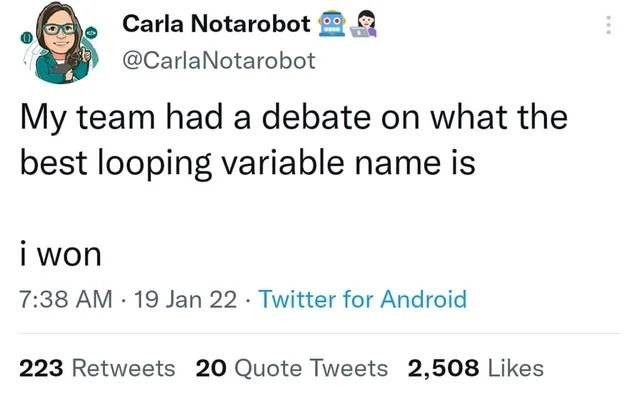
The meme is a screenshot of a tweet from a developer joking about this exact topic. The text says: “My team had a debate on what the best looping variable name is” and then on the next line: “i won.” The humor here has two layers. First, it’s poking fun at the idea that a team of programmers would seriously debate something as tiny as what to name a loop variable. (Programmers do love to argue about little things – it’s a part of developer culture and often done in good fun.) Second, the phrase “i won” is a play on words. It means the letter i was chosen as the best name (so i won the contest). But when you read “i won” out loud, it sounds exactly like “I won,” as in “I am the person who won.” 😄 So the tweet’s author is cheekily saying that not only did i (the variable name) win the debate, but “I” (the person) won as well, presumably because they were advocating for using i all along.

This is a classic bit of coding humor that’s very relatable in the developer community. Even if you’re new to programming, you’ll quickly notice how common certain patterns are – like using i for loops – and you might find it funny that something so small and simple has become almost universally agreed upon. It’s as if all programmers subconsciously decided, “Yep, i is our go-to loop guy.” So the tweet is both celebrating that little fact and making a pun out of it. In summary: the team’s loop-naming argument ended with the simplest, most traditional choice (just the letter i), and the way it’s phrased lets the author humorously claim victory. Once you’ve written a few loops yourself, you’ll likely appreciate why this tiny detail is an ongoing inside joke among coders!

Level 3: One Letter Reigns Supreme

In a team of experienced developers, it’s not uncommon to witness a bikeshedding session (prolonged argument over trivial details) about something as small as what to name a loop index. In this meme (a screenshot of a witty tweet by Carla Notarobot), the team debates “the best looping variable name,” and naturally the venerable single-letter i emerges victorious. The clever twist: the tweet’s punchline is literally “i won” on its own line. That phrase doubles as the result (the letter i won the vote) and reads exactly like “I won” – as if the author is triumphantly declaring personal victory. This double meaning is a classic bit of developer wordplay, causing a knowing smirk for anyone in on the joke.

The humor lands because it nods to a universal truth in programming: naming things in code can spark absurdly passionate debates. We even have that tongue-in-cheek saying: “There are only two hard things in Computer Science: cache invalidation, naming things, and off-by-one errors.” Here the meme zooms in on naming, of all things – specifically naming a throwaway loop variable. It’s a relatable scenario: perhaps you’ve seen a naming-conventions discussion spiral out of control in a code review or during a team stand-up. Everyone agrees on writing readable, self-documenting code, but when it comes to a trivial loop counter, nearly every engineer has used i without a second thought. It’s practically ingrained in our collective coding muscle memory. Debating it explicitly feels absurd – and that absurdity is exactly what this meme highlights.

The “victory” of i underscores how powerful convention and context are in programming. In countless languages – from low-level C to high-level Python – a basic for loop almost expects a variable named i. Typically it’s for (int i = 0; i < N; i++) or for i in range(N). That one-letter name has achieved an undisputed status as the default loop index. Why i? By convention it stands for “index” (or sometimes “iterator”), and it’s short and convenient. Crucially, every coder instantly recognizes i inside a loop. It's so standard that using a verbose name like indexCounter can feel like overkill, even counter-productive. For small loops, a longer name doesn’t really add clarity – it just adds keystrokes. So while good code quality guidelines usually preach descriptive naming, here brevity wins because the loop’s purpose is obvious. The team in the meme presumably went through all the usual arguments: “Should we use i, or a more explicit name like index for clarity?” – only to conclude that tradition and simplicity trump verbosity. It’s a classic case of a dev team collectively realizing: if it ain’t broke, don’t fix it. All hail i.

There’s a bit of affectionate developer-community self-mockery here too. Software developers love to have strong opinions on trivial matters (tabs vs spaces, anyone?). These debates are a rite of passage – part of developer culture bonding and humor. The tweet resonated with thousands of programmers (it racked up over 2.5k Likes), meaning a lot of devs saw it and thought “Haha, so true!” It’s an in-joke: we’ve all either experienced a petty naming debate or at least joked about how silly they can become. The fact that i won is funny because it was the predictable outcome all along. It’s as if the team held an epic contest only to end up crowning the obvious champion. You can imagine a mock-serious meeting where someone finally says, “Let’s put it to a vote,” and after all the buildup, the whiteboard just ends up with a giant i circled in marker. Cue groans, eye-rolls, and laughter.

Fun historical footnote: The dominance of i isn’t just arbitrary; it’s rooted in the history of programming languages and even mathematics. Mathematicians have long used i, j, k as generic index variables (think of summation notation like $\sum_{i=1}^{n}$). Early programming culture inherited this. In fact, the language FORTRAN (back in the 1950s) had a convention where any variable starting with the letters I through N was implicitly an integer if not otherwise declared. Why I–N? Because that convention came straight from math, where those letters often represented integer loop counters. So using i for loops was literally baked into some of the first high-level languages. That practice carried through the decades: from FORTRAN to C to Java to JavaScript and beyond. This explains why your college professor, the Stack Overflow code snippet you copied, and that 1970s IBM punch-card program all use i in their loops. The meme humorously reminds us that sometimes the old ways stick around not because we lack creativity, but because they just make sense and everyone understands them.

From a senior developer’s perspective, this meme is a lighthearted nod to our shared coding habits and the comedic futility of overthinking something as simple as a loop variable name. The team’s little naming-things debate ends in the most relatable outcome for any programmer – sticking with good old i – and the way the tweet is worded lets the author cheekily declare victory. It’s a fun reflection on how even the smallest choices in code can spark joy, eye-rolls, and a sense of camaraderie in the programming world.

Description

A screenshot of a tweet from the user Carla Notarobot (@CarlaNotarobot). The tweet reads, 'My team had a debate on what the best looping variable name is', followed by a separate line that says 'i won'. The post has 223 Retweets, 20 Quote Tweets, and 2,508 Likes. This meme is a classic developer pun. The humor lies in the double meaning of 'i won': it can be interpreted as the author winning the debate, or as the variable 'i' being chosen as the best loop variable name. The use of 'i' as a loop counter is a deeply ingrained convention in programming, dating back to early languages like Fortran, making this joke universally relatable and funny to software engineers of all experience levels. It speaks to the simple, shared cultural norms within the developer community
Comments

20
Anonymous ★ Top Pick The team debated 'index', 'counter', and 'idx'. A senior dev finally ended the meeting by stating, 'It's i. It has always been i. Any more questions?' And that's how 'i' won
  1. Anonymous ★ Top Pick

    The team debated 'index', 'counter', and 'idx'. A senior dev finally ended the meeting by stating, 'It's i. It has always been i. Any more questions?' And that's how 'i' won

  2. Anonymous

    After half a lifetime of code reviews I’ve concluded: “i” isn’t a loop variable, it’s an ABI - change it and the diff, blame, and half the team’s muscle memory all break in prod

  3. Anonymous

    After 20 years in the industry, I've seen teams spend more time debating whether to use 'i', 'idx', or 'index' than they spent on the actual algorithm complexity - though we all know the real winner is whoever manages to sneak in 'ಠ_ಠ' as a valid identifier in their language of choice

  4. Anonymous

    Of course 'i' won - it's had a 65-year incumbency since Fortran, and nobody's ever survived a code review proposing 'loopIndexCounterValue'

  5. Anonymous

    The beauty of this debate is that whether you prefer 'i', 'idx', 'index', or even 'currentIterationCounter' for your loops, we all know the real winner is whoever doesn't have to maintain the codebase where someone used 'ii', 'iii', and 'iiii' for nested loops because they ran out of semantic variable names

  6. Anonymous

    After three design reviews we finally used Raft to standardize the loop counter - ‘i’ got elected leader, ‘j’ and ‘k’ are followers… until someone goes 1‑based and we get split‑brain

  7. Anonymous

    'i' won the loop-var debate - O(1) to type, O(n) to debug once it leaks into a closure or goroutine

  8. Anonymous

    'i' won because after 20 years refactoring enterprise nests, 'index' is just tech debt waiting to happen

  9. @Infinitelineman 4y

    > debate > tracked 2 hours as team meeting

  10. @dsmagikswsa 4y

    i j k

    1. @Benito_Zara 4y

      l m n o p

      1. @MLXProjects 4y

        ñ

  11. @iashchak 4y

    Пля, три недели разгадывал этот ребус, сцук.

    1. @pavel_a_levin 4y

      А че в ответе?

      1. @sylfn 4y

        Translation: "What's answer?" Please use English in this chat

    2. @sylfn 4y

      Please use English in this chat (add a translation)

  12. @feskow 4y

    It's accurate

  13. @iashchak 4y

    Сойдет? "Phuck. I spent 3 weeks to solve with puzzle. Bitsch."

    1. @sylfn 4y

      yes, soydyout

      1. @iashchak 4y

        // @todo say thanks to admin

Use J and K for navigation