Skip to content
DevMeme
3749 of 7435
Backend engineer ignores production bug to chase shiny machine learning hype
Bugs Post #4089, on Jan 25, 2022 in TG

Backend engineer ignores production bug to chase shiny machine learning hype

Why is this Bugs meme funny?

Level 1: Shiny New Toy

Imagine you’re supposed to clean your room because it’s a big mess and your mom asked you to do it (that’s the important task, like the bug that needs fixing). But then, you suddenly see a brand new video game or your favorite toy sitting there. It’s super exciting and fun-looking – way more interesting than picking up dirty laundry, right? So, instead of cleaning your messy room, you start playing with that new game. Meanwhile, the mess is still there and your mom is getting upset that you haven’t done your chore.

This meme is just like that! The messy room that needs cleaning is like the problem in the software that needs fixing. The new video game or toy is like the cool new machine learning project that the engineer finds exciting. And the upset mom is like the angry customers or boss waiting for the bug to be fixed. It’s funny because we all understand the feeling – the fun new thing is so tempting that the boring important job gets ignored. The picture makes us laugh, because we know the engineer really should fix the bug, but we also know how hard it is to resist something shiny and new. It’s a silly reminder that doing the important work first is usually the better idea, even if the new thing is really cool.

Level 2: Production vs Seduction

Let’s break down what’s happening in this meme in simpler terms and define the pieces:

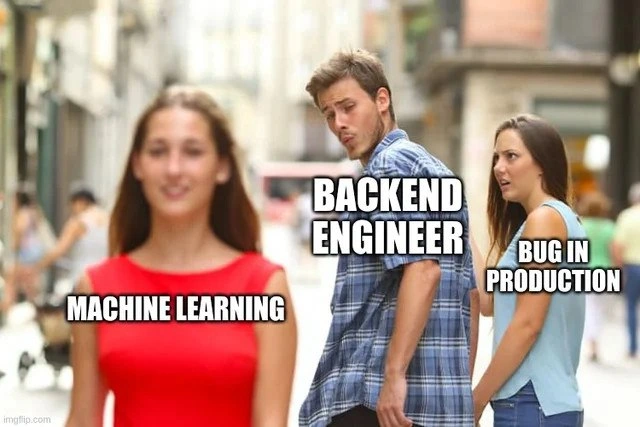
  • Backend Engineer: This is the programmer responsible for the server-side of an application – all the behind-the-scenes functionality like databases, APIs, and business logic. If a website were a restaurant, the backend engineer is the chef in the kitchen making the food (data and logic), not the waiter serving you the webpage. In the meme, the guy in the plaid shirt represents the backend developer. He should be keeping the “kitchen” running smoothly.

  • Bug in Production: “Production” means the live environment where real users are using the software. A bug in production is a mistake or error in the code that’s happening in that live system. It could be causing crashes, wrong outputs, or some feature not working. Think of this as a leak in the kitchen pipe flooding the restaurant – it’s a problem happening in real time, and it needs fixing ASAP. In the meme, the upset girlfriend represents this production bug: she’s demanding attention because something is broken right now. Her annoyed look is just like an alert or a customer complaint saying “Hey, fix this now!”

  • Machine Learning: This refers to a trendy field of AI (Artificial Intelligence) where programs can learn from data and improve themselves, like teaching a computer to recognize images or make predictions. It’s a hot technology in the industry – everyone’s talking about it, lots of blogs and conferences, and many engineers are excited to try it out. In the meme, the woman in the red dress symbolizes Machine Learning – basically a shiny new tech idea walking by, catching the engineer’s eye. She represents the exciting project or experiment that isn’t necessarily related to the urgent work at hand.

Now, the scene makes sense: The backend engineer should really be fixing that production bug (his “girlfriend” pulling on his arm) because it’s part of his job to keep the service running. But he’s distracted by machine learning (the attractive passerby), which is the cool new thing he’d rather be working on. In real life, this could mean the engineer received an alert about an error on the website, but instead of debugging it immediately, he’s reading an article about machine learning or playing with an ML demo project. Maybe he’s always wanted to try adding a machine learning feature to the product, or he’s just bored of dealing with bugs and finds the ML stuff more interesting.

This meme format (the “distracted boyfriend” image) is commonly used to joke about someone ignoring their current commitment in favor of a new temptation. Here, it’s applied to developer humor: the commitment is resolving a bug, and the temptation is the latest tech trend. It’s funny because as developers (especially newer ones), we can relate to the feeling. Fixing bugs can be frustrating and not very glamorous, while starting a new machine learning project sounds fun and cutting-edge. It’s like having homework due but wanting to play with a new toy instead.

For a junior developer or someone new to this environment, the meme highlights a gentle warning: don’t ignore critical issues in your existing project just because something new and shiny comes along. The AI hype is exciting and learning ML is great, but production bugs are like fires – you can’t just turn your back on them without consequences. The humor works on multiple levels: visually the guy’s behavior is silly, and technically it’s poking fun at a real tendency in tech to chase trends over doing maintenance. It’s a lighthearted reminder to keep our priorities straight (even if machine learning is really cool!).

Level 3: Hype-Driven Development

The meme shows a backend engineer literally turning away from his upset girlfriend labeled Bug in Production to gaze longingly at Machine Learning walking by. In classic distracted boyfriend fashion, it humorously captures a phenomenon every seasoned dev recognizes: shiny object syndrome. Instead of tending to the urgent production bug (a glitch in the live system that’s probably breaking something for users right now), our hero is captivated by the latest tech hype – in this case, the allure of AI/ML.

This scenario is a textbook case of hype-driven development (closely related to the infamous resume-driven development). The engineer is neglecting the unglamorous work of debugging in favor of experimenting with a trendy ML project. It’s funny because it’s too real – many of us have seen a critical bug ticket languish while someone chases a shiny new framework or fancy algorithm. The humor bites with a bit of truth: maintaining operational reliability (fixing that production bug) is often less exciting than playing with a hot new technology. Why slog through log files and stack traces to find a null-pointer bug when you could be tweaking a neural network’s hyperparameters, right? 🙄

From an experienced developer’s perspective, this meme nails the tension between operational duty and innovation temptation. On one side, we have the Bug in Production – possibly a nasty issue causing errors or downtime in a live service. Any SRE or on-call engineer would say that bug needs immediate attention (users might be impacted, dashboards are red, alerts are going off). On the other side, we have Machine Learning – the buzzword that’s been riding high on the tech hype cycle, promising magic like self-driving cars and killer recommendations. It’s the cool new thing everyone’s talking about at meetups and on tech Twitter. The backend engineer distraction here is essentially the developer thinking: “Sure, the order processing service is crashing, but have you seen this new TensorFlow model? Gotta try it!”

Machine learning in 2022 is that irresistibly attractive tech trend. Companies are spinning up AI teams, project managers want to sprinkle ML into every product, and engineers are itching to get those sweet AIHype projects on their resume. Meanwhile, the boring old production bug (perhaps a failing API endpoint or a memory leak in the backend service) isn’t sparking anyone’s imagination. This meme exaggerates it by personifying ML as the attractive stranger and the bug as the ignored partner. The labels in bold white text make it crystal clear who each character represents – a classic meme format for delivering the punchline without a single spoken word.

For veteran developers, there’s an extra layer of dark humor. We’ve learned (often the hard way) that ignoring a production bug is just asking for pain later. It’s like ignoring a small fire in the server room because you’re busy reading about quantum computing – you know that fire is going to spread. The ironic chuckle comes from recognizing that the ProductionBugs we ignore today will come back as all-hands-on-deck outages tomorrow. As the saying goes, “If you don’t schedule time for maintenance, your system will schedule it for you” – usually at 3 AM on a weekend. The meme’s joke is essentially pointing out this folly: our intrepid backend dev is courting a future 3 AM emergency by sidelining the fix.

Yet, this kind of developer humor also pokes fun at how we’re all a bit guilty of it. New tech is exciting! Fixing old bugs is drudgery. The industry’s TechHypeCycle practically conditions us to always look for the next big thing – today it’s ML and AI, yesterday it was blockchain, before that it was “Big Data” or microservices. The faces change, but the distracted gaze stays the same. We laugh at the meme because we’ve been that engineer or worked with that engineer. It’s a knowing laugh with a pinch of “oh no, I’ve done that”.

In real-world terms, this situation might play out as follows: instead of investigating why the database is timing out (perhaps an index is missing or a query is stuck in a lock), the developer is off building a toy image classification model unrelated to the immediate job. The bug in production might be causing user complaints or revenue loss, but hey, the engineer’s learning how to make an AI predict cat pictures! It’s an absurd priority mismatch – exactly the kind of thing that fuels BackendHumor on developer forums.

To illustrate the mindset in pseudo-code:

try:
    fix_production_bug()  
except Exception as e:
    # Developer chooses to skip the tedious fix and chase the shiny tech
    print("Skipping bug fix:", e)  

# Meanwhile, an unrelated ML experiment commences  
model = train_neural_network(training_data)  
print("Training new ML model instead of fixing production...")  

Above, instead of handling the exception properly and digging into the bug (fix_production_bug()), the code just logs it and moves on to start a machine learning model training. It’s a tongue-in-cheek representation of how the engineer in the meme is prioritizing the wrong task. In reality, no responsible dev would consciously write code exactly like this – it’s exaggerated – but it feels true when you see colleagues ignore urgent tickets while tinkering with something “cool”.

Ultimately, the meme resonates because it highlights a real engineering culture issue: balancing technical debt and maintenance versus the drive to innovate with new tech. It reminds us (with a laugh) that chasing the latest AI/ML trend can lead to neglecting the basics – like keeping the servers running! The girlfriend’s annoyed face labeled “Bug in Production” is basically every project manager or team lead when they realize their developer is off on a tangent instead of solving the pressing issue. In summary, the meme delivers a sardonic lesson: cool tech is fun, but don’t let your core responsibilities become the jealous, ignored girlfriend.

Description

Classic “Distracted Boyfriend” meme on a busy city street: a young man (face blurred) labeled “BACKEND ENGINEER” turns his head to stare at a woman in a red dress walking past, who is labeled “MACHINE LEARNING.” The girlfriend, holding his arm and looking upset, is labeled “BUG IN PRODUCTION.” All three labels are bold white block text with black outlines. Visually, the scene juxtaposes the engineer’s captivated gaze at the passing trend while literally turning his back on the active production issue. Technically, it pokes fun at engineers who abandon urgent bug-fixing duties in favor of experimenting with the latest ML buzz, highlighting the perennial tension between operational reliability and chasing new tech hype

Comments

7
Anonymous ★ Top Pick PagerDuty’s screaming about a Sev-1, but if I ship a half-baked notebook with “transformer” in the README, finance logs it as strategic innovation
  1. Anonymous ★ Top Pick

    PagerDuty’s screaming about a Sev-1, but if I ship a half-baked notebook with “transformer” in the README, finance logs it as strategic innovation

  2. Anonymous

    After 15 years in the industry, you realize the real machine learning is training yourself to look at production bugs first, even when that new transformer architecture paper just dropped and your k8s cluster is somehow still running despite that memory leak you've been ignoring since Q2

  3. Anonymous

    He'll pivot to ML, spend six months on data cleaning, and discover the model's biggest training signal is the bug he never fixed

  4. Anonymous

    Every backend engineer's career arc: 'I just need to fix this one P0 production bug' → sees a Medium article about transformers → 'Actually, what if we rebuilt our entire CRUD API as a neural network?' Meanwhile, the database is literally on fire and customers are rage-tweeting. The real ML model we need is one that predicts when engineers will abandon their on-call duties to chase the latest arXiv paper

  5. Anonymous

    ML dreams train on GPU fantasies, but prod bugs crash the party with real-time backpressure

  6. Anonymous

    Classic resume-driven development: ignoring the prod bug because if you call it “unsupervised anomaly detection,” it becomes an ML project instead of a postmortem

  7. Anonymous

    Resume-driven development in one frame: backend eyes embeddings while a P0 pages; error budgets don’t care about your cosine similarity

Use J and K for navigation