Skip to content
DevMeme
4580 of 7435
Novice programmer trades pencil for inefficient O(n!) brute-force 'technology' solution
CS Fundamentals Post #5025, on Nov 23, 2022 in TG

Novice programmer trades pencil for inefficient O(n!) brute-force 'technology' solution

Why is this CS Fundamentals meme funny?

Level 1: Spaceship for a Short Trip

Imagine you want to solve a simple problem, like getting across the street to your friend’s house. One person grabs their shoes and walks over (that’s like using pencil and paper, a simple and direct solution). But another person — let’s call him the over-excited novice — says, “No, walking is for cavemen! I have a rocket ship!” He drags out a huge rocket, spends forever fueling it up, and then blasts off just to land on the house next door. 🚀 It’s absurd, right? The rocket launch ends up being way more complicated, noisy, and time-consuming than if he’d just walked. In the end, the fancy technology didn’t actually help – it was overkill. This is exactly what’s happening in the meme: the beginner programmer chooses an over-the-top complicated way (using a computer to try every option like a rocket) instead of the easy way (just figuring it out with simple thinking, like walking). It’s funny because the high-tech solution becomes a silly, inefficient mess, whereas the “old-fashioned” simple way would have worked smoother and faster. Everyone watching can’t help but laugh and shake their heads, because sometimes doing things the simple way beats using a huge machine for no good reason.

Level 2: Caveman with a Computer

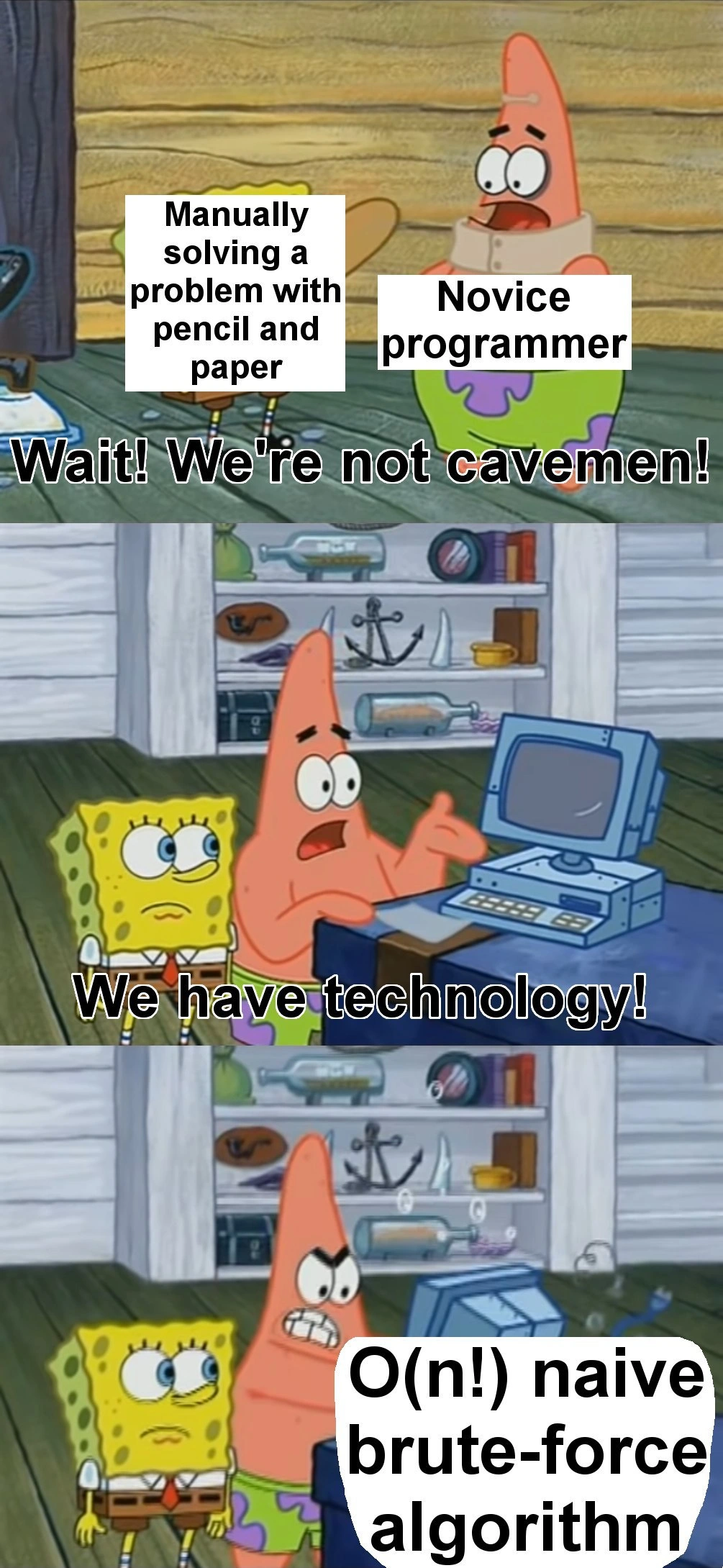
Let’s break down the meme in plainer terms. It’s showing SpongeBob and Patrick in a famous scene where Patrick says, “We have technology!” and then proceeds to smash a computer. Here, SpongeBob with his pencil and paper represents solving a problem by thinking it through or using simple methods. Patrick, labeled “Novice programmer,” represents a beginner developer who thinks using a computer must be better than doing it by hand (hence calling the manual approach something cavemen would do). The phrase “Wait! We’re not cavemen! We have technology!” is the novice basically saying: “Don’t do it the basic way, we have a computer to solve it!” This is a common attitude when someone first learns to code — they want to automate everything, even tasks that might be simpler to reason out without brute force.

Now, what does Patrick do with his precious technology? In the third panel, instead of using the computer wisely, he slams the keyboard and essentially runs an O(n!) naive brute-force algorithm. In plainer words, he makes the computer try every possible solution blindly until one works. Brute-force algorithm means you don’t use any clever tricks or shortcuts; you just brute-force try everything. The notation O(n!) is called Big-O notation (big-Oh), which computer scientists use to describe how fast or slow an algorithm grows as the input size (n) grows. Factorial time, O(n!), is incredibly slow-growing complexity. For example, if n = 5, n! = 120 possibilities to try; if n = 10, n! = 3,628,800 (over three million) possibilities; if n = 15, n! = 1,307,674,368,000 (over a trillion). You see how insane that growth is? We often joke that O(n!) really stands for “Oh no!” because a factorial-time program will run out of steam extremely quickly as n increases. This is the joke’s crux: the novice programmer proudly uses a super-slow approach without realizing how bad it is. Meanwhile, SpongeBob (the one with the pencil) is basically the voice of reason, representing a simpler or smarter solution that the novice dismissed as too primitive.

Let’s illustrate what a brute-force solution might look like in code. Imagine a simple task: find a certain arrangement or solution among many. A novice might literally tell the computer to try every possible arrangement one by one:

# Naive brute-force approach: try all permutations (O(n!) possibilities)
def brute_force_solve(inputs):
    for candidate in generate_all_permutations(inputs):  # generate_all_permutations produces n! combinations
        if is_valid_solution(candidate):
            return candidate
    return None  # if no solution found after checking every possibility

In this pseudocode, generate_all_permutations(inputs) would create every possible ordering or combination of the input items. That’s n! possibilities to check, which becomes astronomically large even for moderate n. The code is straightforward (and a novice might find it satisfying that it “covers all cases”), but it’s extremely inefficient. A more experienced programmer would try to find a smarter approach to cut down the possibilities — or realize that maybe the problem can be solved with a formula or simpler logic rather than brute force. Often there’s a better algorithm that brings that $O(n!)$ down to something like $O(n^2)$ or $O(n \log n)$ or similar, which is much faster for larger n.

So why is the pencil-and-paper method shown as the better approach here? Because sometimes thinking carefully or doing a bit of math can avoid all that unnecessary computation. For example, suppose the “problem” is something like finding the best arrangement of a few items. A pencil-and-paper solution might involve using logic or known formulas to reduce the search dramatically. The novice, however, doesn’t do that reasoning; he just trusts the computer to brute force through everything. The meme humorously shows that approach as literally smashing the keyboard — it’s brute force in the most brute form! SpongeBob’s annoyed expression says, “Using technology this way is just as dumb as a caveman smashing things, you’re not actually being more advanced.” In essence, the meme is teaching a lesson: using a computer isn’t automatically better if your algorithm (your method of solving) is bad. Good algorithm complexity analysis is key. A slow algorithm on a fast computer can still be slower than a smart solution on a piece of paper. The novice programmer in the meme learns (hopefully) that technology is only as good as the way you use it — and an inefficient $O(n!)$ algorithm is basically turning a modern computer into a very fast caveman doing trial-and-error.

Level 3: Brute Force Follies

From a seasoned developer’s perspective, this meme nails a classic Junior vs Senior scenario about problem-solving and performance. The novice programmer (Patrick Star in the scene) scoffs at the “old-fashioned” approach of manually solving a problem with pencil and paper — calling it caveman stuff — and instead proudly declares, “Wait! We’re not cavemen. We have technology!” The punchline is that his so-called technological solution is just a naive brute-force algorithm of complexity O(n!), which is hilariously inefficient. In the final panel, Patrick slams the computer keyboard with caveman-level finesse, and a speech bubble pronounces “O(n!) naive brute-force algorithm”. SpongeBob (representing the sensible pencil-and-paper method) looks irked. To an experienced dev, SpongeBob’s exasperated face is totally relatable: it’s the look you give when a junior engineer proudly deploys a massive brute force hack that you know will end in a performance disaster. The humor comes from that contrast — the junior thinks writing code automatically means progress, while the senior knows that an ill-chosen algorithm can be worse than doing nothing or doing it by hand.

This is essentially an AlgorithmHumor cautionary tale. We’ve all seen (or been) that novice developer who writes a quick script to try every possible combination to solve a problem, thinking “computers are fast, so it’ll be fine.” It’s the programming equivalent of using a sledgehammer on a thumbtack. Sure, the thumbtack goes in, but you’ve also cracked the wall. :smile: The meme highlights a common novice_programmer_behaviour: over-engineering a solution with code without considering complexity. The novice trades a pencil (brainpower and simple logic) for a brute-force program that effectively tries every permutation. In a professional setting, this is a known anti-pattern that can lead to severe PerformanceIssues in code. For instance, picture a junior developer generating every possible schedule to find the best one, or iterating through all permutations of a list to check if it’s sorted (yes, some poor soul might actually attempt that). These brute-force follies tend to work fine for tiny test cases (so the novice is initially confident — “See, it works on my machine!”), but the moment the input size grows a bit, the runtime explodes and things grind to a halt. Senior engineers have universal war stories about that one piece of code that worked in QA with 5 items but then brought production servers to their knees when fed 100 items because its complexity went through the roof. Big-O notation isn’t just academic trivia; it’s a practical part of writing CodeQuality solutions. This meme exaggerates it to factorial-time absurdity, which is why it’s so on point (and so painful) for experienced devs.

Another layer of humor is that Patrick’s “technology” is an ancient-looking 90s desktop PC in a wooden shack, which makes the scene even funnier. It’s a visual gag: the novice is proudly pointing to this clunky computer as if it were some magical solve-all device. The reality is that even a modern supercomputer would choke on an O(n!) algorithm for any meaningful n — and here Patrick is relying on a crusty old PC! It’s a perfect metaphor for overkill meets underpowered. The senior dev in us chuckles because we know that feeling: watching a junior use a complex framework or brute-force script (the metaphorical old PC) to do something that either (a) didn’t require a computer at all, or (b) desperately required a smarter algorithm instead. SpongeBob’s irritation is basically the experienced engineer thinking, “You’re doing what with that outdated approach? Good luck, buddy.”

Importantly, the meme contrasts two problem-solving philosophies. The “pencil and paper” method represents careful thought, maybe using a known formula or simplifying the problem before coding. It’s not literally about doing everything by hand, but about understanding the problem well enough to avoid unnecessary computation. The “We have technology!” method represents the novice impulse to write code immediately, often resulting in a brute-force search because the underlying logic wasn’t fully thought through. In practice, seasoned developers often do a bit of “pencil planning” — sketching out a solution, estimating complexity, considering edge cases — before slamming on the keyboard. The novice in the meme skips straight to coding and ends up essentially banging on the problem with raw compute power. It’s an over-engineered solution in the worst way: using a computer to do vastly more work than a human would have done with a bit of reasoning. The comedy is that Patrick literally treats the computer like a caveman tool, smashing it, which beautifully visualizes how a brute-force algorithm is just blindly thrashing through possibilities rather than using finesse or insight. In short, the meme resonates with developers because it hyperbolically captures a real-world lesson: just because you can throw code at a problem doesn’t mean you should — especially not code that makes the problem exponentially (or factorially!) more complex.

Level 4: Combinatorial Explosion

At the most theoretical level, this meme pokes fun at algorithmic complexity and the folly of ignoring it. The joke highlights a solution with factorial time complexity $O(n!)$, which in complexity theory is about as bad as it gets for any non-trivial input size. Factorial complexity means the runtime grows as $n \times (n-1) \times (n-2) \times \cdots \times 1$ — a combinatorial explosion in the number of possibilities to check. To put it in perspective, while $2^{20} \approx 1,000,000$ (a million), $20!$ is about $2.43\times10^{18}$ (2.4 quintillion). That’s astronomically larger! An algorithm that requires checking n! possibilities will utterly dwarf even exponential $2^n$ scenarios once n grows. No amount of clever coding or fast hardware can fully escape this math; factorial growth overwhelms them all. In fact, computer scientists use $O(n!)$ as an example of an “untractable” runtime — the kind of brute-force approach you only consider for the tiniest of inputs (or as a joke).

This speaks to fundamental CS_Fundamentals: big problems can’t be solved by brute force because of these hard mathematical limits. There’s even a colorful term for it: “combinatorial explosion” describes how the number of possibilities blows up super-polynomially. Many NP-hard problems (like the classic Traveling Salesman Problem) have a naive solution that tries all permutations of a solution — exactly $n!$ possibilities — which becomes impossible to finish except for small n. Unless someone miraculously proves $P = NP$ (don’t hold your breath!), we accept that certain tasks simply can’t be brute-forced within our lifetime once n is moderately large. And yet here comes our eager novice programmer, barreling straight into that complexity buzzsaw with a grin, as if raw computing power alone could defy the math. We have technology! — but no, even cutting-edge technology bows to the tyranny of Big-O notation. The meme cleverly illustrates that PerformanceIssues arising from poor algorithmic choices aren’t solved by just throwing more computing at the problem; you have to tackle the AlgorithmComplexityAnalysis too.

As an aside, there’s a notorious joke algorithm called bogosort—essentially “sort a list by randomly shuffling it until by chance it comes out sorted.” Its expected runtime is $O(n \times n!)$, basically factorial, and it’s used in textbooks as a parody of bad algorithm design. This meme’s O(n!) brute force approach is in the same spirit: it’s a comical extreme, a reminder from theoretical computer science that some solutions are so inefficient that they might as well be a meme. Even the fastest supercomputer running a factorial-time algorithm will effectively stall out for all but trivial inputs (you might get away with n=10 or n=11, but by n=20 you’d be waiting longer than the age of the Earth 🌍). In summary, at this deep level the humor lands on a fundamental truth: no amount of “technology” bypasses the mathematics of factorial growth.

Description

The three-panel SpongeBob meme shows Patrick and SpongeBob inside a wooden shack lined with nautical memorabilia and a chunky 1990s desktop computer. Panel 1 overlays SpongeBob with the label “Manually solving a problem with pencil and paper” and Patrick with “Novice programmer,” while the subtitle says, “Wait! We're not cavemen!”. Panel 2 zooms on Patrick proudly pointing at the old PC with the caption, “We have technology!”. Panel 3 depicts Patrick slamming the keyboard; a large speech bubble declares, “O(n!) naive brute-force algorithm,” and SpongeBob looks irritated. The gag satirizes how beginner developers substitute thoughtful manual reasoning with computational brute force, drawing attention to Big-O growth, factorial-time algorithms, and the performance pitfalls of over-engineering
Comments

12
Anonymous ★ Top Pick Every time a junior swaps a five-minute pencil proof for an O(n!) Lambda swarm, AWS quietly ships another tier called “Ignorance-as-a-Service.”
  1. Anonymous ★ Top Pick

    Every time a junior swaps a five-minute pencil proof for an O(n!) Lambda swarm, AWS quietly ships another tier called “Ignorance-as-a-Service.”

  2. Anonymous

    Ah yes, the classic junior developer journey: spending 3 days implementing a O(n!) solution that times out on production data, when the senior's pencil-and-paper approach would've revealed the pattern was just n(n+1)/2 all along. But hey, at least the CPU got a good workout before the OOM killer showed up

  3. Anonymous

    Ah yes, the classic junior developer arc: discovering that your 'elegant' recursive solution with O(n!) complexity takes longer to compute than manually calculating it would have taken. Nothing says 'we have technology' quite like watching your CPU melt while brute-forcing a problem that a napkin sketch could have solved in 30 seconds. At least when you were using pencil and paper, you could erase your mistakes without needing to kill -9 the process

  4. Anonymous

    Nothing screams junior like replacing a five‑minute invariant with an O(n!) job that scales perfectly until n hits 11 and the pager learns recursion

  5. Anonymous

    “We have technology” is how O(n!) ships to prod - autoscaling dutifully turns combinatorial explosions into cloud invoices

  6. Anonymous

    Computers make brute force 'feasible' - until n=12 permutes your entire cluster into a smoking ruin

  7. @azizhakberdiev 3y

    https://youtu.be/o4-zpAI7qBc

    1. @CcxCZ 3y

      FYI It's actually capital omicron, one of the few places in mathematics where this Greek letter is used.

      1. @azizhakberdiev 3y

        Greek letters have capitals?

        1. @RiedleroD 3y

          no they have city-states

  8. @azizhakberdiev 3y

    Watch this before making any assumptions

  9. @azizhakberdiev 3y

    Thx, learned smth new

Use J and K for navigation