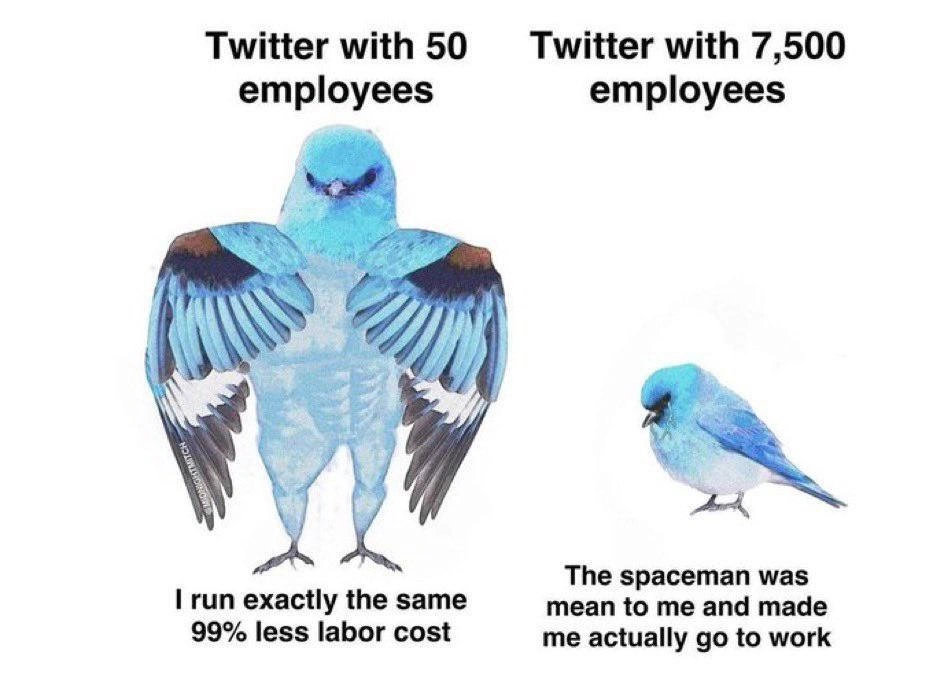
Buff Twitter bird mocks headcount as productivity after mass layoffs
Why is this CorporateCulture meme funny?
Level 1: One Person Does Everything
Imagine you have a huge job to do, like building a giant sandcastle city at the beach. Normally, you might have a big team of kids (say 20 friends) each working on different parts – one gathers water, a few pack sand into buckets, others decorate towers. Now picture a new leader kid comes and says, “All of you except my 1 best friend, go away! We don’t need 18 of you. We two will build the same big sandcastle all by ourselves, and it’ll be just as good. See, we’ll save all the snacks we’d have given to the rest of you.”
For a little while, those 2 kids might keep the castle looking okay – they use the foundations the others already built and maybe finish one small tower. The leader kid flexes and says, “Look, it’s exactly the same castle, and we didn’t need those other kids!” That’s like the strong bird in the meme bragging about running Twitter cheaply with hardly any workers.
Now think about what happens later: the tide is coming in, some walls are cracking, and there used to be a special kid who knew how to fix the moat – but he was sent away. Now the two kids left are scrambling, trying to do everyone’s job at once: one is running to get water, but at the same time the other has to pack sand and decorate and fix cracks. It’s overwhelming! The castle might start to sag or parts might wash away because there just aren’t enough hands. That’s the hidden worry behind the meme’s joke – that maybe you can’t really do a big complex job with only a tiny team without things going wrong eventually.
On the other side, the meme also shows a sad little bird saying, “The spaceman was mean and made me actually go to work.” This is like if those 20 friend helpers were used to taking long breaks, and suddenly the new kid leader (let’s say he’s a super strict kid from another school known for building rocket toys – a “spaceman” kid) yells, “No more lounging around, everyone actually work hard or leave!” The ones who remain might feel stressed and complain, “He’s so mean, he’s making us actually do stuff!” In the sandcastle story, it’s as if some kids maybe were relaxing too much, and the new bossy kid said, “Stop slacking!” Some kids quit in protest, and in the end only his two best buddies stay to build.
The funny part of all this is how exaggerated it is. In real life, you’d never expect one or two people to handle the work of dozens without quality suffering. It would be like a single bus driver trying to drive 100 buses at once – silly, right? But sometimes big bosses talk as if that’s possible! The meme makes us laugh because it takes that idea to the extreme: a super buff Twitter bird doing the same job with almost nobody helping, versus a tiny sad Twitter bird that had a lot of help but is now pouting. It’s poking fun at the new boss’s claim that “Hey, everything’s fine even after I fired most people,” which sounds as crazy as one kid building an entire sandcastle city alone.
In simple terms: The meme is saying “Isn’t it ridiculous (and kind of funny) to think that Twitter can be just as strong and good with basically no employees? And that the only problem before was the old workers didn’t want to work?” It uses the two cartoon birds – one strong, one weak – to make that point in a way that’s easy to see and chuckle at. Even if you don’t know Twitter’s full story, you can understand: usually, you need a team for a big project, and bragging that you don’t can be a goofy thing to do. It’s a bit like a tall tale or a cartoon showing a wild claim, and that’s why it’s amusing.
Level 2: 99% Staff Cut, No Problem?
This meme plays on the sensational events at Twitter around November 2022, when Elon Musk (often jokingly called “the spaceman” because he runs SpaceX) took over. He famously laid off a huge number of employees very quickly – from about 7,500 people down to a few hundred. The meme exaggerates this to “Twitter with 50 employees” vs “Twitter with 7,500 employees.” It’s using two cartoonish blue birds (resembling the Twitter logo) to represent the company in those two scenarios:
- On the left, Twitter with 50 employees is shown as a super muscular, confident bird – basically saying: “Look, I can run the platform just as well, and I slashed 99% of the labor cost!” (“Labor cost” means the money spent paying employees. Cutting 99% of staff would massively reduce costs, at least in salaries.)
- On the right, Twitter with 7,500 employees is a tiny, droopy bird looking down sadly, saying: “The spaceman was mean to me and made me actually go to work.” This side implies that when Twitter had lots of employees, some of them were perhaps not working very hard or were complaining when the new boss (Musk) told them to get to work or return to the office.
So why is this funny to developers and tech folks? It’s highlighting a huge contrast in perspectives:
- Management’s story (as per the buff bird): “We cut the team to almost nothing and hey, Twitter is still running fine! That proves those thousands of extra people were unnecessary overhead. We’re saving tons of money and the product is just as good. High productivity, low headcount – win-win!” This is the cost-cutting narrative you might hear from some executives or managers after big layoffs. They measure Developer Productivity in a very blunt way – if the website/app hasn’t fallen apart, they conclude each remaining developer is magically super productive (or that the others must have been doing very little).
- Employee perspective, or at least how the meme mocks the old culture (sad bird): “Ouch, the new boss is forcing us to work harder or differently, and we don’t like it.” The quote “the spaceman was mean to me and made me actually go to work” is a sarcastic portrayal of employees who were used to a comfortable or slow-paced environment and are now being told to sharpen up. Elon Musk did mandate things like ending remote work and expecting “hardcore” commitment (long hours, high intensity). Some employees publicly or internally complained about his style, and many quit or were fired. The meme jokes that the 7,500-strong Twitter was weaker because people weren’t pushing themselves – hence the little bird slumped over.
For a junior developer or someone new to tech, let’s break down a few concepts and why the scenario is problematic (and thus meme-worthy):
- Headcount vs. Productivity: “Headcount” means number of employees. It’s tempting to think if 7,500 employees produce a working Twitter, then 50 employees would only manage a tiny fraction of that. In practice, more employees doesn’t always mean proportionally more output – there’s coordination overhead, different projects, and some people might not be directly working on the core product (they could be in support roles, management, etc.). However, cutting from 7,500 to just 50 is an extreme drop. It’s like having a big restaurant fully staffed on Monday, and on Tuesday only the chef and one waiter remain to do everything. The restaurant might open that day and serve food, but a lot of things (cleaning, taking orders, cooking multiple dishes, handling many customers at once) will suffer. In software terms, a small team can keep a mature product running in the short term (especially if the systems are automated and stable), but they won’t have the bandwidth to fix every issue, build new features, handle all customer support, etc. Something’s got to give.
- “Runs exactly the same”: This implies no drop in service quality or reliability after the layoffs. Initially, Twitter did stay online and users didn’t notice major changes in November 2022 – which surprised some people! It led to debates: were those extra employees unnecessary or was Twitter just coasting on past work? The meme leans into the idea that according to new management, it was exactly the same, just way cheaper now. It’s a tongue-in-cheek way to say “Look, nothing broke (immediately), so obviously most of those people were redundant.” Techies find this oversimplified. They know a complex site can appear fine for a while even if monitoring, maintenance, and future development have been gutted. It’s like skipping routine maintenance on your car – it still drives today, but you might be setting yourself up for breakdowns later.
- “99% less labor cost”: If you fire 99% of the workforce, you save a ton of money on salaries. That’s attractive to an owner or CEO trying to make the company profitable. Elon Musk was very vocal about cutting costs at Twitter because he thought the company was spending too much. However, to people who actually build and maintain the product, this sounds alarm bells. Yes, you saved money, but who’s doing all the necessary work now? Those costs might come back in other forms – like expensive outages or declining quality that drives users (and advertisers) away. There is also a human cost: the remaining employees might be overworked severely. This ties into Developer Productivity: you can’t indefinitely demand 20-hour workdays; people will burn out or make critical mistakes.
- “The spaceman was mean and made me actually go to work”: This is the meme’s jab at Twitter’s old work culture versus Musk’s expectations. It references that Musk (the “spaceman”) demanded employees show up in person and work intensely (no more casual remote work with lighter hours). The phrase “made me actually go to work” suggests maybe some employees weren’t putting in full effort before, at least in the eyes of the new boss. In reality, Twitter pre-Musk wasn’t a bunch of lazy folks doing nothing; a lot of work was happening, but Musk clearly thought the company wasn’t efficient enough. He cut projects he felt weren’t necessary and told everyone to focus on what he thought mattered (like improving the core system performance, new features like paid verification, etc.). For a junior dev, it’s useful to know this reflects a common management belief: that a smaller team of very driven people can outperform a larger team that’s comfortable. There’s some truth in small agile teams being effective, but there’s a balance — too few people and you simply can’t cover all the jobs well.
- Twitter’s complexity: To appreciate why 50 people running Twitter is a stretch, consider the different components: there’s the timeline (feeds of tweets) generation which involves big data pipelines and algorithms, the real-time WebSocket or long-polling systems to push new tweets/notifications instantly, huge databases to store tweets and user info, countless background jobs (sending email/text notifications, processing video uploads, fighting spam), plus front-end code for web and mobile apps. And beyond engineering, the company had trust & safety teams, customer support, sales, etc., many of whom were also let go. So the claim “runs exactly the same” glosses over that a lot of those functions would be reduced or gone. Even if a junior dev isn’t familiar with all these, the key point is: big service = lot of moving parts. Fewer people means each person must handle more parts or some parts get less attention.
- Corporate Culture and Humor: The meme falls under TechIndustryHumor and CorporateCulture satire. It pokes fun at how a corporate leader might publicize something (“Look at our amazing efficiency now!”) versus how employees and engineers feel internally (“This guy has no clue how much work we actually do, and now we’re spread thin”). There’s a tag ManagementHumor – indeed the humor often comes from management’s often silly metrics or catchphrases. Here it’s productivity = output/headcount, which is overly simplistic. MisalignedExpectations is a tag because engineering expectations (maintaining quality, needing time and people) clash with management expectations (instant results, cost cuts). ManagementVsEngineering captures that tension perfectly illustrated by the two birds: the confident manager view vs the demoralized engineering view.
In summary, at this level: The meme is funny (and a bit shocking) because it suggests a tiny team (50 people) can do the job of an entire large workforce (7500 people) without missing a beat – something any developer knows is fishy. It references real-life events (the twitter_layoffs after the elon_musk_takeover) and how the situation was spun. For a newer developer, it’s a lesson in skepticism: when someone says “we got the same work done with 1% of the staff,” you should question what hidden costs are lurking and whether that’s really sustainable or just management hype. It’s also an example of tech memes reflecting real industry drama: folks in 2022 were actively meme-ing about Twitter’s chaotic downsizing because it was such a jaw-dropping experiment in running a tech company.
Level 3: Mythical Man-Bird
In this meme’s exaggerated world, Twitter somehow runs with only 50 employees – depicted as a swole, muscle-bound bird flexing proudly – while the version with 7,500 employees is a sad, scrawny bird. The buff bird crows, “I run exactly the same, 99% less labor cost,” which drips with corporate cost-cutting narrative. This parrots (or rather, bluebirds) the claims made after Twitter’s mass layoffs in late 2022. The “spaceman” reference points to Elon Musk (famous for rocket ships at SpaceX), who had just taken over Twitter. Under Musk’s takeover, roughly 50 engineers remaining would be a 99% headcount reduction from ~7,500 – an absurd slashing presented here as some triumphant efficiency hack.
From a seasoned engineer’s perspective, this setup screams “misaligned expectations” and a fundamental misunderstanding of software complexity. The meme satirizes how leadership sometimes touts Developer Productivity as if it’s a simple ratio: fewer devs, same output, yay profits! The veteran cynic in us knows it’s never that simple. Sure, in the immediate aftermath of layoffs, the site might still be up (servers don’t instantly catch fire just because HR axed a bunch of folks). But claiming “I run exactly the same” is precariously optimistic. It ignores all the undercurrents of technical debt and operational load that 7,500 staff were handling behind the scenes.
Let’s talk tech reality: Twitter is a massive distributed system – countless microservices, data pipelines, moderation tools, recommendation algorithms, mobile apps, and so on. Running it isn’t like flipping a switch; it’s more like orchestrating a giant, fragile Jenga tower of code and infrastructure. With 7,500 employees (not all engineers, but let’s focus on engineering), you had entire teams specializing in keeping each part stable:
- Site Reliability Engineers (SREs) on 24/7 pager duty for when *bleep* something breaks at 3 AM (databases, caching layers,
DNS– yes, it's always DNS). - Infrastructure Devs maintaining build systems, deployment pipelines, and cloud resources so features can roll out reliably.
- Product Engineers improving features, squashing bugs, and ensuring the app doesn’t crash when you like a tweet or upload a photo.
- Security and Quality Assurance catching vulnerabilities and glitches before they become trending hashtags for all the wrong reasons.
Now imagine decimating those ranks down to a skeletal crew of 50. Fifty! That’s a single small team trying to carry an entire globe-spanning platform. The meme’s buff bird implies those 50 are über-productive super-coders (maybe each a mythical “10x engineer” times fifteen). But even a flock of 10x engineers can’t magically absorb all the responsibilities overnight. The math doesn’t work: 50 people ≠ sustain the work of 7,500 without consequences. Experienced devs recall Brook’s Law from The Mythical Man-Month: adding more people to a late project can make it later due to communication overhead. Conversely, removing people in droves doesn’t proportionally remove complexity – it just means the remaining folks are juggling way more hats. The bus factor (how many people can “get hit by a bus” before knowledge is lost) drops through the floor. With only one or two experts per critical subsystem (or none, if everyone who knew that part got canned), your risk of catastrophic failure skyrockets. In senior-engineer gallows humor, we’d say: “Hope the on-call likes coffee – they’re not sleeping anytime soon.”
This meme hits a nerve in developer culture because we’ve seen similar executive fantasies play out. A Management vs Engineering culture clash: leadership obsessed with cutting “bloat” vs engineers who understand why those extra people existed. Remember the stories of early 2000s dot-com layoffs? Or any time a new CEO sweeps in declaring we have too many developers, they must be doing nothing. It usually ends with overworked survivors and brittle systems. Initially, upper management crows about cost savings – “99% less labor cost” as the meme says – and indeed the next day everything might appear normal. But complex software is like an iceberg: the part users see (tweets still loading) is supported by a huge underbelly of maintenance work. Cut 99% of the crew, and a lot of that work is simply not getting done anymore. Maybe not immediately obvious, but give it days or weeks:
- No one is tending some internal tool -> deployments slow down or break.
- Fewer people reviewing code -> a nasty bug slips through and takes the site down.
- Entire teams gone -> features (like, say, SMS 2FA or content moderation) silently fail or degrade because their caretakers vanished.
And indeed, not long after these layoffs, Twitter did experience strange glitches – images not loading, tweets not appearing, login troubles – the kinds of issues that make seasoned devs nod: there it is, the other shoe dropping. CorporateCulture shifts can temporarily mask problems (perhaps those fired engineers had already built robust systems that coast on autopilot for a bit), but software entropy is relentless. Keeping a platform “running exactly the same” requires constant effort – patching security holes, updating libraries, paying tech debt, scaling for new users, handling data privacy requests, and oh yeah, building new features so your product isn’t frozen in time. With 50 people, you inevitably start cutting corners or triaging hard: you fix only the direst issues and pray the rest holds up.
The second half of the meme – the tiny sad bird complaining “The spaceman was mean to me and made me actually go to work” – skewers the stereotype that the pre-acquisition Twitter staff were just lazing around in a cushy job. It’s portraying the old 7,500-employee Twitter as weak and whiny, implying they weren’t productive until Musk the “spaceman” cracked the whip. This is a jab at the “hardcore work” mandate Musk gave: he literally told remaining staff to commit to being “extremely hardcore” (long hours at high intensity) or take severance. The meme author sarcastically suggests those 7,500 needed a kick in the pants. Developers who’ve lived through management shake-ups recognize this kind of rhetoric: a new boss arrives, declares the old culture too “soft” or inefficient, and implements brutal deadlines and shake-ups. Often it’s true some inefficiencies exist – big orgs can get bureaucratic, and some folks skate by – but the degree is exaggerated for narrative. Cutting an entire workforce to a skeleton crew and telling them to work double-hard isn’t a sustainable productivity plan; it’s a burnout recipe. The veteran viewpoint: Yeah, I’ve seen this movie. It doesn’t end well.
The humor here is dark and multi-layered. On the surface it’s ridiculous: a ripped Twitter bird bragging about incredible efficiency gains, versus a dejected one from before. It lampoons how management (PMs/execs) might oversimplify success: If the site’s still up, it means those extra engineers were useless. Seasoned devs laugh (or groan) because they see the gap between management spin and engineering reality. We’ve been in those all-hands meetings where higher-ups brag about “increased productivity” after layoffs or cost cuts, and we’re thinking, “Sure, for now… give it a month when something legacy breaks that only John in the UK office knew how to fix.” This meme perfectly captures that eyeroll. It’s a send-up of both sides: the delusional bravado of the lean-and-mean narrative (buff bird) and the perhaps entitled or shocked attitude of the old guard (sad bird).
In essence, the joke lands because it’s a caricature of tech industry extremes. It calls out the absurd idea that you can maintain a complex, global software product unchanged while ejecting virtually all the people who write and manage its code. It also pokes fun at the notion that those people were just crying about actually having to work. It’s ManagementHubris.meme() meets EngineersShakingHead.gif. Everyone who’s had to fix a 2 AM outage caused by understaffing or lost expertise feels the sting behind the laughter. As a battle-scarred engineer might quip, “Go ahead, cut 99% of the staff. I’m sure the remaining 1% have got it totally under control... What could possibly go wrong?”
Description
Meme shows two stylized blue birds resembling the Twitter logo on a white background. Left side reads “Twitter with 50 employees” above a body-builder bird with broad wings, visible abs, and a confident stare; caption underneath says “I run exactly the same 99% less labor cost.” Right side reads “Twitter with 7,500 employees” above a small, slumped bird looking downward; caption underneath says “The spaceman was mean to me and made me actually go to work.” Visually, the contrast exaggerates strength versus weakness to satirize the idea that a drastically smaller engineering staff could deliver identical platform reliability. Technically, the joke pokes at corporate culture debates on developer productivity metrics, cost-cutting, and management claims following Twitter’s post-acquisition layoffs, highlighting how leadership narratives often oversimplify software complexity and operational load
Comments
27Comment deleted
“Sure, Twitter ‘runs fine’ with 50 engineers - right up until the lone on-call SRE remembers the fan-out job only stays alive because of a cron tab on the laptop we just disabled in yesterday’s badge-revocation script.”
Turns out the real microservice architecture was the 7,450 employees we laid off along the way - who knew you could achieve five nines of uptime with just fifty engineers and a prayer to the fail whale?
Turns out Twitter's architecture was so over-engineered it needed 7,500 people just to keep the fail whale from surfacing - but one determined spaceman proved you can run a distributed system on spite, caffeine, and 50 engineers who actually merged their PRs instead of attending syncs about syncs
Twitter “runs the same” with 50 engineers - until you hit an edge case and realize the other 7,450 were your retry policy
Twitter's ultimate refactor: slash headcount 99%, watch velocity spike - until RTO forces everyone to debug in the same room
Everything ‘runs the same’ with 50 people - right up until the P0, the audit, and the abuse flood hit at once and your on‑call rotation is 1/50; apparently there’s a CAP theorem for org charts: pick two of cost, compliance, and uptime
Thought were would be no Musk fanboys among software engineers by now, but here we go Comment deleted
they're everywhere 😭 Comment deleted
devs when they're getting fired: NOOOOOO YOU CAN'T FIRE ME NOOO I'M IMPORTANT FOR COMPANY devs when Elon musk fires other devs: LET'S FUCKING GOOOOOOOOOOOOOOOOOOOOO Comment deleted
7450 people who earned their bread in a perfectly working and profitable company: Comment deleted
It was not profitable 🙃 Comment deleted
The spaceman has done a bunch of damn decisions that will gradually destroy the social network Comment deleted
Isn't it already? Comment deleted
Well, you can still log in, so it is not fully destroyed Comment deleted
Good Comment deleted
as a wise man once said: geistig oida (this is barely translatable nonesense lol) Comment deleted
Elon Musk memes, what's next? console.log memes? Comment deleted
App that manages small text chunks does not require so many employees. I work in huge enterprice and 7k+ people manages 100+ projects. I've worked in a company with literally 3 devs and we were succesfully managed 5 b2b projects. Comment deleted
Yes, app that manages text chunks... No infrastructure I guess, and yeah, what's your take on the recommender system? Naïve Bayes? Comment deleted
How's 2FA doing?😁 Comment deleted
this meme is cringe Comment deleted
People are acting as if most of those fired were programmers and not made up positions that did nothing productive. Comment deleted
Yeah, like customer support for their ad sales or working on accessibility features. Advertising exodus from Twitter is very real. Comment deleted
Most Twitter "workers" were "meeting programmers" They didn't write lines of code, they wrote meeting descriptions And that's coming from someone who hates Elon Musk. I just hate Twitter's inability to solve bugs more than that. Comment deleted
It's been years now and they are yet to fix a single fucking scroll bug no matter how much people report it Comment deleted
cringe Comment deleted
Why Comment deleted